Ravelstein: The Difficult Work of Remembering a Friend
Saul Bellow‘s Ravelstein asks what a friend owes to the dead when affection becomes a written portrait. Its central figure, Abe, is a professor of political philosophy with an appetite for expensive objects, demanding conversation, and other people’s lives. His friend Chick must preserve that abundance without reducing it to either a list of virtues or an entertaining collection of faults. The difficult work begins with deciding what remembrance can honestly contain.
This is a literary novel shaped as a memoir, with the intimate pressure of an elegy and the unruly movement of conversation. Published in 2000, Ravelstein draws on the philosopher Allan Bloom, but recognizing a real-life model does not settle the questions raised by the fiction. Chick is a participant in the friendship he describes. His judgments reveal something about himself as well as the man he wants to remember.
The opening luxury matters. In a Paris hotel, intellectual achievement has suddenly become spending power. A successful book pays for pleasures that previously exceeded Abe’s income. The scene allows comedy, admiration, and embarrassment to coexist: thinking does not free anyone from vanity, bodily awkwardness, or the pleasure of being noticed.
Later, illness alters the scale of those observations. Ravelstein brings the celebrated thinker and his surviving witness under the same threat of bodily failure. Remembering a friend becomes inseparable from recognizing that the person doing the remembering is vulnerable too.
The novel’s attraction lies in this unstable combination. It can be generous, gossipy, intellectually combative, and tender within a few pages. Its strongest claim on the reader is not that friendship defeats death, but that attention makes a particular life harder to replace with an abstraction.
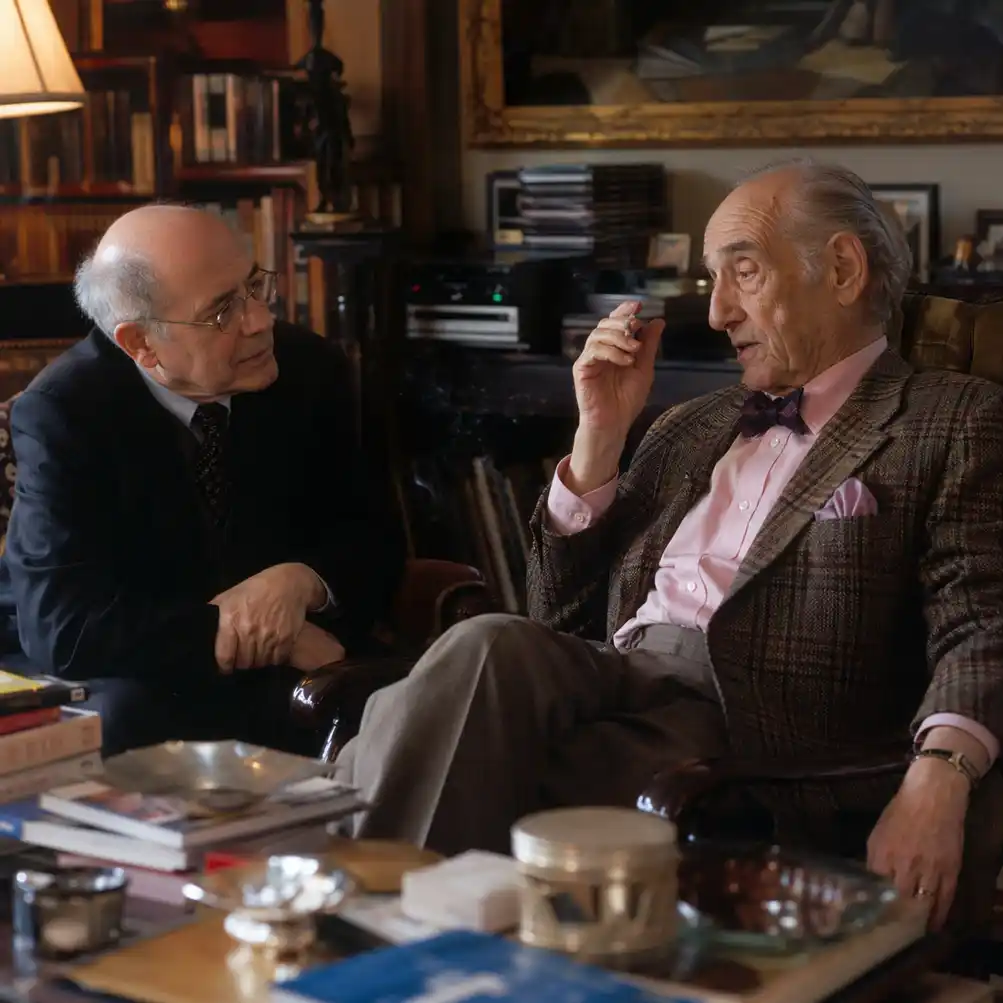
Ravelstein and the Commission to Write a Life
The narrative begins by circling its subject. Chick introduces an old interest in jokes and public figures before moving to Abe’s hotel suite. That apparently indirect route establishes how the portrait will proceed: through remembered associations, interruptions, and examples that become significant because someone recalls them. Ravelstein does not offer a neatly scheduled biography.
Abe’s successful book has transformed his circumstances. He can now support the luxurious habits that friends and associates once helped finance. His request that Chick write about him reverses their positions. The man who has published his convictions wants another person’s account of his life, while the writer must decide how much of his friend’s preferred self-image to accept.
The commission creates an obligation, but it also creates a problem of ownership. Abe encourages Chick toward public life and political understanding. Chick’s recollections, however, keep returning to personal manner, remembered speech, and the texture of encounters. Those approaches overlap without becoming identical.
The Paper Men by William Golding offers a sharper, more antagonistic version of the struggle over a writer’s biography. Reading the two together highlights the difference between pursuing possession of another person’s life and accepting responsibility for describing it.
In Ravelstein, affection does not remove that struggle. It makes the choices more consequential. A flattering account would simplify the friendship, while an inventory of indiscretions would mistake exposure for understanding. The narrative must find room for personality without pretending that any completed portrait could exhaust its subject. That is why the book’s loose movement has a purpose. The life emerges from the witness’s changing sense of what deserves to survive in words.
Luxury, Teaching, and the Appetite for Company
Abe’s expensive tastes can look like comic decorations until the narrative places them beside his intellectual authority. Fine clothes, luggage, food, and hotel rooms belong to the same expansive personality that insists on demanding books and serious political discussion. Ravelstein makes the combination troublesome rather than explaining it away.
Luxury is a form of expression here. It announces a wish to inhabit the world intensely. Yet Chick’s amusement prevents this appetite from becoming a heroic doctrine. Physical awkwardness and extravagant spending remain visible, so the reader can admire the vitality without accepting every preference as wisdom.
The teacher’s influence also continues beyond the classroom. Former students call with news from political and professional life. Their conversations turn the telephone into an extension of an education that has never quite ended. What looks like gossip can carry the pleasure of staying involved in events and maintaining a community.
That community has an unequal structure. Abe evaluates, provokes, and approves. His friends enjoy his attention, but they also feel its force. Intellectual fellowship includes dependence, especially when a charismatic teacher remains the figure around whom everyone else’s reports gather.
The contrast with The Glass Bead Game by Hermann Hesse is useful. Both works ask what an intellectual vocation owes to life outside its institutions. Here, the traffic between abstract thought and ordinary appetite is noisy, personal, and continuous.
Ravelstein gains energy from refusing to make its thinker either a detached sage or a fraud exposed by his pleasures. The pleasures and the thought inhabit one person. Their friction gives the portrait its comic scale and prevents reverence from settling into a pose.

Chick’s Attention and the Ethics of Disclosure
A memoir-like novel invites trust in a voice that sounds familiar with its subject. Chick can supply the gestures, eating habits, jokes, and social judgments that a stranger would miss. Ravelstein uses that intimacy to make Abe recognizable, but it also exposes the selectivity of the observer. Closeness is not complete knowledge. The narrator chooses which detail will stand for a disposition and which remembered exchange will carry an argument. His affection gives those choices weight; it does not make them neutral. Every description is also an arrangement of evidence.
The bodily details are particularly important. They interrupt the grand language of intellectual achievement with the small inconveniences of being alive. Such observations can feel indelicate, yet a portrait without them would risk substituting an institution, a reputation, or a set of ideas for the person himself.
A related tension runs through The Torch in My Ear by Elias Canetti. Its remembered intellectual encounters also show how forcefully a writer’s attention can preserve and judge other people. The comparison concerns the power of portraiture, not an asserted historical influence.
Chick’s authority becomes most interesting when the reader can see its limits. He reports disagreements and acknowledges the pull of personal memory. That leaves room to question whether a charming description has explained someone or merely made the description irresistible.
Disclosure needs a purpose. In Ravelstein, the strongest details connect private existence with the larger difficulty of representing a life. The weaker temptation, which readers may resist, is to treat access to intimate information as an achievement by itself. The book asks for a reader capable of both gratitude and suspicion toward its witness.
Writing Style: Conversation That Keeps Changing Direction
The Writing Style of Ravelstein depends on a voice that can turn a digression into the center of an encounter. Chick moves between public history, intellectual disagreement, visual detail, and remembered jokes without announcing a new system each time. The shifts make a mind audible as it works through its material.
The opening reference to footnotes provides a small model of this method. What might be placed at the edge of a conventional account becomes an entrance to the subject. An apparently supplementary memory reveals why Chick notices people as he does. The detour carries the portrait.
The comedy also changes the scale of admiration. A grand hotel, an unruly garment, or an awkward movement can bring an intellectual celebrity back into a body. Ravelstein repeatedly tests the distance between the language of distinction and the appearance of a particular person in a particular room.
Sentence movement helps sustain this tension. Names, objects, and associations accumulate, while a sudden plain statement can give the accumulation a new direction. The effect resembles conversation with someone whose intelligence is lively enough to be distracting. Readers who prefer a firm plot may find that abundance tiring. The book expects interest in the narrator’s routes through memory, not only in the events waiting at the end of them. Its social references can also require patience when the significance of a name is unfamiliar.
The voice supplies continuity where chronology loosens. Even when the subject wanders, Chick’s mixture of affection, curiosity, and self-exposure holds the prose together. Ravelstein is most persuasive when that movement produces recognition rather than display. Its verbal liveliness then becomes a way of resisting a polished memorial in which nothing awkward, funny, or disputable remains.

Five Short Passages and Their Contexts
These brief passages from the publisher’s opening-chapter extract show different aspects of the narrative voice. They are fragments with their original wording, not free-standing maxims. Their value lies in the surrounding act of description, which turns small phrases into evidence about memory, money, and the relations between friends in Ravelstein.
- “a weakness for footnotes”: Chick describes his own attraction to supplementary material. The phrase helps explain why side observations keep becoming substantial parts of the portrait. Memory enters through what a more orderly narrator might omit, and that choice shapes the reader’s access to the subject.
- “His intellect had made a millionaire”: Chick connects Abe’s thought with his changed financial circumstances. The passage punctures any easy opposition between intellectual life and material reward. Its compactness also gives a practical outcome to the earlier descriptions of luxury and financial dependence.
- “Too many years of inwardness!”: Abe challenges Chick’s tendency toward privacy. The complaint reveals that friendship here includes instruction and pressure. The narrator has been asked to describe a life by someone who also wants to redirect the narrator’s way of living.
- “an ongoing seminar”: Abe characterizes his continuing conversations with former students. Education persists through later careers, telephone calls, and shared political questions. The phrase makes the community sound both lively and dependent on the teacher who remains at its center.
- “minor crimes and misdemeanors”: Chick describes Abe’s pleasure in small breaches of respectable behavior. The context is playful rather than a theory excusing serious harm. It gives the portrait another contradiction: rigorous intellectual expectations coexist with enjoyment of social mischief.
In Ravelstein, such phrases work through their speakers and situations. Quote source: publisher’s extract, Chapter One.
Ravelstein: Publication Facts and a Life Beyond the Portrait
The publication history helps locate Ravelstein without treating the fiction as a substitute for a documented biography. Its real-life background supplies context; the narrator’s language and choices remain the basis of a literary judgment.
- First publication: Ravelstein was published in 2000. That date places it at the end of a long career, but does not by itself explain its particular mixture of comic portraiture, friendship, and mourning.
- Final novel: The publisher identifies it as the author’s final novel. Reading it in that position can sharpen interest in its attention to survival and remembrance, while leaving the specific characters free from a compulsory farewell symbolism.
- An identifiable model: Allan Bloom is the recognized real-life model for Abe. This connection helps explain the novel’s classification as a roman à clef, though details of a fictional character should not automatically become claims about the historical person. Source
- An anniversary edition: The 2015 Penguin Classics edition marked fifteen years since Viking’s first publication and added an introduction by Gary Shteyngart. This is a later framing of the novel, rather than part of Chick’s own account.
- Collected late fiction: Library of America includes the novel in its volume of fiction from 1984 to 2000, edited by James Wood. The placement makes it possible to approach this portrait beside other late experiments in memory and personal attachment.
For a different elegiac method, The Waves by Virginia Woolf distributes remembrance through several voices. Ravelstein holds us close to one difficult witness. Its lasting value is the attention that witness gives a friend he cannot fully contain.
Illness Changes the Position of the Witness
The movement toward death alters the novel’s earlier abundance. Abe’s illness makes the pleasures of company and conversation finite. Chick’s own near-fatal illness subsequently brings the witness into the vulnerability he has been observing. Ravelstein cannot keep mortality safely confined to its named subject.
The observer also has a body. This sounds simple, but it changes the meaning of the memoir-like form. The voice preserving another life must itself be sustained. Writing depends on survival, and survival depends on care that no amount of intellectual confidence can replace.
Illness therefore puts pressure on the wish to make a life coherent. A portrait can organize memories, but it cannot reverse the event that makes remembrance necessary. The reader encounters a work trying to remain attentive without promoting attention into a cure.
War and Peace by Leo Tolstoy places bodily vulnerability within a much larger historical field. Its scenes of injury and care interrupt ambitions that once seemed commanding. Here, the smaller circle of friendship gives mortality an intimate scale, bringing the person who remembers into the same uncertainty as the person being remembered.
The difference matters to the tone of Ravelstein. Comedy is not retrospectively cancelled by death. The expensive tastes and argumentative habits still belong to the man who is being lost. To remove them would make the mourning more solemn but the remembered person less distinct.
Affection preserves contradiction. It can register vulnerability without turning every earlier detail into a symbol of coming disaster. The novel’s emotional force grows from that restraint. It allows the reader to recognize how much a friend can mean without claiming that the loss has yielded a complete explanation of life or a dependable answer to death.
More Reviews of works by the renowned american writer