Accident: A Day’s News by Christa Wolf Unfolds in a Single Breath
Accident: A Day’s News compresses an enormous emotional weight into a single day. Christa Wolf invites us into the thoughts of a woman who spends the hours after a serious accident worrying about her brother’s life. Outside, it’s a day like any other, clear skies, routine errands, the usual quiet rhythms. But inside the narrator’s mind, time has slowed, and everything pulses with urgency.
Her talent lies in how she makes this emotional intensity feel real without ever becoming loud. There’s no melodrama. Instead, we follow thoughts as they surface: memories, science lectures, old conversations, and fragments of regret. It feels unfiltered but carefully shaped. The narrator never screams, yet her quiet voice carries enormous weight.
What makes the novel so powerful is its rhythm. It mirrors how we actually think when something terrible might be happening, but we’re not yet sure. The phone might ring. A knock might come. But in the meantime, we wait. And we think.
There are echoes here of The Hour of the Star by Clarice Lispector, another book about a woman alone, processing the world in her head while a larger crisis unfolds. But her narrator is older, steadier, and more self-aware.
The entire novel feels like a breath held too long. Each sentence is part of an inner monologue, shaped by fear and reflection. The work is about one day, and every day, when we wait for news that could change everything.

Memory, Guilt, and Atomic Time – Accident: A Day’s News
The narrator’s thoughts do not flow in a straight line. Instead, they loop and spiral, moving from the brother’s accident to childhood memories, to reflections on science and political guilt, and then back again. This is not forgetfulness. It’s structure. It reflects how trauma affects the brain: nothing moves cleanly forward.
One of the book’s most striking layers is its pairing of personal pain with national trauma. The narrator once worked with nuclear scientists. Now, she’s processing the long-term effects of that work, both on the world and on her conscience. The accident that sparked this day’s crisis isn’t just a personal wound. It opens up questions about history, war, and responsibility.
Christa Wolf never gives easy answers. Instead, she lets questions echo. She references physics and biology to underline emotional points. Her brother’s injured body becomes a metaphor for damage, both private and public. The body becomes a site of memory.
In that way, the book shares DNA with No Place on Earth by Christa Wolf, which also blurs timelines and blends the personal with the political. The prose here is sparer, the pace slower, but the message just as deep: you cannot separate the body from the world, or emotion from history.
Accident: A Day’s News gives us a narrator who is haunted not by what she’s done, but by what she might have contributed to. The guilt is quiet but persistent, just like the fear that someone we love might not make it through the day.
A Language of Stillness
Her prose is spare but rich. She uses repetition and precise rhythm to slow the reader’s perception of time. Each sentence feels carefully weighted, as if trimmed down to its most essential shape. There’s no rush, and that’s the point. In a story about waiting, language becomes the pause itself.
The narrator doesn’t tell a story in the usual sense. She unspools thought after thought, circling around fear, memory, and remorse. When she talks about her brother, she often slips into past moments with him, childhood scenes, fragments of family history, unresolved conversations. It feels real because it mimics how our minds actually work in crisis, not in straight lines but in layers.
There are also bursts of scientific language, reflecting the narrator’s background and her attempt to make sense of the world. Atomic reactions, medical terminology, and references to radioactive half-lives appear without warning. But rather than feeling technical, these terms feel deeply human, metaphors for damage, delay, and irreversible change.
Her stylistic control here mirrors her earlier work in Cassandra, where the voice of a single woman carries mythic and political resonance. In Accident, that resonance is quieter but no less powerful. It’s in every hesitating phrase, every half-spoken regret.
The language in this novel doesn’t try to impress. It tries to stay honest. And in doing so, it gives shape to emotions that are usually left unnamed, dread, hesitation, suspended grief.
Solitude, Surveillance, and the Feminine Gaze
The narrator spends her day alone, but not in silence. Her solitude is full of observation. She sees her garden, her cat, her telephone and she remembers old love affairs, political debates, and work with atomic scientists. She watches the world and listens for its consequences.
This deep attentiveness becomes a kind of resistance. It contrasts sharply with the surveillance and passivity that dominate much of modern life. She doesn’t ignore what’s happening in the world, she filters it, internalizes it, and reflects it through her body and memories. That makes her, in a quiet way, a radical figure.
Her reflections on science are also gendered. The men she worked with, doctors, physicists, bureaucrats, approached the world as something to be measured and managed. Her own thoughts resist that logic. She doesn’t reduce her brother’s pain to data. She tries, instead, to feel it fully.
This lens is what makes Accident: A Day’s News resonate so strongly with other introspective, politically aware novels by women, like Memoirs of a Dutiful Daughter by Simone de Beauvoir, or Divided Heaven by the author herself. These books don’t just tell stories. They ask how women think, witness, and carry historical weight.
Even while isolated, the narrator remains deeply connected to the world, and to the systems that shaped her. Her solitude doesn’t erase history. It amplifies it. Through her eyes, we see how a single day can hold more than just the present.
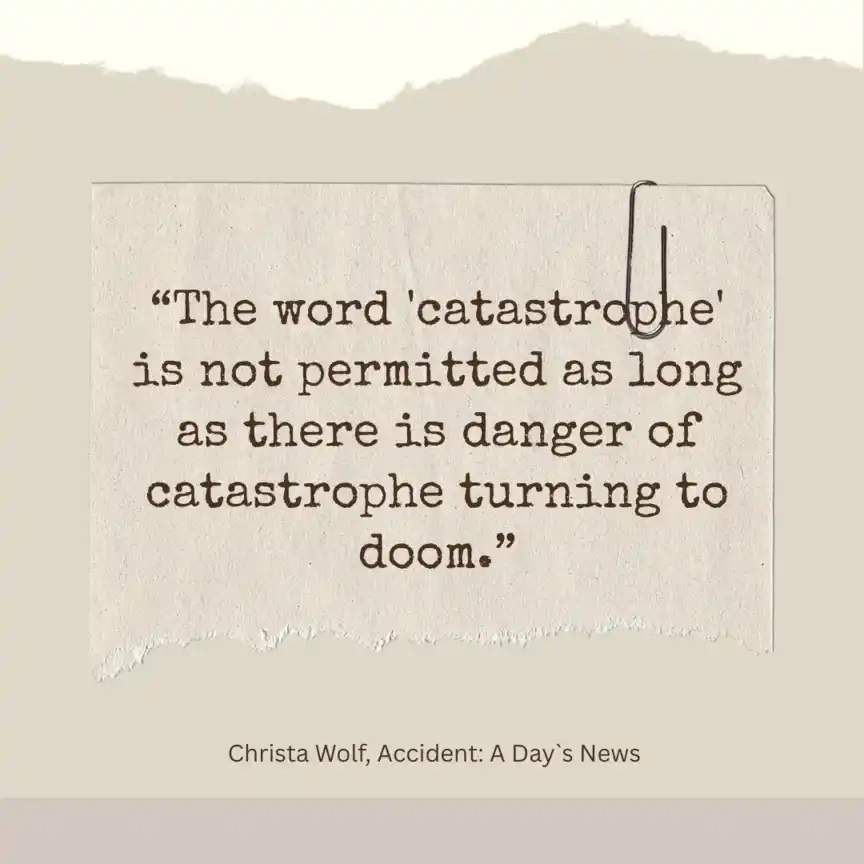
Quotes from Accident: A Day’s News
- “What I’m doing here is not waiting, but trying to grasp what is happening.” This sets the emotional tone of the novel. The narrator isn’t passive, she’s actively confronting her own thoughts, fears, and memories as they unfold.
- “A whole life is in every moment.” Christa Wolf suggests that even ordinary moments hold incredible depth. The past and present blur together, and every thought carries the weight of history.
- “I want to look, not close my eyes.” This line reflects the narrator’s moral stance. She refuses to turn away from uncomfortable truths, about herself, about science, about the world.
- “The silence rings louder than the phone.” Here, the writer captures the unbearable tension of waiting. It’s not noise but silence that builds pressure, the absence of news becomes its own kind of trauma.
- “The time is atomic, broken into pieces, unstable.” This metaphor ties the narrator’s emotional state to her scientific background. Her perception of time fractures like atoms, volatile and full of energy.
- “My brother’s body is both present and unreachable.” Distance becomes more than physical. The narrator feels powerless, unable to help, yet deeply connected by blood, memory, and fear.
- “I no longer know which memories are mine.” This line expresses how fear disorients the mind. The narrator’s identity begins to blur under the emotional weight of the day.
Trivia about Accident: A Day’s News by Wolf
- Written during a time of political fracture: Wolf wrote Accident: A Day’s News in East Germany in the late 1980s, just before the fall of the Berlin Wall. The sense of inner and outer collapse runs through every page.
- Science and self as one: Christa Wolf’s deep interest in atomic science appears here again. The narrator’s reflections are grounded in real-world nuclear ethics, echoing public debates after Chernobyl.
- Ties to Northanger Abbey by Jane Austen: While radically different in tone, both novels examine how perception can become distorted by internal emotion. In both, the characters imagine disaster while waiting for news.
- Public readings were controversial: When the author read passages from the novel at the Frankfurt Book Fair in 1987, critics debated whether the novel was too introspective for its political moment.
- Shared mood with The Maid of Orleans by Friedrich Schiller: Both protagonists confront guilt and helplessness in the face of larger historical forces. But her lens is internal, while Schiller’s is mythic.
- Spiritual cousin to No Exit by Jean-Paul Sartre: Both books examine isolation and the consequences of choice, though Accident: A Day’s News is gentler, more internal, and more forgiving.
- Influence of feminist psychoanalysis: The book draws from feminist thinkers who explored how memory and trauma reside in the body. This is evident in how physical symptoms and mental states overlap.
Why It Resonates Now
Even though Accident: A Day’s News was published in 1987, it feels astonishingly current. It’s about crisis, uncertainty, and how the private overlaps with the political. We’ve all had days where the world keeps spinning, but our own world seems paused, held in place by fear or doubt. This novel captures that feeling, with rare precision.
The narrator isn’t just waiting for a call. She’s processing a lifetime of decisions, wondering what it means to be responsible in a world where consequences unfold slowly. That question could just as easily apply to climate change, war, or health today. It’s timeless, and urgent.
This quiet urgency reminded me of The Plague by Albert Camus, where everyday life continues despite invisible catastrophe. But where Camus uses external observation, she uses interiority. She asks: how do you carry a world’s worth of memory inside one body?
The book also resonates because it refuses easy narratives. There are no villains here. No neat endings. Just a woman trying to live through the not-knowing. That makes it both deeply honest and deeply moving. It doesn’t explain the world. It bears witness to it.
In that way, Accident: A Day’s News connects to The Lost Honor of Katharina Blum by Heinrich Böll, another book that interrogates silence, responsibility, and perception. Christa Wolf simply brings those questions into a different space: the intimate, reflective world of the waiting woman.
Final Reflection: A Single Day, a Life’s Echo
When I finished Accident: A Day’s News, I felt quieter. Not sad, not relieved, just still. The book doesn’t ask for applause. It asks for attention. It proves how much can happen without anyone watching, without a single action taking place and it trusts the reader to feel the weight of thought.
It’s easy to dismiss this book as uneventful. But that would miss the point. The event is internal. The revelation is emotional. The novelist isn’t interested in drama, she’s interested in what comes before it and after. And in that space, she finds something extraordinary.
There’s also a kind of moral clarity here. Not didactic, but firm. The narrator doesn’t forgive herself lightly. She doesn’t look away from the world’s harm, even when she’s powerless to change it. She watches and she remembers. And in doing so, she resists.
This same commitment appears in her other works, but here it’s condensed, like light through glass. The novel’s brevity is deceptive. Its ideas stretch far beyond the page. They linger. They echo.
Books like Melancholy by Jon Fosse explore similar inner landscapes, quiet, patient, unresolved. But Accident remains unique in its clarity and restraint. It doesn’t shout and it doesn’t twist. It simply listens. And by reading it, you begin to listen too.