How many books are in the world?
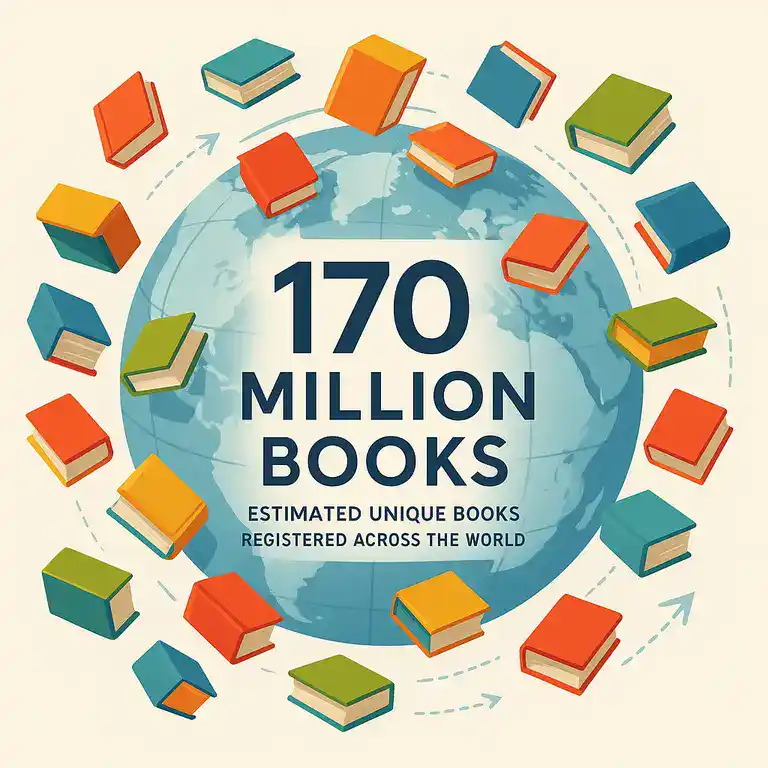
There were an estimated 170 million distinct book editions worldwide at the end of 2025. Applying the same conservative method gives a total of approximately 171 million in August 2026. By the end of 2026, the estimate is expected to reach about 172 million.
No organization maintains a complete worldwide register of every book. Countries collect publishing data in different ways, self-published works frequently fall outside traditional reporting systems, and digital formats make the boundaries less clear. The answer is therefore a documented estimate, not an exact global census.
The calculation begins with Google’s 2010 count of 129,864,880 bibliographically distinct books. We then apply the average annual publishing volume reported in WIPO’s global legal-deposit estimates. This produces the following figures:
| Date | Estimated total |
|---|---|
| End of 2025 | about 169.5 million |
| August 2026 | about 171.1 million |
| End of 2026 | about 172.1 million |
How the 2025 and 2026 totals were calculated
In 2010, Google combined information from library catalogues, ISBN databases and other bibliographic sources. After resolving duplicates, inconsistent author names and conflicting records, it arrived at 129,864,880 different books. The precision of that number reflected the dataset and rules used, not the existence of a perfect world register.
For the annual increase, we use WIPO’s estimated global legal-deposit figures from 2018 through 2022. Those yearly totals were 2.41 million, 2.78 million, 2.44 million, 2.55 million and 2.68 million. Their average is approximately 2.572 million publications per year.
The simplified end-of-2025 calculation is 129.86488 million plus 2.572 million multiplied by roughly 15.4 years. That produces about 169.5 million. Extending the calculation gives 171.1 million for August 2026 and about 172.1 million for the end of the year.
This is deliberately a conservative model. Bowker reported more than four million ISBN book publications in the United States alone during 2025, with self-published books accounting for most of that output. Because formats can receive separate ISBNs and the underlying coverage differs, that figure cannot simply be added to the WIPO series.
What counts as a separate book?
The word “book” can refer to a creative work, a particular edition, a format or an individual physical copy. Those meanings produce very different totals. A useful worldwide estimate must state which level it is attempting to count.
Pride and Prejudice is one literary work. A scholarly edition, a Spanish translation, a paperback and an independently issued ebook may be separate bibliographic publications. Ten thousand identical copies from one print run are still ten thousand copies of the same edition.
ISBN rules follow a comparable distinction. A new language, a substantially revised edition or a different product format may require a separate ISBN. The headline figure therefore describes the scale of the global publishing record, not the number of wholly original stories.
Audiobooks were excluded from Google’s original count. They should not be silently inserted into an extrapolation based on that count. Unpublished manuscripts, private printings and works that have disappeared without a reliable record may also be absent.
Large library databases do not provide a simple substitute. WorldCat contained more than 609 million bibliographic records in October 2025, but those records cover numerous media types, editions and overlapping descriptions. A database record is not automatically one distinct book.
📚 Borges, Libraries, and the Problem of Too Many Books – though not 170 million
Few writers understood the overwhelming scale of books as vividly as Jorge Luis Borges. In “The Library of Babel,” he imagined a library containing every possible combination of letters. Its collection is technically finite, yet it is effectively incomprehensible to the people living inside it.
The real total of 170 million editions is tiny beside Borges’s fictional universe. It would still be impossible for one reader to master. At one book per day, reading the collection would take more than 465,000 years.
Borges returned to the idea in The Book of Sand. Its mysterious volume appears to have no first or last page because new pages always seem to emerge between those already seen. The image suits a publishing world whose boundaries shift whenever another edition enters circulation.
The statistic is therefore about more than abundance. It explains why no catalogue can settle every reading question and no personal list can ever be complete. Choosing one book always means leaving millions of others unopened.
🕵️ Sherlock Holmes and the Case of the Vanishing Books
Arthur Conan Doyle offers another useful example. His Sherlock Holmes stories appeared in magazines, collected volumes, translations and countless later editions. A single body of work can consequently leave many different bibliographic records.
The Adventures of Sherlock Holmes collected twelve stories in 1892. An identical reprint is not automatically a new literary work. A translated edition, an annotated classroom edition or a separately issued ebook may nevertheless be recorded as a distinct publication.
Counting requires a definition before it requires arithmetic. Researchers must decide whether they are counting works, editions, formats or physical objects. Changing that decision can alter a global total by millions.
A Holmes-like investigation would examine the classification rules before trusting an impressive number. That is also the right approach to publishing statistics. Apparent numerical precision can hide uncertain boundaries.

📖 Tolstoy, Word Counts, and the Books That Don’t Know When to Stop
If you’ve ever opened War and Peace and thought, “This feels longer than necessary,” you’re not alone. Tolstoy’s masterpiece clocks in at over half a million words—and that’s just one edition. Multiply that by the dozens of translations, adaptations, and annotated versions, and Leo Tolstoy alone is padding the global book count generously.
With 170 million books in the world, it’s tempting to ask: do we really need all of them? But Tolstoy would say yes. Every small detail—every uniform, every glance, every philosophical aside—is part of the whole. He didn’t write to be brief. He wrote to be complete. There’s a strange comfort in that. Even in a world overflowing with titles, some books are still allowed to take their time. Tolstoy wasn’t in a hurry. And neither is literature.
It also reminds us that size doesn’t always mean substance. Some of the most beloved works in history are short: The Old Man and the Sea, Animal Farm, The Metamorphosis. But when a writer like Tolstoy asks for 1,200 pages, we still follow. Not because we’re counting — but because we’re curious where he’s taking us.
📦 Jane Austen, Small Print Runs, and Unexpected Fame
Jane Austen published Pride and Prejudice in 1813. The first print run? Around 1,500 copies. Today, that number would barely count as a limited release. But somehow, that modest beginning grew into millions — translated, adapted, reissued, memorized.
In the grand number of 170 million books, Austen’s early works take up a tiny fraction. Yet her influence weighs far more than her shelf space. It’s a reminder that literary impact doesn’t always follow big launches or flashy numbers. Sometimes, it starts with a quiet wit and a few well-placed glances.
What’s curious is how many books don’t get that second chance. The majority of titles published each year disappear quietly. Out of print. Out of circulation. and out of mind. But Austen? She stayed. Not just because she was brilliant, but because readers passed her along. Generation to generation. Conversation to conversation.
And that’s something numbers alone can’t measure: how a book survives by being loved. Austen’s stories may be counted once, but they’ve lived millions of times. Somewhere between satire and romance, she taught us that small print runs can still leave very big footprints.
Ray Bradbury and books that disappear
In Fahrenheit 451, books are deliberately destroyed. Ray Bradbury reminds us that literary history is not made solely of publications that survive and accumulate. Works can be banned, burned, forgotten or lost before they enter a durable catalogue.
A worldwide estimate primarily measures books that have left recoverable bibliographic evidence. Lost manuscripts, private printings and poorly archived local publications may remain invisible. Not every written book can be counted.
Digital publishing solves only part of the problem. A file can reach readers immediately but can also vanish when a platform closes or an author removes it. It may also be unclear whether an updated file constitutes a new edition or a technical correction.
The number of books ever created could consequently be higher than any catalogue-based estimate. At the same time, databases regularly merge duplicate records and remove errors. The statistical total does not move upward in a perfectly straight line.
More facts about the world’s books
Annual output explains why any worldwide estimate becomes dated so quickly. The related article How many books are published each year? explores that flow in more detail. It should use the same distinction between works, editions and formats.
The historical opposite can be found in What is the oldest book in the world?. The language dimension is examined in Which language has the most published books?. Together, these questions show why the definition of a book matters as much as the final number.
The best short answer is this: approximately 170 million distinct book editions existed at the end of 2025. The same conservative model produces about 171 million in August 2026. The projected total for the end of 2026 is around 172 million.
More than How many books are in the world? from Facts and Figures about Literature

Review Recommendations while searching How many books are in the world?