Atta Troll: A Midsummer Night’s Dream – Heinrich Heine’s Satirical Masterpiece
Reading Atta Troll: A Midsummer Night’s Dream by Heinrich Heine feels like stepping into a poetic whirlwind—one filled with humor, sharp wit, and biting political commentary. Published in the mid-19th century, this work stands out as a satirical Masterpiece that blends the personal with the political and the fantastic with the critical. In just over a thousand lines, the poet manages to craft a story that is both lighthearted and deeply serious. It is a work of poetry, but also a sharp critique of society, politics, and romanticism.
The poem’s humor pulls the reader in immediately. Yet, as you progress, you realize that his playfulness masks profound reflections on freedom, oppression, and the role of art in turbulent times. This makes the work much more than just a humorous tale—it is a mirror held up to the hypocrisies of 19th-century Europe, and perhaps even to our own time.

What Atta Troll Is All About
On the surface, the book tells the story of a dancing bear named Atta Troll, who escapes captivity and retreats into the mountains to reclaim his freedom. The premise feels whimsical, almost like a fable for children. But the further you read, the more it becomes clear that he is no ordinary bear. He is a symbol, a stand-in for the revolutionary spirit, and his pursuit of freedom mirrors the struggles of oppressed individuals and marginalized voices.
His story is narrated by a poet who follows him into the mountains, eager to observe and capture this wild spirit in verse. Yet, the poet constantly undermines his own romantic notions. He pokes fun at himself and other poets who turn every wild creature into a metaphor for human freedom. Through this self-awareness, The writer gently mocks the romantic movement to which he himself belonged.
Heinrich Heine also uses Atta Troll’s story to critique both revolutionaries and reactionaries. The bear longs for freedom but clings to his own prejudices and simplistic ideas about justice. Meanwhile, the society he flees from remains corrupt, exploitative, and absurd. This dual critique is what makes the poem so sharp. The author spares no one.
The Characters That Give the Poem Its Spark
Atta Troll: The protagonist is both a bear and a revolutionary symbol. His escape from the dancing stage represents the desire for freedom and self-determination. Yet, as the poem progresses, it becomes clear that he is not a heroic freedom fighter. He is proud, stubborn, and filled with his own biases. He uses this contradiction to explore the flaws of revolutionary zeal, exposing the danger of idealism ungrounded in self-reflection.
The Narrator: The unnamed narrator—presumably a version of Heine himself—is just as important as the bear. He follows the bear with fascination, eager to capture his wild freedom in poetry. Yet, the narrator constantly mocks his own romantic tendencies. The writer uses this character to critique not just political ideologies, but also the role of poets and intellectuals who romanticize the struggles of others while maintaining their own comfortable lives.
The Villains: The hunters who pursue him are not portrayed as evil monsters, but rather as representatives of a society afraid of anything that threatens its order. They are mundane, dull, and greedy—driven by money and tradition rather than any real ideological conviction. Through them, the poet critiques the conservative forces that oppose progress, not because they believe in their values, but simply because change threatens their comfort.
Why Atta Troll Still Captivates Today
Satire That Feels Timeless: What makes this work so compelling is how relevant its satire remains. Heine’s humor may target the politics and cultural trends of the 19th century, but his larger points about hypocrisy, romantic delusion, and the limits of revolutionary thinking feel just as pointed today. The characters—whether the pompous poet, the disillusioned bear, or the greedy hunters—are all recognizable in modern political and cultural life.
A Playful Narrative Voice: The poem’s narrator, with his constant interruptions and playful tone, creates a sense of intimacy between poet and reader. This breaks the illusion of epic storytelling, reminding the reader that every story—especially every story about freedom—is shaped by the biases and desires of the storyteller. This playful meta-commentary makes Atta Troll feel fresh and innovative, even for contemporary readers.
A Brilliant Blend of Humor and Seriousness: His greatest trick is his ability to blend humor with serious political and philosophical reflection. The poem is often laugh-out-loud funny, but beneath the jokes lies a deep sadness—a recognition of how difficult true freedom really is, and how often it is corrupted by human frailty. This balance between humor and pathos gives the book an emotional depth that few satirical works achieve.
What Could Challenge Readers Today
Historical and Cultural References: His poem is filled with references to 19th-century politics, literature, and culture. Some of these references can feel obscure to modern readers without background knowledge of the period. While the humor and core message remain clear, some layers of meaning might be lost if the reader is unfamiliar with German romanticism, the 1848 revolutions, or Heine’s personal political conflicts.
Fragmented Structure: The story does not follow a strict plot. Instead, it meanders between the bear’s story, the narrator’s reflections, and digressions into social commentary. This fragmented structure can feel disorienting, especially for readers expecting a straightforward narrative. However, this flexibility is part of his charm, blending storytelling with essay-like reflection.
A Poem, Not a Novel: Because the work is a long poem rather than a novel, readers expecting a traditional narrative might struggle with its pacing and structure. The episodic, rhythmic nature of the poem requires a different kind of reading—one that allows for pauses, reflection, and appreciation of language alongside plot.
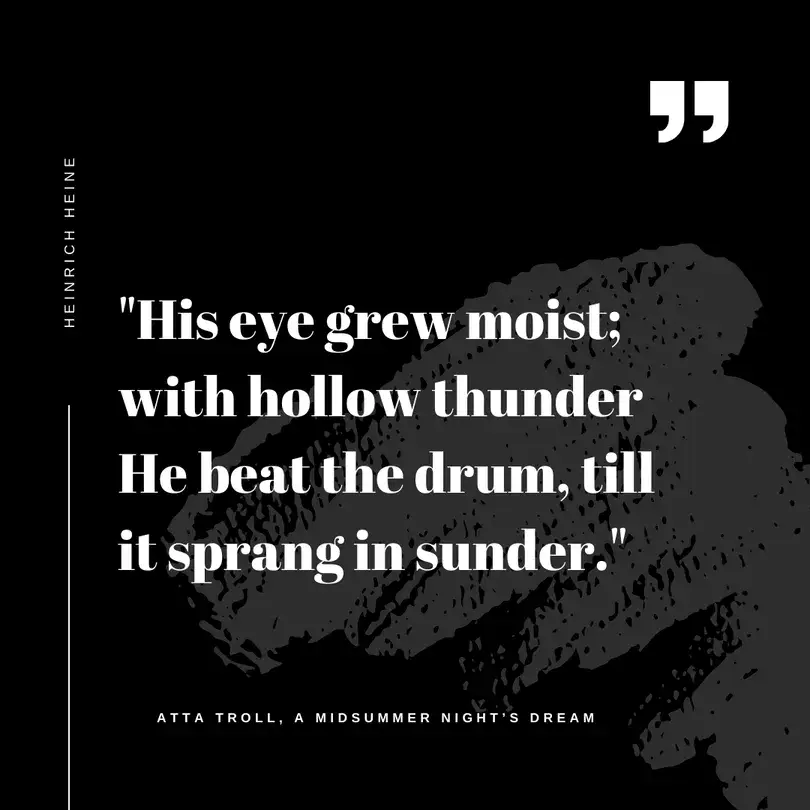
Famous Quotes from Atta Troll: A Midsummer Night’s Dream
- “Freedom is the dream of every chained soul.” The author connects freedom to human longing. He shows that every creature, even a bear like Atta Troll, dreams of breaking free. The quote reflects Heine’s deep belief that liberty is a basic desire in every heart.
- “The world is a cage, but some call it home.” Heine compares the world to a cage, showing that many accept their confinement. He connects this to the way people grow used to restrictions, even when they dream of freedom. The quote highlights the tragic comfort of captivity.
- “Poetry must have wings, but also sharp claws.” The writer connects poetry to both beauty and power. He shows that words must fly high but also strike with force. The quote reflects his belief that art should inspire, but also challenge and criticize.
- “Even the free soul still has chains, hidden deep inside.” He connects outer freedom to inner struggles. He shows that even when someone escapes, they still carry invisible chains of fear or memory. The quote highlights the inner battles that follow every seeker of freedom.
- “Laughter is the sharpest sword against tyranny.” The narrator connects humor to resistance. He believes that satire can cut deeper than violence. This quote shows his belief in using wit to fight against oppression.
Trivia Facts about Atta Troll: A Midsummer Night’s Dream
- Written in Exile in Paris: The poet wrote Atta Troll while living in Paris in the 1840s. Political repression in Germany forced him to leave, and Paris became his second home. Heine connects the story’s theme of freedom to his own experience as an exiled writer craving liberty.
- Inspired by the Pyrenees Mountains: The story is set in the Pyrenees, a mountain range between France and Spain. He traveled there in 1841 and was fascinated by its wild landscapes. The mountains in the poem connect nature to freedom, a central theme of the work.
- Praised by Bertolt Brecht: German playwright Bertolt Brecht admired Heine’s blend of humor, politics, and poetry. Brecht’s own political plays reflect his influence, especially in using satire to challenge authority. This connection shows how Atta Troll inspired later generations of politically engaged writers.
- A Response to Ludwig Börne: The author wrote Atta Troll partly as a reply to Ludwig Börne, a fellow writer and political critic. The two had a public feud over the role of poets in politics. He connects his mock epic to this personal conflict, blending literary humor with sharp criticism.
- Published in a Radical German Newspaper: The work first appeared in 1843 in Der Schweizerische Republikaner, a progressive Swiss newspaper. Censorship in Germany prevented Heine from publishing freely at home. This connection to radical journalism highlights how Atta Troll was seen as both poetry and protest.
- References to Spanish Folklore: Heine fills the poem with images from Spanish culture, from flamenco dancers to smugglers and witches. His love for Spanish music and poetry comes through in these lively scenes. The narrator connects German Romanticism to southern European folklore, blending cultures through imagination.
Themes That Make Atta Troll Timeless
The Illusion of Pure Freedom: Heine exposes the romantic fantasy of pure freedom as just that—a fantasy. Atta Troll, once free, reveals his own prejudices and narrow worldview. True freedom, the author suggests, requires not just escape from oppression, but also self-awareness and inner growth.
The Role of the Poet: The narrator’s self-mockery highlights the awkward position of poets and intellectuals. They admire revolutionaries, but from a safe distance. They romanticize struggle, but rarely experience it firsthand. His critique of the artist as both observer and participant feels as timely today as ever.
Political Hypocrisy: Through both revolutionaries and reactionaries, the poet exposes how political movements often betray their ideals. The hunters who capture Atta Troll may represent oppressive authority, but the bear himself is no saint. Every side, He argues, needs self-criticism.
Why Atta Troll Deserves a Place in Today’s Reading Lists
Atta Troll: A Midsummer Night’s Dream is much more than a historical curiosity. It is a sharp, funny, and deeply wise reflection on freedom, art, and human folly. Heine’s language sparkles with wit, and his insights cut through to the heart of political and artistic dilemmas that still shape our world.
This poem is perfect for readers who enjoy satirical works that blend humor with serious political reflection. It’s also essential reading for anyone interested in how literature responds to political turmoil. While its cultural references might require some background reading, the core message is clear—and it speaks to every generation that struggles with freedom, justice, and the power of art.
For me, the poem was a delightful and challenging read. It made me laugh, think, and question my own assumptions about art and politics. Few works manage that so effortlessly. Rating: 4.5/5 A sharp, playful, and profound work, Atta Troll proves that great satire stands the test of time.