Bonjour Tristesse by Françoise Sagan – Of Youth and Desire
My Thoughts on Bonjour Tristesse
When I read this work by Françoise Sagan, I felt immediately drawn into the luxurious, carefree world of Cécile and her father. The summer setting on the French Riviera felt idyllic, yet there was an undercurrent of restlessness. I sensed Cécile’s boredom and her complicated relationship with her father.
As the story unfolded, I saw Cécile’s innocence clash with her growing desire to manipulate. Her jealousy and impulsive actions created a tense atmosphere, and I couldn’t look away. Watching her play with emotions, including her own, felt unsettling but captivating.
By the end, I felt a mix of sadness and reflection. Cécile’s choices had real consequences, leaving her and those around her hurt. The novel captured the raw intensity of youth and the confusion of freedom. Her writing left me with a bittersweet feeling about innocence lost too soon.

Françoise Sagan‘s Bonjour Tristesse is not just a novel. It’s a hypnotic dive into the tumultuous world of youth, desire, and the intricacies of love. This novel is not just a novel; it’s a hypnotic dive into the tumultuous world of youth, desire, and the intricacies of love. As readers are swept away by the sun-soaked French Riviera, the story unfolds with an alluring blend of sophistication and raw emotion, leaving an indelible mark on the literary landscape. Brace yourself for a journey through the heady days of summer, where the line between pleasure and pain blurs, and the consequences of youthful decisions linger like the fading echoes of laughter.
The Allure of the Riviera: Bonjour Tristesse
Before delving into the narrative, one cannot ignore the allure of the setting in Bonjour Tristesse. The French Riviera, with its azure waters, glamorous lifestyle, and languid summer days, becomes more than a backdrop; it is a character in its own right. Her evocative prose transports readers to a world of opulence and hedonism, where the scents of the Mediterranean breeze and the rhythmic sounds of waves crashing on the shore create a sensory tapestry.
The Riviera’s intoxicating atmosphere becomes a reflection of the characters’ emotional states, mirroring the highs and lows of their relationships. Sagan masterfully weaves the setting into the fabric of the narrative, infusing it with an ambiance that is both seductive and melancholic—a microcosm of the novel’s themes.
At the heart of the book is the complex and enigmatic character of Cécile, a seventeen-year-old girl navigating the murky waters of adolescence. She presents Cécile as a protagonist whose narrative voice is simultaneously precocious and naive. Through her introspective musings, readers gain access to the inner workings of a mind grappling with desire, rebellion, and the awakening of adult emotions.
Cécile’s character is a study in contradictions. On one hand, she exudes a veneer of sophistication, indulging in the pleasures of the Riviera’s social scene. On the other hand, her vulnerability and insecurities expose the fragility of youth. The writer crafts a nuanced portrayal of a young woman on the cusp of maturity, exploring the duality of her nature as she navigates the complexities of love and familial relationships.
Love, Desire, and the Shifting Sands of Morality
Bonjour Tristesse is a narrative that delves into the multifaceted nature of love and desire. The novel’s title, translating to “Hello Sadness,” sets the tone for an exploration of the emotional landscape where joy and sorrow coexist. The author ventures into the realms of passionate love affairs, the transient nature of desire, and the blurred boundaries between societal norms and personal fulfillment.
The central conflict revolves around Cécile’s relationship with her father, Raymond, and the introduction of Anne, a sophisticated woman who disrupts the delicate equilibrium of their lives. She provocatively examines the morality of love and the consequences of unrestrained desire, inviting readers to question societal expectations and the complexities of human relationships.
Sagan’s narrative style in this novel is a captivating blend of reflection and impulse, mirroring the dichotomy within the characters. Cécile’s introspective and often contemplative voice provides a window into her thoughts, exposing the raw emotions that underlie her actions. The prose is imbued with a lyrical quality that heightens the novel’s emotional impact, capturing the fleeting intensity of youth.
The narrative oscillates between past and present, weaving a tapestry of memories and immediate experiences. Her temporal shifts create a sense of fluidity, reflecting the characters’ transient emotional states. This narrative technique serves as a mirror to the ephemeral nature of the characters’ relationships and the impermanence of youth.
Supporting Characters in Bonjour Tristesse
Beyond Cécile, “Bonjour Tristesse” introduces a cast of supporting characters, each contributing to the narrative’s rich tapestry. Raymond, Cécile’s father, is portrayed as a charismatic and self-indulgent figure whose actions catalyze the unfolding drama. Anne, the sophisticated woman who enters their lives, adds an element of tension and intrigue. The supporting cast is rounded out by Elsa, a family friend, and Cyril, a young man entangled in the web of Cécile’s desires.
She crafts characters who defy easy categorization, infusing them with complexities that mirror the nuances of real-life relationships. Each character becomes a vessel for exploring different facets of love, morality, and the human capacity for both selfishness and selflessness.
The theme of youthful rebellion is a prominent thread in this book, as Cécile grapples with the constraints of societal expectations and familial obligations. Sagan captures the heady sense of liberation that comes with youth, as well as the consequences of unbridled rebellion. Cécile’s actions, driven by a desire for autonomy and self-expression, become a prelude to the inevitable transition into adulthood.
The novel becomes a coming-of-age tale that transcends the boundaries of a single summer, encapsulating the broader journey of self-discovery and the reckoning with the consequences of one’s choices. The narrator navigates the complexities of adolescence with sensitivity, offering readers a glimpse into the universal experience of navigating the tumultuous waters between childhood and maturity.
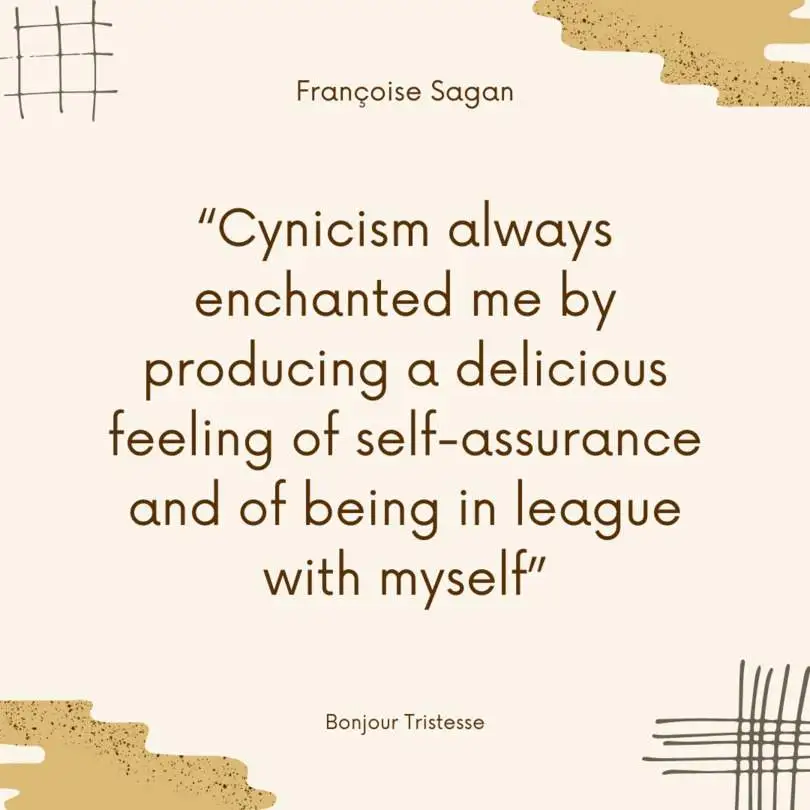
Famous Quotes from Bonjour Tristesse by Françoise Sagan
- “I knew it was love, because I felt light and alive, and full of dangerous happiness.” She connects love to excitement. The feeling is bright, but also risky. This quote shows how passion often brings both joy and fear at once.
- “A strange melancholy pervades me, like a soft mist.” The author connects sadness to atmosphere. It creeps in slowly and quietly. This quote shows how emotions can surround us without warning or explanation.
- “I was not a bad person. Just a happy one.” Françoise Sagan connects joy to guilt. The narrator enjoys life, even when it hurts others. This quote explores how pleasure and conscience often clash.
- “It’s so easy to think one loves someone.” The writer connects feeling to confusion. Sometimes, we mistake desire or need for love. This quote warns us to look deeper before trusting emotions.
- “I could not bear the idea of being left out.” She connects belonging to fear. The need to be included can drive bad decisions. This quote shows how loneliness shapes our choices.
- “She disturbed the peace of our summer.” The novelist connects change to disruption. A new person upsets the easy rhythm of life. This quote captures the tension between comfort and control.
Trivia Facts about Bonjour Tristesse
- Published When she was Just 18: Françoise Sagan wrote Bonjour Tristesse at the age of 17 and published it in 1954, just after turning 18. The novel became an instant success in France and beyond. This connection between youth and literary fame made her a symbol of postwar rebellion and freedom.
- Title Comes from a Paul Éluard Poem: The title Bonjour Tristesse (“Hello Sadness”) is taken from a line in a poem by surrealist poet Paul Éluard. Sagan admired French poetry and often used poetic influence in her writing. This connection between poetry and prose adds depth and literary reference to the book.
- Praised by Jean-Paul Sartre: Jean-Paul Sartre, the famous existentialist, praised her debut. He saw honesty and freedom in her voice. This connection between a young writer and a philosophical icon boosted her literary credibility.
- Criticized by Simone de Beauvoir: While Sartre praised her, Simone de Beauvoir was more critical. She thought the novel reflected bourgeois values and emotional shallowness. This connection between Françoise Sagan and feminist debate made the book a cultural talking point.
- Part of the Nouveau Roman Movement: Though not a formal member, she is often linked to the nouveau roman (“new novel”) movement in France. These writers broke with tradition and focused on inner thought and structure. This connection places her alongside authors like Marguerite Duras and Alain Robbe-Grillet.
- Inspired Writers like Fran Lebowitz and Eve Babitz: Writers known for their wit and cool tone—like Fran Lebowitz and Eve Babitz—cite the author as an influence. They admired her fearless voice and emotional honesty. This connection between generations shows her lasting impact on women writers.
Criticisms: A Tumultuous Elegance
While “Bonjour Tristesse” has been celebrated for its elegance and emotional depth, it is not immune to criticism. Some readers may find the characters’ behaviors and moral ambiguities challenging or unsettling. The novel’s exploration of taboo subjects and its unapologetic portrayal of desire may be provocative. For those who prefer more conventional narratives.
Additionally, the brevity of the novel, while contributing to its impact, may leave some readers yearning. For further exploration of certain themes and characters. Her succinct storytelling, while a strength, may be perceived as a limitation for those seeking a more expansive narrative.
The novel remains a seminal work in French literature. Admired for its exploration of passion, morality, and the complexities of human relationships. Sagan’s ability to capture the ephemeral beauty of youth. And the consequences of unrestrained desire has left an indelible mark on the literary landscape.
The novel’s legacy extends beyond its initial publication, influencing subsequent generations of writers and readers. Her unflinching portrayal of youthful emotions, coupled with the novel’s timeless themes, ensures its place as a classic. That continues to resonate with those drawn to narratives of love, rebellion, and the bittersweet symphony of human existence.
In conclusion, the work is an exquisite tapestry of emotions. A vivid portrayal of youth, desire, and the complexities of love set against the sun-drenched backdrop of the French Riviera. Her narrative elegance, coupled with her exploration of moral ambiguity, creates a timeless work that continues to captivate readers.
As Cécile’s story unfolds, “Bonjour Tristesse” becomes more than a novel. It is an ode to the transient beauty of youth, a meditation on the consequences of passion, and a poignant exploration of the ever-shifting sands of love.