Breakfast at Tiffany’s by Truman Capote – Illusion of Belonging
When I first read Breakfast at Tiffany’s, I didn’t quite know what I was looking at. Was it a love story? A social satire? A character sketch? What I found was something slipperier, a portrait drawn from across the room, where the more you look, the less you see. That’s Capote’s trick. He makes Holly Golightly shimmer, but always just out of reach.
We see her not through her own voice but through the narrator’s filtered gaze. He’s not just fascinated. He’s haunted. That makes the novel feel like a memory, not a plot. Holly becomes a collage of glimpses, a cat, a black dress, a champagne laugh. We never quite know her, and that unknowing becomes the point.
Truman Capote writes with restraint, letting details carry emotional weight. A lipstick print, a half-eaten croissant, an envelope with no return address. It’s these fragments that shape our sense of Holly. And in the gaps between them, we feel the ache of something not said. This isn’t a story of transformation. It’s a record of how hard it is to hold on to someone who refuses to be held. And that’s what gives the novel its ghostly elegance.
Style as Self-Defense in Breakfast at Tiffany’s
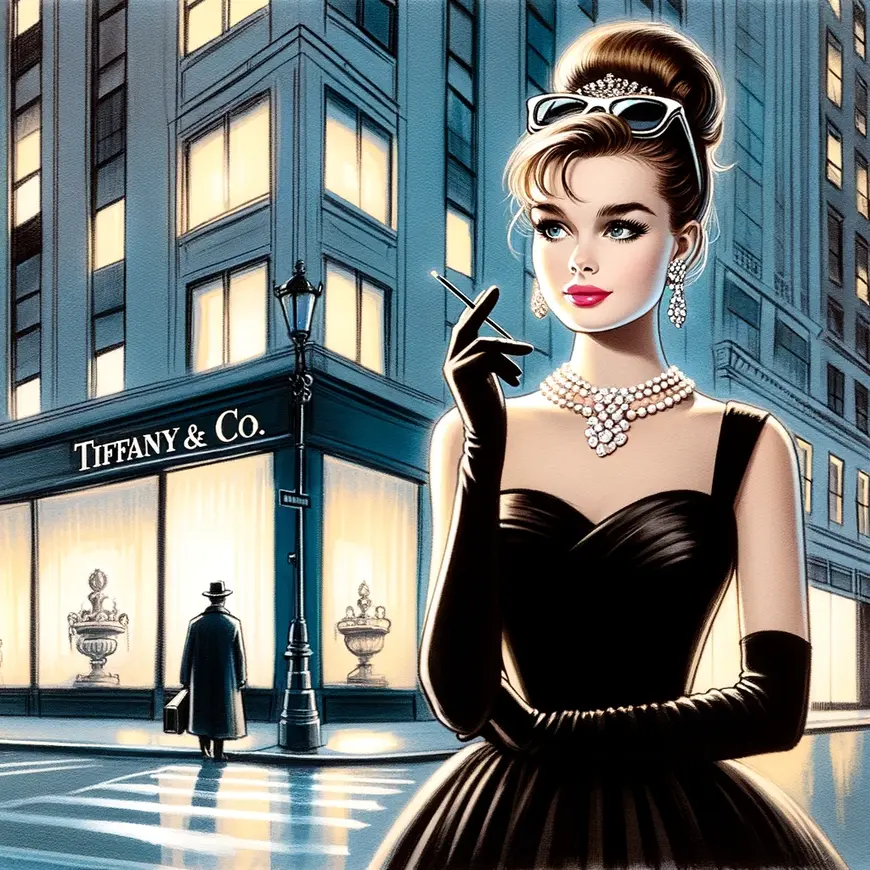
Holly Golightly doesn’t wear style. She weaponizes it. Her look, her voice, her apartment, everything is curated. But not to impress. To protect. Beneath the surface is someone far more fractured than her appearance allows. And the author lets us feel that fracture, even when Holly won’t admit it herself.
This duality — surface and shadow — runs through the book. Holly throws wild parties, but barely eats. She charms strangers, but avoids commitment. While she talks in circles, yet listens too carefully. She is not a liar, she is a survivalist. And her survival depends on remaining unfixed.
👉 Amerika by Franz Kafka offers a similar ambiguity, a protagonist displaced, always redefined by context. Holly too resists definition. She reinvents herself constantly, not to deceive others, but to escape the weight of being known.
Hiss prose keeps pace. It’s cool, precise, never indulgent. That makes Holly’s few emotional slips even more powerful. A shiver. A broken sentence. A sudden silence. These are the moments when the novel cuts deepest.
And through it all, we feel the narrator’s yearning, not for sex, but for understanding. That ache drives the book. Breakfast at Tiffany’s is not about getting close to Holly. It’s about how impossible closeness can be, even when someone is right in front of you.
The Economy of Charm
The star of American literature gives us a New York full of noise, neon, and names, but the novel’s emotional economy is quiet, even brutal. In Breakfast at Tiffany’s, charm is currency. Holly Golightly knows how to spend it, hoard it, and fake it when needed. Yet underneath that effortless glow is a life paid for in loneliness.
Men adore Holly, but she keeps them orbiting. Her relationships are carefully negotiated, expensive dinners in exchange for stories she never quite finishes. Her gift is knowing exactly what to withhold. She’s rarely cruel. She’s just protecting the illusion.
We learn quickly that even her name is fiction. Her origins, family, and dreams are fragments that contradict each other. And every time the narrator tries to pin them down, she changes the subject. But what keeps us reading is not her truth, it’s the fact that she’s not sure what it is either.
Truman Capote doesn’t shame Holly. He lets her live in her contradictions. In doing so, he critiques a society obsessed with respectability and punishment. Holly is a threat to that system, not because she’s immoral, but because she refuses to explain herself.
New York as Theater
The city in Breakfast at Tiffany’s is not a setting, it’s a stage. And Holly Golightly is its most radiant actress. Her apartment becomes a theater, where each visitor plays a part. Her outfits are costumes, her stories, scripts. But the longer you watch, the more the performance trembles.
👉 An Ideal Husband by Oscar Wilde also stages lives built on secrets, reputation, and performance. Capote, like Wilde, shows us that beneath the elegance lies emotional debt, and Holly is constantly borrowing time she can’t repay.
Yet this isn’t a tragedy. The novelist fills the novel with laughter, music, cocktails, and moments of surreal grace. The balance is careful. Too much sadness would betray Holly. Too much whimsy would betray us.
We laugh when Holly sings to her cat or flirts in the elevator. But we also feel the weight of that cat, unnamed, unclaimed, symbolic of her refusal to root herself. She insists she and the cat “belong to nobody.” It’s liberating. But it’s also deeply sad.
A Love That Refuses Definition
The relationship at the center of Breakfast at Tiffany’s is one of literature’s most elusive. It isn’t romantic, not really. And yet it carries the tension of longing, jealousy, and quiet dependence. Holly and the unnamed narrator orbit each other in ways that feel both innocent and intimate. Their bond isn’t about possession, it’s about recognition.
He watches her with fascination, but also hesitation. He’s not trying to win her. He’s trying to understand why he cares so much. And she, for all her outward freedom, keeps returning to him, uninvited but not unwelcome. They both sense in the other something that mirrors their own loneliness.
He plays with the space between them. Their conversations are clipped, evasive. But the gaps between words reveal more than the words themselves. And that restraint becomes emotional fuel. You start to feel that everything they don’t say is what really matters.
This kind of love, without destination, without certainty, is rare in fiction. It’s often either romanticized or dismissed. The writer does neither. He treats it as real, with its own quiet urgency.
Escaping the Self
To Holly, the greatest threat isn’t heartbreak. It’s identity. The idea of being defined — as a wife, a sister, a lover — is suffocating. She’s terrified of becoming static. She needs motion. New names and new cities. New stories. To stop would mean to collapse.
👉 Auto-da-Fe by Elias Canetti also explores this fear of being trapped inside one’s own identity, though through far darker and more surreal lenses. Like its protagonist, Holly dances on the edge of reinvention and annihilation.
The author shows us this escape impulse in subtle ways. Holly sends half-finished letters, avoids eye contact when things get serious, keeps her luggage packed. Even her memories shift, as if being remembered might make them too real. Yet she’s not running from shame. She’s running from gravity. To be fixed in place is to be vulnerable. And in her world, vulnerability is a luxury she can’t afford. That’s what makes the final scenes so haunting. Holly doesn’t crash. She vanishes. Her departure isn’t a fall. It’s a refusal to land.

Famous Quotes from Breakfast at Tiffany’s
- “Anyone who ever gave you confidence, you owe them a lot.” This quote captures his quiet understanding of human fragility. For Holly, confidence is not innate, it’s a gift she receives, often unexpectedly, and guards closely.
- “It may be normal, darling; but I’d rather be natural.” Holly refuses societal molds. This line crystallizes her rejection of convention, favoring authenticity over acceptance, even if it isolates her.
- “You can love somebody without it being like that.” Truman Capote complicates love. This quote challenges the need for romance or possession. It’s about emotional truth without conditions or categories.
- “I don’t want to own anything until I find a place where me and things go together.” This line echoes the novel’s central ache. Holly’s refusal to attach reveals a deeper longing: not for luxury, but for belonging.
- “I’m always top banana in the shock department.” Witty, sharp, and evasive, this quote shows how Holly uses humor to deflect vulnerability. It’s a performance, but it also reveals her control.
- “She was a triumph over nothing.” This devastating description, given by the narrator, suggests that Holly’s glamour masks an inner void, beauty constructed over emptiness.
- “The mean reds are horrible. Suddenly you’re afraid, and you don’t know what you’re afraid of.” One of his most haunting inventions. The “mean reds” give voice to anxiety with no clear cause, something Holly carries quietly.
- “Poor slob without a name.” Holly’s cat becomes a symbol for herself, unanchored, unclaimed, yet deeply loved. This line fuses vulnerability with poetic finality.
Trivia about Breakfast at Tiffany’s by Truman Capote
- Originally wanted Marilyn Monroe: Truman Capote envisioned Marilyn Monroe as Holly Golightly for the film adaptation. Monroe declined after her acting coach warned it might damage her image.
- The novella was banned in several places: Due to themes of sexuality and unconventional relationships, Breakfast at Tiffany’s faced bans and controversy, especially in conservative regions during the 1960s.
- Narrator remains unnamed: The unnamed narrator enhances the mystery of Holly’s life. Scholars at The New York Public Library suggest this anonymity was deliberate, reflecting his themes of detachment.
- Audrey Hepburn disliked her role: Although now iconic, Hepburn felt she was miscast. She believed the role conflicted with her image, as documented in various biographies and film retrospectives.
- The novel contrasts well with Billards at Half-Past Nine by Heinrich Böll, which also explores memory, identity, and the unreliability of appearances.
- For another haunting female lead, Blindness by José Saramago presents a radically different woman defined by strength in a collapsing world.
- Manuscript sold for $300,000: In 2006, Sotheby’s auctioned the original typed manuscript — complete with handwritten edits — for nearly $306,000. The event is documented in Sotheby’s literary archives.
The Fragile Myth of Freedom
His brilliance lies in how he allows Breakfast at Tiffany’s to challenge its own fantasy. At first, Holly’s life feels like liberation, parties, lovers, no strings, no guilt. But as the story deepens, that freedom becomes hollow. It’s not independence she lives in. It’s exile.
Holly insists on detachment. But that detachment costs her more than she admits. She has no home, no roots, no past she’s willing to name. Her freedom is not the absence of limits, but the refusal of connection. And it begins to show its cracks.
The narrator watches this unraveling with a mix of admiration and sorrow. He doesn’t judge her. But he sees what she won’t say: that in protecting herself from pain, she’s also blocking out intimacy, stability, even self-understanding.
The story turns gently melancholic. Not dramatic. Not cruel. Just quietly devastating. We begin to wonder if Holly’s freedom is actually a performance, and if she’s forgotten how to stop acting.
The Ending That Never Settles
When Holly disappears, she doesn’t leave behind a note or a message. Just absence. And yet her absence is louder than any ending. Truman Capote resists resolution. He leaves us suspended, still searching, still hoping, still wondering.
👉 Being and Nothingness by Jean-Paul Sartre might seem like an unexpected reference, but its existential tension, the refusal of fixed identity, the pull toward authenticity, echoes through Holly’s final flight. The narrator clings to small details: a rumor in Africa, a bird in the window. But we feel what he feels, that Holly was never meant to be caught, even by memory.
His restraint gives the novel its power. He doesn’t tie things up. He lets them float. And in that choice, he honors Holly. Because to define her would be to betray everything she tried to be. Breakfast at Tiffany’s ends not with answers but with ache, the kind that lingers long after the pages close.