The Black Tulip by Alexandre Dumas – A Story of Obsession, Politics, and Love
Alexandre Dumas is best known for his grand adventure novels like The Three Musketeers and The Count of Monte Cristo, but The Black Tulip, published in 1850, offers something different. Instead of duels, conspiracies, and revenge-driven protagonists, this novel focuses on political intrigue, personal ambition, and an unusual passion—the cultivation of a perfect black tulip.
Set in the Dutch Republic during the political turmoil of 1672, the novel follows Cornelius van Baerle, a tulip breeder caught in a web of conspiracy. His crime? Being associated with the powerful and recently executed De Witt brothers. Thrown into prison for treason, Cornelius clings to his obsession with growing the first-ever black tulip, even as his life crumbles.
Though less famous than his other works, this novel is a fascinating mix of history, romance, and suspense. It is a story about perseverance against corruption, the fine line between obsession and passion, and the power of love to triumph over injustice. While it lacks the grand action sequences of Dumas’ swashbuckling tales, it compensates with tightly woven intrigue and richly developed characters.
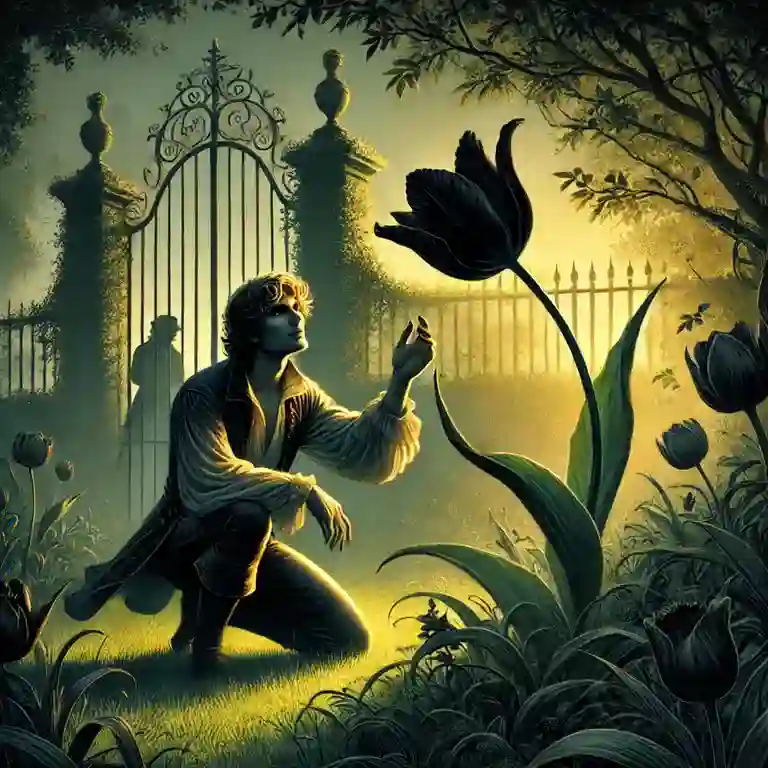
The Black Tulip and Alexandre Dumas
Dumas’ literary career was shaped by grand epics, but The Black Tulip stands out as one of his more compact and focused works. Rather than crafting a long, episodic narrative filled with betrayals and escapes, the author takes a more intimate approach, focusing on one man’s dream and the forces that seek to destroy it.
The novel is deeply rooted in real historical events. The execution of the De Witt brothers, powerful Dutch politicians, serves as the catalyst for Cornelius’ downfall. While the writer takes creative liberties, the setting remains true to the political unrest of the Dutch Republic in the late 17th century, a time when power struggles and paranoia ran high.
This novel also showcases his ability to write about a different kind of hero. Unlike Edmond Dantès (The Count of Monte Cristo), who seeks vengeance, or d’Artagnan (The Three Musketeers), who craves adventure, Cornelius van Baerle is a peaceful scholar, uninterested in politics. His only ambition is to cultivate the elusive black tulip, a feat that represents both scientific achievement and artistic beauty.
Though The Black Tulip is often overshadowed by his more famous works, it remains a remarkable novel that blends history, romance, and suspense in a fresh and unique way.
Summary of The Black Tulip – A Tale of Passion and Betrayal
The novel opens in 1672, a year of political upheaval in the Dutch Republic. The powerful De Witt brothers, who have ruled the country for years, are accused of treason by the supporters of William of Orange. As tensions rise, Johan and Cornelius de Witt are brutally lynched by an angry mob, marking a turning point in Dutch politics.
Meanwhile, in the quiet town of Dordrecht, Cornelius van Baerle, a wealthy and brilliant tulip grower, is unaware of the danger approaching him. His life revolves around a singular goal: cultivating the first perfect black tulip, an achievement that would secure him fortune and fame.
However, his peaceful existence is shattered when he is falsely accused of treason. His neighbor and rival, Isaac Boxtel, who envies Cornelius’ skill in tulip breeding, betrays him out of jealousy. Using Cornelius’ past correspondence with the De Witt brothers as evidence, Boxtel manipulates the authorities into believing Cornelius is a political traitor.
Arrested and thrown into Loevestein Prison, Cornelius faces a grim future. But even in the darkness of his cell, his mind remains fixed on one thing—the black tulip. He manages to smuggle three precious tulip bulbs into prison, determined to complete his life’s work.
Inside the prison, Cornelius meets Rosa Gryphus, the daughter of his brutal jailer. Unlike her father, Rosa is kind and intelligent. As Cornelius teaches her about tulip cultivation, a tender bond forms between them. Rosa becomes his only ally, vowing to protect the tulip bulbs from destruction.
This sets the stage for a gripping story of hope, betrayal, and resilience. While Cornelius fights to nurture his dream, enemies conspire against him, and the political turmoil of the Dutch Republic threatens to crush him.
Power, Passion, and Justice
At its heart, The Black Tulip is about the struggle between personal ambition and external forces of power. Cornelius van Baerle, an innocent man, is imprisoned not because of his own actions but because of the political turmoil that engulfs his world. This highlights one of the novel’s central themes: injustice driven by corruption and envy.
The pursuit of perfection is another major theme. The black tulip represents an impossible ideal, a challenge that drives Cornelius to remain hopeful even in prison. This pursuit of beauty contrasts with the cruelty of the world around him, emphasizing the idea that true passion can survive even in the darkest places.
Love also plays a crucial role. Rosa’s devotion to Cornelius and his tulip bulbs is more than just affection—it symbolizes loyalty, perseverance, and the belief in something greater than oneself. In a novel filled with political betrayal and injustice, love becomes a force of resilience.
Engaging, Suspenseful, and Rich in History
One of the novel’s greatest strengths is its blend of history and fiction. While based on real events—the political unrest in the Dutch Republic and the execution of the De Witt brothers—the author weaves a compelling personal story into the larger historical backdrop. This balance makes The Black Tulip engaging for both history enthusiasts and lovers of dramatic storytelling.
Another strength is the character development. Cornelius is not the typical Dumas hero—he is not a swordsman or a cunning strategist. Yet his obsession with the tulip and his quiet resilience make him a unique and memorable protagonist. Rosa, too, is a strong character, proving to be more than just a love interest. Her role in protecting Cornelius and his tulip bulbs adds emotional depth to the story.
The novel’s suspenseful pacing keeps readers engaged. Despite being a novel about tulip cultivation, the high stakes—Cornelius’ wrongful imprisonment, Boxtel’s scheming, Rosa’s secret efforts—create a thrilling atmosphere. Each moment feels significant, as even small actions have major consequences for the fate of the black tulip.
A Slower, Less Action-Packed Novel
While its is a compelling novel, it is not for everyone. Unlike The Three Musketeers or The Count of Monte Cristo, this book lacks high-energy action sequences and dramatic duels. Instead, the story unfolds in a quieter, more introspective manner, which may not appeal to readers looking for fast-paced adventure.
Another challenge is the historical context. Readers unfamiliar with Dutch history may find the political backdrop confusing or difficult to engage with. The novelist assumes a certain level of knowledge, which can make it harder for some readers to fully grasp the significance of the political events.
Additionally, some of the villains feel underdeveloped. While Boxtel is a clear antagonist, his motivations remain fairly one-dimensional—jealousy and greed. Compared to the complex, morally ambiguous villains in Dumas’ other works, Boxtel lacks depth.
Despite these weaknesses, The Black Tulip remains a rewarding read for those who appreciate historical fiction, strong character dynamics, and the exploration of human ambition.

Famous Quotes from The Black Tulip by Alexandre Dumas
- “A man is nothing without his dreams.” He connects ambition to identity. He suggests that dreams give people purpose and direction. This quote reminds us that without dreams, life feels empty.
- “In politics, my dear fellow, you must hate people before they hate you.” Dumas connects power to strategy. He shows how politics is full of distrust and competition. This quote highlights the dark side of ambition and leadership.
- “A tulip is more than a flower; it is a work of art.” The writer connects nature to beauty. He believes that tulips, especially rare ones, hold artistic and cultural value. This quote reflects the novel’s theme of obsession with perfection.
- “Love and flowers need time to bloom.” Dumas connects patience to growth. He suggests that true love, like a rare flower, requires care and time. This quote reminds us that the best things in life cannot be rushed.
- “He who sows hatred will reap revenge.” The author connects actions to consequences. He warns that spreading negativity will bring destruction in return. This quote highlights the novel’s themes of justice and betrayal.
- “In the darkest prison, hope is the only light.” He connects suffering to survival. He believes that even in terrible situations, hope keeps people alive. This quote reflects the struggles of Cornelius as he fights for freedom.
Trivia Facts about The Black Tulip
- Set During the Dutch Golden Age: The Black Tulip takes place in the Netherlands in the 1670s, a time of great wealth and art. The country was famous for its trade, tulip mania, and scientific progress. This connection to history gives the novel a rich and realistic background.
- The De Witt Brothers Were Real People: The novel begins with the execution of Johan and Cornelis de Witt, two real Dutch politicians. They were brutally murdered by an angry mob in 1672. This connection to real political events adds depth to the novel’s themes of betrayal and justice.
- Connection to Dutch History: Even though Dumas was French, he was fascinated by Dutch history. He researched the political struggles and the tulip craze in great detail. This connection between a French writer and a Dutch setting makes the novel unique among his works.
- The Novel Features a Strong Female Character: Rosa, the jailer’s daughter, plays a key role in the story. She helps Cornelius in prison and risks everything to protect the black tulip. This connection between romance and courage makes Rosa one of his most admirable heroines.
- Similar to Victor Hugo’s Themes: Dumas and Victor Hugo were both famous French writers of the 19th century. Like Hugo’s Les Misérables, this book deals with injustice, imprisonment, and the struggle for freedom. This connection between two literary giants shows their shared interest in dramatic, emotional storytelling.
- The Black Tulip Remains a Mystery: To this day, no one has ever discovered a truly black tulip. Scientists and botanists have created dark purple or deep red tulips, but a completely black one remains impossible. This connection between fiction and reality makes the novel’s central quest both romantic and unattainable.
How It Stands Among Dumas’ Works
Compared to Dumas’ most famous novels, The Black Tulip is a departure from his usual swashbuckling adventure stories. Unlike The Three Musketeers or The Count of Monte Cristo, this novel is more contained, focusing on a single protagonist’s struggle rather than an expansive, multi-character epic.
What makes this work unique is its blend of historical fiction, political intrigue, and romance. While it may not have the dramatic action sequences of his better-known works, it builds suspense through tension and quiet perseverance. The high stakes surrounding Cornelius’ imprisonment and the fate of his tulip create a gripping story despite the absence of sword fights or grand betrayals.
For those who appreciate character-driven stories with historical depth, this novel is a hidden gem in his bibliography. However, readers looking for fast-paced action and elaborate schemes may find it less engaging than his other novels.
Who Should Read The Black Tulip?
This novel is ideal for readers who enjoy historical fiction and psychological drama rather than traditional adventure tales. The political context and slower pacing may require patience, but the emotional depth and character development offer a rewarding reading experience.
For fans of Dumas, this book provides a different perspective on his storytelling abilities. It showcases his talent for weaving romance, historical events, and suspense into a tightly focused narrative. It is also an excellent introduction to his ability to write compelling stories without relying on action-heavy plots.
The language and style, though slightly more restrained than in his other works, are still accessible. However, those unfamiliar with 17th-century Dutch history may find parts of the political intrigue difficult to follow. Even so, the novel’s emotional core—the themes of love, perseverance, and justice—remain universally engaging.
A Worthwhile but Underrated Classic
The Black Tulip may not be Dumas’ most famous work, but it is a beautifully crafted novel that deserves recognition. Its themes of obsession, injustice, and quiet resilience make it a powerful and thought-provoking read.
While it lacks the sweeping adventure of his more well-known books, it makes up for it with rich character development and an engaging historical backdrop. Cornelius’ journey from a man of leisure to a prisoner determined to protect his tulip is both heartbreaking and inspiring. Rosa’s role in the story adds depth and emotional warmth, making the novel not just about politics and rivalry, but about love and devotion in the face of adversity.
Final Rating: 8.5/10
A compelling and underrated novel, The Black Tulip is a must-read for fans of historical fiction and those who appreciate a more intimate, character-driven story. While it may not be as thrilling as The Count of Monte Cristo, its emotional resonance and unique premise make it a rewarding experience.
More Reviews of Works by Dumas

The Three Musketeers by Alexandre Dumas: An Adventure My Thoughts on The Three MusketeersThe novel by Alexandre Dumas was an…

The Count of Monte Cristo – A Tale of Revenge and Redemption My Thoughts on The Count of Monte CristoWhen…