Ernest Hemingway’s The Old Man and the Sea – A Timeless Tale
What I think about The Old Man and the Sea
I had a powerful experience reading the novella by Ernest Hemingway. Right, from the beginning I found myself immersed in Santiagos deep story. As he faced a major challenge in his life. His clear and descriptive writing style transported me to Santiagos boat making me feel like I was there alongside him.
Following Santiagos battle with the marlin I could sense his determination, pride and exhaustion. The struggle was. Emotional, revealing the bond between man and sea. Santiagos resilience and unwavering spirit struck a chord with me emphasizing the importance of perseverance in times.
By the time I reached the end of the book Santiagos journey had left an impact on me. The story instilled in me an admiration for strength and dignity, in challenging circumstances. His skillful storytelling made this read unforgettable lingering in my thoughts long after I turned the page.
Ernest Hemingway, one of the greatest American writers of the 20th century, crafted a profound and introspective novella with The Old Man and the Sea. First published in 1952, this captivating work transports readers to the sea. An aging fisherman named Santiago embarks on a relentless battle against nature and himself. In this review, we will explore the mesmerizing narrative, the distinct style, and the enduring themes of determination and the human spirit. These elements make the book an undisputed classic.
Unveiling the Tale of Perseverance in The Old Man and the Sea
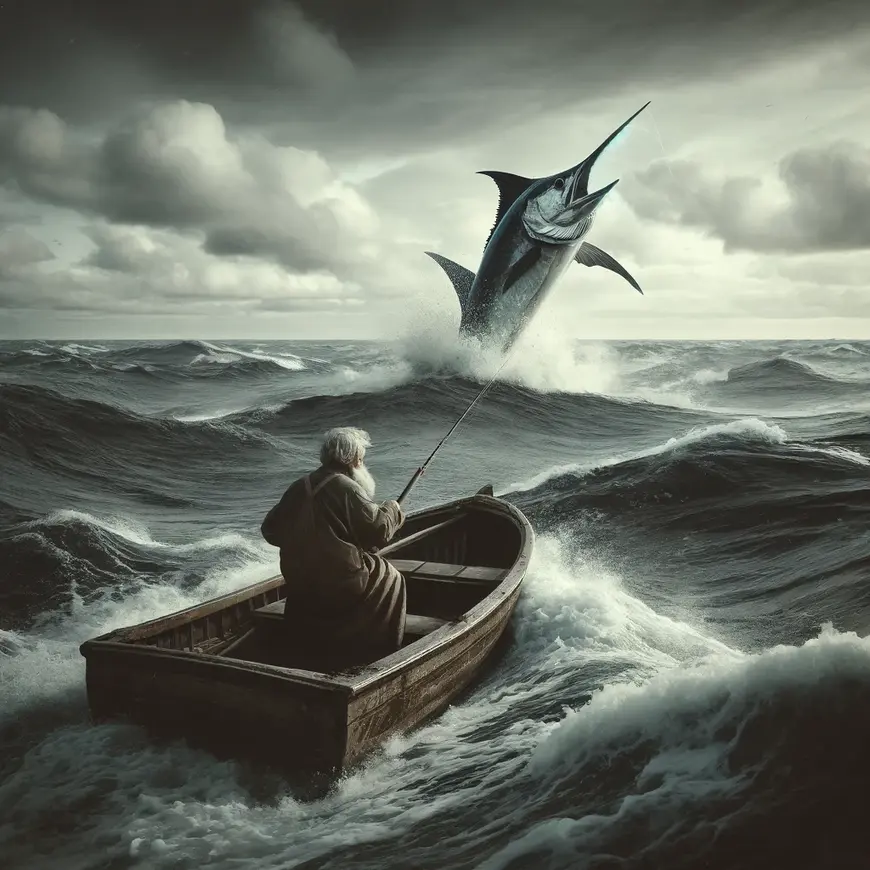
The Old Man and the Sea tells Santiago’s story. He is an aging Cuban fisherman who has gone 84 days without catching a fish. Undeterred by bad luck, Santiago sets out on a fateful journey into the deep sea. He is determined to prove his worth and reclaim his former glory.
Santiago faces the vast and unpredictable ocean. He becomes entangled in a relentless struggle with a colossal marlin. This battle pushes him to his physical and mental limits. Hemingway’s portrayal of Santiago’s solitary journey captures the human spirit. It highlights the indomitable will to overcome adversity and the pursuit of personal triumph.
One of the author’s trademarks is his unique writing style characterized by simplicity, precision, and sparse use of words. In the novel, this distinctive prose elevates the narrative. It transports readers to the heart of Santiago’s struggle while leaving room for personal interpretation.
The author’s concise descriptions evoke vivid imagery. He immerses readers in the world of the old fisherman and the vastness of the sea. His ability to capture the nuances of human emotions. And the raw beauty of nature with such economy of language is a testament to his mastery as a writer. The stripped-down prose enhances the emotional impact of the story, making every word count in the portrayal of Santiago’s journey.
Themes of Resilience and Redemption
At its core, The Old Man and the Sea is a profound exploration of resilience, determination, and the quest for personal redemption. Santiago’s relentless pursuit of the marlin reflects the human spirit’s capacity to persevere in the face of seemingly insurmountable challenges. The physical and mental strength he exhibits in the midst of his solitary struggle is a testament to the unwavering resolve of the human soul.
Ernest Hemingway also delves into the theme of redemption, as Santiago seeks to prove his worth and regain his dignity. Through the character of the old fisherman, the novella explores the inherent worth of an individual beyond external achievements. Santiago’s battle with the marlin becomes a metaphor for his personal journey of self-discovery and redemption, transcending the mere act of fishing.
The Old Man and the Sea is replete with rich symbolism and allegorical elements. That invite readers to delve deeper into its meaning. The marlin, representing Santiago’s worthy opponent, embodies both the elusive nature of success and the adversities that test one’s character. The struggle between Santiago and the marlin parallels the larger struggles of life—man’s ongoing battle against the forces of nature, his own limitations, and the inexorable passage of time.
The presence of Manolin, the young boy who admires and supports Santiago, adds a touch of warmth and humanity to the story. Manolin’s unwavering loyalty symbolizes the power of friendship and the intergenerational bonds that transcend age and circumstance.
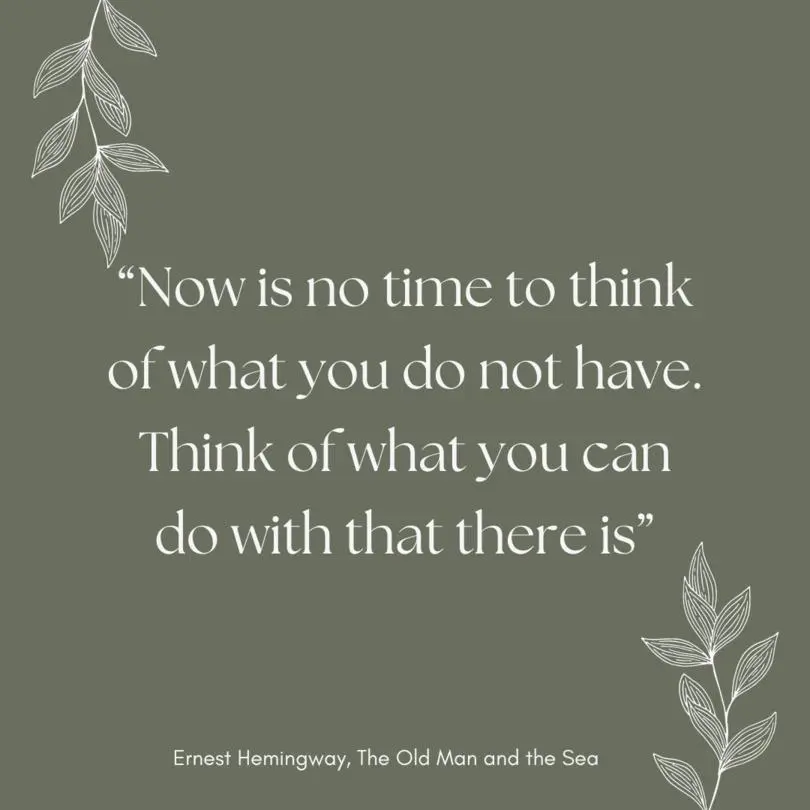
Famous Quotes from The Old Man and the Sea by Ernest Hemingway
- “But man is not made for defeat. A man can be destroyed but not defeated.” This quote captures the indomitable spirit of Santiago, the old fisherman, and the central theme of the novel: the battle between man and nature, and man’s resilience in the face of overwhelming odds. It speaks to the idea that while external forces can physically harm or even kill a person, they cannot crush his will or spirit unless he allows them to.
- “The sea is my brother, but sometimes it behaves like an enemy.” Santiago sees the sea as both a provider and a challenger. This duality reflects his respect and intimate knowledge of the natural world. Acknowledging that it can be both nurturing and brutal. The sea symbolizes life itself, which can be supportive and sustaining at times, yet harsh and unforgiving at others.
- “Pain does not matter to a man.” Santiago says this as he endures physical suffering while struggling to catch the giant marlin. This quote underscores his stoicism and determination, emphasizing the theme of enduring physical and emotional pain in pursuit of one’s goals. It reflects Ernest Hemingway’s admiration for characters who show grit and perseverance in the face of adversity.
- “It is better to be lucky. But I would rather be exact. Then when luck comes you are ready.” Santiago reflects on the importance of preparation and skill over relying solely on luck. This quote underlines the value of hard work, knowledge, and precision in achieving one’s goals. It suggests that while luck may play a role in success, being prepared and skilled allows one to fully capitalize on opportunities when they arise.
Trivia Facts about The Old Man and the Sea
- Last Major Work: This story was the last major work of fiction written by the author published during his lifetime. It was released in 1952, and Ernest Hemingway won the Nobel Prize in Literature in 1954, partly due to the acclaim this novella brought him.
- Pulitzer Prize: In 1953, The Old Man and the Sea was awarded the Pulitzer Prize for Fiction. The award cited its powerful and enduring narrative as a significant factor for the accolade.
- Inspiration for the Story: The story was inspired by his experiences in Cuba, where he lived for periods of time from the 1930s. The character of Santiago was likely based on local fishermen Hemingway knew, melding their traits and his observations into the story’s protagonist.
- A Return to Form: Before this book, he had not published a major successful work for nearly a decade.
- Life Magazine Feature: Shortly after its publication, the novella was featured in Life magazine, which printed it in its entirety in a September 1952 issue. This publication was incredibly successful, selling over 5 million copies in just two days.
- Symbolic Depth: The novella is rich in symbolism, with interpretations ranging from Christian allegory to a meditation on the relationship between humans and nature.
- Critical and Commercial Success: Despite its brevity, The Old Man and the Sea was both a critical and commercial success, demonstrating his ability to tell a compelling story with minimalism and precision. It helped to cement his legacy as one of the greatest writers of the 20th century.
- Writing Style: The novella is a prime example of Hemingway’s distinctive writing style, known as the Iceberg Theory or the theory of omission.
Why Read The Old Man and the Sea by Ernest Hemingway?
If you’ve never read The Old Man and the Sea, you might wonder — why should you? After all, it’s a short book, written in simple language, and the whole story is about an old fisherman and a big fish. But that’s exactly why it’s special. The novelist didn’t need fancy words or complicated plots to create a story that still moves people today.
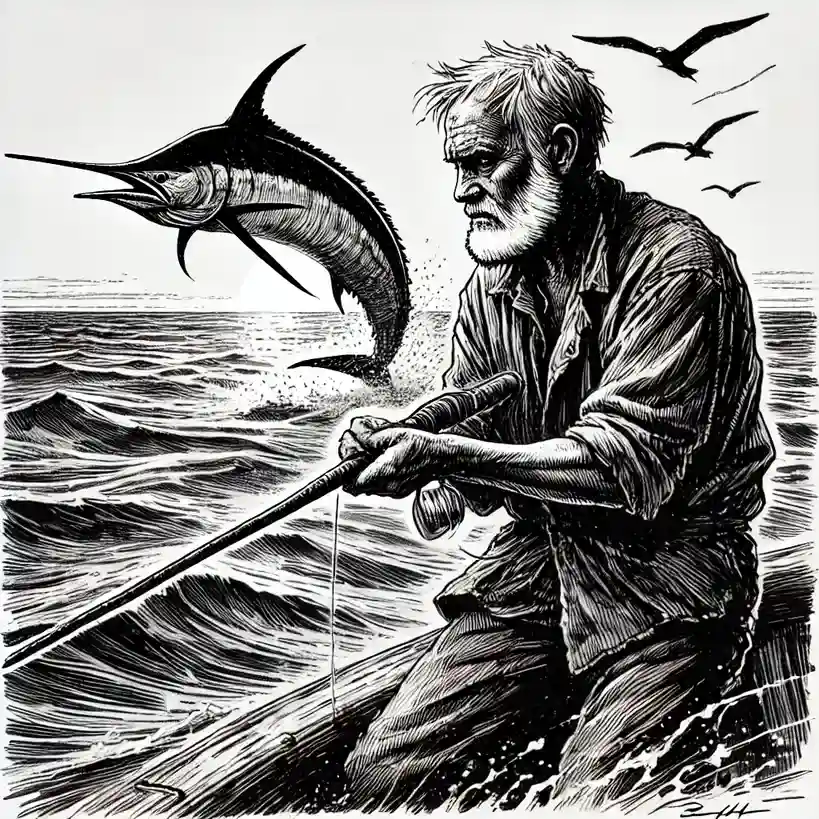
At its heart, this book is about struggle and dignity. Santiago, the old fisherman, hasn’t caught a fish in eighty-four days. The people around him think he’s finished, a man too old, too unlucky. But Santiago refuses to give up. When he finally hooks a giant marlin, it’s not just about catching a fish. It’s a fight between man and nature, between strength and time, between hope and reality.
What makes this story unforgettable is how Hemingway shows courage. Santiago knows he’s losing, but he keeps going. His body breaks, but his spirit never does. That quiet bravery, facing defeat with grace, is why this book speaks to everyone, no matter their age or background. It’s also a masterclass in writing. His style, short sentences, strong images, no extra words, proves that simplicity can be powerful.
You don’t read this just for the story. You read it to understand what it means to be human, to fight for something even when you know you might lose. That’s why this little book still matters so much.
A Timeless Classic
The novel continues to captivate readers and inspire generations with its timeless themes and profound storytelling. His ability to weave a poignant tale of human strength and the pursuit of meaning resonates with readers everywhere.
Ernest Hemingway’s The Old Man and the Sea is a literary gem. It embodies the resilience of the human spirit. Through evocative prose, powerful themes, and enduring symbolism, the novella invites reflection. It highlights timeless values of determination, redemption, and the will to overcome adversity. Santiago’s solitary battle against the marlin reminds us of the beauty and complexity of human experience. This story leaves an indelible mark on the hearts of its readers.