Which language has the most published books?
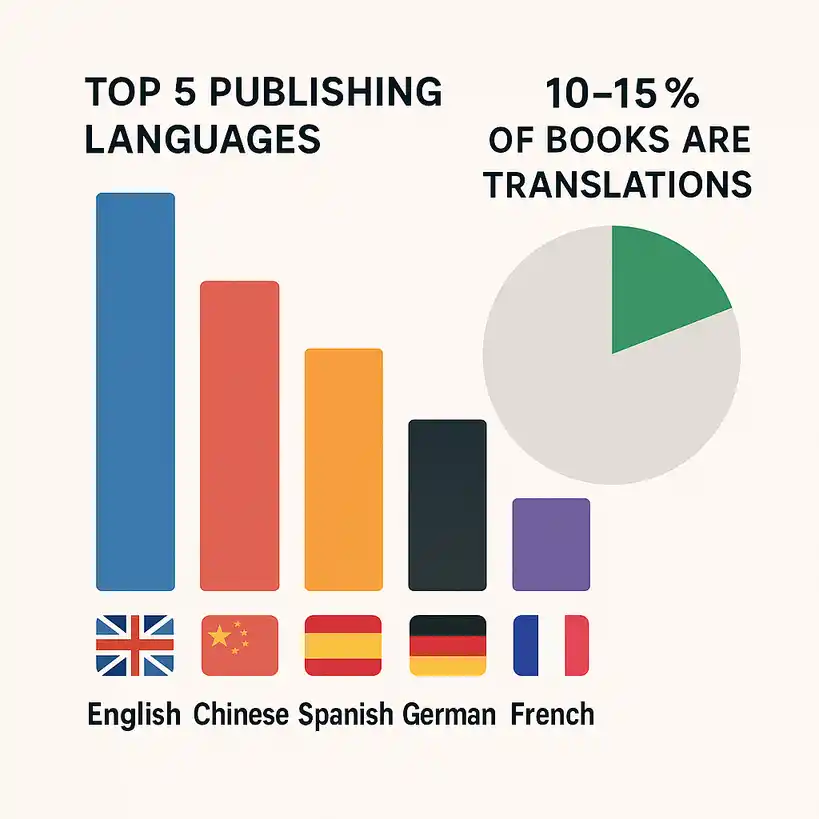
The language with the most published books in the world is English. According to UNESCO and various national library databases, more than 350,000 new titles are published in English each year, with estimates often exceeding 1 million when counting all editions, self-published books, and digital formats. English dominates the global publishing market, with contributions from the U.S., U.K., Canada, Australia, India, and other English-speaking countries.
English isn’t just a widely spoken language. It’s a publishing powerhouse. More than half of the world’s academic journals are published in English. Major global publishers are headquartered in English-speaking countries. The international book trade often treats English as a default—even in regions where it’s not the mother tongue.
It’s not just about volume, either. English books are more likely to be translated into other languages than the reverse. English is both a source and target in the global book ecosystem.
Several factors explain this dominance. First, the U.S. and U.K. produce an enormous number of books per year. Second, English is the leading language in science, business, and technology. Third, many writers around the world publish in English to reach a broader audience.
But this global presence comes with trade-offs. Books written in other languages often struggle to find English translations, while English-language works are quickly exported across continents. So while English books dominate in quantity, the diversity of voices often flows in just one direction. Still, the numbers are clear. English is not just a language of readers. It’s the most prolific language of publishers, too.
✍️ Hermann Hesse and the Global Echo of English
Hermann Hesse wrote in German, but most people read him in English. Steppenwolf, Siddhartha, The Glass Bead Game—none were originally English works. But today, these titles are part of the English-speaking literary canon. Hesse’s global reach didn’t begin in Germany. It exploded after his books were translated and published widely in English-speaking countries.
That’s the reality of the publishing world. English is the most published language in the world, and any author who wants a global audience eventually passes through it. Hesse was skeptical of mass culture, but his ideas—spiritual crisis, identity, rebellion—fit beautifully into the post-war English-language market. Readers in the U.S. and U.K. embraced him as both philosopher and novelist.
Ironically, Hesse’s most enduring fame came not from his native readers, but from American students in the 1960s who discovered him in English translation. His books became cult classics, often printed in small, cheap English paperbacks that circulated in universities and counterculture scenes.
That wouldn’t have been possible without English’s overwhelming presence in global publishing. Even deeply “non-English” authors find their breakthrough there. For Hesse, that path made him timeless. It’s the language of amplification.
📚 J.D. Salinger and the Myth of the English Bestseller – Which language has the most published books?
When we talk about English being the most published language in the world, we often think of global empires, multinational publishers, and mass-market paperbacks. But then there’s J.D. Salinger.
Salinger published very little. He hated publicity. He refused interviews. And still, The Catcher in the Rye became one of the most printed and assigned novels in the English-speaking world. It’s been translated into more than 30 languages, but it remains most powerful in English—its slang, its rhythm, its voice are built around how English works.
That’s the strange power of English publishing. A writer can go quiet and still sell millions. English does that not only because of reach, but because of infrastructure—schools, libraries, markets, global licensing, and reprints.
Salinger’s success wasn’t just literary. It was logistical. The scale of English-language publishing helped his single book live dozens of lives in classrooms, dorms, and backpacks. Even without the author participating. English is the language that can carry a whisper across continents. Salinger mumbled, and the world still listened.

🌐 V.S. Naipaul and the Language That Gave Him the World
V.S. Naipaul was born in Trinidad. His family spoke a mix of Hindi and English. He studied in Oxford. He wrote in English. And that choice gave him the world. Naipaul’s career is a case study in how English, the most published language globally, acts as a literary passport. Had he written in Bhojpuri or even Hindi, he likely wouldn’t have found global readers. But by writing in English, he stepped directly into the international publishing mainstream.
That wasn’t just luck. It was structure. English-language publishers had the money, the reach, and the translations ready. Naipaul’s themes—colonialism, displacement, irony—hit especially hard in the very language that once imposed itself on his homeland. And the publishing world responded. He won the Booker Prize, the Nobel Prize, and secured a readership across continents.
But Naipaul also complicated the idea of English dominance. He didn’t flatter the empire. He exposed it and didn’t accept Englishness as default. While he used it to interrogate its own legacy. That dual position—inside the system but not submissive to it—is exactly why his books matter. Naipaul’s career proves that English is both gateway and battleground. It can lift a voice—or flatten others. In his case, it did both.
More Facts and Figures about Literature next to Which language has the most published books?






Some Recommendations for Book Reviews