The Dystopian Depths of 1984 – An Ominous Vision
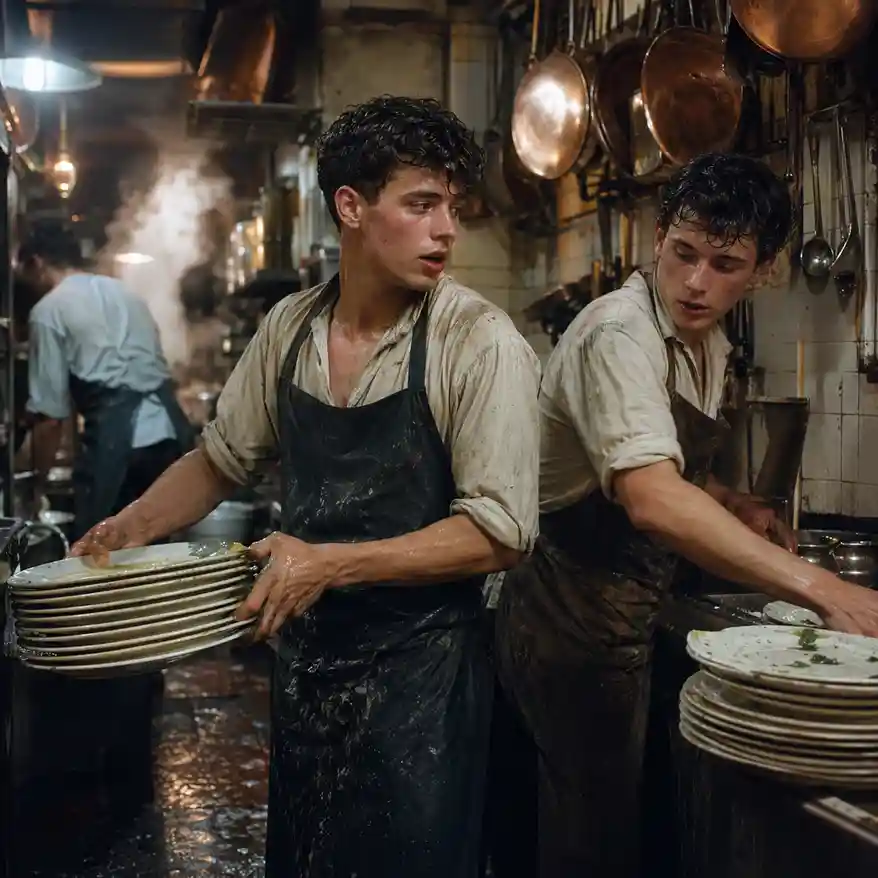
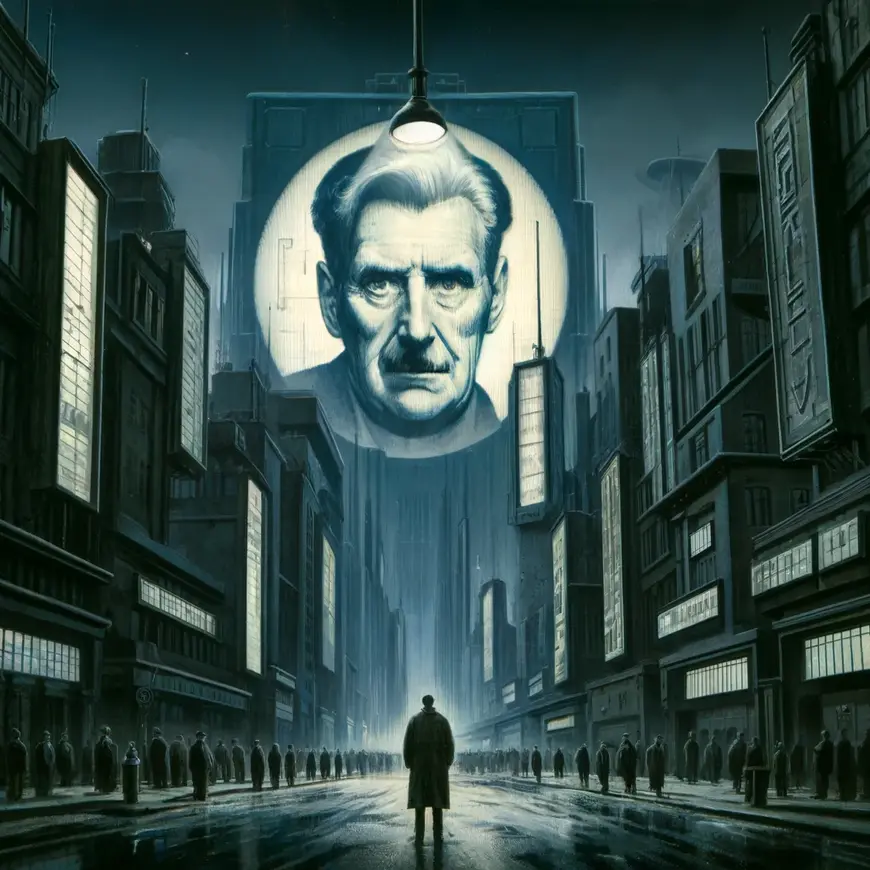
1984 does not begin with a battle or a public execution. It begins with a man doing paperwork for a lie. Winston Smith works in the Ministry of Truth, where old records are changed so the Party can always appear correct. The past is not remembered. It is repaired, adjusted and destroyed.
George Orwell builds the terror of the novel from this quiet labor. Winston does not only live under surveillance. He helps manufacture the reality that imprisons him. Every article he rewrites, every name he removes and every correction he makes turns history into Party property.
That is why the novel feels more severe than a simple dystopian warning. The regime in Oceania does not merely punish dissent. It attacks the conditions that make dissent possible. If facts can vanish, memory becomes fragile. If memory fails, a person stands alone against the official version of everything. The first battlefield in 1984 is the past. Winston’s rebellion begins not with a weapon, but with the dangerous suspicion that yesterday actually happened.
The novel appeared in 1949, but its force has not faded because the writer understood something deeper than technology. A system does not need to control every thought at once. It can begin by controlling the records people use to test their thoughts.
Oceania and the disappearance of shelter
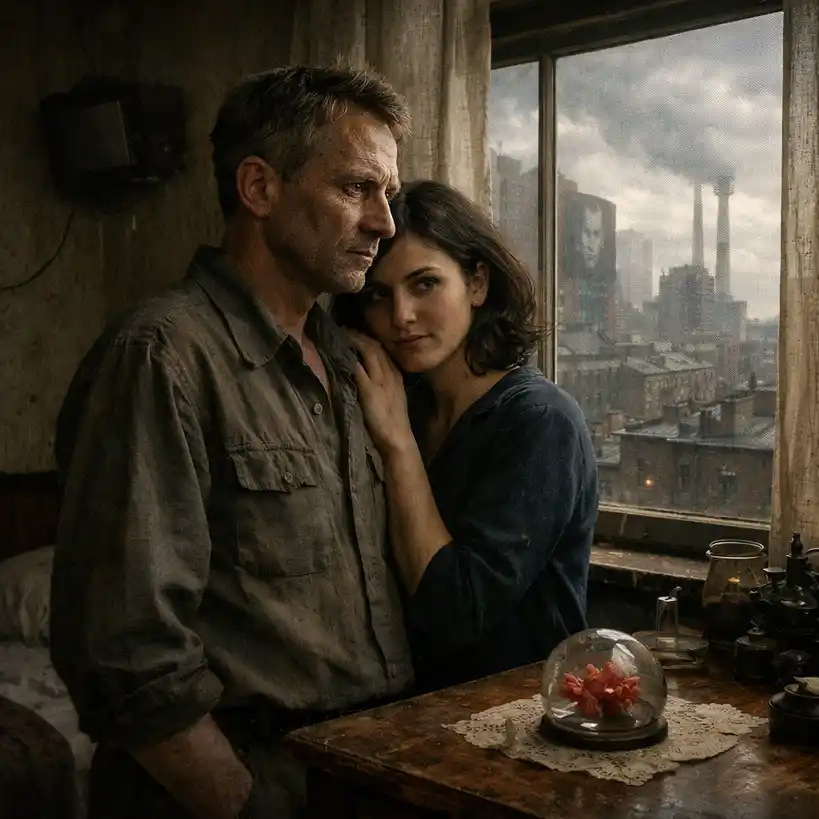
Oceania is frightening because it leaves almost no private space untouched. The telescreen watches, speaks and interrupts. Posters announce Big Brother’s presence. Children are trained to betray parents. Neighbors listen. Workplaces demand visible enthusiasm. Even a facial expression can become suspicious.
Yet this world is not only a surveillance state. It is a society designed to make solitude unsafe. Winston’s room, his diary, his memories of his mother and his desire for Julia all become risky because they suggest an inner life not fully owned by the Party.
The power of this world lies in its spread. It enters architecture, language, routine, family and appetite. A person cannot simply close the door and become free. Even the body becomes political, because fear changes posture, speech, sleep and desire.
Privacy disappears before the person disappears. That is the novel’s deepest social horror. The state does not only want obedience in public. It wants the citizen to lose the habit of inward independence.
A less obvious but useful comparison is 👉 The Method by Juli Zeh. Zeh imagines a system that turns health, discipline and social normality into instruments of control. His state is harsher and more openly totalitarian, but both works ask how power grows when institutions claim authority over the body.
Winston Smith is not built for heroism
Winston Smith matters because he is not a grand rebel. He is tired, physically weak, frightened and full of contradictions. His courage is real, but it is not clean. He hates the Party, yet he has served it for years. He wants truth, yet he barely knows how to trust his own memories. When he longs for freedom, but much of his rebellion begins as hunger, disgust and loneliness.
This makes him more convincing than a heroic symbol. Winston’s resistance starts in small, almost pathetic acts. He writes in a diary. And he remembers a fragment of a rhyme. He is moved by an old man’s face. So he desires Julia not only as a lover, but as proof that something can exist outside Party doctrine.
The genius is that he never lets Winston become larger than the world he inhabits. The system is bigger, colder and more patient. Winston’s rebellion has dignity, but it also has limits. He is brave enough to want the truth, but not strong enough to survive a machine built to break the relation between truth and self.
His weakness gives the novel its human weight. If Winston were fearless, the book would become a legend. Because he is afraid, it becomes a study of what fear can do to an ordinary mind.
Julia and the politics of pleasure
Julia is often treated as Winston’s lover, but she is more than that. Her rebellion is not theoretical. She does not dream of rewriting political history or exposing the Party’s lies. She wants to reclaim the body, the present and the right to private pleasure. That makes her resistance practical, sensual and limited.
For Winston, Julia becomes evidence that the Party has not conquered everything. Their meetings are dangerous because they create a small area of experience that is not officially approved. The rented room above Mr. Charrington’s shop feels precious not because it is truly safe, but because it allows them to imagine a life with ordinary objects, quiet conversation and physical tenderness.
Julia’s politics are not abstract, and that is exactly why they matter. The Party wants desire to serve reproduction, loyalty and hate. Julia turns desire back into personal choice. Her body refuses to become only state material. Pleasure becomes political when a regime fears private loyalty. Love, sex and memory threaten Oceania because they create attachments stronger than slogans.
This private revolt has a faint connection to 👉 Mario and the Magician by Thomas Mann. Mann studies manipulation, performance and submission before a controlling figure. This world is much larger, but both works understand that authoritarian power often begins by humiliating the will.
Newspeak and the narrowing of thought
Newspeak is one of his most frightening inventions because it does not merely rename the world. It reduces the range of what can be thought. A language with fewer words, fewer distinctions and fewer forbidden shades of meaning makes rebellion harder before punishment is even needed.
The Party’s aim is not only censorship. Censorship assumes that dangerous thoughts already exist and must be suppressed. Newspeak imagines something more radical: a future in which certain thoughts cannot form easily because the language needed for them has disappeared.
Doublethink works beside it. A citizen must accept contradictions, forget the act of forgetting and adapt instantly to whatever truth the Party currently requires. This is not ordinary hypocrisy. It is trained mental obedience. The Party wants language to stop being a refuge. If words no longer protect memory, judgment or contradiction, inner freedom begins to shrink.
Orwell makes this language politics concrete through Winston’s work. He sees facts altered and slogans repeated until truth becomes less a record than a command. The horror is not that people are forced to say false things. The deeper horror is that they may lose the ability to recognize falseness as falseness. That is why 1984 remains powerful wherever public language is abused. It shows that political violence can begin inside grammar, vocabulary and repetition.

O’Brien and the intelligence of cruelty
O’Brien is terrifying because he understands exactly what he is doing. He is not a dull official or a mere sadist. He is intelligent, patient and almost intimate in his cruelty. Winston is drawn to him because O’Brien seems to represent hidden understanding. That hope becomes the trap.
In the Ministry of Love, O’Brien reveals the Party’s deepest logic. Power is not a temporary means toward happiness, justice or peace. Power is the goal. The future he imagines is not a harmonious society, but endless domination. That makes him one of the coldest figures in modern political fiction.
The torture scenes are brutal not only because Winston suffers physically. They are brutal because O’Brien wants Winston’s inner surrender. It is not enough for Winston to confess. It is not enough for him to obey. He must accept the Party’s version of reality as truth. He must betray not only Julia, but the part of himself that once believed in independent perception.
O’Brien turns thought into occupied territory. He does not destroy Winston from outside alone. He forces Winston to participate in his own defeat.
Here 👉 The Spark of Life by Erich Maria Remarque offers a darker historical counterpoint. Remarque writes about human dignity under extreme totalitarian violence. His setting is fictional and ideological, but both books ask what remains of a person when power tries to reduce life to obedience.
Hate as a public ritual – An Ominous Vision
The Party does not rely on fear alone. It also organizes emotion. The Two Minutes Hate is one of the clearest examples. Citizens gather to direct rage at a chosen enemy, and the ritual allows private frustration to become public loyalty. Anger is not removed from society. It is managed.
This matters because Oceania is built on permanent emotional redirection. War may shift enemies. Statistics may change. Yesterday’s ally may become today’s target. What must remain constant is the habit of believing intensely on command.
Goldstein functions less as a person than as a container for hatred. He gives citizens something to despise, something to fear and something against which they can prove their purity. The Party turns emotional exhaustion into political energy. A controlled society needs controlled feelings. It must decide not only what people know, but what they love, fear, desire and hate.
This part of the novel is especially unsettling because the crowd does not feel artificial. The author shows how quickly individuals can be pulled into collective emotion, even when part of them resists. Winston himself is not immune. That is crucial. The novel does not place manipulation only in the weak or foolish. It shows that mass feeling can enter almost anyone when fear, repetition and belonging align.
Famous Quotes from 1984
- “Big Brother is watching you.” – This quote has become synonymous with the concept of an overly intrusive government or authority keeping a close eye on its citizens.
- “War is peace. Freedom is slavery. Ignorance is strength.” – Part of the Party’s slogan, this quote epitomizes the use of doublethink and the paradoxical acceptance of contradictory beliefs.
- “If you want to keep a secret, you must also hide it from yourself.” – This reflects the extreme measures taken to control thoughts and the concept of thoughtcrime.
- “Doublethink means the power of holding two contradictory beliefs in one’s mind simultaneously, and accepting both of them.” – It explains how the citizens of Oceania are able to accept the Party’s changing truths and contradictions without question.
- “Until they became conscious they will never rebel, and until after they have rebelled they cannot become conscious.” – This catch-22 reflects the difficulty of awakening from the manipulation of the Party.
- “Freedom is the freedom to say that two plus two make four. If that is granted, all else follows.” – A statement on the importance of objective truth and its role as a foundation for freedom.
- “Who controls the past controls the future. Who controls the present controls the past.” – This underscores the Party’s manipulation of history to maintain its power.
Trivia Facts about 1984
- Inspired by Real-World Events: His experiences during the Spanish Civil War, his observations of Stalinist Russia, and the aftermath of World War II heavily influenced the themes and concepts in the book.
- Health: The author was battling tuberculosis while writing his novel, and he wrote much of the novel on the remote Scottish island of Jura, despite his declining health.
- The Title’s Origin: The title 1984 is believed to have been derived from a simple inversion of the last two digits of the year it was completed, 1948. He initially intended to title it “The Last Man in Europe,” but his publisher suggested a more marketable title.
- Big Brother: The concept of “Big Brother” has entered the lexicon as a synonym for abusive government surveillance.
- Newspeak: In fact the author created the language “Newspeak” as a means of controlling thought through language. Its purpose was to diminish the range of thought by cutting down the complexity of the language.
- Orwellian: Indeed the term has come to describe any oppressive or manipulative social condition echoing the dystopian characteristics of Nineteeneightyfour.
- Room 101: The infamous Room 101, where prisoners are confronted with their worst fears, is a metaphor for places where unpleasant things are done or where people are subjected to interrogation and torture. In fact, the room number is from conference room at the BBC where the writer sat through tedious meetings.
Why 1984 feels less like prophecy than diagnosis
1984 is often praised as prophetic, but that can flatten its achievement. The writer did not simply predict screens, surveillance or political lies. He diagnosed patterns of power that can appear in different technologies, parties and historical moments. The novel remains alive because it is not tied to one device or one regime.
Its central question is still urgent: what happens when truth becomes whatever power can enforce? From that question, everything else follows. History becomes unstable. Language becomes thinner. Love becomes dangerous. Privacy becomes suspicious. The body becomes evidence. Fear becomes a method of education.
👉 The Martian Chronicles by Ray Bradbury belongs to another kind of speculative fiction, but it shares his concern with civilization, memory and the stories societies tell to justify themselves. Bradbury looks outward to Mars and cultural loss. The novelist looks inward to the machinery of domination.
The lasting force of 1984 lies in its attack on reality itself. A dictatorship in the novel does not merely want subjects who obey. It wants people who can be made to deny what they have seen, remember what never happened and love what has destroyed them.
That is why the ending remains so devastating. Winston does not simply lose a political struggle. He loses the inner place from which struggle could begin. His final cruelty is not death. It is survival after surrender.
My Findings from 1984 – The Dystopian Depths
Reading this famous novel profoundly changed my views on freedom and privacy. Inhabiting an atmosphere where every aspect of life was under surveillance, set in the oppressive world of Oceania, this book cut to the quick with its timely themes.
Its main character, Winston Smith, personified the struggle to carry on human language against the absolute domination of totalitarian control, reminding one of the haunting narrative that terminates with a bleak reminder of the catastrophic effects wreaked by authoritarianism.
Every time I finish some book, I remind me how many liberties we have and those that need to be kept. The book is, in my opinion, not just good literature but some sort of alert-sounding call.
Other Reviews of Works by the famous novelist