Nobel Prize in Literature Winners: The Complete List
The most recent Nobel Prize in Literature winner is Anne Carson, who received the 2026 prize “for her bold and inventive oeuvre”. From 1901 through 2026, the Nobel Prize in Literature was awarded 119 times to 123 laureates. Four prizes were shared by two writers, while no award was made in seven years.
This complete list covers every award year and every laureate. It also explains the missing years, the women who have won, notable records and the confidential selection process. The 2026 Nobel Prize in Literature was announced on 8 October 2026.
| Fact | Answer |
|---|---|
| First laureate | Sully Prudhomme, 1901 |
| Most recent laureate | László Krasznahorkai, 2025 |
| Prizes awarded | 119 |
| Individual laureates | 123 |
| Women laureates | 19 |
| Shared prizes | 4 |
| Years without an award | 7 |
| Youngest laureate | Rudyard Kipling, 41 |
| Oldest laureate | Doris Lessing, 87 |
| 2025 prize amount | 11 million Swedish kronor |
2026 – 2006
| Year | Laureate | Famous Works |
|---|---|---|
| 2026 | Anne Carson | Autobiography of Red, Eros the Bittersweet |
| 2025 | László Krasznahorkai | Satantango; The Melancholy of Resistance |
| 2024 | Han Kang | The Vegetarian; Greek Lessons |
| 2023 | Jon Fosse | Melancholy, The Other Name: Septology I II |
| 2022 | Annie Ernaux | The Years; La Place |
| 2021 | Abdulrazak Gurnah | Paradise; Gravel Heart |
| 2020 | Louise Glück | The Wild Iris; Averno |
| 2019 | Peter Handke | The Goalie’s Anxiety at the Penalty Kick; Offending the Audience |
| 2018 | Olga Tokarczuk | The Books of Jacob; Flights |
| 2017 | Kazuo Ishiguro | The Remains of the Day; Never Let Me Go |
| 2016 | Bob Dylan | Like a Rolling Stone; Highway 61 Revisited (lyrics from the albums) |
| Year | Laureate | Famous Works |
|---|---|---|
| 2015 | Svetlana Alexievich | Voices from Chernobyl; War’s Unwomanly Face |
| 2014 | Patrick Modiano | Missing Person; Dora Bruder |
| 2013 | Alice Munro | Too Much Happiness; Dear Life |
| 2012 | Mo Yan | Red Sorghum; Big Breasts and Wide Hips |
| 2011 | Tomas Tranströmer | The Sorrow Gondola; Baltics |
| 2010 | Mario Vargas Llosa | The Green House, The Time of the Hero, Captain Pantoja and the Special Service |
| 2009 | Herta Müller | The Land of Green Plums; The Hunger Angel |
| 2008 | J. M. G. Le Clézio | Désert; Le Procès-verbal |
| 2007 | Doris Lessing | The Golden Notebook; The Good Terrorist |
| 2006 | Orhan Pamuk | My Name Is Red; Snow |
2005 – 1986
| Year | Laureate | Famous Works |
|---|---|---|
| 2005 | Harold Pinter | The Caretaker; The Birthday Party |
| 2004 | Elfriede Jelinek | The Piano Teacher; Women as Lovers |
| 2003 | J. M. Coetzee | Life & Times of Michael K; Disgrace |
| 2002 | Imre Kertész | Fatelessness; Liquidation |
| 2001 | V. S. Naipaul | A House for Mr Biswas; In a free State |
| 2000 | Gao Xingjian | Soul Mountain; The Other Shore |
| 1999 | Günter Grass | The Tin Drum; Crabwalk; The Flounder; Dog Years |
| 1998 | José Saramago | Blindness; The Gospel According to Jesus Christ |
| 1997 | Dario Fo | Accidental Death of an Anarchist; Mistero Buffo |
| 1996 | Wisława Szymborska | Cat in an Empty Apartment |
| Year | Laureate | Famous Works |
|---|---|---|
| 1995 | Seamus Heaney | Death of a Naturalist; District and Circle |
| 1994 | Kenzaburō Ōe | A Personal Matter; The Silent Cry |
| 1993 | Toni Morrison | Beloved; The Bluest Eye |
| 1992 | Derek Walcott | Omeros; The Capeman |
| 1991 | Nadine Gordimer | Burger’s Daughter; The Conservationist |
| 1990 | Octavio Paz | El laberinto de la soledad; El arco y la lira |
| 1989 | Camilo José Cela | The Family of Pascual Duarte; The Hive |
| 1988 | Naguib Mahfouz | Children of Gebelawi; Midaq Alley |
| 1987 | Joseph Brodsky | Gorbunov and Gorchakov; A Part of Speech |
| 1986 | Wole Soyinka | Chronicles from the Land of the Happiest People on Earth |
1985 – 1966
| Year | Laureate | Famous Works |
|---|---|---|
| 1985 | Claude Simon | The Palace; Blind Orion |
| 1984 | Jaroslav Seifert | Morový sloup; Všecky krásy světa |
| 1983 | William Golding | Lord of the Flies; The Spire; The Paper Men |
| 1982 | Gabriel García Márquez | One Hundred Years of Solitude; Love in the Time of Cholera |
| 1981 | Elias Canetti | Auto-da-Fé; Crowds and Power |
| 1980 | Czesław Miłosz | The Captive Mind; A Treatise on Poetry |
| 1979 | Odysseas Elytis | Axion Esti; Orientations |
| 1978 | Isaac Bashevis Singer | The Magician of Lublin; Meshugah |
| 1977 | Vicente Aleixandre | Sombra del paraíso; La destrucción o el amor |
| 1976 | Saul Bellow | Herzog; The Adventures of Augie March; Ravelstein |
| Year | Laureate | Famous Works |
|---|---|---|
| 1975 | Eugenio Montale | Ossi di seppia; Le occasioni |
| 1974 | Eyvind Johnson and Harry Martinson | Johnson: Grupp Krilon Harry Martinson: Aniara |
| 1973 | Patrick White | Voss; The Tree of Man |
| 1972 | Heinrich Böll | The Lost Honor of Katharina Blum; The Clown |
| 1971 | Pablo Neruda | Canto General; Ode to the Cat |
| 1970 | Aleksandr Solzhenitsyn | The Gulag Archipelago; One Day in the Life of Ivan Denisovich |
| 1969 | Samuel Beckett | Waiting for Godot; Endgame |
| 1968 | Yasunari Kawabata | Snow Country; Thousand Cranes |
| 1967 | Miguel Ángel Asturias | Leyendas de Guatemala; Mulata de tal |
| 1966 | Shmuel Yosef Agnon and Nelly Sachs | Sachs: In den Wohnungen des Todes Agnon: The Bridal Canopy |
1965 – 1946
| Year | Laureate | Famous Works |
|---|---|---|
| 1965 | Mikhail Sholokhov | And Quiet Flows the Don; Fate of a Man |
| 1964 | Jean-Paul Sartre (rejected) | Nausea; No Exit |
| 1963 | Giorgos Seferis | Strophe; Mythistorema |
| 1962 | John Steinbeck | The Grapes of Wrath; Of Mice and Men |
| 1961 | Ivo Andrić | The Bridge on the Drina; Bosnian Chronicle |
| 1960 | Saint-John Perse | Amers; Anabase |
| 1959 | Salvatore Quasimodo | Lirici greci; Ed è subito sera |
| 1958 | Boris Pasternak | Doctor Zhivago; My Sister, Life |
| 1957 | Albert Camus | The Stranger; The Plague |
| 1956 | Juan Ramón Jiménez | Platero y yo |
| Year | Laureate | Famous Works |
|---|---|---|
| 1955 | Halldór Laxness | Sjálfstætt fólk; Íslandsklukkan |
| 1954 | Ernest Hemingway | The old man and the sea; Fiesta |
| 1953 | Winston Churchill | The Second World War |
| 1952 | François Mauriac | Thérèse Desqueyroux; Vipers’ Tangle |
| 1951 | Pär Lagerkvist | Barabbas; Dvärgen |
| 1950 | Bertrand Russell | Principia Mathematica; A History of Western Philosophy |
| 1949 | William Faulkner | The Sound and the Fury; Light in August |
| 1948 | T. S. Eliot | The Waste Land; Four Quartets |
| 1947 | André Gide | The Counterfeiters; The Immoralist |
| 1946 | Hermann Hesse | Siddhartha; Steppenwolf |
1945 – 1926
| Year | Laureate | Famous Works |
|---|---|---|
| 1945 | Gabriela Mistral | Winepress; Tenderness |
| 1944 | Johannes V. Jensen | The Fall of the King; Stories from Himmerland |
| 1943 | Not awarded | – |
| 1942 | Not awarded | – |
| 1941 | Not awarded | – |
| 1940 | Not awarded | – |
| 1939 | Frans Eemil Sillanpää | Hurskas kurjuus; Nuorena nukkunut |
| 1938 | Pearl S. Buck | The Good Earth; East Wind: West Wind |
| 1937 | Roger Martin du Gard | The Thibaults; Jean Barois |
| 1936 | Eugene O’Neill | Mourning Becomes Electra; All God’s Chillun Got Wings |
| Year | Laureate | Famous Works |
|---|---|---|
| 1935 | Not awarded | – |
| 1934 | Luigi Pirandello | Six Characters in Search of an Author; Henry IV |
| 1933 | Ivan Bunin | The Village; The Life of Arseniev |
| 1932 | John Galsworthy | The Forsyte Saga; Strife |
| 1931 | Erik Axel Karlfeldt | Fridolins visor; Flora och Pomona |
| 1930 | Sinclair Lewis | It Can’t Happen Here; Babbitt |
| 1929 | Thomas Mann | Buddenbrooks; Death in Venice |
| 1928 | Sigrid Undset | Kristin Lavransdatter; Jenny |
| 1927 | Henri Bergson | Essai sur les données immédiates de la conscience; L’Évolution créatrice |
| 1926 | Grazia Deledda | Canne al vento; Elias Portolu |
1925 – 1901
| Year | Laureate | Famous Works |
|---|---|---|
| 1925 | George Bernard Shaw | Pygmalion; Saint Joan |
| 1924 | Władysław Reymont | The Peasants; The Promised Land |
| 1923 | William Butler Yeats | The Tower; The Wild Swans at Coole |
| 1922 | Jacinto Benavente | Los intereses creados; La malquerida |
| 1921 | Anatole France | Thaïs; The Gods Are Athirst |
| 1920 | Knut Hamsun | Growth of the Soil; Hunger |
| 1919 | Carl Spitteler | Olympian Spring; Unser Schweizer Standpunkt |
| 1918 | Not awarded | – |
| 1917 | Karl Adolph Gjellerup and Henrik Pontoppidan | Pontoppidan: Lykke-Per Gjellerup: Der Pilger Kamanita |
| 1916 | Verner von Heidenstam | Karolinerna; Folkungaträdet |
| 1915 | Romain Rolland | Jean-Christophe; Péguy |
| 1914 | Not awarded | – |
| 1913 | Rabindranath Tagore | Gitanjali; Gora |
| Year | Laureate | Famous Works |
|---|---|---|
| 1912 | Gerhart Hauptmann | The Weavers; The Rats |
| 1911 | Maurice Maeterlinck | Pelléas and Mélisande; The Blue Bird |
| 1910 | Paul Heyse | L’Arrabbiata; Kinder der Welt |
| 1909 | Selma Lagerlöf | The Wonderful Adventures of Nils; Gösta Berlings Saga |
| 1908 | Rudolf Eucken | Geistige Strömungen der Gegenwart; Der Sinn und Wert des Lebens |
| 1907 | Rudyard Kipling | If—; The Jungle Book |
| 1906 | Giosuè Carducci | Odi barbare; Rime nuove |
| 1905 | Henryk Sienkiewicz | Quo Vadis; With Fire and Sword |
| 1904 | Frédéric Mistral and José Echegaray | Frédéric Mistral: Mirèio; Lou Tresor dóu Felibrige José Echegaray: El gran Galeoto; Mariana |
| 1903 | Bjørnstjerne Bjørnson | Synnøve Solbakken; En fallit |
| 1902 | Theodor Mommsen | The History of Rome; Corpus Inscriptionum Latinarum |
| 1901 | Sully Prudhomme | Stances et Poèmes; Le Bonheur |
What is the Nobel Prize in Literature?
The Nobel Prize in Literature is one of the five original Nobel Prizes. Alfred Nobel, the inventor of dynamite, established it in his will in 1895. The Nobel Prizes are awarded annually. They recognize outstanding achievements in Physics, Chemistry, Medicine, Literature, Peace, and Economic Sciences.
The laureate’s name is announced every October. The Nobel Prize in Literature celebrates literature’s power to explore and illuminate the human experience. It addresses important themes, creativity, and cultural impact.
Nominations for the Nobel Prize in Literature are typically submitted by a select group of qualified individuals and institutions. Unlike the Peace Prize, which has a broader nomination pool, the Literature Prize has a more restricted process.
The primary nominators for the Nobel Prize in Literature include:
- Members of the Swedish Academy: The Swedish Academy, responsible for selecting the laureates for the Literature Prize, consists of 18 life-elected members. These members are usually prominent figures in literature, linguistics, and related fields.
- Previous Laureates: Past recipients of the Nobel Prize in Literature sometimes submit nominations for future laureates.
- Permanent Secretaries of National Academies: Certain national academies, especially those focusing on literature and culture, can submit nominations.
Who won the 2025 Nobel Prize in Literature?
Hungarian author László Krasznahorkai won the 2025 Nobel Prize in Literature. The Swedish Academy recognised an imaginative and visionary body of work in which catastrophic worlds are repeatedly met by the sustaining force of art.
Krasznahorkai is known for demanding, darkly comic novels, very long sentences and a Central European tradition often associated with Franz Kafka and Thomas Bernhard. Useful starting points include Satantango, The Melancholy of Resistance and Baron Wenckheim’s Homecoming. His award made him the second Hungarian literature laureate after Imre Kertész in 2002.
Which women have won the Nobel Prize in Literature?
Nineteen women had received the literature prize by the end of 2026. Selma Lagerlöf was the first woman laureate, in 1909. Anne Carson, awarded in 2026, is the most recent.
- Selma Lagerlöf, 1909
- Grazia Deledda, 1926
- Sigrid Undset, 1928
- Pearl Buck, 1938
- Gabriela Mistral, 1945
- Nelly Sachs, 1966
- Nadine Gordimer, 1991
- Toni Morrison, 1993
- Wisława Szymborska, 1996
- Elfriede Jelinek, 2004
- Doris Lessing, 2007
- Herta Müller, 2009
- Alice Munro, 2013
- Svetlana Alexievich, 2015
- Olga Tokarczuk, 2018
- Louise Glück, 2020
- Annie Ernaux, 2022
- Han Kang, 2024
- Anne Carson, 2026
Which years had no literature prize?
The Nobel Prize in Literature was not awarded in 1914, 1918, 1935, 1940, 1941, 1942 and 1943. Most of these gaps coincide with the two world wars. Under the Nobel statutes, a prize may also be reserved or withheld if no nominated work is judged to meet the required standard.
The 2018 award is a different case. It was postponed during a crisis at the Swedish Academy and announced in 2019, when Olga Tokarczuk received the 2018 prize and Peter Handke the 2019 prize.
When has the prize been shared?
The Swedish Academy has divided the Nobel Prize in Literature between two laureates on four occasions:
- 1904: Frédéric Mistral and José Echegaray
- 1917: Karl Adolph Gjellerup and Henrik Pontoppidan
- 1966: Shmuel Yosef Agnon and Nelly Sachs
- 1974: Eyvind Johnson and Harry Martinson
No writer has won the Nobel Prize in Literature twice.
Youngest, oldest and other unusual laureates
Rudyard Kipling remains the youngest literature laureate. He was 41 when he received the prize in 1907. At 87, Doris Lessing became the oldest literature laureate when the Swedish Academy announced her 2007 award.
Erik Axel Karlfeldt received the 1931 prize after his death and remains the only posthumous literature laureate. Boris Pasternak initially accepted the 1958 prize, but Soviet authorities later forced him to decline it. Jean-Paul Sartre declined the 1964 prize because he consistently refused official honours. Both Pasternak and Sartre remain Nobel laureates in the official record.
Winston Churchill won in 1953 for historical and biographical writing as well as oratory, not for political office. Bob Dylan’s 2016 award recognised his contribution to poetic expression within the American song tradition.
What does the Nobel Prize in Literature recognise?
Alfred Nobel’s 1895 will established prizes for work that had conferred the greatest benefit on humankind. The Swedish Academy generally honours an author’s overall body of work with the literature prize, although the official motivation may highlight a particular book or aspect of that work.
The prize can recognise fiction, poetry, drama, essays, historical writing and other literary forms. The Swedish Academy decides the laureate. The award includes a medal, a diploma and a financial prize. The full 2025 prize was worth 11 million Swedish kronor.
Writers may be born in one country, write in another language and hold another citizenship when they receive the award. Historical states and dual nationality create further differences. That is why this main list uses the official award year and laureate name rather than pretending that every writer belongs to one uncontested national category.
How are Nobel literature laureates nominated and selected?
The process begins with confidential invitations to qualified nominators. They include members of the Swedish Academy and comparable academies, professors of literature and language, previous literature laureates and presidents of representative writers’ organisations. Writers cannot nominate themselves.
The Nobel Committee for Literature evaluates the valid nominations and gradually reduces the field. The Academy studies a final shortlist and votes in the autumn. A candidate must receive more than half of the votes cast to become the laureate. The result is normally announced in October, while the medal and diploma are presented on 10 December, the anniversary of Alfred Nobel’s death.
Names of current nominees are not public. Nomination records and deliberations remain secret for 50 years, so annual lists of “official favourites” are speculation rather than a disclosed shortlist.
Where should you start reading Nobel laureates?
The complete winners list is also a map of very different literary traditions. These eight authors offer accessible routes into the archive:
- Jon Fosse uses repetition, silence and spiritual concentration in works such as Septology.
- Mario Vargas Llosa combines political conflict with complex narrative architecture.
- Gabriel García Márquez transformed the international reach of magical realism.
- Toni Morrison examines memory, history and the afterlife of slavery with exceptional lyric force.
- José Saramago builds philosophical fables through long, flowing sentences and moral pressure.
- Heinrich Böll portrays postwar Germany through moral clarity, satire and close social observation.
- Pablo Neruda ranges from intimate love poetry to large-scale historical and political verse.
Which other Nobel Prizes exist?
- Nobel Prize in Physics: Awarded for significant contributions to the field of physics.
- Nobel Prize in Chemistry: Presented to individuals who have made outstanding contributions to the field of chemistry, including discoveries and developments that have led to a deeper understanding of the properties and interactions of matter.
- Nobel Prize in Physiology or Medicine: Recognizes individuals who have made exceptional contributions to the field of medicine or medical research.
- Nobel Peace Prize: Awarded to individuals, organizations, or movements that have made significant contributions to the promotion of peace, the resolution of conflicts, and the prevention of war.
- Sveriges Riksbank Prize in Economic Sciences in Memory of Alfred Nobel (Nobel Prize in Economics): This prize, though not one of the original Nobel Prizes established by Alfred Nobel, is about contributions to the field of economics.
- Nobel Memorial Prize in Economic Sciences: Referred to as the Nobel Prize in Economics and the Award is in the same manner and at the same time as the other Nobel Prizes.
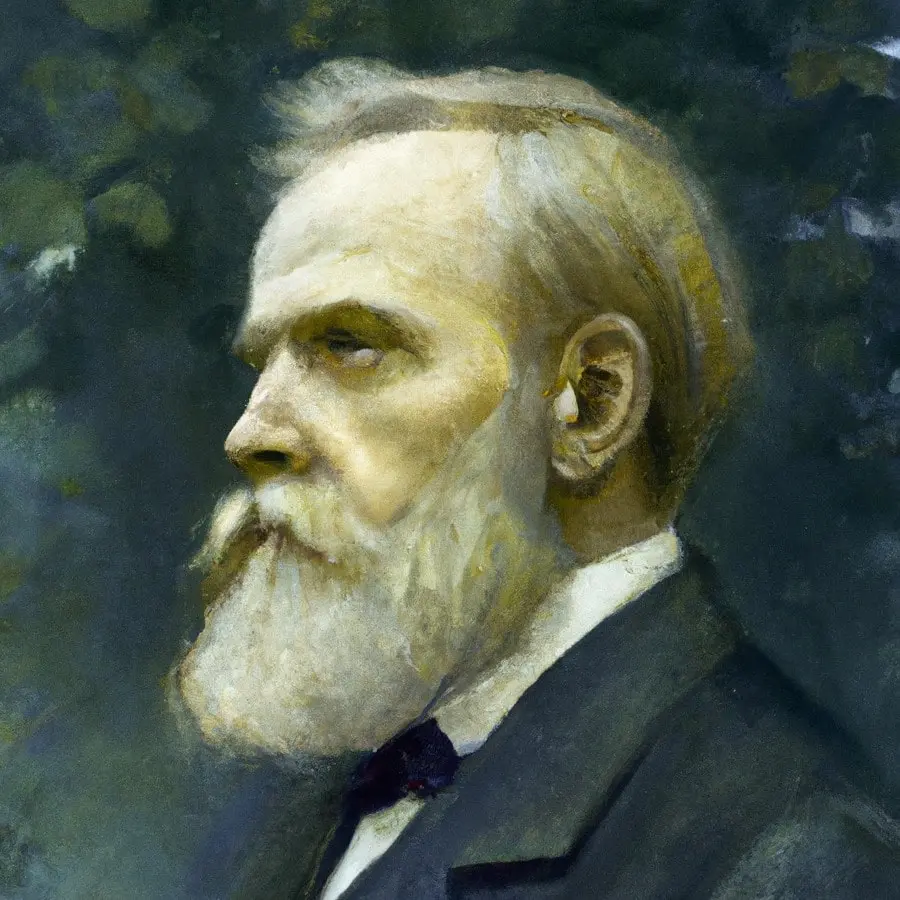
Alfred Nobel: The Man Behind the Nobel Prizes
Alfred Nobel, a Swedish chemist, engineer, and inventor, is famous for inventing dynamite and establishing the Nobel Prizes. Born on October 21, 1833, in Stockholm, Sweden, Nobel’s life showcased remarkable achievements in science, technology, and philanthropy.
Curriculum Vitae:Like his father, Immanuel Nobel, was a prominent inventor and engineer. Lastly this environment sparked Alfred’s interest in science and technology. Finally Nobel’s education was diverse and international. Furthermore he received his primary education from private tutors and later attended schools across Europe. His family’s frequent relocations, due to his father’s business ventures, exposed him to different cultures and languages, broadening his intellectual horizons.
Career: In addition Nobel’s career featured numerous innovations and inventions. He held 355 different patents during his lifetime, with the most notable being dynamite, invented in 1867. Dynamite revolutionized construction and mining industries worldwide, as it was a safer and more stable explosive than previous alternatives. However this invention brought Nobel fame and considerable wealth. In addition to dynamite, Nobel developed other important inventions, including a blasting cap, a detonator, and a more stable nitroglycerin-based explosive.
Nobel’s Philanthropic Legacy: Furthermore one remarkable aspect of Alfred Nobel’s life was his dedication to philanthropy. In his last will, dated November 27, 1895, Nobel left most of his vast fortune to establish the Nobel Prizes. Additionally Nobel wanted to contribute positively to humanity and leave a lasting legacy beyond his inventions.
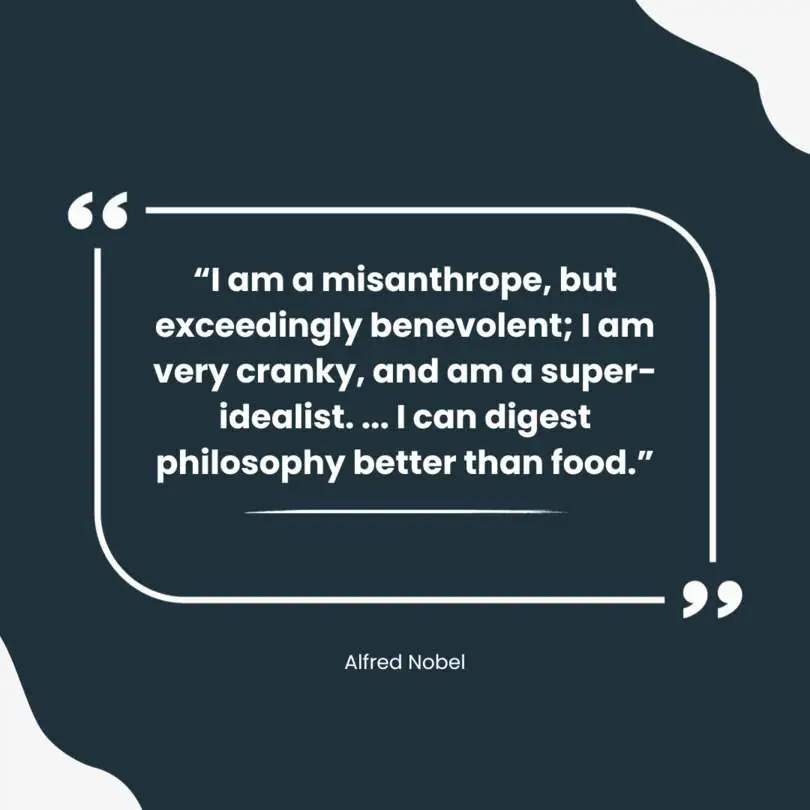
Alfred Nobels love for Literature: Alfred Nobel, known for his scientific achievements and the Nobel Prizes, also loved literature. This passion added depth to his personality finally. While his scientific work shaped his public identity, literature was a significant part of his private life. Moreover, Nobel was not just a reader. Besides he wrote poetry and plays. His literary works often reflected his philosophical and contemplative nature, however.
Why did Alfred Nobel established the Nobel prizes?
Alfred Nobel established the Nobel Prizes in his last will and testament primarily for several reasons:
- Humanitarian Concerns: However Nobel worried about the destructive potential of his inventions, like dynamite. Definitely he wanted to leave a positive legacy to counterbalance these negative uses.
- Promoting Peace: Nobel, a well-known pacifist, witnessed the devastating effects of warfare for sure, such as the Crimean War and the Franco-Prussian War.
- Recognizing Human Achievement: Nobel valued science, literature, and culture equally important. He believed recognizing exceptional contributions in these fields would motivate further advancements.
- Encouraging Progress in Key Areas: Firstly Nobel established prizes in categories like physics, chemistry, medicine, literature, and peace to incentivize progress in these crucial domains.
- Fostering International Cooperation: However Nobel’s will specified awarding prizes without regard to nationality, encouraging global cooperation among scholars, scientists, and peace advocates.
Frequently asked questions
Who is the latest Nobel Prize in Literature winner? László Krasznahorkai is the latest laureate. He received the 2025 Nobel Prize in Literature.
How many people have won the Nobel Prize in Literature? There were 122 individual laureates from 1901 through 2025. The prize was awarded 118 times because four awards were shared.
Has anyone won the Nobel Prize in Literature twice? No. Every literature laureate has received the prize once.
Is the Nobel Prize in Literature awarded for one book? Usually not. It generally recognises an author’s body of work, although the official motivation can highlight an especially important work.
Who chooses the literature laureate? The Swedish Academy chooses the laureate after a confidential nomination and review process.