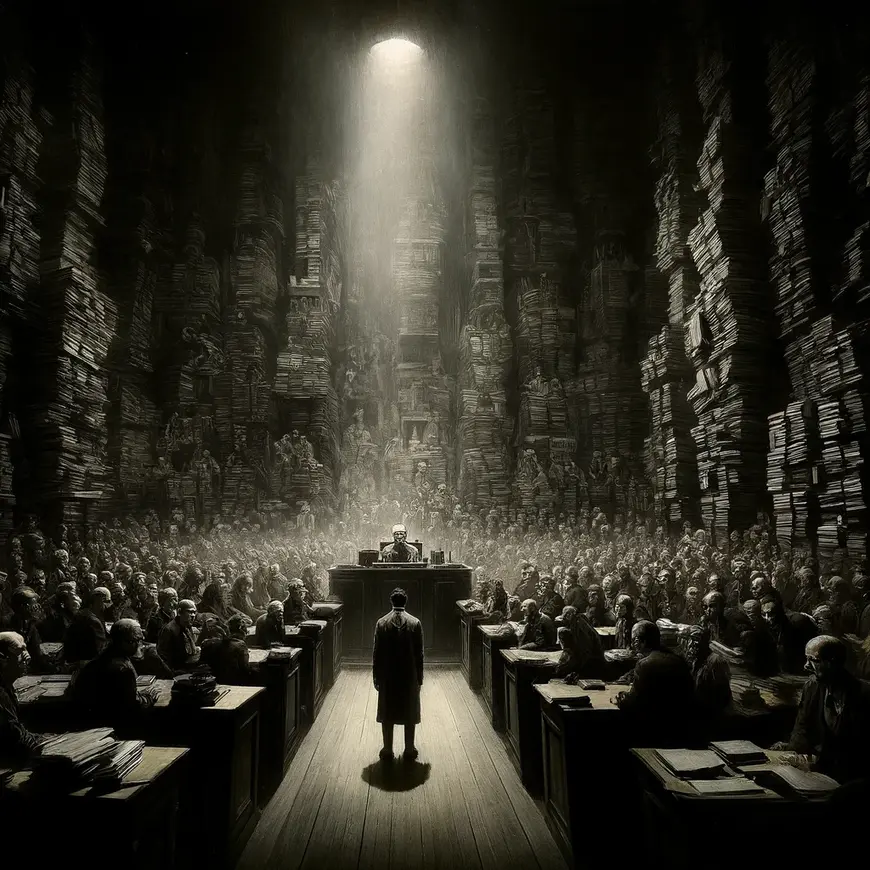
A Hunger Artist by Franz Kafka – Fasting as Spectacle
At first glance, A Hunger Artist reads like a strange little parable. A man sits in a cage and fasts, watched by crowds, admired, ignored, and finally forgotten. But the story by Franz Kafka is never just about what’s happening. It’s about what’s haunting the silence behind it.
The hunger artist claims he can fast longer than anyone allows. But this isn’t a record to break, it’s a form of devotion. Or perhaps punishment. Or maybe both. His act becomes a performance no one truly understands, least of all himself. The author doesn’t explain the his motivations. He simply lets them twist, tighten, and collapse.
Published in 1922, the work arrived at the end of his life, during a period when he was physically ill, increasingly isolated, and obsessed with communication and failure. That context matters. This isn’t a story about fasting. It’s a story about being seen, and being misread.
The hunger artist’s cage becomes a strange kind of spiritual confessional, where the audience thinks it’s witnessing greatness, but actually watches a man slide toward meaninglessness. His suffering is real, but also staged. The public applauds, but it doesn’t care. And when interest fades, so does he.
This double reality, of truth and theater, makes the story echo works like The Prime of Miss Jean Brodie by Muriel Spark, where performance masks instability. The writer, though, strips it down to silence. No climax. No release. Just hunger, in all its forms.
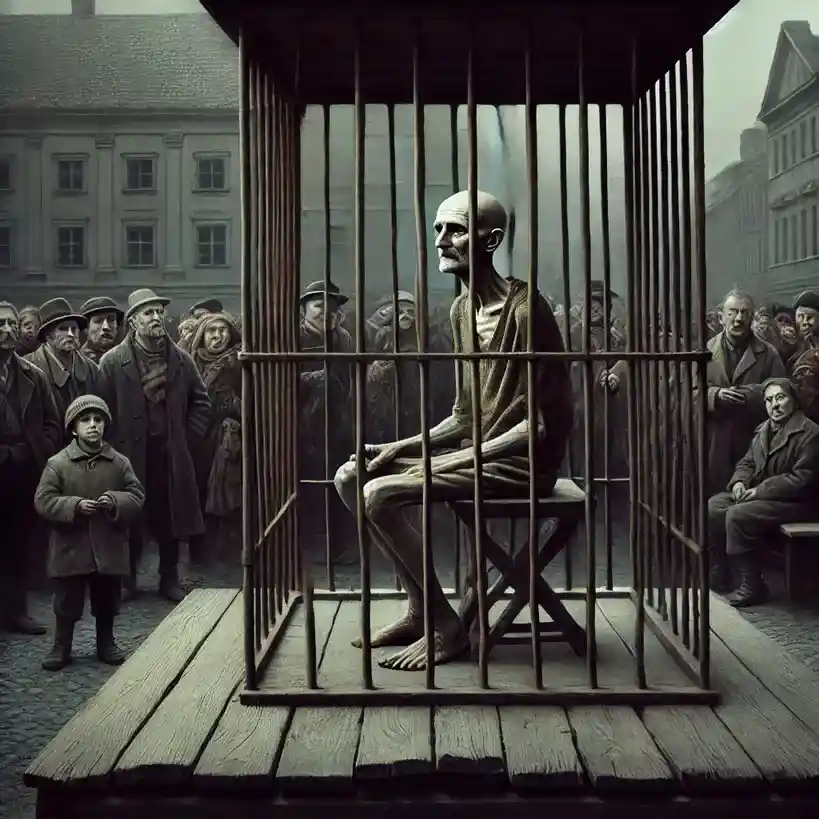
What Kafka Leaves Unsaid – A Hunger Artist
With Kafka, what matters most is often what’s missing. In A Hunger Artist, we never hear the crowd’s full reaction. We don’t get a detailed history. The hunger artist’s thoughts are never fully trusted. This is his genius, he builds mystery by withholding clarity.
There’s no clear reason why the actor fasts. He doesn’t protest. He doesn’t explain. When he finally does speak, near the end, his confession is heartbreaking, but also cryptic: “Because I couldn’t find the food I liked.” It’s simple. And devastating. The line hints at deep emotional hunger, a yearning for something more than food, applause, or recognition.
This is the moment the novelist turns the story inward. What if the hunger isn’t physical at all? What if his emptiness is a metaphor for spiritual hunger, creative despair, or existential loneliness? Suddenly, the cage becomes a mind. The bars, thoughts. And the audience? Perhaps us, the readers, failing to understand what we witness.
That’s what gives the novel its chilling power. The author refuses to moralize or explain. He simply lays bare a condition of being misunderstood. This silence, this failure to connect, is echoed in works like 👉 The Book of Disquiet by Fernando Pessoa, where inner turmoil unfolds without comfort.
He doesn’t invite empathy. He forces us to confront distance, the distance between effort and meaning, between the protagonist and audience. It’s not the hunger that disturbs.
Kafka’s Fractured Path to the Cage
To understand the despair of A Hunger Artist, it helps to trace Kafka’s own journey into silence. By the time this story was written, he was battling tuberculosis and watching his voice, both literal and literary, vanish. He had already burned drafts, withdrawn publications, and insisted in his will that his remaining work be destroyed. The book emerged from that space of doubt, decay, and distance.
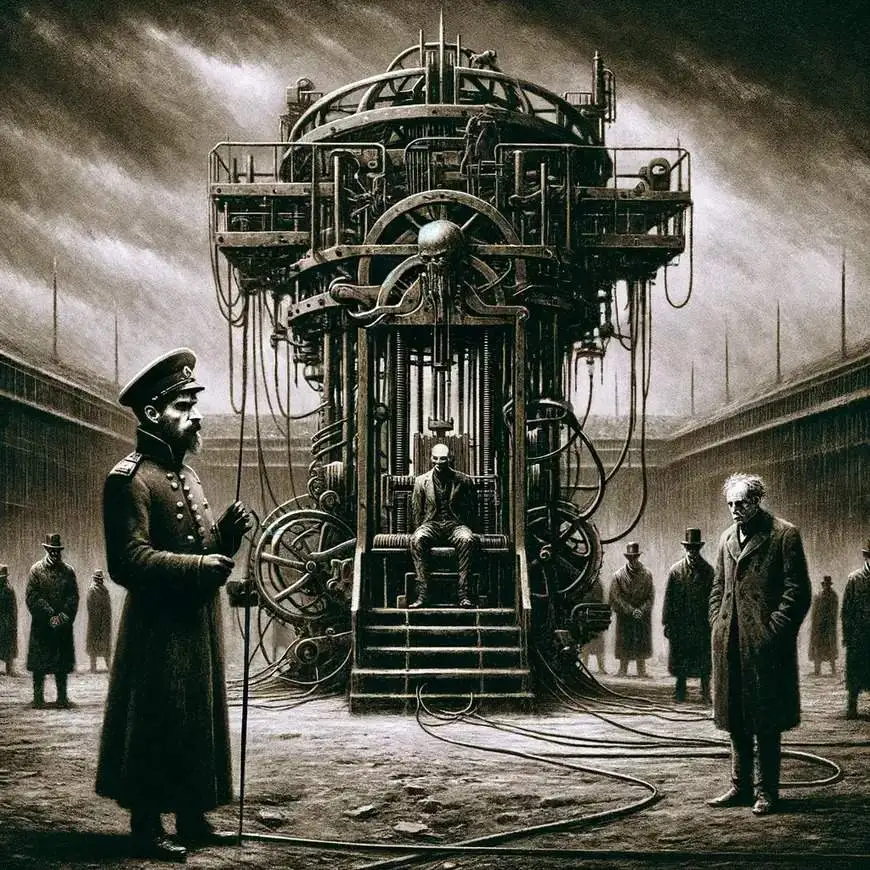
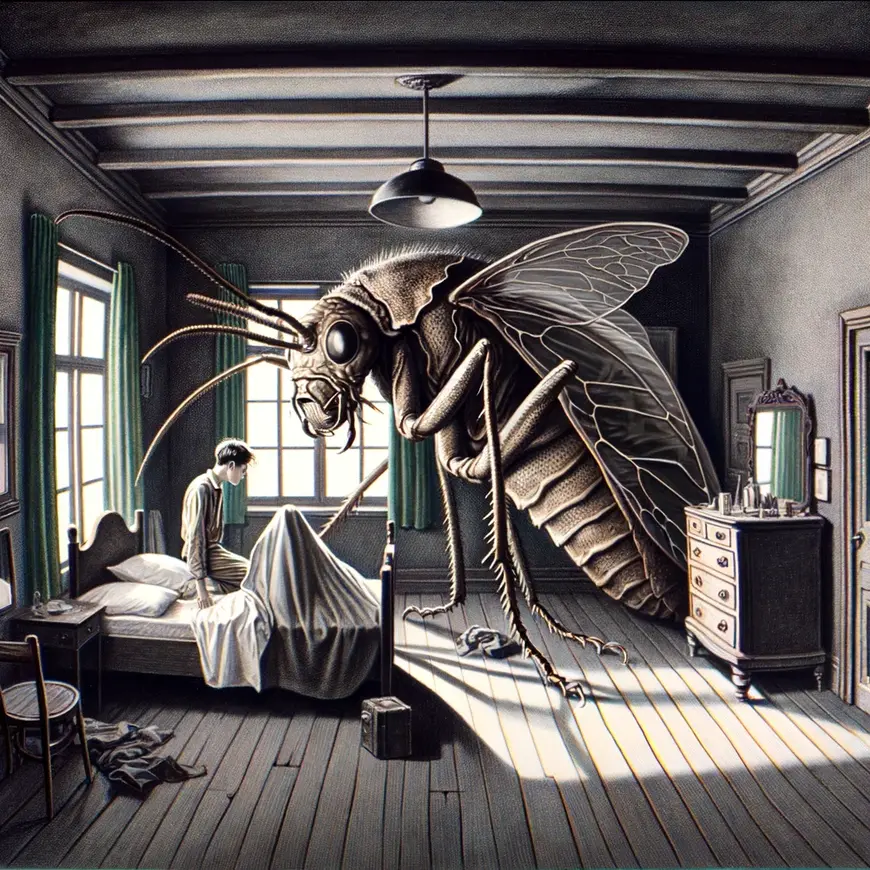
He had long been fascinated by confinement. Earlier works like The Metamorphosis and In the Penal Colony trap their characters in routines, roles, and systems. But in this story, the trap is subtler. He builds it, sustains it, and ultimately vanishes inside it.
This paradox, of self-imposed suffering, mirrors his own perfectionism. He rewrote obsessively, never satisfied. The main character fasts because nothing satisfies him either. Not food nor praise. Not understanding. It’s an echo of what philosopher Emil Cioran later called “the burden of lucidity.”
His biography reads like a rehearsal for this story. His jobs at insurance firms, his failed relationships, his fierce independence, all created an inner logic of retreat. As in The Man Without Qualities by Robert Musil, we sense a man overwhelmed not by chaos, but by the failure of meaning to materialize. The hunger artist is not just Kafka’s creation. He’s his mirror. And by the end, neither one is looking back.
The Loneliness of Performance
The hunger artist never truly connects with his audience. He performs, but no one listens. He suffers, but people doubt him. This gap between action and recognition defines the deep loneliness of being watched without being seen.
The writer uses this distance to explore a brutal irony. The more the actor perfects his craft, the less the public cares. At first, he’s surrounded by crowds. But over time, fewer people come. Eventually, he’s replaced by a panther, wild, full of life, and easy to admire. What does that say about us?
We don’t reward discipline. We reward spectacle. And in that sense, he saw the future. His story anticipates a world of fast consumption, where attention fades quickly and quiet suffering becomes invisible. Today, this resonates even more, in the scrolling, skimming, skipping age of digital attention.
The story invites comparison to books like Bartleby, the Scrivener by Herman Melville, where passive resistance is both mystifying and ignored. In both cases, performance becomes a quiet protest, and ultimately, a path to death.
But there’s also something beautiful in his vision. He, though abandoned, never compromises. He fasts longer than he should. He stays in the cage even when forgotten. That purity may seem foolish. But the novelist treats it with respect, as if failure itself can be a kind of truth. This isn’t a story about fame. It’s a story about devotion. And sometimes, devotion means choosing solitude over applause.
The Art of Starving and Being Seen
What is the protagonist really starving for? It’s not food. It’s understanding. The author makes it painfully clear that the artist is not simply fasting, he’s offering a vision of art itself: rigorous, invisible, and doomed to misinterpretation.
No one understands why he fasts so long. The impresario turns it into showmanship. Spectators invent reasons. Even when the artist tries to speak, he’s met with pity, not insight. The result is a portrait of artistic labor as both sacred and useless, an act of expression that’s misread, trivialized, and finally ignored.
In this way, A Hunger Artist fits alongside works like 👉 The Immoralist by André Gide, where personal conviction isolates the individual from the world. Both artists, Gide’s Michel and his fasting man, move further from society as they pursue something pure. But purity, the writer reminds us, rarely earns recognition.
The cage becomes a stage. But also a coffin. And yet the main character refuses to fake his performance. Even when interest fades, even when he’s hidden behind straw, he continues. This insistence becomes tragic, yes, but also strangely noble.
The novelist leaves us with a difficult question: Is it better to be understood and compromised, or misunderstood and pure? The hunger artist chooses the latter. And that choice, however bleak, carries its own beauty.
Sentences Built Like Traps
His language in A Hunger Artist is deceptively simple. Short sentences. Clean structure. But beneath the clarity lies a trap of meaning. The more we try to define what’s happening, the more it escapes us.
This is his signature move. He uses plain words to describe surreal worlds. The effect is unsettling, like trying to hold water in your hands. The tone is calm, even when the events are disturbing. We never hear a scream. We never see a breakdown. But we feel the pressure mounting.
He never explains himself until the very end, and when he does, it changes everything. He didn’t fast for fame or belief. He fasted because he never found food he liked. That’s not metaphor. That’s existential despair stripped of romance.
The influence here is vast. Writers like Samuel Beckett and Thomas Bernhard built entire careers on this kind of fatal clarity. And you can hear echoes of A Hunger Artist in 👉 The Hour of the Star by Clarice Lispector, where the narrator circles meaning until meaning gives up.
There’s also a rhythm to his sentences. They loop while they hesitate. They narrow the space around the character until there’s nowhere left to move. And then, just like the hunger artist, they disappear. To read Kafka is to lose your footing, sentence by sentence. And this book is one of his purest forms: quiet, precise, fatal.
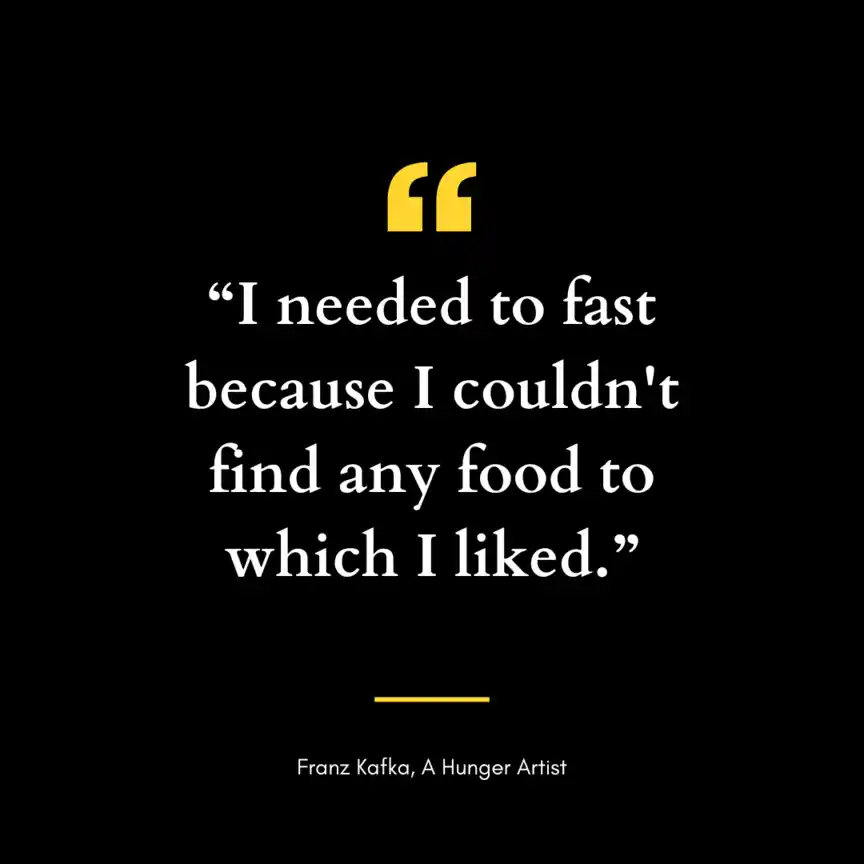
Famous Quotes from A Hunger Artist by Kafka
- “Because I couldn’t find the food I liked.” His final words, simple but devastating. It’s not about fame or faith. It’s about never finding satisfaction.
- “Fasting was the easiest thing in the world.” What others saw as extreme, he saw as natural. That’s what made his act so alien, and so real.
- “No one was in a position to know how great his achievement was.” The story shows how spectators can never fully understand the performer. True effort often goes unseen.
- “He lived only for his fasting.” His identity and act were inseparable. He suggests that the artist’s obsession is both purpose and prison.
- “He alone knew, what no other initiate knew.” Franz Kafka paints the actor as a misunderstood prophet, someone whose vision isolates him.
- “People grew tired of seeing him.” Even the most passionate performance fades in the public eye. The writer saw the fragility of attention early.
- “He was put in a cage like an animal.” This image blends art with cruelty. The line questions whether true expression always comes at a cost.
- “It was not the hunger artist’s fault that he fasted.” The author removes blame. He didn’t choose suffering; suffering chose him.
- “They wanted to admire him for his willpower.” But admiration often replaces understanding. He critiques superficial praise.
Trivia about the Book
- First published in 1922: A Hunger Artist was first printed in the respected German journal Die neue Rundschau. This placement gave his work exposure to a more literary and philosophical readership.
- Final collection before his death: The story was later published in his final collection, also titled A Hunger Artist, in 1924. It was edited and released by Max Brod shortly after Kafka’s death, despite his explicit wish that his unpublished manuscripts be destroyed.
- Admired Flaubert’s discipline: The writer deeply respected Gustave Flaubert’s literary discipline, which influenced his minimalist style. Like Flaubert, he believed every word should serve structure over sentiment.
- Legacy explored in The Paris Review: A 2017 essay in The Paris Review revisited the hunger artist as a lens for thinking about creative burnout, loneliness, and the body as metaphor.
- Prefigures themes in Blindness by Saramago: Both Kafka and 👉 José Saramago explore the fragility of public perception. In Blindness, as in this work, society turns its back on suffering when it becomes inconvenient.
- Early modernist rejection of resolution: The novelist resisted the tidy conclusions found in earlier narrative traditions. Like 👉 Virginia Woolf, he embraced open-ended structures that leave interpretation to the reader.
- Public fascination faded quickly: Just like the fictional crowds who lost interest in the hunger artist, his own work received little attention in his lifetime. His major recognition only came posthumously.
A Hunger Artist and the Modern Gaze
In a world driven by attention, A Hunger Artist feels eerily modern. Though written a century ago, his tale captures the emotional decay of being watched, and forgotten, by a crowd that moves on.
The author predicted something we now live with: visibility without understanding. Viral fame that fades. Deep performance with shallow reception. Today’s artists, creators, even everyday users online echo his dilemma, perform to stay visible, but know it won’t last. And worse: no one ever really knew you.
His cage, once public, becomes part of a forgotten corner of the circus. That shift, from center stage to background noise, mirrors the way attention works today. The story feels close to The Book of Laughter and Forgetting by Milan Kundera, where public memory is a fickle, unstable force.
The panther that replaces the artist at the end is key. It doesn’t think and it doesn’t explain. It simply eats, moves, lives. The crowd loves it. Here, his final twist stings: maybe authenticity doesn’t attract us. In this way, he warns us not just about art, but about perception. Who we notice. Who we discard. What we understand. And what we choose to forget.
The Meaning That Slips Away
So what is A Hunger Artist about? That question itself is dangerous. He didn’t write for explanation. He wrote to disturb, to fracture clarity. We might say it’s about art. Or suffering. Or misunderstood genius. We could say it’s about his illness, or his rejection of society. All of these are true, and none are enough. He escapes us, even now.
This is what makes this writing one of his most haunting works. It’s small. Barely a few pages. But it opens up into endless interpretation. That’s the mark of a story not trying to impress, but to mirror something deep in the reader’s mind.
The novelist doesn’t offer peace. Even the final moments, the artist’s quiet death, the arrival of the panther, give no closure. They simply shift the gaze. From someone who starves for understanding to something that thrives in oblivion.
This resistance to meaning aligns the writer with writers like 👉 Bret Easton Ellis, whose narrators also float in disconnected worlds. But he goes further. He doesn’t just describe alienation, he writes from inside it.
The main character doesn’t want to be solved. It wants to linger and it wants to haunt. It asks us not to explain the hunger, but to feel it, and maybe recognize it in ourselves. Kafka leaves us with silence. And somehow, that says more than any ending could.