La Galatea by Miguel de Cervantes tests desire and pride
Miguel de Cervantes opens with bright fields and sharper tongues. Consequently, La Galatea lets eclogues meet envy, debt, and rumor. Because shepherds speak like poets and rivals, song meets trial in every clearing. I track garlands, pipes, and ledgers together; therefore beauty with a bill becomes the book’s tempo. Although the setting promises sweetness, pride edits every tune and love learns its limits in daylight.
Voices carry craft, not haze. Moreover, the work builds debates where metaphors must withstand evidence. A promise invites witnesses; a stanza risks a life; consequently, poetry as contract holds. By contrast, pastoral convention would hide the price in flowers. Cervantes refuses that trick and keeps count in plain view. Meanwhile, lyric form still glows, and care still sounds like music.
Rivalry trains attention. Because praise travels fast, slander travels faster, and fame under pressure hardens choices. I kept noting how a compliment narrows a path, while a rumor widens a wound. In fact, this book treats ornament as argument: who deserves the laurel, who earned the kiss, who paid the loss. Finally, the grove turns judicial. The song resolves only when honesty rules, not when sweetness overpowers sense.

How La Galatea tunes love: ear, evidence, and revision
Cervantes makes listening a moral skill. Therefore La Galatea teaches lovers to weigh tone, proof, and timing before vow or flight. Because desire arrives loud, ear before impulse prevents harm. A stanza shines; however, a ledger speaks back, and evidence in daylight corrects fantasy. Moreover, the chorus of friends tests rhetoric until care replaces display and promise earns its place.
Pastoral ethics needs neighbors. Consequently, this work pairs private feeling with public scrutiny, so lyric risk stays accountable. I read this beside 👉 The Pastoral Symphony by Andre Gide, since both works measure tenderness against responsibility. By contrast, the novelist refuses solitary purity; therefore community as meter keeps rhythm honest. Although jealousy knocks, clear talk opens safer doors.
Revision saves more than eloquence. In fact, this work rewards lovers who rewrite their claims when facts change. Because apology counts, pride loses some shine and mercy with rules holds couples together. Meanwhile, wit trims exaggeration, and music returns as a promise kept, not a trick performed. Finally, feeling grows durable. The song survives because truth tunes it, and the grove remembers who chose to listen.
Voices, forms, and how the book conducts argument
Cervantes mixes prose roads with lyric clearings. Consequently, La Galatea turns eclogues into decisions, not ornaments. Because speakers answer each other in alternating meters, prosimetrum as engine carries plot as well as music. Rival shepherds sing, yet they also bargain; therefore argument in song feels natural, never staged. Moreover, the narrator lets rumors touch rhyme, so sources stay traceable.
Structure welcomes many claims. Although one couple appears central, side stories refuse to defer; as a result, chorus of rivals keeps the field democratic. A stanza may praise a beauty; however, the next tale exposes the cost of that praise. Meanwhile, the book stays nimble between complaint, compliment, and correction, so readers hear how poetry trains judgment instead of merely decorating feeling.
Form shapes ethics. A villancico ends, then a new witness starts; consequently, form as commons invites listening before verdict. I noted how the book repeats the keyword La Galatea when a decision turns, since titles become signals for attention. Furthermore, the prose frames never smother the verse; rather, they test it. Finally, the page rewards the singer who edits a claim after evidence arrives, and the grove records that edit as growth, not defeat.
Honor, rumor, and public risk
Reputation moves faster than feet. Therefore this renaissance work treats honor as logistics and shows how a careless couplet can travel like fire. Because neighbors arbitrate worth, honor as currency determines who speaks and who waits. Lovers plan a vow; however, friends price the fallout, and privacy under scrutiny becomes the daily state. Moreover, rivals weaponize rhetoric, then learn that proof still matters.
Miguel de Cervantes studies cost with clarity. A gift binds; a dance records witnesses; consequently, oaths with costs replace dreamy pledges. The wrong boast narrows the marriage market; by contrast, a measured apology opens a lane. Meanwhile, a lyric request becomes a public claim the moment a chorus repeats it, and La Galatea insists that care must survive chorus volume.
Comparisons clarify the peril. For love pressed by family codes and civic noise, see 👉 Romeo and Juliet by William Shakespeare. That tragedy spends lives where rumor outruns sense; consequently, the writer chooses argument over haste and rescues dignity through hearing. Finally, the grove teaches a harsh but useful lesson: desire earns safety only when language respects neighbors, and public risk of desire lowers when lovers revise their songs before the village does it for them.

Landscape, image, and how language decides
Pastoral ground looks gentle; however, every grove contains a court. Consequently, La Galatea treats landscape as evidence and turns shade, water, and rock into reasons. Because metaphors must carry weight, nature as rhetoric replaces decoration. A spring invites confession; moreover, a cliff refuses exaggeration. Therefore image that argues governs praise, since a scene can accept or reject a stanza based on truth.
Poems behave like contracts. Although shepherds sing, their lines face neighbors and memory; as a result, catalogue with purpose replaces empty listing. I watch how flowers and rivers map debts and favors; meanwhile, slander tries to pass for wit. The story answers by demanding proof in daylight, so listener as judge shapes the melody. By contrast, flattery collapses when the grove remembers the last harvest.
Revision steadies love. Because pride speaks first, correction must follow; consequently, metaphor under audit keeps couples from mistaking performance for care. A stanza brightens, then a fact dims it, and the next stanza learns restraint. Furthermore, La Galatea repeats its title at turns of feeling, so readers hear when the book tests desire, poetry, and pride again. Finally, the world argues before it sings, and the song improves because the argument holds.
Letters, melody, and the risks of sincerity in La Galatea
Feeling needs form; therefore La Galatea studies how letters, songs, and speeches carry heat without burning fields. Because declarations can wound, sincerity with limits protects both lover and village. A note travels faster than a walk; moreover, rumor outruns both. Consequently, letter as stage makes private vow a public act the moment a chorus repeats it.
Music edits impulse. Although emotion rises, melody as measure forces breath, pause, and second thought. The verse holds back just enough to keep care intact, while prose frames test each claim. By contrast, haste breaks trust. The novel counters by pairing vow with evidence and by asking whether tenderness can survive the market for wonder that fame creates.
Comparisons sharpen the danger. For a later case where written feeling creates a weather system of its own, see 👉 The Sorrows of Young Werther by Johann Wolfgang von Goethe. That link clarifies how pages can amplify pride until harm looks like purity. Meanwhile, La Galatea prefers restraint that still speaks, so grief that edits becomes a virtue. Finally, the pastoral world tests desire through audience and time, and care before applause keeps both melody and dignity alive.
Language, songcraft, and what translation must carry
Miguel de Cervantes writes bright, mobile sentences that turn quickly. Consequently, La Galatea asks translators to move music and meaning together. Because wit often lands in the final clause, syntax as score becomes crucial to keep timing intact. Moreover, pastoral vocabulary must stay clear without sugar, so register as strategy matters more than gloss. Therefore the voice can argue and sing in one breath without drifting into haze.
Forms keep purpose visible. Although lyrics bloom, the prose frames keep claims accountable; as a result, rhyme with reasons prevents ornament from excusing harm. I tracked how refrains return after facts shift, and the second return always speaks wiser. Meanwhile, the story pairs soft vowels with crisp judgment, so the ear enjoys cadence while the mind counts costs. By contrast, over-polished English would risk losing bite.
Scenes hold their ground in any language. A spring that invites confession must still test exaggeration; consequently, image with leverage remains the rule. Translators gain room to smooth, yet they must keep debate audible, because the book treats listening as ethics. Finally, La Galatea survives travel because the line prefers clarity over perfume. It chooses care first, music next, and victory only when both agree to stay.
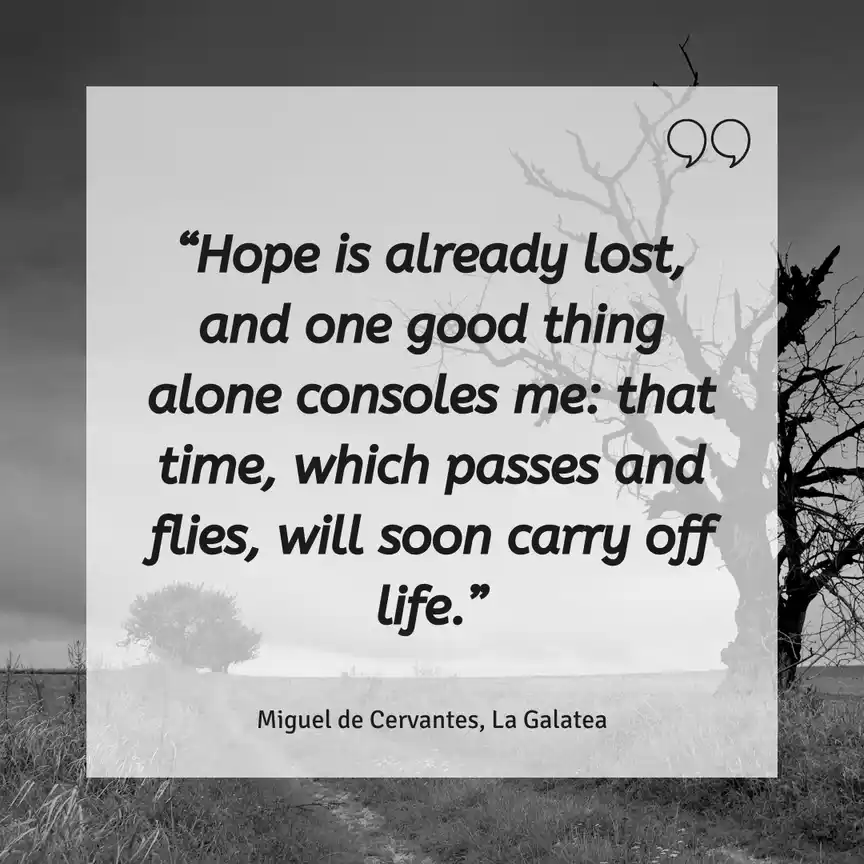
Clear-voiced Quotes from La Galatea by Miguel de Cervantes
- “The occupation of writing eclogues, at a time when poetry goes so little favored, needs a particular satisfaction to readers.” Consequently, Miguel de Cervantes frames the book as argument as well as song in this work.
- “Who came to subject my free thought? Who built such high towers of wind on a feeble foundation?” Therefore Lauso names desire as architecture and illusion as engineering in La Galatea.
- “But I, wholly—where am I, where do I come from, or where do I go?” As a result, identity falters when rumor and passion outpace reason.
- “I demand a strict account of myself, yet I cannot settle it.” Moreover, conscience becomes a ledger, so feeling must answer to evidence.
- “I see myself dying in the present, and in the past, living.” Consequently, the poem weighs memory against the market for wonder that fame creates.
- “Rich and happy token, you adorned pure snow and precious ivory.” Therefore the sonnet turns a gift into proof, and promise into public record in this book.
- “Swift hours of swift time—yet for me, slow and weary.” Meanwhile, Silerio measures grief by tempo, not by thunder, which keeps the scene human-scaled.
- “If now you finish me, do it when my misfortunes are most full.” Finally, the line binds fate to timing; therefore mercy requires listening before decree.
Context-Rich Trivia from La Galatea
- Pastoral with teeth: The work dresses like an eclogue; however, jealousy, debt, and rumor keep the stakes real, so poetry answers to evidence, not perfume.
- Prosimetrum engine: Because Cervantes mixes prose frames with songs, La Galatea turns melody into argument, and therefore stanzas must survive cross-examination.
- Audience as judge: Shepherds sing in public; consequently, the “village” functions like a court where praise risks sanction and gossip travels faster than truth.
- Spain’s Golden Age texture: Rustic scenes name tools, ledgers, and favors; moreover, La Galatea counts costs in daylight instead of hiding them behind garlands.
- Comparative chorus — love under rules: For a lyric world where feeling meets social scrutiny, compare 👉 A Midsummer Night’s Dream by William Shakespeare.
- Comparative chorus — memory and jealousy: To study attention, rumor, and the labor of listening, see 👉 Swann’s Way by Marcel Proust.
- Catalogs with purpose: Flower lists look decorative; however, in this work the catalog maps debts, alliances, and reputations that matter tomorrow.
- Pastoral ethics: Because neighbors arbitrate worth, apologies repair more than bravado; consequently, restraint becomes a civic virtue inside the grove.
- Pastoral primer (authoritative): For a clear, topic-level definition that fits La Galatea’s frame, see 🌐 Pastoral literature — Encyclopaedia Britannica
Legacy, influence, and why La Galatea still instructs
The book endures because it shows how feeling learns rules. Therefore La Galatea teaches readers to weigh tone, timing, and proof before vow or verdict. Because neighbors arbitrate worth, courtship as system stays central to the risk. Moreover, rivalry pushes craft to improve, so pastoral with teeth becomes a training ground for later novels. The grove looks pretty, yet it grades every stanza with consequences.
The lineage spreads along two paths. One keeps lyric argument alive inside narrative; consequently, genre as laboratory shapes scenes where love and reputation collide. The other cleans rhetoric with evidence, then lets wit stand guard; therefore wit with ballast protects dignity when rumor rises. I place this civic schooling beside 👉 Pride and Prejudice by Jane Austen, where dialogue trims pride until care can hold.
Readers still gain a method, not a mood. Although flowers remain, sentences do the work: listen, test, revise, and promise only what the village can bear. Meanwhile, La Galatea repeats its title at honest turns, and the echo feels earned. Finally, the pastoral closes like a lesson that keeps opening: sing, but count; praise, but prove; love, but let the line answer to the life it touches next.