Romeo and Juliet: Private Love in a Violent City
Romeo and Juliet gives its lovers a language that seems capable of remaking the world, then places that language inside a city unwilling to change its habits. William Shakespeare announces the deaths before the action begins. The tragedy therefore asks us to watch how an outcome already known becomes possible through particular encounters, decisions, and failures of protection. Its force comes from the persistent feeling that the ending could still be prevented.
Verona’s feud extends beyond the Montagues and Capulets themselves. Servants rehearse insults, friends defend reputations, and the prince struggles to restrain public violence. Romeo enters the story absorbed in an unsuccessful attachment to Rosaline. Juliet faces an approaching marriage decision whose terms her family expects to determine. Their meeting creates a private recognition that neither household has prepared itself to accommodate.
Romeo and Juliet does not make that recognition convincing merely by calling it overwhelming. The lovers begin by making a sonnet together: each answers the other’s verbal move, and desire becomes a shared act of invention. Later, Juliet questions the authority of a family name. Their intimacy develops through language that proposes another way of assigning value to a person.
The difficulty is that names still organize the world beyond their conversation. Violence, parental command, exile, and failed communication keep interfering with what they have chosen. Romeo and Juliet is strongest when youthful haste remains inseparable from the pressures that make waiting dangerous. Its lovers can misjudge and act rashly without becoming the sole authors of a catastrophe their elders have helped make possible.
Verona Teaches Violence Before Romeo and Juliet Meet
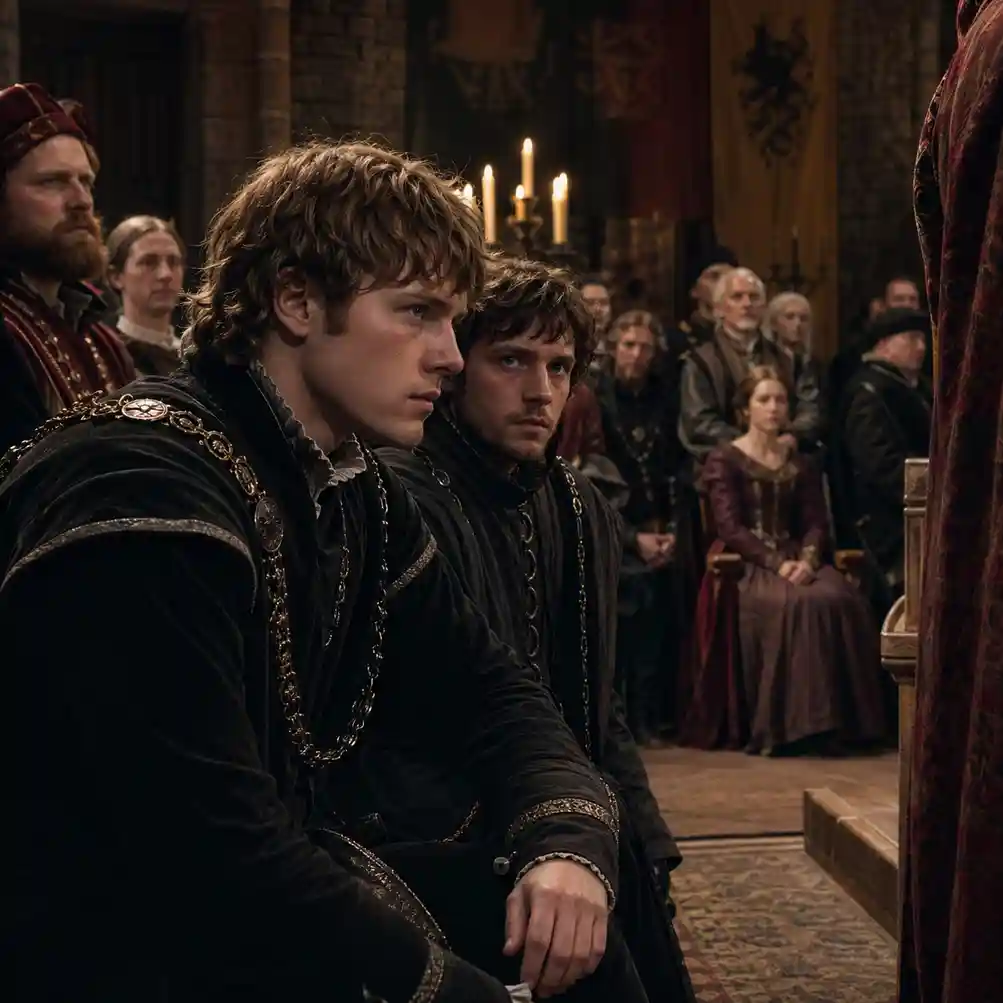
The opening street encounter turns a trivial gesture into a potential fight. The servants do not need an important new grievance; they need an opportunity to demonstrate that they belong to the correct side. Insult becomes a performance of loyalty. Before the lovers appear together, the city has already shown how quickly an inherited opposition can acquire fresh bodily consequences.
Romeo and Juliet gives public honor a dangerous vocabulary. Tybalt reads Romeo’s presence at the Capulet feast as an injury requiring retaliation. Capulet temporarily restrains him, but the restraint concerns the management of an occasion more than the abandonment of hostility. The household can permit a guest for one evening without dismantling the values that will make his presence intolerable later.
The prince’s threats establish a civil authority capable of recognizing the problem. Yet recognition does not immediately transform the habits through which the feud reproduces itself. His eventual admission of responsibility matters because political failure belongs inside the ending. This violent city has permitted private antagonism to remain a recurring public danger.
Another conflict between intimate attachment and an order built around obedience appears in Don Carlos by Friedrich Schiller. Its court makes love inseparable from dynastic power. Here, the streets extend the household’s authority, turning a family identity into something defended through the bodies of friends and servants.
Romeo and Juliet makes the feud disturbing partly by leaving its origin less important than its continuation. Nobody needs to recover the first offense before carrying the opposition forward. The lovers encounter a world in which belonging has become sufficient reason to inherit an enemy, and refusing that inheritance can itself look like betrayal.
Two Lovers Make a Language Together
Romeo’s earlier talk about Rosaline gives love a recognizable conventional form: he suffers, exaggerates, and makes contradiction sound like the proper evidence of feeling. Juliet changes the dramatic situation because she can answer him. At the feast, their exchange develops a sonnet between two speakers. The poetry becomes responsive rather than simply a display of one person’s private intensity.
In Romeo and Juliet, shared language makes attraction credible. The religious imagery of saints, pilgrims, hands, and lips allows the lovers to test a proposal while remaining inside a playful formal pattern. Juliet does not merely receive Romeo’s words. She directs the exchange, modifies its terms, and participates in the movement towards a kiss.
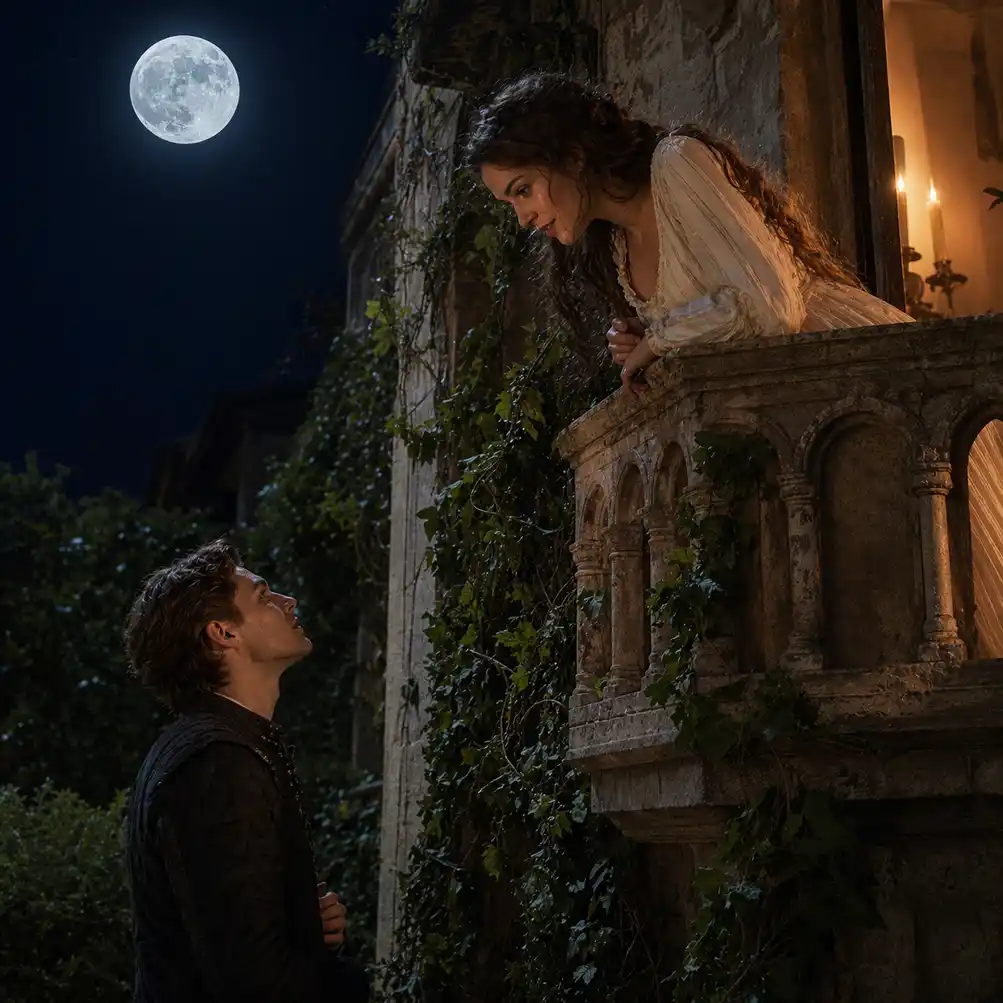
The later night scene brings the problem of naming into that intimacy. Juliet’s question asks why he must be Romeo, a member of the opposing family. The word wherefore means why, not where. She distinguishes the person she recognizes from the inherited designation that makes him unacceptable, but she cannot make the surrounding city adopt the distinction by stating it clearly.
For a contrasting treatment of love through an intensely individual voice, The Sorrows of Young Werther by Johann Wolfgang von Goethe concentrates desire within letters and a troubled consciousness. This play repeatedly gives desire an answering voice. That difference helps explain why its intimacy feels like an encounter rather than merely an accumulation of beautiful declarations.
Romeo and Juliet remains open to skepticism about the speed of the attachment. Yet the verbal reciprocity supplies something more substantial than an instruction to admire youthful passion. Two people briefly discover that conversation can recognize an identity their families will not allow them to inhabit publicly.

Mercutio’s Death Changes the Terms of Choice
Romeo’s refusal to fight Tybalt follows the secret marriage, which has changed his understanding of their relationship. The others do not possess that information. What looks to him like a new obligation can look to his friends like a humiliating failure of courage. The marriage has altered one person’s private world without changing the public meanings available around him.
Romeo and Juliet makes incomplete knowledge a motor of violence. Mercutio steps into the quarrel, and Romeo’s attempt to intervene helps create the circumstances of the fatal wound. A peaceable intention cannot control what the participants understand or what an armed encounter makes possible. The scene destroys the hope that private goodwill can reliably suspend the city’s inherited rules.
Romeo’s retaliation then exposes how deeply those rules still inhabit him. He interprets restraint through a language of wounded masculinity and turns back towards the violence he had briefly refused. Tybalt’s death produces exile, separating the lovers at precisely the moment when their situation requires better communication and more dependable protection.
A death whose causes become inseparable from communal expectations also structures Chronicle of a Death Foretold by Gabriel García Márquez. Its retrospective investigation distributes responsibility differently. Both works, however, make an announced catastrophe feel preventable through the actions of people who continue to understand violence as somebody else’s necessary business.
Romeo and Juliet changes after this scene without losing the earlier comedy’s significance. Mercutio’s wit belongs to the same social world as his willingness to defend honor with a weapon. His death shows how a culture can make intelligence, affection, and aggression dangerously compatible, then leave everyone else to live within the consequences.
Writing Style: Poetry Meets Bodies and Deadlines
The Writing Style moves among sonnets, blank verse, prose, bawdy jokes, threats, and urgent practical instructions. These forms do not give every character the same voice. They reveal how a scene’s emotional possibilities depend on who can speak, who answers, and how much time remains before speech must become action.
Romeo and Juliet uses formal cooperation in the first meeting. The shared sonnet makes mutual recognition audible through its structure. Later scenes loosen or interrupt such patterns as the lovers negotiate danger. Poetry can create a temporary space for intimacy, but the play keeps reminding us that words arrive from bodies exposed to doors, swords, messengers, and parental demands.
Desire constructed through talk and interpretation also drives Moderato Cantabile by Marguerite Duras. Its repetition and silence produce a markedly slower pressure. The comparison makes this tragedy’s changing pace especially visible: eloquence exists beside practical deadlines that will not wait for desire to understand itself fully.
The audience’s foreknowledge creates dramatic irony without eliminating suspense. We know that the lovers will die, yet each alternative seems to acquire a brief possibility while it is being attempted. The gap between what a character intends and what the audience fears makes an ordinary delay unusually charged.
There is also a productive excess in the lovers’ speech. Their images can be extravagant enough to invite resistance, especially when separated from performance and treated as isolated wisdom. Romeo and Juliet rewards reading them as acts within scenes. A declaration may persuade, conceal, prolong a departure, or push someone towards an irreversible choice; its beauty matters because it is doing something under pressure.

Quotes: From Inherited Names to Shared Responsibility
The five passages below follow public framing, private questioning, injury, separation from a trusted adviser, and the final reckoning. Wording follows the Folger edition. They show different voices confronting the same divided world, rather than treating Romeo and Juliet as a collection of interchangeable sayings about romance.
- “Two households, both alike in dignity”. The prologue establishes a symmetry before any individual grievance appears. Comparable social standing has not produced mutual respect. The feud grows within a shared civic world, making the opposition something its participants maintain rather than a natural division between unrelated kinds of people.
- “O Romeo, Romeo, wherefore art thou Romeo?”. Juliet asks why the person she loves must bear the identity associated with an enemy household. She is not asking where he is. Her question exposes the difference between knowing a person and accepting the social meaning attached to his name.
- “A plague o’ both your houses!”. Mercutio’s curse refuses to reserve blame for the side that wounded him. His injury turns the feud’s loyalties into a shared accusation. The line makes visible the cost borne by someone who is not himself one of the two central lovers.
- “Thou and my bosom henceforth shall be twain.”. Juliet privately rejects the Nurse after advice that would require abandoning her marriage. The statement marks a loss of trusted companionship. Her increasing independence also means that she must face the next crisis with fewer people to whom she can speak openly.
- “All are punished.”. The prince includes his own loss within the concluding reckoning. Public authority cannot stand entirely outside the disaster it failed to prevent. Romeo and Juliet closes its account of private love by making the city’s responsibility impossible to exclude.
Trivia: Sources, Printings, and a Changed Stage
The play’s history includes an inherited story, differing early texts, and later adaptation. These facts help distinguish an uncertain composition date from documented publication and performance records. They also show how transformation accompanies transmission, without requiring every version to preserve the same pace, wording, or social setting.
- A likely composition period: The Royal Shakespeare Company identifies 1595 to 1596 as the likeliest period of composition. This is a scholarly dating, not an exact documented writing date. It should therefore retain its qualification rather than becoming a precise claim about a first performance.
- Brooke’s English poem: Arthur Brooke published The Tragicall Historye of Romeus and Juliet in 1562. The poem supplies an immediate source within a story already circulating through French and Italian versions. The stage tragedy compresses the source’s more extended courtship into the urgency of a few days.
- Inspired Later Romantic Tragedies: Many later writers were influenced by this writing, including Victor Hugo and Alexandre Dumas. Even in modern literature, tragic love stories often reference his play. The idea of star-crossed lovers appears in books, movies, and theater around the world.
- First Performed in the 1590s: The exact date of the first performance is unknown, but historians believe it was staged between 1594 and 1596. It was likely performed at The Theatre or The Curtain, early playhouses in London.
- A Broadway transformation: West Side Story opened on Broadway on 26 September 1957. Its creators moved the tragic conflict into a different urban setting and made music and dance central to the form. Adaptation preserves a relationship to the earlier play while changing how its social divisions become visible. The original production’s record
Romeo and Juliet and the Cost of Learning Too Late
Juliet’s isolation becomes particularly severe when Capulet insists on marriage to Paris and the Nurse recommends accepting it. She has to protect a commitment the people closest to her do not fully understand. The friar’s solution offers a way out, but it also makes her safety depend on an elaborate arrangement whose success requires a message to arrive elsewhere.
Romeo and Juliet gives that failed message a practical cause: Friar John is detained because of suspected infection. The interruption is not simply a vague declaration that fate dislikes the lovers. It shows how a plan with several necessary stages can fail at a point beyond the central characters’ immediate control, leaving incomplete information to govern their final decisions.
Love under pressure from a damaged wider world has a different rhythm in Three Comrades by Erich Maria Remarque. Its companionship unfolds over a longer span and encounters different threats. The connection lies in the refusal to let affection become a guarantee that the surrounding conditions will permit a shared future.
Romeo and Juliet suits readers willing to examine the institutions around a famous romance. Its emotional immediacy remains considerable, but its strongest questions extend beyond whether the lovers are too young or too impulsive. Family command, masculine reputation, unreliable protection, and public toleration of violence all help determine the options available to them.
Romeo and Juliet ends with recognition that arrives after it could have saved the people who required it. Reconciliation has value, yet the proposed monuments cannot restore the lives they commemorate. The play’s enduring disturbance comes from that interval between knowing enough to stop a disaster and finally admitting, when the disaster is complete, what should have been understood earlier.
Who Should Read this story?
This play isn’t just for scholars or literature students. It’s for anyone who loves great storytelling. Whether you enjoy romance, drama, or deep emotional journeys, this play offers something for you.
If you love tragic love stories, this is one of the greatest ever written. The intensity of their love, the forces that tear them apart, and the devastating ending all make for an unforgettable experience. Unlike modern romance stories, this one doesn’t follow the usual patterns. There’s no happy ending, no second chance. That’s what makes it so powerful.
For those interested in family and social conflict, this play is also a must-read. The Montague-Capulet feud is not just background noise, it’s a driving force. It shows how longstanding hatred can destroy lives, even the lives of those who want nothing to do with it. This theme remains relevant today. Whether in personal relationships, politics, or history, we see how conflicts passed down through generations cause unnecessary suffering.
It’s also a great read for people who love drama. Romeo and Juliet is filled with intense emotions, quick-paced action, duels, betrayal, secret meetings, and shocking twists. It’s not a slow, boring love story, it moves fast, keeping you hooked until the very last moment.
Final thought: This work isn’t just about love. It’s about choices, consequences, and the fragile nature of life. It’s about how love and hate can shape destinies. And most importantly, it’s a warning, about acting too quickly, about letting old grudges control the future, and about the cost of learning a lesson too late. If you haven’t read it yet, you should. And if you have, read it again. Every time, you’ll find something new.
More Reviews of Works by the Bard



Was this article helpful?
…One vote per user. No account needed.