Music for Chameleons by Truman Capote – Masterclass in Voice
Reading Music for Chameleons by Truman Capote is like stepping into a conversation you weren’t meant to hear, intimate, surprising, and strangely magnetic. This collection defies easy classification. It’s not just fiction, not just memoir, not just journalism. The author blends genres with the confidence of someone who no longer cares about literary rules. The result is both personal and performative, light and heavy at once.
At the heart of this book is voice. Not just his famously sharp, gossipy tone, but the voices of those he listens to: criminals, friends, strangers, himself. These stories are shaped by dialogue — real or imagined — and by his gift for turning even the smallest detail into a moment of revelation.
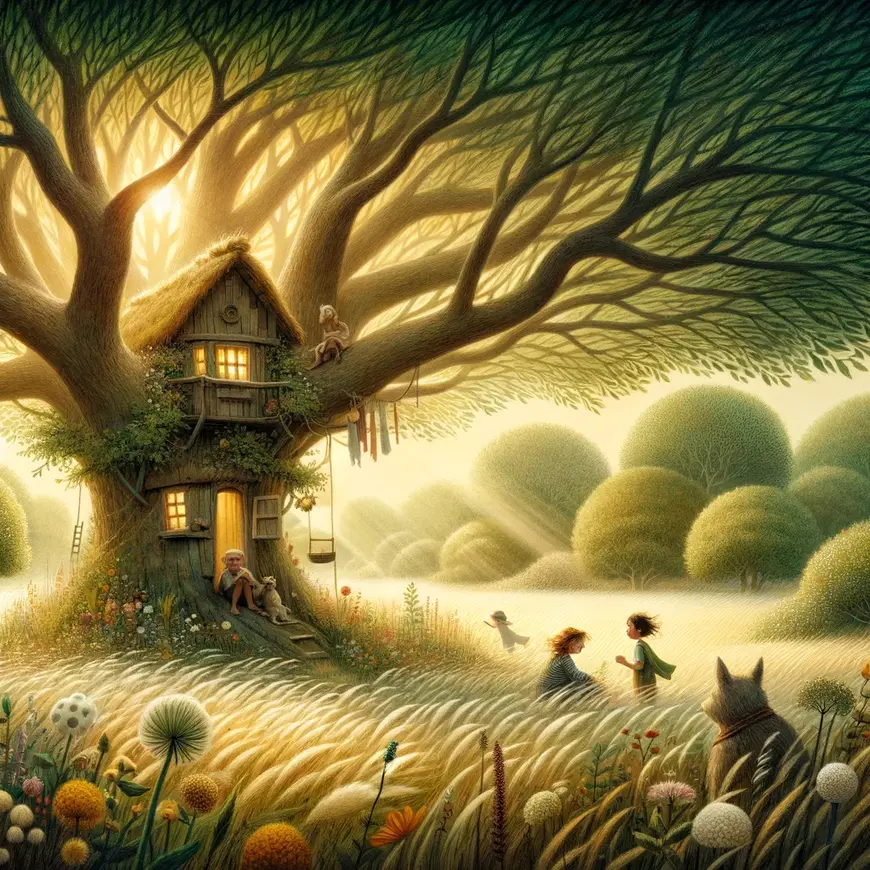
The title story, Music for Chameleons, sets the tone. In a quiet garden, The author chats with his hostess while tiny lizards seem to listen. It’s a story about nothing, and yet about everything: connection, observation, the odd poetry of daily life. The music here is metaphorical, the sound of presence, of being alive.
The experimental mixing of truth and invention finds a distant relative in 1984 by George Orwell. Both works question how language shapes perception, whether in dystopia or in polite conversation. It’s a masterclass in how voice can transform the ordinary into something unforgettable.

Truman Capote’s Mastery of Conversation – Music for Chameleons
What makes Music for Chameleons so distinctive is its tone. Truman Capote speaks directly, casually, often conspiratorially. His writing feels less like prose and more like conversation — slow, meandering, full of asides and small confessions. It’s as much about how things are said as what’s being said.
He understood that dialogue reveals more than description ever could. In these stories, people talk themselves into corners, reveal secrets they didn’t mean to share, and expose their weaknesses with a kind of accidental honesty. The writer listens without judgment. His genius lies in the silences between words, in the spaces where truth slips out sideways.
Take “Handcarved Coffins,” the most famous piece in the collection. It’s a true crime story, but told like a coffee shop rumor: suspenseful, messy, oddly intimate. The novelist inserts himself as both narrator and character, blurring the lines between witness and participant. This method allows him to explore not just crime, but friendship, loneliness, and the performance of masculinity.
These stories are full of masks, social, emotional, literary. He removes them slowly, with humor and patience. His voice invites trust, then gently challenges it. He turns conversation into art, observation into literature.
A Christmas Carol by Charles Dickens offers a surprising parallel. Both Capote and Dickens reveal human weakness and kindness through quiet conversation and sharp observation. In each, transformation comes not from action, but from listening.
Blurring the Line Between Truth and Fiction
One of the most fascinating aspects of Music for Chameleons is how it deliberately plays with truth. The storyteller doesn’t clearly separate fact from fiction. Instead, he invites the reader into a space where observation, imagination, and memory bleed together. This refusal to clarify becomes part of the book’s charm.
The collection mixes profiles, stories, and personal essays. In Handcarved Coffins, he presents a true crime narrative, but his role within the story is ambiguous. Is he a reporter, a participant, or something in between? This ambiguity draws attention to storytelling itself. What we believe depends not just on facts, but on how they are told.
His style here feels like a response to the rigidity of journalism. He wants something looser, stranger, more human. These stories aren’t meant to inform; they’re meant to engage. He uses voice the way a musician uses improvisation — shifting tone, repeating motifs, exploring rhythm over resolution.
👉 A Clergyman’s Daughter by George Orwell offers a parallel. Orwell’s work also questions reality and performance, blending realism with surreal shifts in tone. Both authors ask us to reconsider where truth lives in literature. His genius is in his transparency. He admits the performance. He invites the reader to enjoy it, knowing full well we’ll wonder what’s true.
The Power of Small Moments
Music for Chameleons finds beauty in the overlooked. Truman Capote’s eye for detail turns small encounters into revelations. A conversation about garden insects, a comment on a stranger’s hands, a shared cigarette, these moments linger longer than dramatic scenes in more traditional works. They reveal character in quiet, lasting ways.
The attention to smallness reflects his belief that life’s meaning hides in its texture. Big events matter, but so do the pauses between them. This is why his writing slows down, circles around, and sometimes seems to hesitate. He isn’t filling space. He’s asking us to look closer.
In this way, he aligns with certain modernist traditions. His focus on ordinary exchanges feels similar to the careful observations in 👉 Life of Galileo by Bertolt Brecht. Both writers understand that revolutions — scientific, personal, or emotional — begin in conversations, not in grand speeches.
His tone remains light, but beneath it runs a deeper current of empathy. Though his characters, both real and fictionalized, are flawed, lonely, and searching. His gift is in listening — not to what people say loudly, but to what they reveal quietly. In these pages, conversation becomes art. And art becomes conversation.
Voice as Identity
Throughout Music for Chameleons, voice becomes more than style. It shapes identity. The author knew how to perform on the page, but beneath the performance is something honest: his need to connect. These stories often sound like monologues meant for an audience of one. They pull the reader close, like a secret whispered late at night.
The voice moves between tones, playful, confessional, sharp, vulnerable. This variety mirrors the fragmented nature of the self he presents. Sometimes he’s the confident storyteller and sometimes he’s lonely. Sometimes both at once. The shifts feel natural because people contain contradictions.
The book is structured like a collection of conversations: with friends, with criminals, with himself. These voices overlap and blur. He shows how identity is shaped not just by what we say, but by what others hear.
A Study in Scarlet by Arthur Conan Doyle plays with similar ideas. Holmes’s deductions are about voice, clues, and perception. Both the writer and Doyle explore how listening can reveal hidden truths.
The writer isn’t solving mysteries here, but he’s uncovering something just as important: how people use words to protect, to confess, to transform. His writing listens as much as it speaks. That’s why it feels so alive.
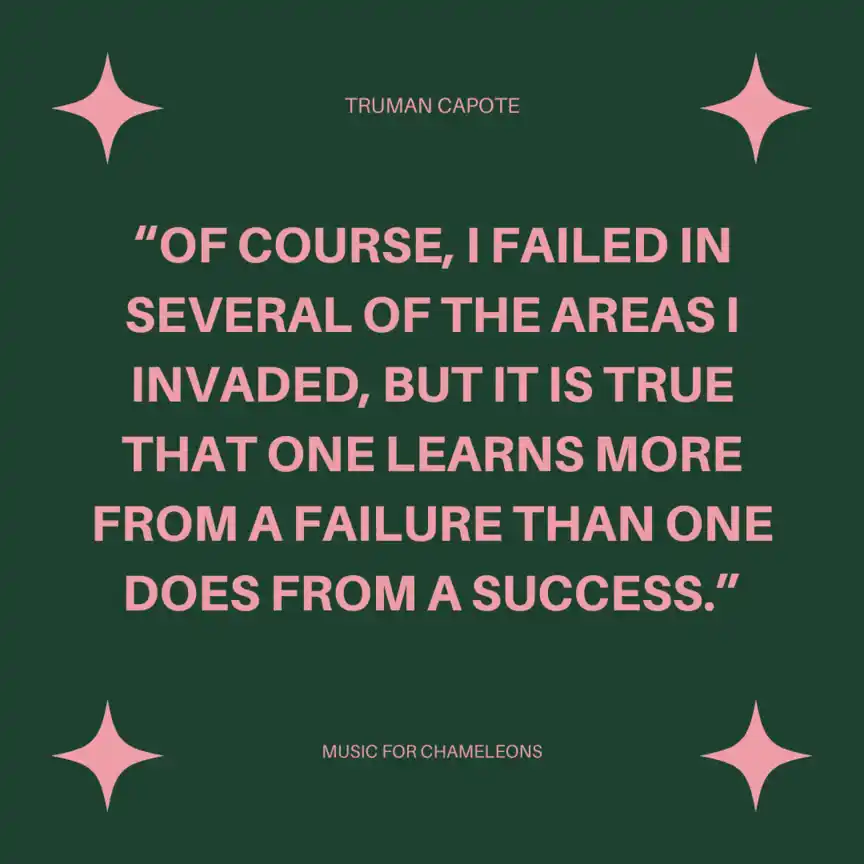
Quotes from Music for Chameleons by Truman Capote
- “Life is a moderately good play with a badly written third act.” Capote’s humor softens this bleak view. It reminds us that endings rarely satisfy, in fiction or in life.
- “The dead don’t believe in accidents.” A chilling line from Handcarved Coffins. He blends crime and philosophy, hinting at fate’s shadow behind coincidence.
- “I don’t care what is written about me as long as it isn’t true.” His wit shines here. It speaks to the power of perception over fact — a theme throughout the collection.
- “Hope is a very unruly emotion.” A quiet observation wrapped in a casual tone. The writer reveals how small feelings often steer the biggest choices.
- “Conversation is a kind of performance art.” This reflects the heart of Music for Chameleons. Every story here turns dialogue into revelation.
- “Style is knowing who you are and what you want to say.” The aesthetic philosophy distilled. His writing models this in every sentence.
- “Silence often says more than words ever could.” Truman Capote listens between sentences. This respect for quiet shapes the collection’s rhythm.
- “We all wear masks; some just fit better than others.” A truth hiding beneath the book’s playful tone. Identity here is flexible, layered, and theatrical.
Trivia Facts about Music for Chameleons
- Last Completed Work: Music for Chameleons was the final book Truman Capote published in his lifetime. It shows his shift from fiction to hybrid forms.
- Inspired Later Narrative Nonfiction: Writers like Joan Didion cite his conversational tone as formative. His influence extends beyond genre boundaries.
- Title Reflects his Themes: Chameleons adapt, listen, survive. The title speaks to Capote’s fascination with hidden lives and quiet transformations.
- Parallels with Blindness: Jose Saramago’s exploration of human behavior in crisis mirrors his interest in how people reveal their true selves in quiet moments of conversation.
- Celebrity Circles: His relationships with figures like Tennessee Williams and Gore Vidal influenced the tone of the work, blending gossip with deeper reflections on fame.
- Referenced by The New Yorker: The style continues to be studied in publications like The New Yorker, which often revisits his impact.
- Connection to Blind Orion: Claude Simon’s fragmented storytelling aligns with his blend of fact and imagination. Both authors highlight the gaps between memory, truth, and narrative.
- A Bridge Between Genres: Music for Chameleons helped dissolve boundaries between reportage, memoir, and fiction, influencing literary forms today.
Why This Collection Still Matters
Music for Chameleons remains a remarkable collection because it resists neat categories. It’s memoir, fiction, journalism, and something else entirely. Capote created a space where voice and style matter more than form. This freedom feels fresh even now.
The book speaks to anyone who values observation, who finds stories in small moments. It reminds us that writing doesn’t have to choose between fact and feeling. The novelist shows how truth often lives in the blur between them.
Today’s nonfiction writers often claim the author as an influence, especially those blending reportage with personal reflection. His legacy is visible not just in journalism, but in how we think about narrative voice. He proved that conversation could be art.
1984 by George Orwell warns of language as control. He shows its opposite: language as connection, as play, as refuge. Both understand that words shape reality. Both demand attention.
His work endures because it’s intimate without being invasive, stylish without being cold. It invites the reader into a space where the rules don’t matter — only the rhythm of the sentence, the weight of a glance, the sound of a name repeated in a quiet room.
A Collection Built on Listening
Finishing the book feels like leaving a long, wandering conversation. There’s no grand conclusion, no single lesson to carry forward. Instead, there’s a sense of having spent time with someone deeply observant, someone who knew how to listen as much as speak. Truman Capote offers not answers, but attention.
This attention makes the collection unique. It notices what others overlook. It slows down when the world wants speed. In a time obsessed with plot and clarity, his refusal to categorize, his trust in tone and voice, feels quietly radical.
The stories here stay with you. Not because they shock or dazzle, but because they reveal how much life happens in whispers and glances, in things half-said or never said. They remind us that writing is not always about telling. Sometimes it’s about listening.
This approach links him with A Christmas Carol by Charles Dickens, where kindness grows not from grand gestures but from noticing the invisible. Both books offer small, human miracles, disguised as ordinary conversation.
His title speaks to this: music for chameleons. Not loud, not universal, but specific. A private song for those willing to listen closely. And those who do will hear something rare — a voice unafraid of silence.