Of Mice and Men: A Dream of Belonging
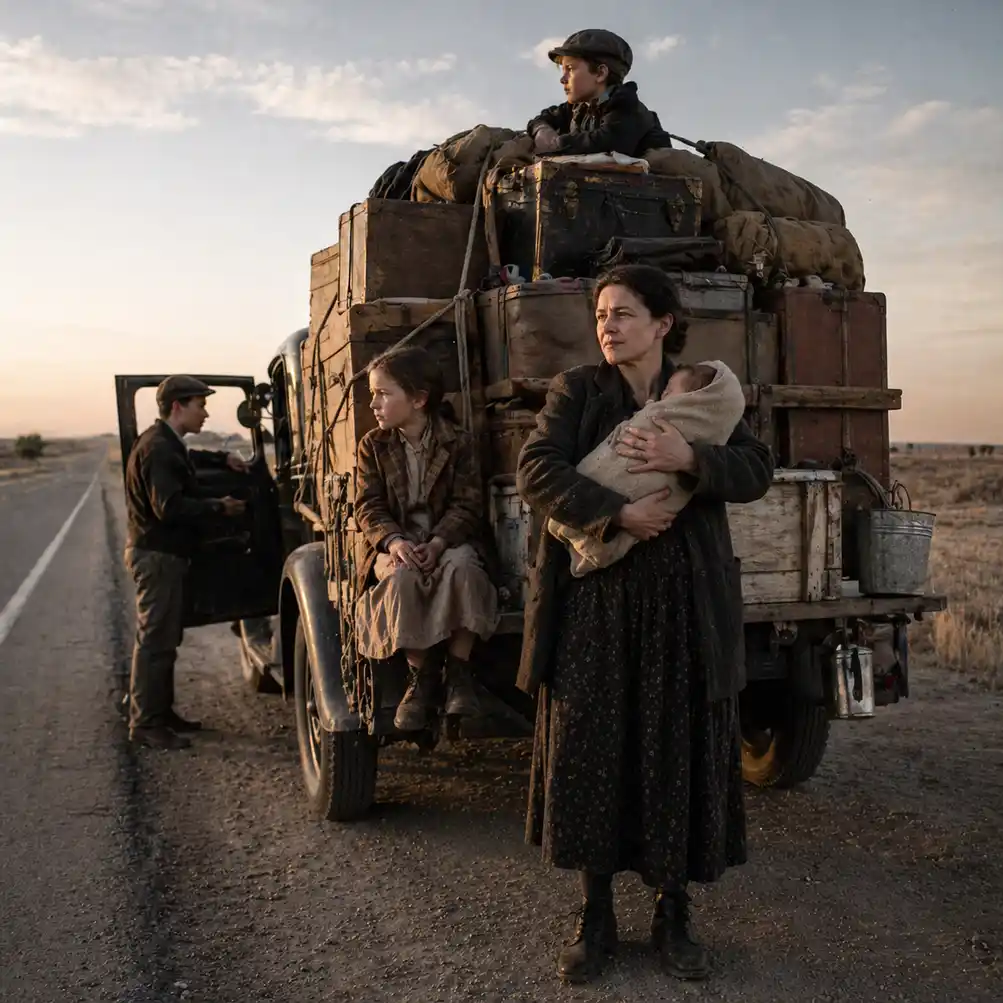
The little farm matters because it would give two men somewhere to stay. In Of Mice and Men, John Steinbeck makes ownership sound less like upward mobility than relief from being disposable. George Milton and Lennie Small move through California looking for ranch work during the Great Depression, carrying a repeated description of the life they hope to build together.
George is quick, practical, and frequently exasperated. Lennie is physically powerful, intellectually disabled, and unable to anticipate the consequences of his strength. Their friendship interrupts the solitary pattern of migrant labour, but it also creates demands George cannot meet simply by being loyal. The novella treats affection as a substantial resource without pretending that it provides adequate protection.
What distinguishes Of Mice and Men is the pressure placed on its apparently modest wish. A few acres, animals, and control over work become extraordinary prospects for people whose bodies and labour are useful only under someone else’s terms. When other workers begin imagining a place on the farm, the dream briefly resembles a practical arrangement rather than a private bedtime story.
The writing keeps that hope close to material particulars. Savings, wages, age, housing, and the next job determine what can be promised. Tenderness grows inside those calculations, which makes the eventual loss more painful than an abstract statement about broken dreams would be.
This review includes the ending. The book’s force depends on the connection between its opening refuge, the ranch’s hierarchies, and George’s final action. Reading it only as a moving friendship story can miss how thoroughly the available choices have been narrowed before that action takes place.
Who Can Share the Dream in Of Mice and Men?
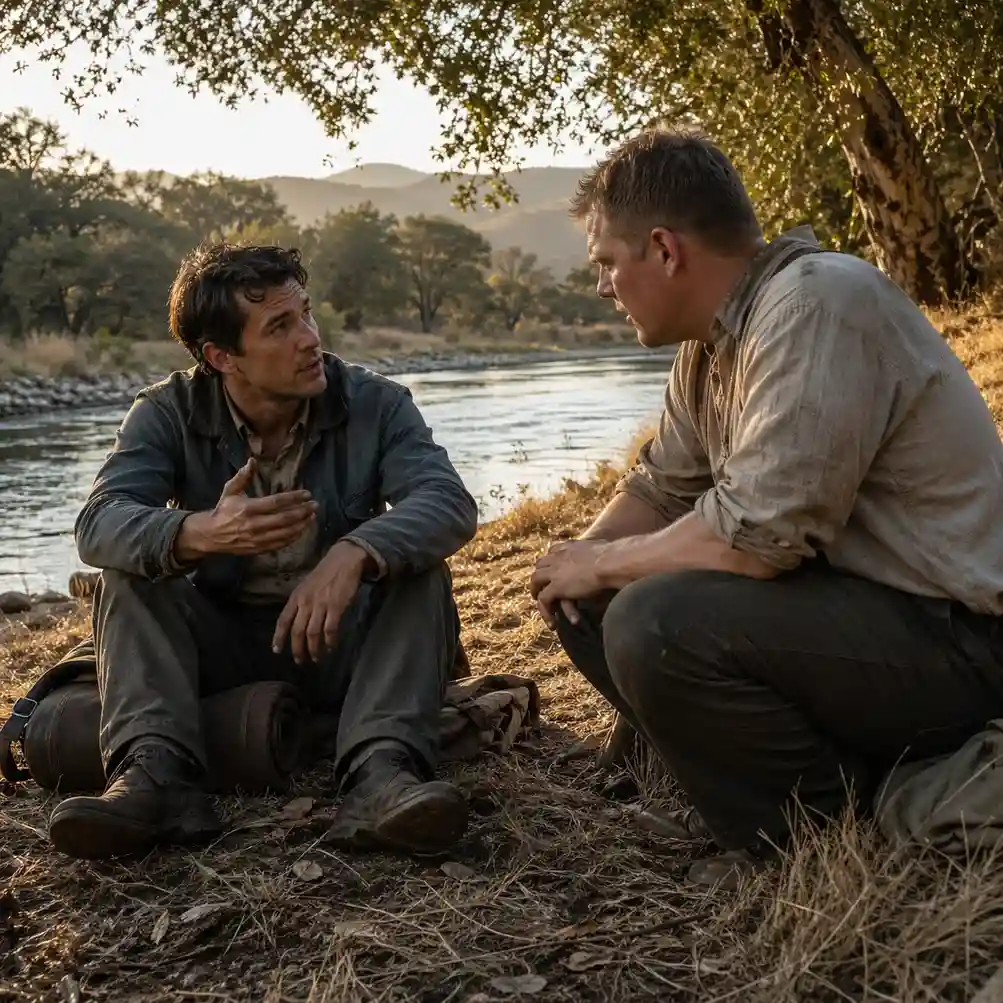
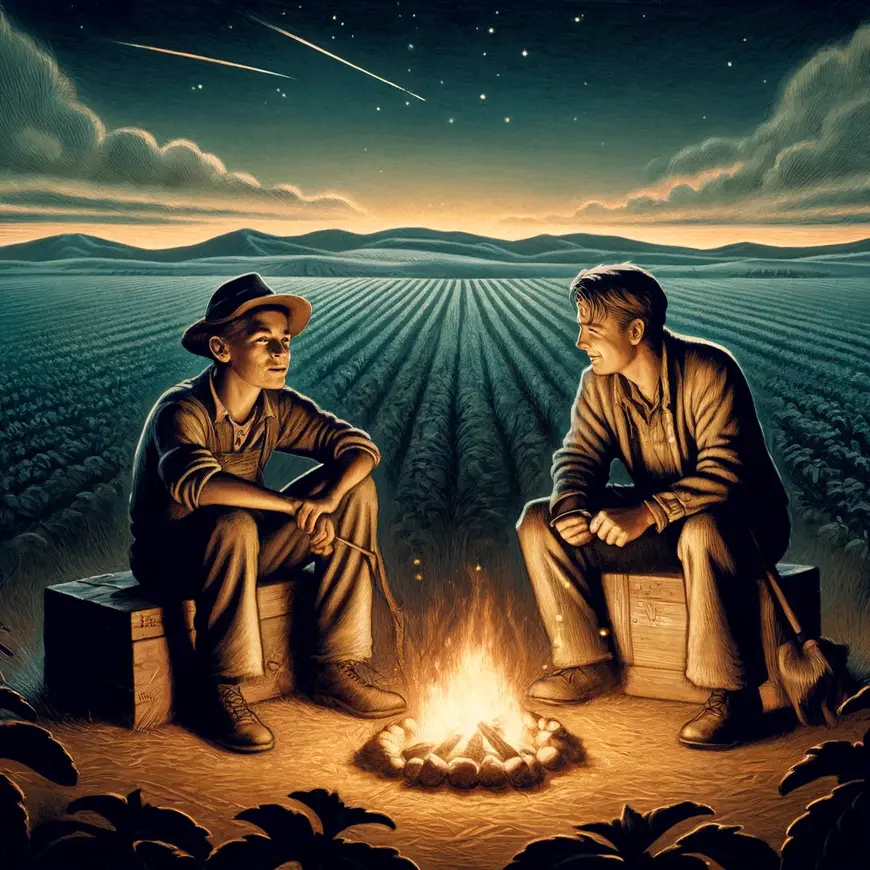
George’s account of the farm begins as a familiar performance between friends. Lennie knows which details he wants repeated, especially the rabbits. The ritual gives their wandering a destination, even before either man can demonstrate that the destination is affordable. Repetition makes hope inhabitable for a few minutes at a time.
The arrangement changes when Candy offers money. His savings transform the story into something that might be purchased. He also brings a need of his own: age and his injured body leave him vulnerable to dismissal. His contribution buys the possibility of remaining useful somewhere that is not organised entirely around an employer’s convenience.
In Of Mice and Men, this movement from fantasy towards arithmetic is crucial. Hope is neither wholly delusional nor securely achievable. The figures briefly appear to work, and that moment gives the later collapse a particular sting. They have not merely wished; they have almost assembled a plan.
The friendship in Three Comrades by Erich Maria Remarque offers a broader social circle for comparison. Both books place loyalty under economic pressure. Here, however, the small number of reliable relationships means that one person’s failure can bring down the whole imagined future.
Of Mice and Men also makes belonging conditional. Crooks can briefly imagine joining, yet a racist threat reminds him that hopeful conversation has not altered his position. The farm is attractive partly because it promises a different social arrangement, but its imagined inclusiveness remains fragile. The question is not only whether land can be acquired. It is whether the people who need it can remain safe long enough to reach it.
Loneliness Has Different Causes
The ranch gathers people who are lonely, but it does not make their loneliness equivalent. George and Lennie have unstable work. Candy fears becoming unemployable. Crooks is segregated because he is Black. Curley’s wife has a marriage and a house without satisfying companionship. Shared pain does not erase unequal power.
Crooks’s room is especially revealing. His separation from the bunkhouse is enforced, not a preference for solitude. When Lennie enters, the encounter begins with a struggle over the few boundaries Crooks can claim. His sharpness is intelligible as defensive conduct inside a system that routinely denies him ordinary inclusion.
Of Mice and Men then complicates sympathy by letting Curley’s wife threaten him with racist violence. Her exclusion from the men’s companionship does not prevent her from exercising power over someone more exposed. The scene refuses a comforting division between vulnerable people and those capable of harm.
Her lack of a personal name remains troubling. The designation keeps her attached to a husband whose household restricts her, while her account of a possible performing career briefly supplies ambitions beyond that role. The narrative allows her disappointment to register, yet her characterisation remains constrained by the fatal function she eventually performs.
Beloved by Toni Morrison gives the struggle for safety and personhood a very different historical and narrative scope. Its relevance here lies in the warning against making vulnerable lives interchangeable. The institutions and histories producing danger matter.
That distinction improves a reading of Of Mice and Men. A general claim that everybody needs somebody is true but insufficient. Some characters are denied companionship by prejudice, others by their position within work or marriage. Their brief encounters reveal how those causes intersect without becoming identical.

Writing Style: Plain Speech, Precise Construction
The Writing Style combines concrete description with dialogue that performs several jobs at once. A conversation can introduce the ranch’s social rules, establish a character’s fear, and prepare a later reversal. The prose is accessible, but accessibility rests on compression, not on a shortage of design.
Of Mice and Men unfolds through a small number of sharply bounded scenes. Characters enter an already defined space, speak under pressure, and leave consequences behind them. The bunkhouse and Crooks’s room feel almost stageable because objects, entrances, and listening arrangements help determine what can happen there.
The landscape passages offer another rhythm. The opening riverbank supplies shade, water, animal movement, and the possibility of rest before human demands interrupt it. Returning there near the end makes recognition painful. The setting gathers memory: a familiar location has not remained emotionally unchanged merely because its physical features are still present.
Speech establishes the friendship’s routines without requiring a lengthy explanation of its history. George’s irritation, Lennie’s prompts, and their shared account of the farm carry the relationship through repeated verbal habits. The dream has a spoken form, and its recurrence lets the reader hear shifts in George’s confidence.
The concentrated suffering in Woyzeck by Georg Büchner provides a useful formal comparison. Both works make short encounters disclose pressures acting on a precarious life. The novella’s carefully returning motifs differ from the play’s fragmentary construction, but neither requires an expansive plot to make social power visible.
At times, Of Mice and Men is almost too orderly in its preparation of catastrophe. Animals, warnings, and parallels can feel arranged towards a foreknown result. The same construction also gives the ending its force: a reader recognises what is being repeated and still hopes the repetition might be interrupted.
The Animals and the Final Choice
The deaths of the mouse, the puppy, and Candy’s dog prevent the final scene from arriving without warning. They connect vulnerability, affection, and the power to decide which lives can continue. Of Mice and Men uses the animals as more than predictions: each incident exposes a different failure of care.
Lennie’s desire to touch soft things is pleasurable to him and dangerous to what he holds. The narrative does not make intention equivalent to effect. His remorse cannot revive an animal, and instructions cannot reliably give him the capacity to regulate his strength under fear. Affection is not sufficient control.
Candy’s dog’s death introduces another problem. The others frame the killing through discomfort and usefulness, while Candy loses a companion. His later regret that he did not perform the act himself prepares George’s decision without settling its morality. A structural parallel is not automatically an ethical justification.
When Lennie kills Curley’s wife, George faces the prospect of a violent pursuit and Lennie’s inability to understand what is coming. His final retelling of the farm offers reassurance while concealing what he is about to do. Care and betrayal occupy the same gesture, which is why a simple label of mercy cannot exhaust it.
In The Old Man and the Sea by Ernest Hemingway, killing and attachment also coexist. The comparison clarifies an important difference: George’s decision concerns a dependent friend within a social emergency, not a struggle whose terms can be contained by a fisherman’s vocation.
Of Mice and Men lets Slim acknowledge George’s suffering. Carlson’s final incomprehension then exposes a limit to that acknowledgment. The surrounding world has not learned what the reader has witnessed, and it provides no guarantee that the conditions producing the disaster will change.
Quotes from Of Mice and Men: The Small Language of a Larger Need
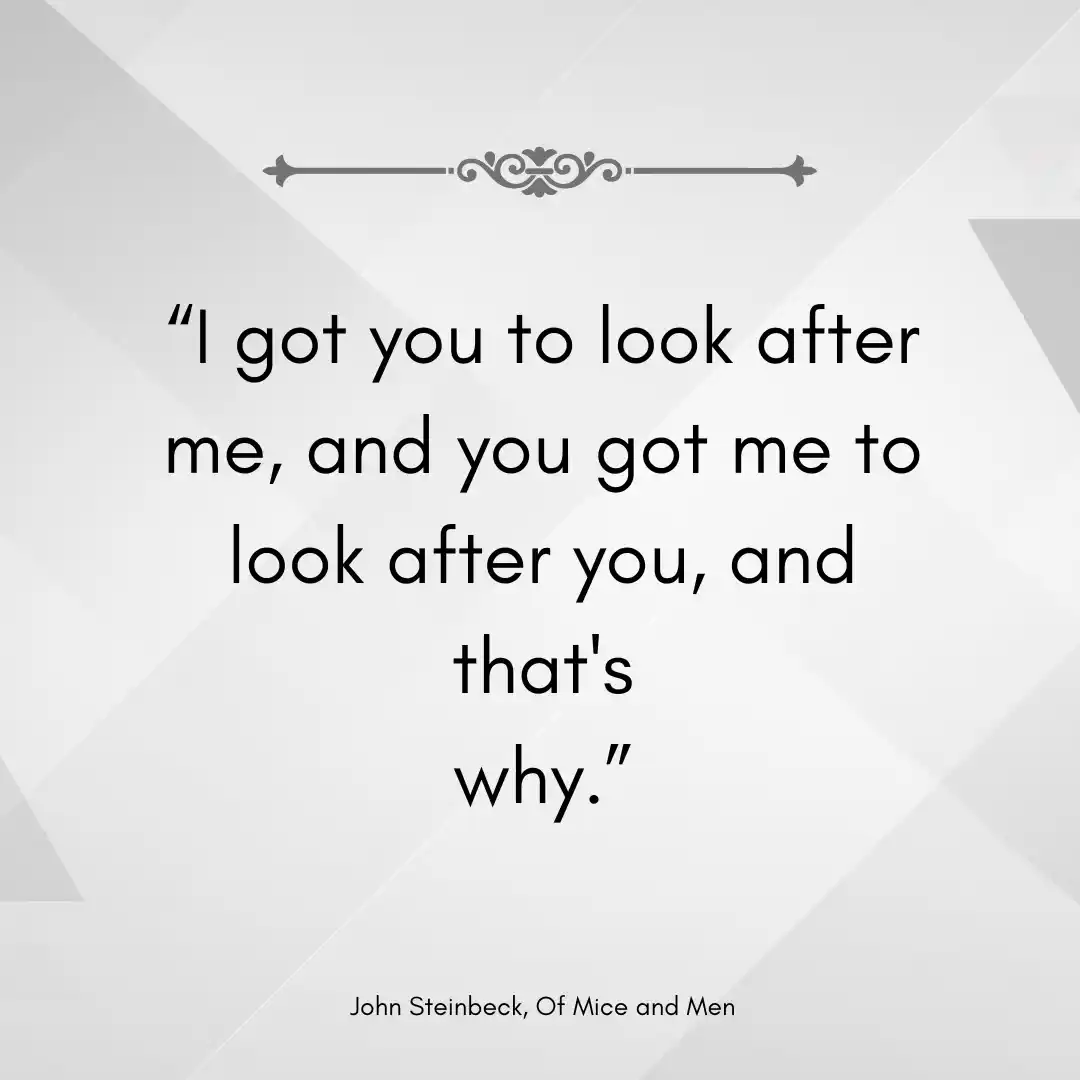
These short passages retain the novel’s English wording, including its colloquial grammar. The publisher’s reading guide reproduces them with edition-specific page references. In Of Mice and Men, their significance depends on who speaks, or on whose perception the narration asks us to trust.
- “take so much trouble” This fragment comes from Slim’s question to George about his commitment to another man, quoted on page 21 in the guide. The question makes ordinary companionship sound unusual within the ranch’s habits, revealing how solitary labour has become the expected arrangement.
- “understanding beyond thought” The narrator’s description of Slim, on page 31, gives him an authority different from the boss’s employment power. His capacity to recognise what another person is enduring becomes important at the end, when explanation alone cannot restore George’s loss.
- “We’d belong there” George says this while describing the farm, on page 54. The possessive ambition is inseparable from a wish for membership and security. Ownership promises a place in the world, rather than simply a larger balance of money.
- “live on the fatta the lan’” The farm refrain, cited on page 101, returns beside the river. Lennie’s anticipation carries earlier pleasure into a scene the reader now understands differently. Repetition creates the devastating distance between what he imagines and what George knows.
- “A guy got to sometimes” Slim’s words, on page 102, acknowledge the pressure surrounding George’s action. They are a character’s response to a particular situation, not a universal permission slip for deciding another person’s fate.
Read together, the fragments show why Of Mice and Men cannot be confined to its final shock. The language has been building the need that makes the shock hurt.
Trivia: A Novella Built Near the Theatre
- Publication before performance: Of Mice and Men was published by Covici-Friede on 6 February 1937. The Broadway play opened later that year, on 23 November, so the book did not follow a stage premiere that had already taken place several months earlier.
- A deliberately playable form: The work belongs to the author’s experiments with the play-novelette. Its compact scenes and prominent dialogue were therefore connected to a practical interest in prose that could become theatre, rather than being accidental features noticed only after adaptation.
- A title from Burns: Robert Burns’s poem To a Mouse supplies the title’s association between human plans and disruption. The connection makes Of Mice and Men‘s small animals part of a wider meditation on vulnerable creatures, without implying that humans and animals face identical circumstances.
- The Broadway venue: The original New York production opened at the Music Box Theatre. This locates the stage adaptation in a specific theatrical history and helps distinguish it from subsequent revivals and screen versions. IBDB production record
- Recognition for the stage version: The play received the New York Drama Critics’ Circle Award in 1938. That distinction belongs to its theatrical reception, rather than being a prize awarded to the novella as a novel or a retrospective honour for the writer’s complete career.
- An early screen adaptation: A film version was released in December 1939, according to the Center for Steinbeck Studies chronology. Book, stage, and screen thus followed distinct dates, even though later discussion often treats their shared title as one continuous event. Publication and adaptation chronology
Of Mice and Men Beyond the Final Shock
The ending is memorable, but the novella’s achievement begins earlier, with the credibility of a future two friends can describe before they can afford it. Of Mice and Men makes that description emotionally substantial through ordinary particulars. The promised animals and shared work are the shape that dignity takes for these men.
Its strongest passages preserve uncomfortable distinctions. Lennie’s disability does not make the damage he causes unreal. George’s commitment does not give him unlimited capacity to prevent it. Curley’s wife’s loneliness does not erase her racism, and Crooks’s guarded manner does not diminish the injustice of his exclusion. Sympathy requires attention to difference.
A gentler alternative community appears in The Grass Harp by Truman Capote . Reading the two together illuminates how belonging can be imagined outside conventional usefulness. The difference in tone also shows how relentlessly this ranch closes down such possibilities.
The book’s limitations deserve to remain visible. Its concentration of suffering sometimes gives the characters the outline of tragic functions, especially Curley’s wife. The final parallel with Candy’s dog can encourage a sentimental defence of George that moves too quickly past questions of disability and power. Emotional force should not end the argument.
For readers willing to stay with those tensions, Of Mice and Men offers a remarkably concentrated experience. Its readable surface makes it approachable, while its decisions remain difficult enough for substantial discussion. I find its final incomprehension as telling as its final act: the dream has vanished, George has lost his companion, and somebody standing nearby still cannot understand why either loss matters.
Other Reviews of Works by the modern american writer