Strait is the Gate by André Gide: When Love Demands Sacrifice
Strait is the Gate by André Gide is a quietly devastating story of love, faith, and the unbearable weight of moral restraint. First published in 1909, the novel follows Jérôme, a young man who falls in love with his cousin Alissa. As they grow closer, Alissa’s spiritual obsession and self-denial slowly unravel their bond. At its surface, the plot is simple. But the emotional depth is staggering.
His narrative isn’t concerned with action. Instead, he explores emotions buried beneath silence, and the moral decisions that shape — and ruin — lives. What makes this novel so moving is not what happens, but what doesn’t. The missed chances, the unread letters, the words left unsaid. Through this absence, the author reveals a tragic spiritual conflict that feels deeply human.
What I found most haunting is the structure. The novel begins with Jérôme’s perspective, full of confusion and devotion. Then comes Alissa’s voice, clear, cold, and devastating. We see the same events through her eyes, and suddenly, everything shifts. Gide forces us to reread the story with new pain, exposing the limits of love when bound too tightly to faith.
Strait is the Gate belongs to a small group of novels that can be read in a few hours but linger for a lifetime. It offers no easy answers. Only a question: how much should we give up for love?

The Path That Grows Narrower
At the heart of Strait is the Gate lies a tragic romance told through restraint. The story begins with Jérôme, a sensitive and intelligent boy, who becomes emotionally entangled with his cousin Alissa. Their bond, formed during adolescence, soon deepens into love. But Alissa, raised in a strict Protestant household and burdened by spiritual guilt, starts to pull away. She does not reject Jérôme out of dislike or indifference, quite the opposite. Her love is genuine, but she believes that denying it is a higher virtue.
Jérôme never fully understands the cause of her distancing. She offers half-explanations and gentle evasions, choosing spiritual elevation over earthly attachment. What begins as a potential romance slowly becomes a one-sided search for closeness. Alissa’s silence becomes the central force of the novel. Through her letters and actions, we see a woman at war with her own heart, refusing happiness out of a belief that love must be renounced to be holy.
The story takes on a new layer when we hear from Alissa directly in the second part. Her diary entries reveal that her actions were not cold, but rooted in intense emotional suffering and spiritual fear. The tragedy is not only that they are apart, but that both loved deeply and misunderstood completely.
The novel ends not with closure but with quiet resignation. Jérôme finally understands Alissa’s motives, but too late. Their love, once a path toward happiness, has narrowed into something unreachable. 👉 The Good Person of Szechwan by Bertolt Brecht offers a similarly moral dilemma, where virtue and desire seem permanently at odds.
The Man Behind the Restraint
André Gide was no stranger to inner conflict. Born in 1869 in Paris, he grew up in a rigid Protestant household not unlike the one he would later depict in Strait is the Gate. A writer, thinker, and Nobel Prize laureate, he remains one of France’s most complex literary figures. His works consistently explore the tensions between desire and morality, freedom and repression, truth and convention.
His own life mirrored many of the struggles in his fiction. Though he married Madeleine Rondeaux, his cousin and a deeply religious woman, the novelist eventually embraced his homosexuality, a radical act for a man of his background in early 20th-century France. His courage in writing openly about sexuality, particularly in Corydon, paved the way for future generations of authors grappling with identity and repression.
What makes Strait is the Gate so powerful is that it doesn’t moralize. He avoids judgment. He simply lays bare the emotional wreckage caused by rigid belief systems. His style is clean, precise, and profoundly introspective, favoring psychological realism over plot-driven narratives. Even in his most spiritual or philosophical works, the author stays grounded in the personal.
👉 The Stranger by Albert Camus is another novel where the author’s biography adds powerful subtext to a story about alienation and conviction. Both authors confront the quiet tragedies of people who can neither change the world nor fully accept it.
When Devotion Turns into Denial
At the emotional core of Strait is the Gate lies a spiritual paradox: Alissa’s rejection of love is not rooted in indifference but in deep belief. She sees her love for Jérôme as something too earthly, too selfish, too distracting from her greater commitment to God. Her actions are not driven by cruelty but by a kind of moral rigor that becomes its own prison. What Gide portrays is not religious piety, but how piety can contort genuine human emotion into silence and sacrifice.
This theme of denial is mirrored throughout the book. Jérôme, too, is deeply affected by Alissa’s choices. He doesn’t rebel or push back, instead, he retreats into longing. As readers, we watch two characters walk parallel paths toward loneliness, each convinced they are doing what is right. The tragedy is not betrayal but obedience, to ideals, to expectations, to something larger than themselves.
Faith here is not comfort. It is duty, guilt, and loss. Alissa believes that renunciation is her spiritual calling, and that fulfillment in love would only diminish her purity. The author doesn’t judge her; he observes her. The result is painful and haunting, because her spiritual strength becomes her emotional undoing.
The novel invites comparison with 👉 Mario and the Magician by Thomas Mann, another story where idealism — whether religious or political — leads to personal disintegration. In both, ideology is not abstract; it’s lived, suffered, and carried in silence.
Characters and Inner Silence – Love Demands Sacrifice
The emotional intensity of Strait is the Gate does not come from dramatic events. It emerges from what is withheld. The novel’s two central characters, Jérôme and Alissa, are caught in a lifelong conversation of silence, a dialogue of letters, glances, and gestures. They are both sincere, yet incapable of fully understanding one another. This emotional misalignment, rendered through sparse and poetic prose, creates a powerful atmosphere of quiet tragedy.
Jérôme is introspective and patient, shaped by longing more than action. He loves Alissa deeply but never learns to truly communicate with her. His devotion borders on passivity, a trait that adds to the novel’s slow, almost painful unfolding. Alissa, in contrast, is all restraint. Her diary reveals a storm of contradictions: love, guilt, yearning, and a deep need for spiritual perfection. She chooses self-denial as a form of purity, but in doing so, cuts herself off from life.
Secondary characters, like Alissa’s sister Juliette, offer glimpses into other paths. Juliette is more worldly, less constrained by religious burden. She could have been a mirror to Alissa’s alternate fate, had Alissa chosen differently. But even Juliette, in the end, is marginal — this is Alissa’s and Jérôme’s story, written in spiritual ink.
One can draw an emotional parallel with 👉 The Heart of a Broken Story by J. D. Salinger. Both narratives explore characters so absorbed by inner tension that real connection becomes elusive. It’s not that they lack feeling — it’s that their feelings remain locked within.
Language, Form, and Spiritual Precision
Gide’s language in Strait is the Gate is stripped of embellishment. His sentences are short, almost hesitant, yet each word carries emotional weight. This simplicity is not a limitation but a choice, a way to reflect the spiritual austerity of the novel’s theme. There are no unnecessary metaphors or overwrought descriptions. The prose is devotional, like a prayer written in secret.
The novel’s structure mirrors a quiet, inward spiral. It begins with recollection — Jérôme looking back — and unfolds through letters, diary fragments, and sparse narration. This fragmented form enhances the feeling of emotional distance, even as we are brought closer to the characters’ thoughts. The use of diaries and letters gives voice to Alissa’s inner world, one she could never share openly in life. It is only after her death that Jérôme fully reads her heart.
He understood that love stories are often stories of failure. And failure, when rendered in spare and honest prose, can be more moving than triumph. His careful rhythm — the silences between the lines — gives Strait is the Gate its peculiar power. It reads not like a novel, but like a spiritual confession, bare and unsettling.
This minimalist, introspective style recalls 👉 The Method by Juli Zeh, where control and silence shape both character and form. In both novels, restraint is a form of narrative power, and a source of psychological tension.
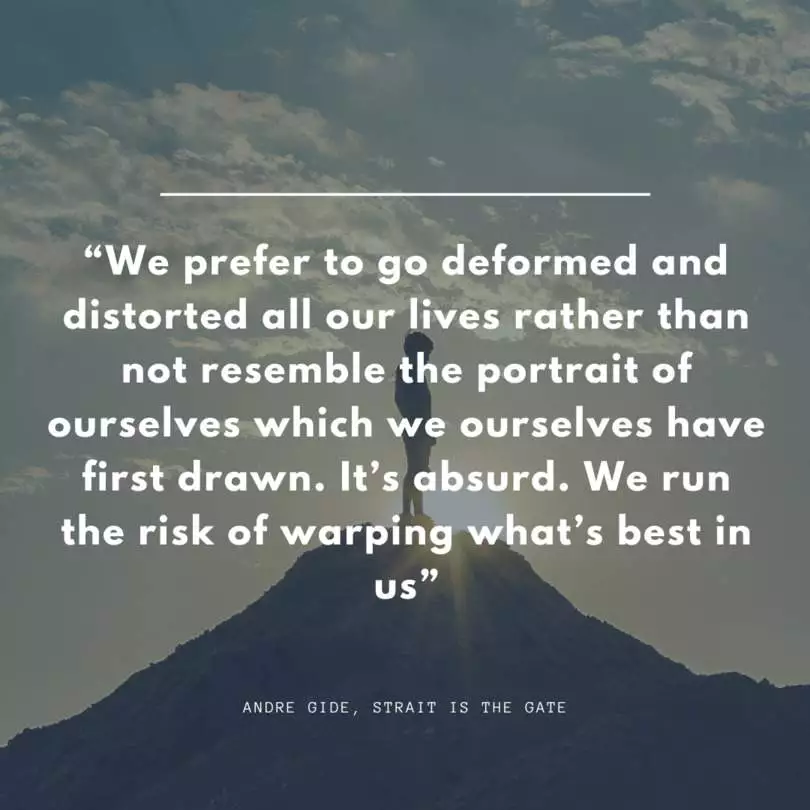
Quietly Devastating Quotes from Strait is the Gate by André Gide
- “I wanted to possess her soul more than her body.” Love here is not about physical closeness but spiritual dominance. Jérôme’s desire is shaped by idealism, not reality.
- “It is easier to renounce love than to learn moderation in it.” This is the core of Alissa’s decision. She doesn’t trust herself to love without sin, so she denies it completely.
- “She took refuge in silence, as if it were a sanctuary.” André Gide uses silence not as absence but as action, a powerful retreat from feeling, yet filled with meaning.
- “Everything in me that rejoiced died when she closed the door.” The novel thrives on these quiet moments of emotional finality, never loud but permanently felt.
- “We were too sincere to ever be happy.” This line encapsulates the paradox of the novel: that truthfulness, when absolute, can be isolating.
- “The purer my love, the less she trusted it.” He shows how ideals can twist perception, Alissa sees purity as threat, not gift.
- “She starved herself of joy so that she might be worthy of grace.” A heartbreaking line that reveals how deeply Alissa internalized guilt and holiness as opposites.
- “Each of us loved in solitude, afraid to contaminate the other.” Their mutual devotion becomes a kind of exile, not from each other, but from the real, flawed possibility of happiness.
Hidden Insights from Strait is the Gate
- Inspired by his cousin and lost love: The character of Alissa was loosely based on Madeleine Rondeaux, Gide’s real-life cousin and wife. Their complex relationship deeply influenced his portrayal of idealized, unattainable love.
- A title drawn from scripture: The phrase “Strait is the gate” comes from the Gospel of Matthew. The writer uses it to frame Alissa’s spiritual struggle, where salvation is imagined through renunciation rather than fulfillment.
- Letters before literature: The novel’s structure mimics an exchange of letters and diary entries. He often wrote personal letters as a form of literary experimentation before developing them into fiction.
- Paris, but always distant: Though set partly in France, the novel never immerses itself in Parisian life. The urban backdrop remains blurred, reflecting the characters’ detachment from worldly experience.
- Comparable to Remarque’s emotional restraint: The Road Back by Erich Maria Remarque also uses subtle prose to express profound emotional loss, though with a social, not spiritual, focus.
- A rare woman’s voice in his canon: Alissa is one of Gide’s most vividly rendered female characters. Her internal voice stands out in a body of work otherwise focused on male consciousness.
- Büchner’s echo in Alissa’s breakdown: Like the protagonist in Woyzeck by Georg Büchner, Alissa is slowly crushed by moral pressure, not by madness, but by excessive moral solitude.
- A masterpiece of understatement: Strait is the Gate is often praised for what it does not say. Its emotional power lies in pauses, hesitations, and what remains unsaid. This subtlety has been recognized by outlets like The Paris Review as a defining trait of modernist introspective fiction.
Why I Loved It
Strait is the Gate left me feeling quiet, not just thoughtful, but truly hushed. Some books leave you with images or ideas. This one leaves you with a silence. Not an empty silence, but one that echoes. I didn’t fall for it right away. The plot is delicate, the action subdued, but once I began to listen between the lines, I couldn’t let it go.
What moved me most wasn’t the love story, though it’s beautifully tragic. It was the earnestness of the characters. Jérôme’s longing isn’t cynical. Alissa’s retreat isn’t dramatic. Everything feels painfully sincere, and that sincerity is rare. The novel trusts the reader to find depth not in events, but in restraint, and that made me lean in, line by line.
There’s also something daring in writing a story where nothing is quite fulfilled. The novelist refuses resolution. There is no catharsis, no dramatic climax. Just the slow erosion of hope, and the aching beauty of what could have been. That, to me, is more powerful than any happy ending.
👉 Orlando by Virginia Woolf also evokes a sense of time folding inward, though with a more playful tone. Where Woolf experiments with gender and identity, he stays rooted in purity and denial. But both authors understand something essential: that inner lives are often stranger, and richer, than outward ones.
Final Thoughts on Strait is the Gate and Enduring Echoes
Finishing Strait is the Gate felt like closing a letter I was never meant to read. The story doesn’t shout its meaning, it whispers it, softly, like a memory that refuses to fade. The novel lingers in the mind because it avoids what most love stories crave: completion, comfort, clarity. Instead, it offers something more unsettling and honest, the haunting weight of missed connection.
His genius lies in how little he needs to say to say everything. With each reread, I found new pain in old lines, and fresh admiration for the craft behind the stillness. Alissa and Jérôme never truly meet, not in the way they hope. Their bond is spiritual, literary, tragic, and that’s exactly why it endures. Their silence becomes their legacy, and we are left to interpret what was lost in translation.
I believe the novel’s staying power comes from its refusal to explain. Gide trusts the reader to feel the ache without dressing it up. In doing so, he places us beside Jérôme, holding Alissa’s final words, asking ourselves what we missed.
For those drawn to quiet devastation, to moral paradoxes, to prose that feels like breathing, the book will find its place in your heart. It’s a book not to be finished, but carried. 👉 Germany. A Winter’s Tale by Heinrich Heine similarly blends spiritual search wit