The Heart of a Broken Story: Romance, Cliché, and Failure
Published in Esquire in September 1941, The Heart of a Broken Story begins with the material of a conventional magazine romance. Justin Horgenschlag, a poorly paid printer’s assistant, sees Shirley Lester on a Third Avenue bus and believes that she could end his loneliness. J. D. Salinger then interrupts the encounter before the two strangers exchange a word.
What follows is not an unfinished romance but a carefully completed metafictional comic short story. The self-interruption becomes the governing form of The Heart of a Broken Story. The narrator tests one formula after another, exposes its falsity, and finally allows ordinary life to replace literary destiny. The failed plot becomes the story’s successful design, turning the work into a parody of magazine romance and an early example of self-reflexive literary satire.
Justin and Shirley Meet Only Inside a Writer’s Problem
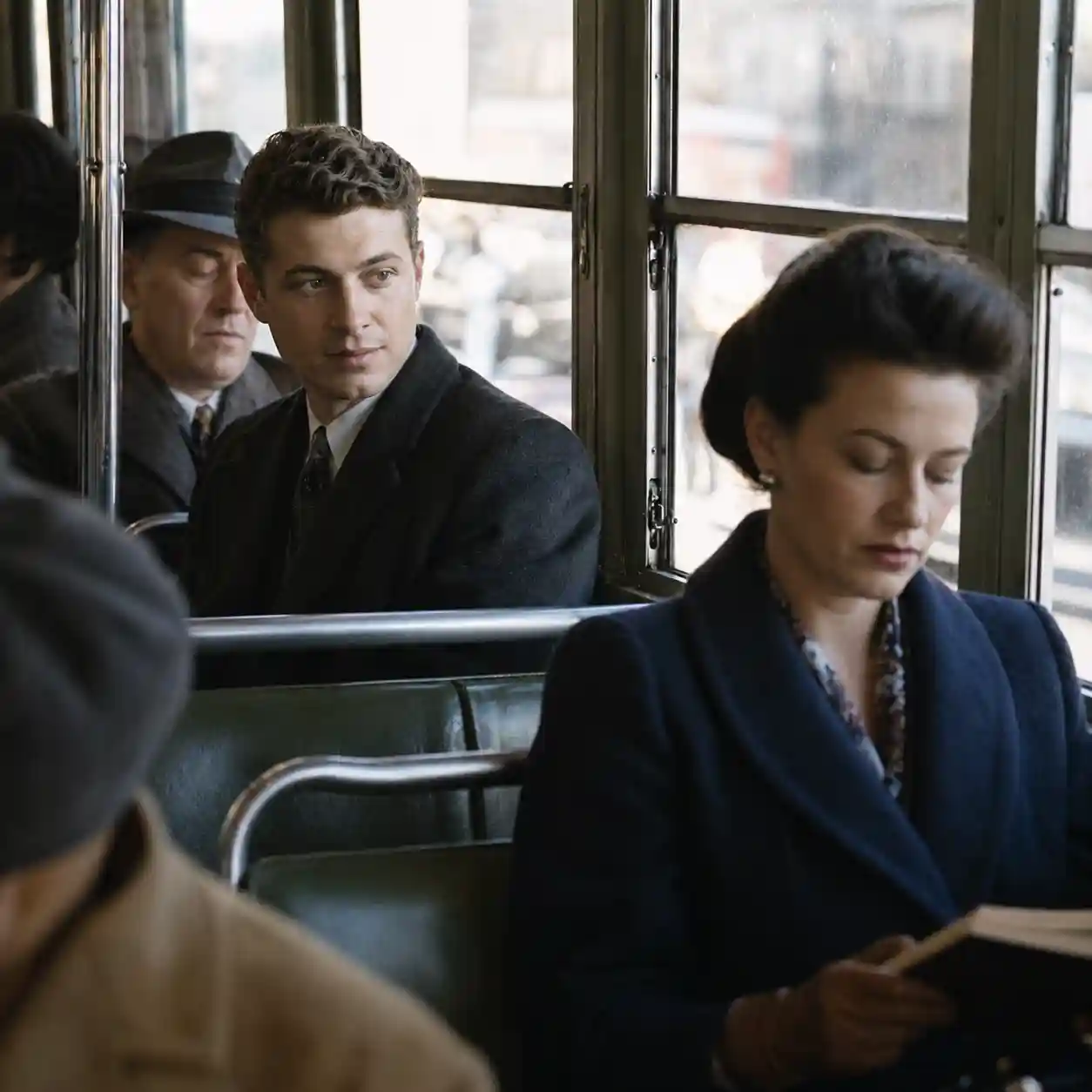
Justin and Shirley share physical space, but they never meet in any social or emotional sense. He stands near her on the bus, studies her parted lips, and invests a stranger with the power to cure years of urban loneliness. Shirley remains unaware of this private transformation and continues reading an advertisement. His love begins as a narrative imposed on someone he does not know.
That imbalance controls The Heart of a Broken Story. Justin has an intense feeling, yet intensity cannot create mutuality or even justify an introduction. The narrator understands that a sentimental plot needs the appearance of reciprocity, but the actual circumstances provide only desire on one side and silence on the other. The supposed lovers therefore exist together only in possibilities manufactured after the narrator stops the initial scene.
Fiction about fiction takes a more expansive form in The Counterfeiters by André Gide. Gide places the making of a novel inside the novel itself, while the writer turns a blocked introduction into a compact argument about authorship. Both works reveal that narrative conventions do not merely organize experience. They can counterfeit emotional knowledge when a writer makes form more authoritative than the people being described.
The comedy depends on the narrator recognizing this danger while repeatedly approaching it. He could force the meeting through coincidence, disguise, injury, or crime, but each device would falsify either Justin or Shirley. The Heart of a Broken Story is thus driven by refusal. The writer’s problem is not a shortage of events, but an unwillingness to pretend that one person’s fantasy already contains a relationship.
The Third Avenue Bus Makes Loneliness Statistical
The opening reduces New York encounter to comic arithmetic. Justin supposedly sees about sixty unfamiliar women each day, and the narrator narrows thousands of possible faces through age, weight, and attractiveness until Shirley appears as the single object of love at first sight. Statistical precision disguises emotional absurdity. Numbers make chance look measurable while exposing how little Justin actually knows.
This catalogue also places The Heart of a Broken Story inside a modern city shaped by proximity without connection. The bus brings bodies close together, but social custom limits speech between strangers. Justin has lived in New York for four years and moves through crowds every day, yet he imagines loneliness as a monster that one visually appealing woman might instantly destroy. His longing is real, although the solution he projects onto Shirley is not.
Romantic disillusionment emerges with quieter social polish in A Certain Smile by Françoise Sagan. Sagan follows characters who enter relationships and discover the limits of their own expectations. The bus scene never reaches that stage because Justin converts an advertisement-reading commuter into an answer before she can become a person to him.
The counting is also openly judgmental. Women are filtered as if they were items in a commercial inventory, while Shirley’s income, height, body, family obligations, and appearance are rapidly catalogued. J. D. Salinger uses that objectifying voice without making it a reliable measure of value. In The Heart of a Broken Story, the ridiculous calculations reveal a culture that teaches desire to speak through ranking, consumption, and cinematic selection even when the desired person remains inaccessible.
Collier’s Becomes the Market Behind the Story
The narrator explains that he intended to write a tender boy-meets-girl story for Collier’s. That declaration transforms an apparently private romantic failure into a problem of commercial production. In The Heart of a Broken Story, he is not simply wondering whether Justin could approach Shirley. He is trying to construct an encounter that readers and editors will recognize as plausible, attractive, and worth buying. The imagined magazine becomes an invisible co-author.
The work repeatedly addresses what an audience might accept. A blunt confession would make Justin seem foolish, while a polished introduction would require a sudden personality he does not possess. The narrator mocks sentimental expectations but also understands their economic force. Even his jokes about plausibility are tied to the price of the magazine and the need to give consumers the conventional satisfaction promised by a romance plot.
Love becomes similarly entangled with narrative construction in Swann’s Way by Marcel Proust. Proust shows an individual transforming partial knowledge into an obsessive story about another person. This short satire adds a second maker of illusions: the professional storyteller who must translate projection into a marketable sequence.
The publication context sharpens the joke. The story that claims it could not become a piece for Collier’s appeared instead in Esquire, so failure within the fiction becomes distinction in another editorial market. J. D. Salinger does not reject magazine publication from a position outside it. He uses one periodical to parody the formulas associated with another. In The Heart of a Broken Story, artistic skepticism and commercial calculation remain inseparable because the critique itself must find readers.
Every Possible Introduction Exposes Another Cliché
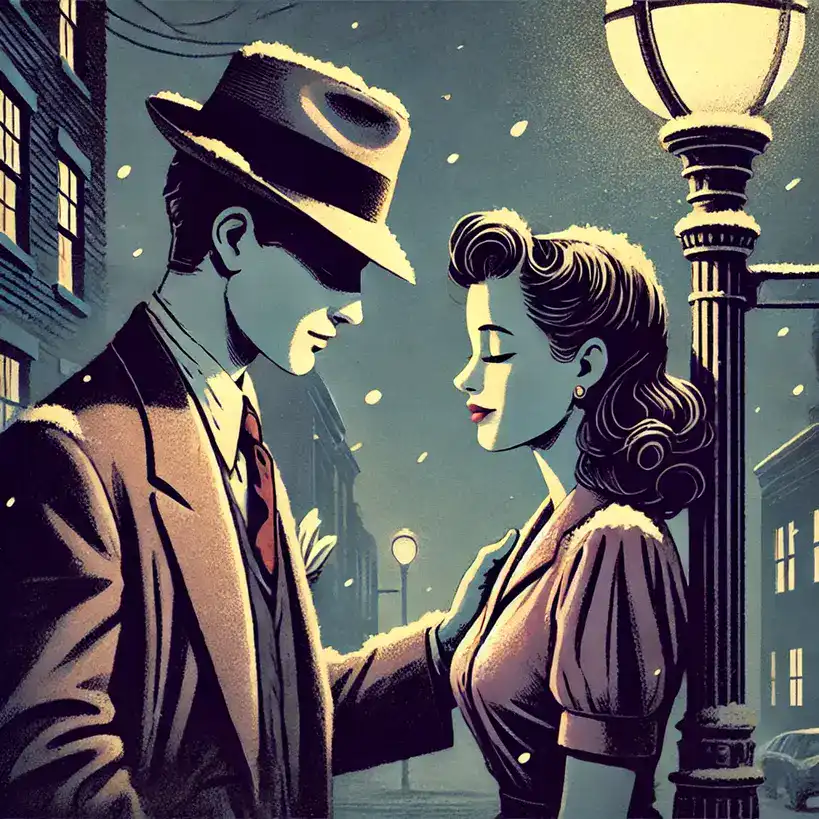
Once direct speech fails, the narrator begins testing mechanisms. Justin could pretend to mistake Shirley for someone from Seattle, faint and damage her stocking, or steal her handbag so that a court would disclose her address. Each scheme promises contact, yet each also exposes the coercion hidden inside an apparently charming convention. Plot devices keep solving the writer’s problem by worsening the characters’ lives.
The false-recognition approach requires Justin to manipulate a stranger who has already signaled disinterest. The fainting plan turns bodily accident and damaged clothing into a route toward personal information. The handbag theft goes further by treating fear, police intervention, and judicial punishment as machinery for romance. The Heart of a Broken Story makes these devices funny because the narrator follows their logic past the point where sentimental fiction usually stops looking.
Competing scripts of attraction drive The Rules of Attraction by Bret Easton Ellis. Ellis distributes desire among voices that misread one another, whereas this narrator invents every voice and still cannot make them converge. More control produces no greater truth because the obstacle is not technical complexity. It is the lack of mutual desire in the original situation.
The criminal scenario finally kills Justin during a prison escape that he joined after Shirley stopped answering him. This extravagant chain parodies the way stories convert coincidence into necessity. He lets a trivial bus encounter expand into courtroom melodrama, prison brutality, a hostage crisis, and accidental death, then rejects the whole structure. The book demonstrates that unlimited invention cannot rescue a premise when every rescue depends on violating character and probability.
Imaginary Letters Turn Romance into Self-Performance
The prison correspondence in The Heart of a Broken Story gives the narrator’s fantasy its deepest emotional register. Justin first writes in plain, awkward language, explaining that he took the handbag only because he wanted to know Shirley. Her imagined reply is polite but distant. When he writes again, she withholds another answer, and the narrator attributes her refusal partly to embarrassment, social judgment, and even irritation at his surname. Written intimacy reveals performance on both sides.
After Justin’s hypothetical death, the narrator composes the more eloquent exchange that might have redeemed the romance. Justin describes his failed ambitions, low professional status, social invisibility, and belief that love could give meaning to an ordinary life. Shirley’s imagined response abandons conventional standards of male success and recognizes common ground. The Heart of a Broken Story briefly produces the emotional reciprocity that the bus scene lacked, but only through letters that neither character ever writes.
An absent beloved becomes an organizing obsession in The Zahir by Paulo Coelho. Coelho examines how an unseen person can dominate consciousness and stimulate a search for meaning. Here, absence is manipulated by a narrator who supplies both confessions and responses, making ideal intimacy possible only after he has removed real consent from the exchange.
The letters are moving precisely because they are compromised. They reveal compassion for Justin’s insignificance and imagine Shirley as more perceptive than the opening catalogue allowed, yet their compatibility belongs entirely to the writer’s design. In this work, epistolary sincerity becomes another genre device. The narrator can make two voices answer perfectly, but he cannot convert that verbal harmony into an honest meeting.
Class and Gender Decide Which Encounters Seem Plausible
The narrator treats personality as inseparable from material position. Justin earns thirty dollars a week, wears unimpressive clothes, lacks status, and has discovered that he will probably remain an assistant while younger men advance. These facts shape which approaches the story considers credible. Romantic possibility is filtered through social value before either character speaks.
Gender sharpens the inequality in The Heart of a Broken Story. Justin watches, ranks, and imagines Shirley, while she becomes responsible for accepting, rejecting, pitying, or redeeming a man she has never met. At the same time, the narrator recognizes that a woman alone on a bus has reasons to distrust an intrusive stranger. Her coldness in the invented conversations is not proof of emotional shallowness. It is a plausible defense against an approach that gives her no secure knowledge of his intentions.
Romantic self-dramatization becomes socially destructive in The Sorrows of Young Werther by Johann Wolfgang von Goethe. Goethe gives the desiring man sustained control of the narrative through letters. This short story instead lets an intrusive narrator expose how easily male feeling can occupy the entire imaginative field and reduce the woman to a role within it.
Shirley also supports her mother and works as a stenographer, so she is not merely the decorative figure implied by Justin’s first gaze. Yet the story reveals her practical life only in fragments. Class and gender make the desired magazine ending improbable, while the narrator’s solution is to invent deeper compatibility rather than grant her independent consciousness. The satire exposes that limitation without entirely escaping it.
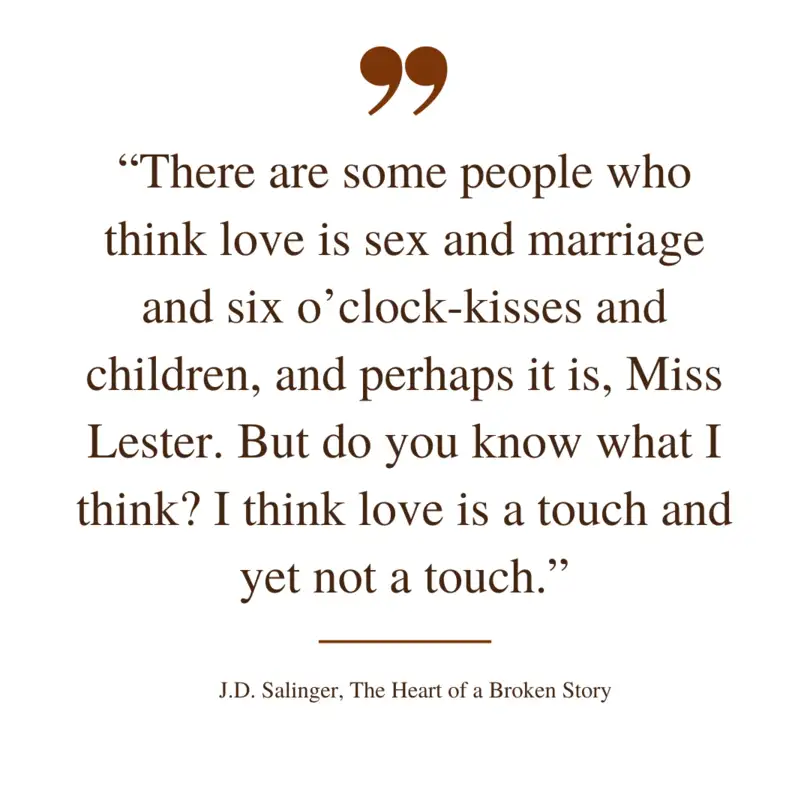
Famous Quotes from The Heart of a Broken Story
- “This is a love story. You’d never know it, would you?” He connects irony to honesty. He admits upfront that The Heart of a Broken Story won’t follow typical love story rules. This quote sets the playful and self-aware tone right away.
- “I started to write a boy-meets-girl story, but it got all messed up.” The writer connects storytelling to failure. He wants the reader to know that even the best intentions can go wrong. This quote shows how the novelist breaks the fourth wall and laughs at classic romance plots.
- “If only you knew how much I wanted to write this right.” He connects writing to emotion. He shows that storytelling isn’t just words—it’s about getting feelings across. This quote shows vulnerability and the struggle to express something deeply personal.
- “I think the boy would’ve loved the girl, really loved her.” The novelist connects possibility to imagination. The narrator describes a love that never fully happens. This quote emphasizes potential over reality, making this book feel bittersweet.
- “She had eyes like—well, never mind.” He connects beauty to restraint. He pulls back just as he begins to describe her, breaking romantic tradition. This quote shows his refusal to use clichés, even while writing about love.
- “Maybe the best stories are the ones that don’t end right.” The author connects imperfection to meaning. He suggests that messy, unfinished stories can feel more real. This quote questions traditional storytelling and embraces emotional truth.
Trivia Facts about The Heart of a Broken Story
- Published in 1941 in Esquire: The Heart of a Broken Story was first published in Esquire magazine in September 1941. This was one of his early published works before he became famous. This connection between literary magazines and early career growth shows how young writers built their reputations at the time.
- Early Example of Meta-Fiction: The book playfully breaks the fourth wall, with the narrator addressing the reader directly. This technique was rare at the time and shows his early experimentation. This connection between narrative style and innovation reveals his interest in storytelling as both art and joke.
- Set in New York City: Like many of his stories, it takes place in New York. The city’s bustling atmosphere and romantic possibilities serve as the backdrop. This connection between location and mood reflects how New York shaped his fictional world.
- Referenced in Biographies: Biographers like Kenneth Slawenski and Ian Hamilton mention the story when discussing his early development. They describe it as playful and sharply aware of clichés. This connection between biography and fiction helps readers understand his growth.
- Influenced by F. Scott Fitzgerald: The romantic elements and city setting show the influence of F. Scott Fitzgerald. He admired Fitzgerald’s elegance and emotional writing. This connection between generations of American writers reflects how the author built on earlier styles.
- Part of his “Pre-Catcher” Phase: Scholars group this story with others the writer wrote before The Catcher in the Rye. These works often explore shallow love, literary frustration, and New York settings. This connection between early writing and his later novel shows how ideas evolved.
The Writing Style Turns Digression into the Real Plot
The Writing Style of The Heart of a Broken Story moves between third-person narration, direct address, dialogue, lists, miniature scenes, letters, parenthetical stage directions, and blunt editorial commentary. The initial narrative stops almost as soon as it begins, but the story does not lose momentum. Each failed alternative creates the next one. Digression becomes a sequence of escalating consequences.
Repetition supplies comic structure. The narrator keeps returning to the formal requirement that the boy must meet the girl, then invents another reason why this cannot happen. Names, wages, clothing, attractiveness, magazine taste, and social awkwardness recur as practical obstacles. The accumulation makes storytelling sound like engineering, although every proposed mechanism reveals a new emotional or ethical defect.
Register changes give The Heart of a Broken Story its tonal range. Casual jokes and caricature surround passages of unexpected vulnerability, especially when the imagined Justin describes his ordinary failures. The narrator can mock him as socially hopeless and then articulate the pain of being neither admired nor hated. That instability prevents the satire from becoming simple contempt for an awkward man.
The style also keeps the writer visible. J. D. Salinger does not hide invention behind a seamless fictional world, because the making and unmaking of that world is the central action. Hypothetical verbs announce possibilities, dialogue tests them, and commentary withdraws them. The reader experiences form as a series of decisions rather than a transparent container. In this book, the narrator’s inability to proceed is therefore not a pause in the plot. It is the plot’s most active principle.
Doris Replaces Shirley and Defeats Romantic Destiny
The ending returns to the uneventful bus ride. Shirley gets off at one street and Justin at another, after which she goes to the cinema with Howard Lawrence while he stays home with a radio play. Their separate routines replace every melodramatic possibility the narrator has constructed. Ordinary time quietly defeats narrative destiny.
The final reversal concerns memory rather than union. Justin thinks about Shirley intensely for a month, but an introduction to Doris Hillman and the pressure of other events gradually move Shirley into the background of his mind. Her image is no longer available to him with its original force. The Heart of a Broken Story does not preserve love at first sight as an eternal wound. It shows projection weakening when life supplies a new person and new demands.
This outcome revises the emotional logic of the imagined letters. Justin’s eloquent declaration had made Shirley the meaning of his existence, yet the actual conclusion reveals that such absolute language would have described a temporary state. Shirley also loves Howard, who regards her with casual affection rather than equal passion. Nobody receives the perfect correspondence that the narrator could compose for them.
The replacement of Shirley by Doris is not presented as a triumphant romance. Doris is introduced through her fear of remaining unmarried, which adds another social pressure rather than a providential solution. The conclusion of The Heart of a Broken Story is harsher and more accurate than sentimental fulfillment. People misunderstand the scale of their feelings, adapt, redirect desire, and continue. The narrator fails to write the promised formula because reality does not owe anyone the unique partner, meaningful coincidence, or completed emotional arc that the formula requires.
More Reviews of Books by the American writer