The Lost Elegance of Summer Crossing by Truman Capote
When I first read Summer Crossing, it felt less like discovering a novel and more like overhearing a secret. Written in the 1940s, abandoned by Truman Capote, and published decades after his death, the book carries the weight of something private, urgent, imperfect, and oddly timeless. It’s a coming-of-age story set in New York, but its real setting is emotional limbo. The prose is slim. The world is hot. And everything feels like it could disappear at any moment.
He introduces Grady McNeil, a 17-year-old from Manhattan high society, left behind for the summer by her parents. What follows is not just rebellion, it’s disintegration. Grady drifts away from wealth and toward Clyde, a parking attendant from Brooklyn. Their relationship is marked not by romance but by dissonance. I didn’t see love in their story, I saw a hunger for control, escape, and identity.
What makes this novel so compelling is how sharply it cuts. The sentences are sleek, but the emotions beneath them are messy. The author doesn’t try to explain Grady’s behavior. He lets it unfold, recklessly, beautifully, and with a sense of quiet doom. There’s no safety net in this book. And that’s what makes it feel honest.

Summer Crossing and the Unraveling of Privilege
In Summer Crossing, Truman Capote uses wealth not as a backdrop but as a pressure system. Grady isn’t just rebelling, she’s erasing herself from a world she never believed in. The rituals of high society, the parties, the conversations, the sense of polished distance, are things she walks away from with alarming ease. Yet the novelist shows that freedom from that world doesn’t guarantee happiness. It often brings a sharper kind of loneliness.
Grady’s world is defined by contradiction. She has everything and nothing. Her defiance is daring, but her direction is unclear. She wants to be ordinary, yet clings to her difference. The novel never resolves that tension, it magnifies it. Watching Grady shift between her penthouse life and Clyde’s modest world, I felt the sting of dislocation. She belongs nowhere.
The renowned author of american literature doesn’t romanticize her choices. He presents them with the same cool precision found in 👉 The Scorpion God by William Golding, where civilization breaks down not with drama, but through quiet erosion. Grady’s detachment feels modern. So does her confusion. She isn’t tragic because she falls, she’s tragic because she was never steady to begin with. By the end of this chapter, he has already made his point: privilege can feel like a cage, and freedom doesn’t always come with a key.
Love, Illusion, and the Need to Burn
His portrayal of Grady’s relationship with Clyde is one of the most quietly unsettling aspects of Summer Crossing. This is not a passionate love story. It’s a slow, aimless spiral, two people trying to find something solid in each other, and failing. Grady doesn’t fall in love with Clyde. She dives into him. And then she keeps swimming, deeper and deeper, until the surface is no longer visible.
The power imbalance between them is never resolved. Clyde is practical, ordinary, and opaque. Grady is reckless, proud, and desperate to be unseen. Their attraction is never romantic. It’s more like inertia, the momentum of two people clinging to a version of love they don’t understand. He writes their scenes with restraint, but there’s always something jagged underneath.
The city hums around them, indifferent, beautiful, harsh. I felt that indifference echo through their interactions. Every time I wanted tenderness, I found discomfort. And that choice, I think, is deliberate. his characters don’t grow closer. They grow more confused. And the result is a relationship that never becomes safe, only more claustrophobic and unpredictable.
A City That Refuses to Comfort
In Summer Crossing, New York is not a romantic backdrop. It’s a character, aloof, hot, and full of danger. Capote presents the city not as a dream, but as a testing ground. It doesn’t embrace Grady. It challenges her. And in that challenge, her confidence unravels. She wants to disappear into the city. But the city doesn’t notice. That, to me, is the novel’s quietest heartbreak.
The novelist is precise about place. Rooftops, apartments, cars, and sidewalks are drawn with an intimacy that feels cinematic. Yet there’s always a distance between the city and the people inside it. Grady wanders through spaces that look glamorous but feel empty. Even her escapes, dancing, drinking, arguing, carry no thrill. They are expressions of a life stripped of meaning.
This emotional detachment reminded me of 👉 The Trial by Franz Kafka. In both, the protagonist moves through a landscape of rules they can’t explain, facing consequences they never fully understand. Grady isn’t trapped by law, but by expectation, by herself, by the weight of pretending she doesn’t care.
The writer makes the reader feel that weight. He doesn’t yell, he whispers. He shows how beautiful things, like cities, dresses, kisses, can become meaningless when the person inside them has no place left to go.
Descent Without Melodrama – The Lost Elegance
Grady’s downfall is not explosive, it’s slow, quiet, and almost private. He resists drama. There are no grand betrayals or revelations. Instead, we watch a girl drift further and further from herself. The world doesn’t punish her. It simply forgets her. And in that indifference, the story becomes brutal.
Grady loses her way not because she makes one fatal choice, but because she stops choosing altogether. Her actions, the engagement, the lies, the secrecy, feel less like rebellion and more like surrender. Truman Capote paints her with tragic restraint. She isn’t broken by the world. She drifts out of frame, until her voice becomes harder and harder to hear.
That’s what makes Summer Crossing so haunting. It avoids the typical arc. There is no lesson, no catharsis, no redemption. There is only motion, downward, inward, then gone. It’s the kind of descent that feels too real to be fiction.
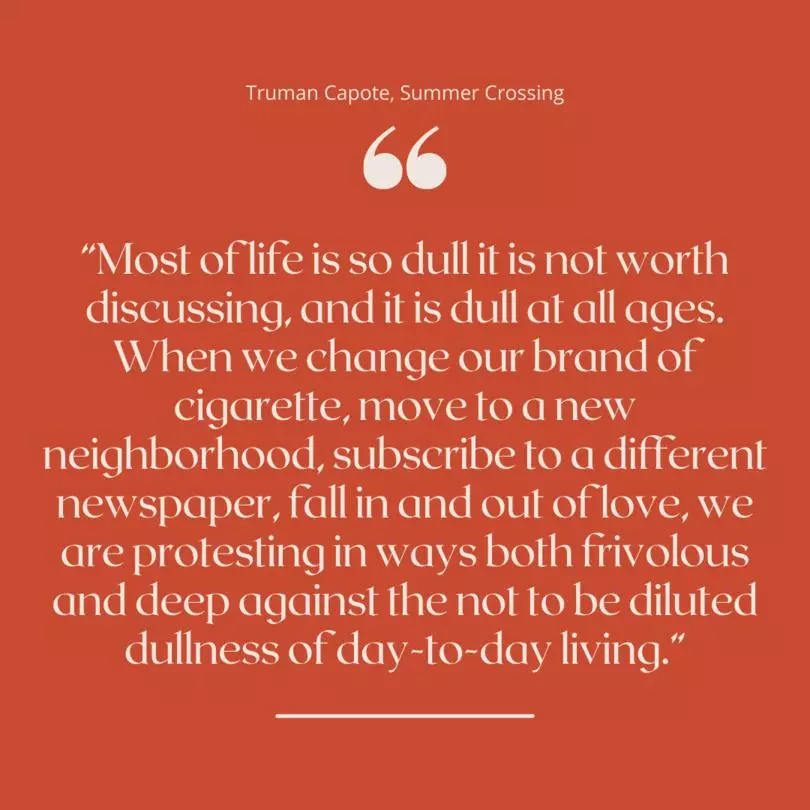
✒️ Thoughtful Quotes from Summer Crossing by Truman Capote
- “She wanted to burn, to explode, to be seen and never forgotten.” Grady’s longing isn’t romantic, it’s existential, loud and painful beneath her silence.
- “There is something savage in summer.” This line wraps the season’s heat, desire, and danger into one perfect phrase, the author at his most elegant.
- “She couldn’t be ordinary. She couldn’t even pretend.” Grady’s inability to blend in is not a performance, but a wound she carries without remedy.
- “Love wasn’t something she needed. It was something to escape from.” Truman Capote flips the classic arc, love here is claustrophobic, not freeing.
- “Silence is what’s left when no one tells the truth.” One of the novel’s most haunting lines, revealing how emotional gaps widen without confrontation.
- “He kissed her like someone afraid of breaking glass.” The tenderness here is brittle, unsure, a perfect image of Clyde’s distance and fear.
- “She had no future, only options.” Grady’s crisis isn’t about fate, but about too many paths that lead nowhere.
- “There’s a violence in doing nothing.” He captures the passive collapse of Grady’s world, the danger of drifting.
- “She wasn’t running from home. She was running from herself in it.” The conflict is not place but identity, the person she must perform in her old world.
📚 Trivia Facts from Summer Crossing
- Frst novel, almost lost: Summer Crossing was written in the 1940s and discarded by Truman Capote, only to be rediscovered in a box decades later.
- Published posthumously in 2005: The manuscript was found among his papers and restored for publication by the New York Public Library.
- Set in 1940s Manhattan: He captures a sweltering, restless New York stripped of glamour, a city of friction, not fantasy.
- A minimalist novella in tone: With just over 130 pages, it packs emotional weight into a spare, lyrical structure, much like 👉 The Mother by Bertolt Brecht.
- Themes of class rebellion: Grady’s desire to escape her upper-class identity aligns with later Capote heroines who reject societal scripts.
- Ambiguous, tragic ending: The novel closes with a literal and emotional blaze, unresolved and unforgettable.
- Influence on modern minimalist fiction: Its style has drawn comparisons to 👉 Demian by Hermann Hesse and the early work of Joan Didion.
- Published by Random House: The restored manuscript was released in partnership with the the author estate and NYPL’s Berg Collection.
- Preserved in literary archives: The original typescript is now part of The New York Public Library’s Collection, and cited in academic research worldwide.
The Last Dance of a Vanishing Self
In the final stretch of Summer Crossing, the prose sharpens. The dialogue tightens. And the spaces between the lines grow heavier. Capote seems to know that endings don’t require volume, only precision. Grady’s final days are messy, secretive, and brittle. The wedding is rushed. The pregnancy, unspoken. Everything accelerates toward something we sense but can’t quite name.
Her detachment becomes complete. Even Clyde becomes irrelevant, another shadow in a life full of dim outlines. The climax doesn’t explode. It dissolves. The sense of erasure, of disconnection, reminded me strongly of 👉 Moderato Cantabile by Marguerite Duras. Both works use silence as a weapon, showing how absence can be louder than conflict.
When Grady drives into the final scene, one marked by fire, ambiguity, and silence, it doesn’t feel like shock. It feels like punctuation. Not a period. A comma, hanging in air. I closed the book feeling hollow, impressed, and unsettled. The novelist had managed to write a novel where the real action happened not outside, but deeply, devastatingly inside.
Youth, Recklessness, and the Illusion of Control
Grady is not simply lost, she’s convinced she’s in control. That’s what makes her collapse so eerie. She makes choices, but without grounding. She claims freedom, but without direction. Every gesture, marrying Clyde, hiding her pregnancy, burning bridges, is bold. But the writer shows us that boldness, untethered from purpose, becomes a form of self-destruction.
There’s something painfully modern in her spiral. She wants everything: independence, passion, simplicity, escape. But she resents the compromises required by any of them. Capote never blames her. He simply watches. And what we see is a girl with a sharp mind, a strong will, and nowhere left to place them.
Summer Crossing is not about immaturity. It’s about clarity, and how it often arrives too late. Grady has glimpses of it. She knows, deep down, that she’s crossing lines that can’t be uncrossed. But the momentum of youth is hard to stop. Especially when no one is watching, and no one is helping.
Hidden First Novel and Its Lasting Weight
What makes Summer Crossing extraordinary is how much it says with so little. It’s barely a novel in size, yet emotionally immense. It deals with class, gender, loss, and rebellion, not through plot twists, but through atmosphere. Through small moments that bruise and then vanish. He doesn’t give us a heroine. He gives us a girl falling through layers of expectation, one summer at a time.
Reading it reminded me of 👉 To Have and Have Not by Ernest Hemingway, another work where social structure, personal recklessness, and fate intersect under unforgiving heat. His tone is different: more internal, more stylized. But both writers explore the moment when survival turns into surrender.
He originally threw the manuscript away. It was found in a box, decades later. That origin alone makes the book feel like an echo. And yet, it’s startlingly complete. The voice is unmistakable. The sadness is precise. And the silence that follows the ending, it doesn’t fade. It deepens. In many ways, this book isn’t a beginning. It’s a quiet explosion. One that leaves traces long after the pages are closed.