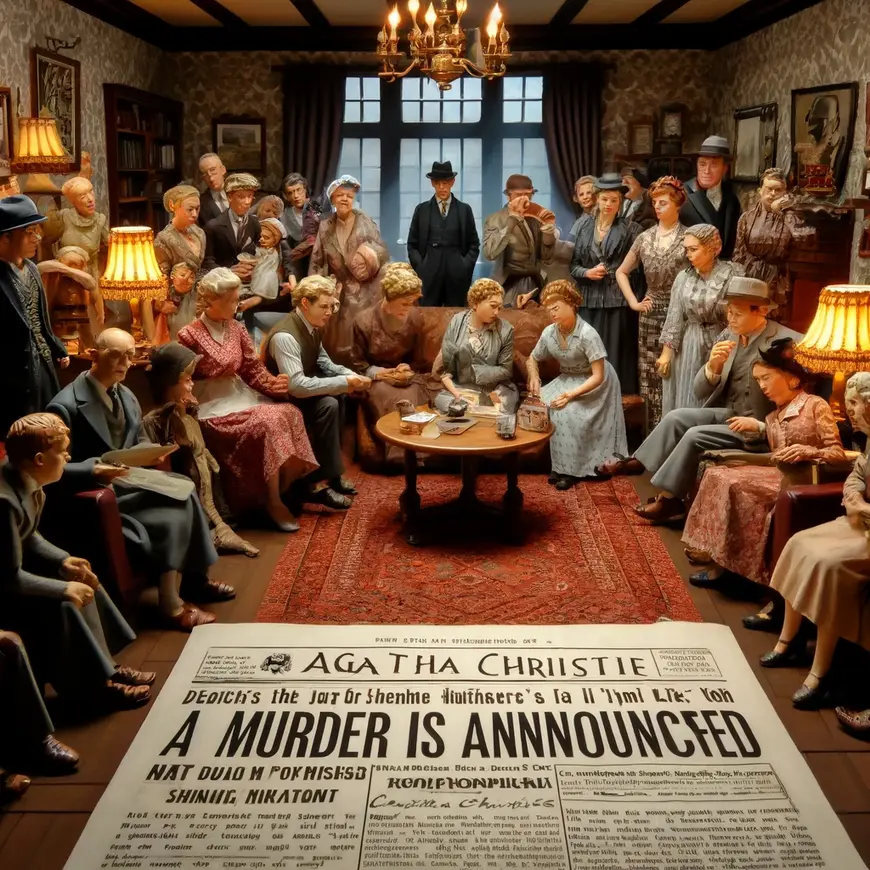
The ABC Murders and the Trap of Perfect Order
An alphabet promises a world that can be put in order. The ABC Murders by Agatha Christie turns that comforting promise into a threat: a succession of deaths appears to follow a rule so simple that everyone can understand it. The difficult question is whether understanding the sequence means understanding the crime. Published in 1936, this detective novel makes the apparent clarity of its central device the chief obstacle to clear thinking.
Hercule Poirot receives anonymous letters announcing violence. Alice Ascher dies in Andover, Betty Barnard in Bexhill, and Sir Carmichael Clarke in Churston. The matching initials and railway guides invite investigators to imagine a murderer whose private compulsion governs the whole country. Yet a pattern describes an arrangement; it does not automatically explain the reasons behind it.
That distinction gives The ABC Murders its particular bite. It asks readers to inspect the stories they build around evidence, including the attractive story that an exceptionally strange crime requires an exceptionally strange mind. The alphabet becomes both a clue and a ready-made interpretation. Once the interpretation takes hold, ordinary motives can seem disappointingly inadequate.
The novel also complicates the familiar partnership between a brilliant detective and his admiring companion. Hastings supplies enthusiasm, recognisable assumptions, and occasional impatience with crimes that lack glamour. His reactions expose how entertainment can distort attention to victims. The result is a brisk puzzle with a sharper argument beneath its ingenuity: noticing everything matters less than knowing what a conspicuous detail has encouraged you to overlook. This review discusses that argument without naming the murderer or revealing the final solution.

A Threat That Travels Beyond the Drawing Room
The first letter unsettles Poirot because it addresses him directly. Before a murder has occurred, somebody has assigned him a role in a public contest. The police can reasonably doubt the letter’s significance, but its specificity becomes harder to dismiss once Alice Ascher is found dead. In The ABC Murders, suspense begins with the gap between a warning and the knowledge needed to act on it.
The geographical movement changes the scale of investigation. Different communities, households, and witnesses enter the case, while each new place seems to confirm the same organising principle. The crime travels faster than understanding. Knowing the next letter cannot identify the next endangered person with useful precision. Prediction creates pressure without providing control.
This is an effective expansion of the classic whodunit. Rather than keeping all possible suspects inside one house, the novel brings an apparently unrestricted threat into contact with particular domestic circumstances. The victims remain embedded in local relationships even while the larger pattern encourages everyone to think nationally. Poirot has to keep both scales in view.
That tension distinguishes the investigation from a simple chase. Travel, interviews, and correspondence supply material, but the central work concerns the relationship between that material and the explanation imposed upon it. The ABC Murders repeatedly makes the most portable explanation look like the most persuasive one.
Consider how The Hound of the Baskervilles by Arthur Conan Doyle gives investigators a powerful story before they possess a reliable account of the crime. A family legend there and an alphabetical sequence here shape what witnesses fear and what detectives must question. Both novels make interpretation an active part of the danger.

The ABC Murders Makes Its Pattern Too Persuasive
The alphabet has an unusual advantage over most clues: it requires almost no explanation. Readers recognise its progression immediately, and that recognition produces a small pleasure even inside a frightening story. A follows B’s place in a sequence, while towns and surnames appear to submit to the same design. The ABC Murders turns that easy recognition into intellectual overconfidence.
A visible rule can conceal a less visible purpose. The sequence encourages investigators to treat the victims as interchangeable units. Once each person has become an initial, differences of age, circumstances, and relationships can seem secondary. Yet these differences are precisely what a detective cannot afford to discard.
The railway guide intensifies the effect. It is a practical object that orders places for travellers, so its appearance beside a body lends apparent solidity to the abstract pattern. The arrangement feels material rather than merely imagined. Nevertheless, the guide tells investigators how the crimes have been presented; it does not settle why they occurred.
The ABC Murders therefore rewards a particular kind of scepticism. Poirot does not need to deny the sequence. He needs to ask whether its obviousness serves somebody’s interests. The strongest clue may also be a performance. Its perfect order is the trap. That possibility makes the puzzle richer than a test of remembering names and dates.
Apparent inevitability takes a different form in Chronicle of a Death Foretold by Gabriel García Márquez. There, widespread knowledge fails to prevent a death. Here, widely shared knowledge of a sequence can obstruct understanding. The comparison highlights a disturbing difference between possessing information and accepting responsibility for interpreting it well.

Writing Style: Two Ways of Knowing Too Little
The Writing Style of The ABC Murders depends on a carefully managed difference between proximity and understanding. Hastings narrates much of the investigation in the first person, while third-person passages follow Alexander Bonaparte Cust. These sections offer another apparent route into the case. They also encourage readers to assume that access to a person’s private confusion must bring them closer to the truth.
Changing perspective does not guarantee better knowledge. Hastings can report what he observes without recognising its significance. Cust’s presence can feel more intimate while remaining difficult to interpret. The narrative thus complicates the usual promise that additional viewpoints steadily complete a picture.
The prose generally favours dialogue, practical detail, and forward movement over elaborate description. Questions and answers distribute evidence in manageable pieces. This accessibility matters: The ABC Murders does not hide its design behind stylistic obscurity. It lets clear sentences support uncertain conclusions, which is a subtler form of concealment.
Humour adds another disturbance. Hastings enjoys the conventions of detective adventure, and Poirot can gently expose the limitations of that enjoyment. Their exchanges keep the book lively while reminding readers that expectations arrive before facts. Narrative pleasure becomes part of the experiment.
Questions about credible accounts also animate The Lost Honor of Katharina Blum by Heinrich Böll, where competing accounts also influence who appears credible. The moral and political stakes differ substantially, but both works ask how a persuasive account can make a person legible in the wrong way. Their shared concern lies in the consequences of framing, rather than in any claim of historical influence.
Victims and the Man Who Looks Like a Suspect
The alphabetical arrangement tempts readers to remember the dead by their initials. Alice Ascher, Betty Barnard, and Carmichael Clarke belong to different social worlds, however. The ABC Murders gains much of its tension from the mismatch between those individual lives and the apparently uniform system imposed upon them. A convincing sequence does not erase the need to investigate each person separately.
Hastings exposes this problem early. When he learns that the first victim is an elderly shopkeeper, he feels disappointed by the crime’s apparent lack of spectacle. That reaction is uncomfortable because it resembles a reader’s appetite for novelty. An ordinary victim seems less interesting than an unusual plot. The novel allows that judgement to appear without endorsing it.
Cust introduces a different danger of simplification. His vulnerability and uncertainty make him available to suspicion, especially once readers begin fitting people into the story the alphabet has suggested. Confusion is not a confession. The possibility that someone can look implicated without understanding his own position complicates the familiar demand for a conspicuous villain.
These elements do not turn The ABC Murders into an extended social study. Its characterisation remains economical, and the puzzle determines how long most figures stay in view. Yet the economy has an ethical cost worth noticing: people can become memorable because of the function they serve in an investigation.
In Cold Blood by Truman Capote offers a useful contrast in its sustained attention to lives surrounding a murder. The comparison clarifies the choices of a compact detective puzzle without equating fictional ingenuity with the responsibilities of writing about real deaths.

Verified Lines and Their Implications
These short passages illuminate the difference between a crime and its presentation. Two come from the official Chapter 3 extract; the third is attributed to Poirot on the official story page. They offer distinct points of entry into The ABC Murders without disclosing its solution.
- “A very simple crime.” Poirot imagines a modest case while Hastings favours the spectacular possibilities of detective fiction. The remark makes simplicity sound almost like a preference for restraint. Its importance lies in the difference between complicated appearances and complicated motives. In the surrounding conversation, an ordinary domestic setting can contain everything necessary for a compelling investigation.
- “This is the beginning.” Poirot says this after the news from Andover. Hastings barely attends to the words, although he later remembers their significance. The sentence therefore operates on two timescales: the immediate discovery and the retrospective account. It also shows how a narrator can honestly preserve an observation that he did not understand when it first occurred.
- “Words, mademoiselle, are only the outer clothing of ideas.” This observation treats speech as evidence that requires interpretation. It does not imply that every speaker lies. Rather, phrasing can conceal, distort, or incompletely express an intention. In The ABC Murders, that distinction matters because letters and conversations are conspicuous components of the investigation. The reader must consider both what a statement says and what its form invites others to believe.
The selections are deliberately brief. Together they address the desire for an exciting crime, the belated recognition of significance, and the distance between expression and intention. Official text extract.
Publication and Adaptation: Five Useful Facts
- Published in 1936: The ABC Murders belongs to the interwar Poirot novels. The official bibliography identifies it as a novel, which matters when distinguishing the original investigation from later television retellings. Its publication context places the apparently nationwide sequence within an established tradition of carefully constructed detective puzzles.
- A railway guide supplies the initials: The ABC guide is a practical travel reference as well as a recurring object in the case. Its alphabetical organisation links ordinary mobility with the murderer’s presentation of the crimes. The title therefore carries a concrete association beyond the first three letters themselves.
- The narration changes perspective: The official story commentary identifies the movement between first-person and third-person narration. This is an important formal feature rather than an incidental variation. It changes how readers assess apparent access to evidence and to a suspect’s mental life.
- The 1965 film is a comedy: The Alphabet Murders used the novel as the basis for a film starring Tony Randall. Its comic approach illustrates how strongly adaptation can alter tone. A viewer’s memory of that version should not automatically become a description of the original book’s narrative method. Original prose and adaptations remain distinguishable.
- An early conversation tests genre expectations: The officially published Chapter 3 extract places Poirot’s preference for a simple crime beside Hastings’s more theatrical expectations. News of the Andover death interrupts that exchange. The juxtaposition gives the discussion immediate dramatic relevance and makes an early clue out of reading habits.
The ABC Murders Tests the Meaning of Guilt
The most interesting psychological question in The ABC Murders concerns the reliability of psychological explanations. A supposedly abnormal sequence makes a supposedly abnormal mind seem necessary. Once that inference has taken hold, uncertainty, fear, and vulnerability can be read as supporting evidence. The danger lies in explaining a person before establishing what that person has done.
Poirot’s alternative is not a rejection of psychology. He questions the psychology already built into the case. His attention to ordinary interests and relationships resists the assumption that spectacle must reflect an equally spectacular motive. This makes his reasoning more challenging than the familiar opposition between logic and intuition suggests.
The novel also distinguishes feeling guilty from being responsible for a particular act. That distinction is especially important when considering Cust. A confused person’s response to suspicion cannot substitute for a demonstrated chain of events. The ABC Murders asks readers to separate the emotional plausibility of an accusation from its evidential strength.
Knowing the killer from the outset, as in Crime and Punishment by Fyodor Dostoevsky, directs attention towards rationalisation, conscience, and confession. Here, uncertain attribution makes the interpretation of apparent guilt part of the mystery itself. The two books organise the relationship between inner distress and criminal responsibility in almost opposite ways.
There are limits to the comparison. The detective novel does not pursue a sustained account of spiritual renewal or moral philosophy. Its strength is the precision of its distinctions. By showing how easily an explanatory category can become a substitute for evidence, it gives the puzzle an intellectual consequence that survives the final revelation and makes the apparently tidy sequence remain troubling.
A Puzzle Worth Reading Without Treating It as Gospel
The ABC Murders is especially rewarding for readers interested in how detective fiction controls attention. Its ingenuity comes from giving an organising principle unusual visibility, then testing the conclusions drawn from it. The reader is invited to participate, but participation requires more than collecting details. It requires resistance to the satisfaction of a theory that appears to explain everything.
The book’s principal pleasure is the revaluation of apparently settled evidence. Letters, railway guides, witness accounts, and shifts of perspective acquire importance through their relationships. A striking clue does not have to be false to become misleading. This distinction gives the construction considerable elegance.
Readers seeking sustained emotional immersion may find the characterisation comparatively narrow. Several lives receive attention because the case needs their circumstances, and the pace favours clarification over extended mourning. The period’s assumptions about mental disturbance also deserve critical distance. The ABC Murders can expose the dangers of stereotyping while still using some of the vocabulary and conventions of its time.
That mixture makes the novel more interesting than an unqualified declaration of mastery would suggest. Its strengths lie in architecture, controlled disclosure, and the friction between familiar detective expectations and an unfamiliar scale of threat. Its limitations concern the human experience that a highly efficient puzzle leaves at the edges.
The final judgement is therefore specific: The ABC Murders is a compelling example of a detective story that makes its organising idea do double duty as evidence and misdirection. Approach it for the pleasure of careful reasoning, but pay attention to the assumptions that reasoning must undo. The alphabet will remain simple. The story people build around it will not.
Reviews of other Works by the Queen of Mystery