The Murder of Roger Ackroyd: trust the evidence?
A village doctor seems an excellent person to explain a murder. He knows the household, understands illness, and can distinguish an observation from an extravagant theory. In The Murder of Roger Ackroyd, Agatha Christie builds a detective novel around that reassuring assumption, then tests how much authority a familiar voice deserves. Published in 1926, the book remains remarkable because its puzzle involves the act of reading as closely as the investigation itself.
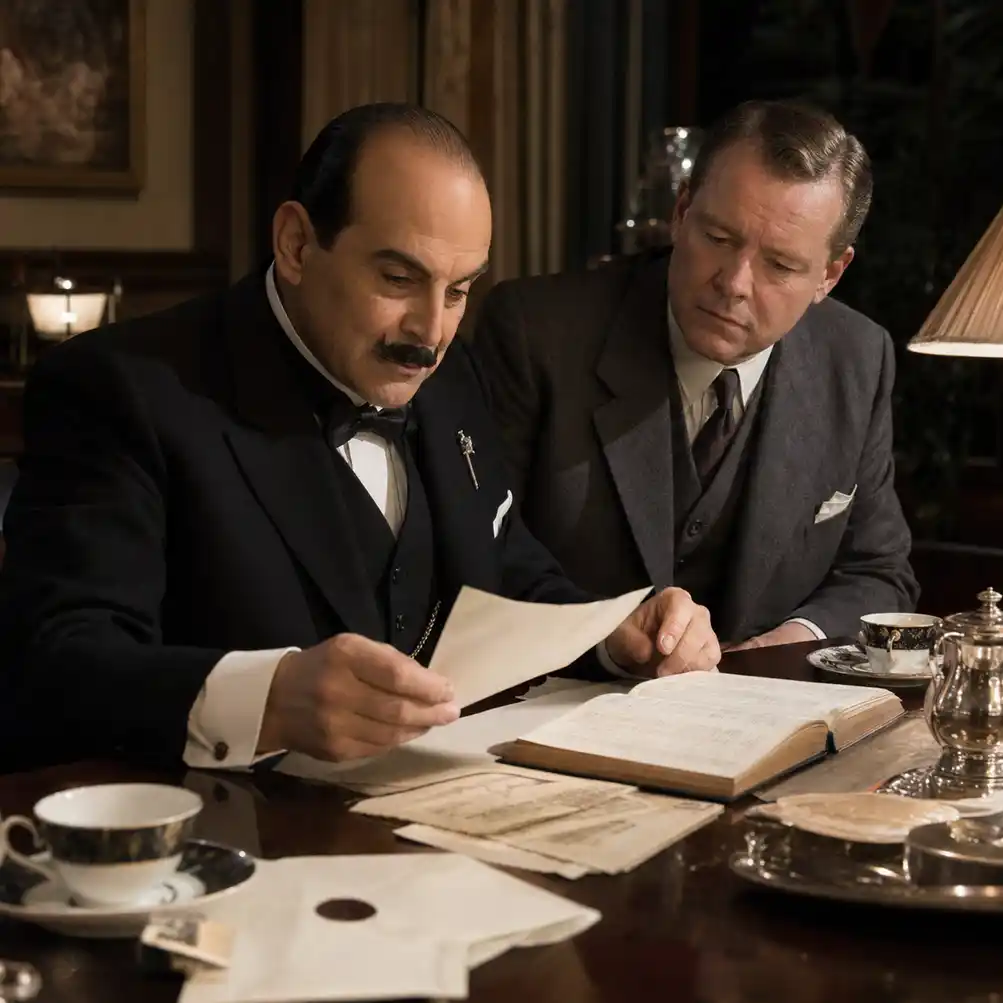
King’s Abbot initially offers the recognizable comforts of village mystery: gossip, professional routines, money troubles, and people who know one another slightly too well. Hercule Poirot has retired nearby, although his retirement cannot survive the death at Fernly Park. Dr. James Sheppard becomes his companion and records the case. Meanwhile, the doctor’s sister Caroline demonstrates that unofficial information can travel faster than professional inquiry.
The attraction of The Murder of Roger Ackroyd lies in the gap between what readers receive and what they assume has been supplied. A precise statement can leave something important unsaid, while an apparently harmless detail can establish a damaging fact. Trust becomes part of the evidence. The novel therefore rewards attention to tone and wording as well as to movements, objects, and opportunities.
This review keeps the opening discussion free of the solution, then marks the section that examines the ending directly. Knowing the answer changes the experience, but it does not exhaust the book. On a second reading, the question becomes how a narrative can guide attention so effectively while leaving the machinery of its deception available for inspection. That is where the novel’s lasting interest begins.

King’s Abbot turns private business into public knowledge
The village in The Murder of Roger Ackroyd is small enough for information to circulate constantly, yet large enough for its inhabitants to conceal important parts of their lives. People recognize one another’s routines and still misunderstand their motives. This combination makes gossip useful without making it dependable. Familiarity creates evidence, but it also supplies the assumptions that distort it.
Caroline is essential to that arrangement. Her brother treats her inquisitiveness with amused irritation, although she regularly knows things that he has not troubled to discover. Her methods depend on conversation, household connections, and an alertness to apparently minor departures from routine. Consequently, the contrast between them concerns whose knowledge receives respect as much as who possesses the correct facts.
Money supplies another current beneath the village’s respectable surface. Financial dependence, the fear of exposure, and the need to preserve appearances affect what people are willing to tell investigators. However, a concealed difficulty does not automatically prove responsibility for murder. A secret and a murder motive are different things. The investigation must establish the connection instead of allowing suspicion to substitute for it.
The social misreading in Northanger Abbey by Jane Austen offers a useful comparison. Catherine’s expectations can turn limited evidence into an elaborate story. Here, too, readers risk allowing a familiar narrative pattern to decide what another person’s behaviour must mean.
That is why the village in The Murder of Roger Ackroyd is more than a picturesque setting. The Murder of Roger Ackroyd draws its misdirection from ordinary habits of judgment: trusting professional status, dismissing gossip, or treating embarrassment as guilt. The people become most interesting when those habits fail. Their smaller deceptions create a social world that the central crime exploits, rather than merely furnishing a convenient list of suspects.
Poirot investigates what statements actually prove
Poirot’s apparent eccentricity makes an effective disguise for his intellectual discipline. Gardening and comic misunderstandings introduce a man who might seem safely outside village business. Once he investigates, however, he refuses to let other people’s confidence determine the value of their evidence. A statement matters for what it establishes, not for how firmly someone repeats it.
This distinction gives The Murder of Roger Ackroyd much of its energy. Investigators need to reconstruct movements and times, but they must first decide whether a witness saw something, heard something, or merely inferred it. A confident account may collapse when those categories are separated. Conversely, an awkwardly explained detail may prove reliable once its limitations are recognized.
Objects complicate the inquiry because their meaning depends on use. A piece of furniture can matter through its position, while an apparently incidental communication can matter through the action it causes. Why does this particular detail exist? Poirot’s work connects such details without assuming that their first explanation is their only possible one.
The relationship with the doctor invites comparison with The Hound of the Baskervilles by Arthur Conan Doyle. Watson’s participation establishes the familiar pleasures of the medically trained companion who reports a detective’s work. Readers bring that tradition to Sheppard, whether or not they consciously notice the expectation.
Nevertheless, The Murder of Roger Ackroyd gives Poirot a method that operates beyond genre recognition. He listens for inconsistencies between an account and the behaviour it supposedly explains. He also uses conversation strategically, allowing people to reveal what matters to them before they realize why it matters to him. Detection becomes an exercise in testing interpretation against particulars, rather than simply collecting more information than everyone else.
The Murder of Roger Ackroyd makes reading an investigation
A first-person narrator stands between the reader and the case. That is obvious in principle, yet easily forgotten when the voice seems practical, mildly humorous, and professionally trustworthy. Sheppard does not need to announce his authority because his social position supplies it. Meanwhile, the companion format encourages readers to treat his observations as the stable ground from which Poirot’s brilliance can be admired.
The Murder of Roger Ackroyd exploits the difference between reading a sentence and accepting an implication. A statement about one action can encourage an assumption about the time surrounding it, even if that interval has not been described. Similarly, an emotion may be reported accurately while its cause remains unstated. The reader supplies continuity because stories ordinarily depend on that cooperation.
The page records less than the reader imagines. This does not mean every omission constitutes cheating or every narrator deserves suspicion. It means that an account must be evaluated as an account, with choices about sequence, relevance, and emphasis. The Murder of Roger Ackroyd turns those choices into an unusually concrete part of its detective machinery.
A related unease appears in The Fall by Albert Camus. There, a speaker’s apparent openness gradually reveals a more controlling purpose. The books differ sharply in genre and moral atmosphere, but both ask how confession, intimacy, and narrative control can reinforce one another.
This is also where rereading becomes rewarding. Once the destination is known, attention shifts toward the wording that made other destinations appear more likely. Humour, transitions, and apparently minor qualifications acquire new weight. The novel’s achievement depends on that second experience, because an effective surprise should withstand examination after the immediate shock has passed. Its construction invites scrutiny rather than requiring the reader to forget how it worked.
Spoilers: the ending puts the narrator on trial
The solution to The Murder of Roger Ackroyd identifies Dr. Sheppard as the killer. He has blackmailed Mrs. Ferrars, and the danger of exposure leads him to murder Ackroyd. His participation in the investigation then gives him opportunities to monitor its direction. The person recording the case has a direct interest in how its evidence will be understood.
The deception combines physical arrangement with narrative management. A dictaphone helps create a misleading impression about when Ackroyd was alive, while the telephone call helps bring Sheppard back to the house. Meanwhile, his written account passes over the crucial action without supplying the complete sequence readers assume they have received. These mechanisms work together because the doctor’s practical access supports his verbal authority.
The confession transforms the earlier pages. They become a document written by an interested party, rather than a transparent record of an investigation. Yet the revelation does not make every preceding observation false. Its more disturbing effect is to show how accurate details can support a misleading account when their arrangement conceals the decisive relationship.
The ending also complicates Poirot’s moral position. He offers Sheppard an opportunity to take his own life before the truth reaches the police, partly to spare Caroline. This resolution exposes a troubling mixture of compassion, coercion, and private authority. The detective establishes the truth, but his handling of its consequences invites judgment rather than automatic approval.
Agatha Christie thus gives the puzzle a darker afterlife. Sheppard remains capable of treating his writing as a technical accomplishment even after its purpose is exposed. The Murder of Roger Ackroyd ends with the criminal assessing the elegance of his own concealment, leaving readers to consider how easily intelligence can become an instrument of self-excuse.
Writing Style: plain language with carefully placed gaps
The Writing Style of The Murder of Roger Ackroyd appears economical and unshowy. Conversation carries much of the information, while the doctor’s observations move between professional detail and domestic comedy. This surface accessibility matters because an ostentatiously evasive voice would warn the reader too quickly. The prose must seem cooperative even when its choices deserve close examination.
Humour helps establish that cooperation. Caroline’s interventions, Poirot’s mannerisms, and the doctor’s impatience create a rhythm of recognizable social friction. However, the jokes also distribute credibility. Readers may laugh with Sheppard at someone whose observations later deserve more respect, discovering that an entertaining tone has influenced their assessment of evidence.
The Murder of Roger Ackroyd also manages time through apparently ordinary transitions. A movement into or out of a room may feel narratively complete, although completeness is precisely what needs to be tested. Fluency can make an omission difficult to notice. The prose rarely stops to advertise that difference, so its craft becomes most visible when the reader returns to a passage with a specific question.
Dialogue adds a second layer because speakers have different reasons for withholding information. Some protect affection, others protect status, and some fear consequences unrelated to the murder. The resulting evasions prevent the central deception from standing alone as an obvious anomaly. Nevertheless, the characters remain briskly drawn, and readers seeking expansive psychological portraits may find the construction more compelling than the emotional range.
Within English Literature, The Murder of Roger Ackroyd demonstrates how a popular detective form can investigate its own narrative conventions. Its innovation does not require obscure language or a visibly fractured page. Instead, it relies on ordinary syntax, selective emphasis, and the reader’s willingness to turn a plausible voice into a trustworthy guide.

Revealing quotations from the novel
These quotations follow the 1926 text reproduced by Project Gutenberg. In The Murder of Roger Ackroyd, they concern evidence, concealment, and the purpose of investigation, although their implications deepen after the solution is known. Each line belongs to a particular exchange and should be read as part of that exchange. Source: Project Gutenberg
- “Every one concerned in them has something to hide.” Poirot explains a recurring feature of cases to the doctor. The remark broadens suspicion, but it also requires discrimination. A hidden matter may explain misleading behaviour without proving that its owner committed the murder under investigation.
- “Be sure there was a reason.” Poirot responds to puzzlement over the telephone call. An unexplained action is still an action with a purpose. The detective’s confidence concerns the need for an explanation, not an immediate claim that he already possesses the correct one.
- “The truth, however ugly in itself, is always curious and beautiful to the seeker after it.” Poirot distinguishes the horror of an event from the intellectual satisfaction of understanding it. However, that distinction also creates an ethical tension. The victims’ suffering cannot be reduced to the elegance of a solution.
- “And on your reticence”. Poirot adds this observation when discussing Sheppard’s manuscript. What sounds like a small qualification directs attention toward what the account withholds. The compliment therefore becomes a warning about treating modest presentation as a guarantee of complete disclosure.
- “I mean to know.” Poirot’s insistence gives his investigation a force beyond professional routine. Nevertheless, the ending makes the consequences of knowledge uncomfortable. The Murder of Roger Ackroyd separates discovering the truth from deciding how that truth should be used.
Publication facts and the book’s changing reputation
- A new publisher in 1926: The Murder of Roger Ackroyd began the author’s publishing relationship with William Collins. It was also her third Poirot novel, so its formal daring arrived relatively early in the detective’s long career rather than as a late experiment.
- Two suggestions helped generate the idea: The official history credits both James Watts and Lord Mountbatten with independently suggesting the basic possibility behind the murderer. This does not reduce the book to an ingenious premise, because its achievement depends on the detailed construction that makes the premise work.
- The dedication names her sister: The book is dedicated to Madge, affectionately called Punkie, who had challenged her to write detective fiction. A comparison with In Cold Blood by Truman Capote highlights how differently crime writing can establish its relationship with evidence and narrative authority.
- Alibi brought the story to the stage: Michael Morton’s adaptation opened in London in 1928, with changes that included replacing Caroline. That change matters because the novel’s social intelligence depends partly on an observer whom its narrator repeatedly underestimates, making her removal more than a simple adjustment of cast.
- A century of attention does not settle every question: The British Library identifies the novel as a major innovation in crime writing in its centenary context. Its constructed testimony also offers a useful contrast with Chronicle of a Death Foretold by Gabriel García Márquez, where the difficulty lies in reconstructing a publicly anticipated death. Source: British Library
Why The Murder of Roger Ackroyd rewards a second reading
The first reading offers the pleasure of an investigation, while the second reveals the methods that directed it. That difference makes The Murder of Roger Ackroyd unusually resistant to being exhausted by a spoiler. Once readers know the answer, they can inspect the relationship between statements, intervals, and assumptions. The puzzle becomes a practical lesson in how narrative authority is produced.
The relevance of The Murder of Roger Ackroyd does not depend on claiming that all communication is deceptive. Such a conclusion would flatten the distinctions the detective works to establish. Some witnesses are confused, some are embarrassed, and one person has a much more serious purpose. Critical reading requires careful distinctions. The novel asks for patient scrutiny rather than the satisfaction of suspecting everyone equally.
Dark Matter by Juli Zeh provides a useful later comparison in the relationship between knowledge, competing explanations, and investigation. Both books make certainty something to be constructed and tested. However, the earlier novel concentrates that problem within a particularly controlled village case and a deceptively approachable narrative voice.
There are also limits worth acknowledging. The social world contains period assumptions, and the resolution’s treatment of suicide can feel morally abrupt. Moreover, the emphasis on construction sometimes makes characters seem subordinate to the jobs they perform within the puzzle. Those reservations do not erase the achievement, but they help describe the experience honestly.
Agatha Christie gives readers a book that can entertain before it asks them to examine their own participation. The examination then makes the entertainment more intricate. The Murder of Roger Ackroyd remains worth reading because its surprise has an architecture, and because that architecture remains visible when the surprise itself is gone.
Summary of The Murder of Roger Ackroyd
Dr. James Sheppard records events in King’s Abbot after the death of Mrs. Ferrars. His sister Caroline suspects that the widow had poisoned her husband, while Roger Ackroyd reveals that Mrs. Ferrars had suffered blackmail. A letter promises to identify the blackmailer, but Ackroyd is murdered before its contents can become generally known. His death turns private village business into an investigation.
Hercule Poirot, who has retired to the village, takes up the case at Flora Ackroyd’s request. Sheppard accompanies him and describes the inquiry, while the police examine the movements of relatives, servants, and visitors. Ralph Paton’s disappearance makes him an especially vulnerable suspect. However, the household’s other concealed affairs repeatedly complicate the apparent pattern of evidence.
Poirot separates those lesser secrets from the arrangements surrounding the killing. Statements about timing, a telephone call, a moved chair, and the use of a dictaphone acquire significance when considered together. Meanwhile, the doctor’s position allows him both practical access to the scene and a privileged place in its written reconstruction. Readers initially encounter the case through the account of someone they have little reason to exclude from trust.
The solution identifies Sheppard as Mrs. Ferrars’s blackmailer and Ackroyd’s murderer. His manuscript has concealed the decisive action through selective narration, while the physical arrangements created a misleading sequence of events. The investigator’s companion has controlled the account. Poirot offers him a final opportunity to avoid public exposure through suicide, with Caroline’s suffering part of that troubling decision.
Sheppard’s closing explanation completes the document and exposes its earlier design. The Murder of Roger Ackroyd therefore ends by making the narrative itself part of the evidence. The crime is solved, but the reader’s trust remains available for a much less comfortable examination.
Other Reviews of Works by the renowned author