The Black Obelisk by Erich Maria Remarque
Postwar Germany in The Black Obelisk by Erich Maria Remarque feels like a living wound. The streets hum with life but also carry a constant undertone of despair. Currency loses value by the hour. Old certainties dissolve. I follow Ludwig Bodmer, a young veteran, as he drifts between jobs, friendships, and hesitant romances. His voice blends wit with quiet grief, making the turbulence strangely intimate.
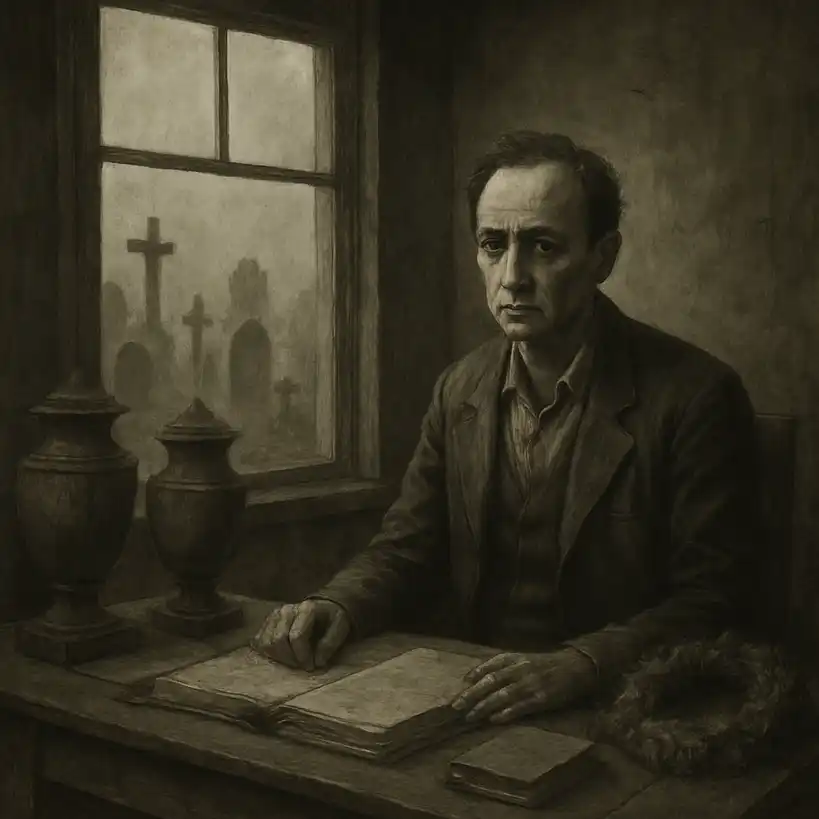
The black obelisk itself, standing in a cemetery, becomes more than a monument. It is a silent witness to human absurdity and suffering. The juxtaposition of death’s permanence and life’s instability resonates in every chapter. I feel as if Remarque is holding a mirror to a country in denial, laughing at itself while teetering on the edge of collapse.
Bodmer’s humor, sharp and sometimes biting, offers a fragile refuge. I admire how he uses it as armor against both political chaos and personal sorrow. This blend of satire and melancholy gives the novel a unique rhythm. The war is over, but peace feels elusive, and dreams of stability crumble under the weight of inflation and mistrust. Even in its comedy, the novel exposes the raw nerves of survival in a country still counting its dead.
The Many Faces of Survival in The Black Obelisk
In The Black Obelisk by Erich Maria Remarque, survival is never just about finding food or work. It is about adapting morals, reshaping relationships, and deciding which parts of one’s humanity to keep. Bodmer’s friends mirror different paths: some embrace cynicism, others cling to faith or romantic ideals. Each choice feels precarious, and the author shows how moral compromise becomes an everyday necessity.
Money drives many interactions. The inflation crisis transforms even simple deals into acts of desperation. There’s a scene where a gravestone sale becomes a negotiation of dignity, with the obelisk standing nearby like an unspoken reminder of mortality. In these moments, humor cuts through the bleakness, yet it never fully hides the uneasy weight of history pressing down on every character.
Friendship, too, is a survival tool. Bonds form not just out of affection, but from the shared need for shelter from the storm. I can feel the fragile trust between characters, knowing that a shift in politics or a sudden opportunity could change everything. The beauty of his writing is that it makes me see survival not as a triumph, but as a delicate balancing act, performed daily in the shadow of the obelisk.
Love in a Time of Uncertainty
In The Black Obelisk, love often feels like a negotiation with fate. Bodmer’s relationships are tender but also shadowed by the instability around him. Romantic gestures happen against a backdrop of collapsing currency and political unease, making them both more urgent and more fragile. Affection is fleeting here, as if each embrace could be the last before the world changes again.
One of the novel’s strengths is how it blends intimacy with social commentary. A flirtation in a café might seem lighthearted, yet the conversation inevitably circles back to survival, ideals, or memories of the war. I’m struck by how personal longing intertwines with collective trauma. Bodmer’s hesitancy in love reflects a generation unsure if any future is worth building.
The women in his life are not merely background figures; they have their own scars, desires, and compromises. Through them, the novel asks what it means to connect when trust has been eroded by politics and loss. Even the humor in these encounters is laced with melancholy, a reminder that in postwar Germany, romance exists in the shadow of ruin.

The Satire of Everyday Life
Remarque uses satire in The Black Obelisk like a scalpel, cutting through pretension and exposing human contradictions. Funeral directors haggle over gravestones while politicians deliver hollow speeches about stability. The absurdity is everywhere, and it makes me both smile and wince. Laughter becomes survival, a way to reclaim dignity in a world that often feels undignified.
Bodmer’s work at the cemetery reveals a society obsessed with appearances, even in death. A polished obelisk can’t hide the decay beneath, much like public optimism can’t mask economic collapse. I find these moments of dark comedy some of the most poignant in the book, because they show how humor coexists with grief.
The satire is never cruel for its own sake. It serves as a lens to examine morality, ambition, and the fine line between self-preservation and exploitation. In this way, Remarque aligns with works like 👉 1984 by George Orwell, where sharp observation exposes societal absurdities. By weaving wit into tragedy, the novel avoids despair while never denying the harshness of reality.
Faith, Doubt, and the Search for Meaning – Turmoil and Renewal
In The Black Obelisk, faith is both a refuge and a battlefield. Bodmer encounters priests, believers, and skeptics, each wrestling with what to hold onto in an age of disillusionment. Belief becomes a currency as valuable, and as unstable, as money in the inflation economy. Some find comfort in ritual; others see faith as another system in collapse.
I’m struck by how religion in the novel is not painted in absolutes. Instead, it appears as a mirror, reflecting each character’s hopes and fears. Bodmer himself drifts between quiet respect for tradition and biting irreverence. His conversations with a war-injured veteran about the nature of God feel deeply personal yet speak to the broader spiritual fatigue of postwar Germany.
This theme reminds me of 👉 A Hunger Artist by Franz Kafka, where questions of purpose and sacrifice are left unanswered. In both, the act of questioning itself becomes part of survival. The black obelisk in the cemetery looms like an unanswered prayer, solid, silent, and enduring while faith wavers all around it.
Friendship in the Ruins
The friendships in The Black Obelisk are shaped by scarcity and uncertainty. Bodmer’s circle is an odd mix, fellow veterans, business associates, and occasional strangers who become confidants. These bonds are rarely built on grand declarations. Instead, they grow through small acts: sharing a meal, offering a job lead, or simply listening without judgment. Trust is a fragile currency, easily spent and slow to earn.
What makes these friendships so moving is their impermanence. Political shifts, personal ambition, or sheer desperation can dissolve even the strongest ties. Yet, in fleeting moments, camaraderie feels like a lifeline. I think of how 👉 A Mercy by Toni Morrison explores relationships born out of necessity, where love and loyalty are entangled with survival.
The writer captures this paradox perfectly: people cling to one another not because they believe in forever, but because they need someone to face the next day with. In the ruins of a broken society, companionship becomes an act of quiet defiance against isolation.

Poignant Quotes from The Black Obelisk by Erich Maria Remarque
- “It is better to laugh about things than to cry over them, especially when they cannot be changed.” Humor is portrayed as a survival tool, offering release when the weight of reality feels unbearable. The novel often uses wit to keep despair at bay.
- “Every man carries the past within him as a burden that he can neither discard nor fully accept.” This captures the theme of memory’s persistence, a key thread in this novel, where the past shapes every present choice.
- “War changes not only landscapes but also the souls of men.” The book treats this as an unavoidable truth, showing how deep internal scars remain long after the conflict ends.
- “Poverty is not a virtue, but it can teach the value of what truly matters.” His characters learn hard lessons about priorities when money loses meaning and only essentials remain.
- “Love is both refuge and illusion in uncertain times.” This reflects the way relationships in The Black Obelisk by Erich Maria Remarque oscillate between hope and inevitability.
- “Faith is the last currency of a world that has lost all others.” The line underscores how belief becomes a form of emotional investment when all material securities collapse.
- “Friendship is a defiance of despair.” The novel often shows companionship as a choice to resist the isolation and hopelessness of the times.
- “Truth is rarely pure and never simple, yet it is worth pursuing.” This speaks to the moral complexity of the story, where clear answers are elusive but the search for them remains essential.
Interesting Facts from The Black Obelisk by Remarque
- Postwar setting: The novel is set during Germany’s 1920s hyperinflation crisis, a period when banknotes lost value daily. This setting mirrors historical accounts from 🌐 The German Historical Institute about the economic chaos that shaped the Weimar Republic.
- Title symbolism: The black obelisk in the cemetery serves as a monument to the dead but also as a silent witness to the living. Its permanence contrasts with the fragile stability of postwar life.
- Satirical tone: Remarque blends humor with tragedy, a technique also present in A Hunger Artist by Franz Kafka, allowing readers to digest harsh truths through irony.
- Love in instability: Relationships in the novel form and dissolve rapidly, reflecting the uncertainty of the era. This emotional volatility parallels themes in 👉 Absalom, Absalom! by William Faulkner.
- Cemetery setting: Much of the action unfolds around a cemetery, a choice that reinforces themes of mortality. According to 🌐 Deutsche Welle, such spaces often carried political and cultural symbolism in postwar German literature.
- Influence of war veterans: Many characters are ex-soldiers whose worldviews are shaped by their service. Their cynicism and resilience echo throughout the plot.
- Religious ambiguity: The novel portrays faith as both a comfort and a challenge. Characters navigate belief in a way that mirrors postwar Germany’s spiritual crisis.
The Weight of the Past in The Black Obelisk
In The Black Obelisk by Erich Maria Remarque, the past is never silent. For Bodmer and those around him, the war lingers like a shadow that shapes every decision. Old wounds—physical and emotional, surface unexpectedly in conversations, business deals, or moments of solitude. Memories are both anchor and burden, grounding characters in shared experience while keeping them from moving forward.
I notice how the narrative treats nostalgia with suspicion. A fond recollection of prewar life can quickly dissolve into bitterness when compared with the present reality. The characters are caught between honoring what came before and confronting what has been lost forever. This makes the past feel less like a comfort and more like a presence that demands constant negotiation.
In this way, the novel resonates with 👉 A Midsummer Night’s Dream by William Shakespeare, where memory and illusion blur the boundaries between longing and reality. Here, the line between past and present is fragile, and every attempt to forget feels incomplete. The past is not simply remembered, it insists on being lived alongside the present.
Closing Reflections
By the end of the book, I am left with the sense that survival is as much about adaptation as it is about endurance. The novel never offers easy resolutions, there is no triumphant victory over hardship, no sudden redemption. Instead, there is the quiet, persistent act of living. Life goes on, not because it is perfect, but because it is all there is.
Bodmer’s journey is a reminder that meaning can be found in small gestures: a shared joke, a moment of kindness, a refusal to give in to cynicism. This understated resilience feels truer than grand heroics. It reflects the reality that healing after collective trauma is slow, uneven, and deeply personal.
In its closing pages, the novel leaves space for ambiguity, much like Absalom, Absalom! by William Faulkner, where truth is layered and incomplete. What matters most is the refusal to surrender to despair. The human spirit, though bruised, remains unbroken, and that, in the end, is the quiet triumph of the story.