Time, Terror, and Truth in The Last Day of a Condemned Man
The Last Day of a Condemned Man by Victor Hugo is a book I couldn’t forget. Short, intense, and written with a pulse of quiet rage, this slim novel follows the final hours of an unnamed prisoner awaiting execution. It’s not a historical drama or a courtroom thriller. It’s a monologue. A diary. A cry. And in its pages, the author gives voice to a man society has already silenced.
First published in 1829, the book lands somewhere between philosophical essay and psychological fiction. Its structure is simple: the condemned man speaks. He doesn’t argue for his innocence and he doesn’t describe his crime. He just speaks about fear, time, memory, and the unbearable weight of waiting to die. This voice, raw, ironic, and often lost in reverie, stays with you long after you close the book.
The book was his direct attack on the death penalty, and he wrote it not as a politician but as a novelist. His intention was clear: not to describe justice, but to expose cruelty. What makes the novel powerful, however, is that it refuses to preach. It simply shows us a man, frightened, flawed, full of contradictions, and asks us to sit with him until the end.
I first read the novel years ago and returned to it for this review. With each reading, the silence between the lines becomes louder. And in a world still struggling with the morality of punishment, The Last Day of a Condemned Man feels more urgent than ever.
A Man Waiting to Die
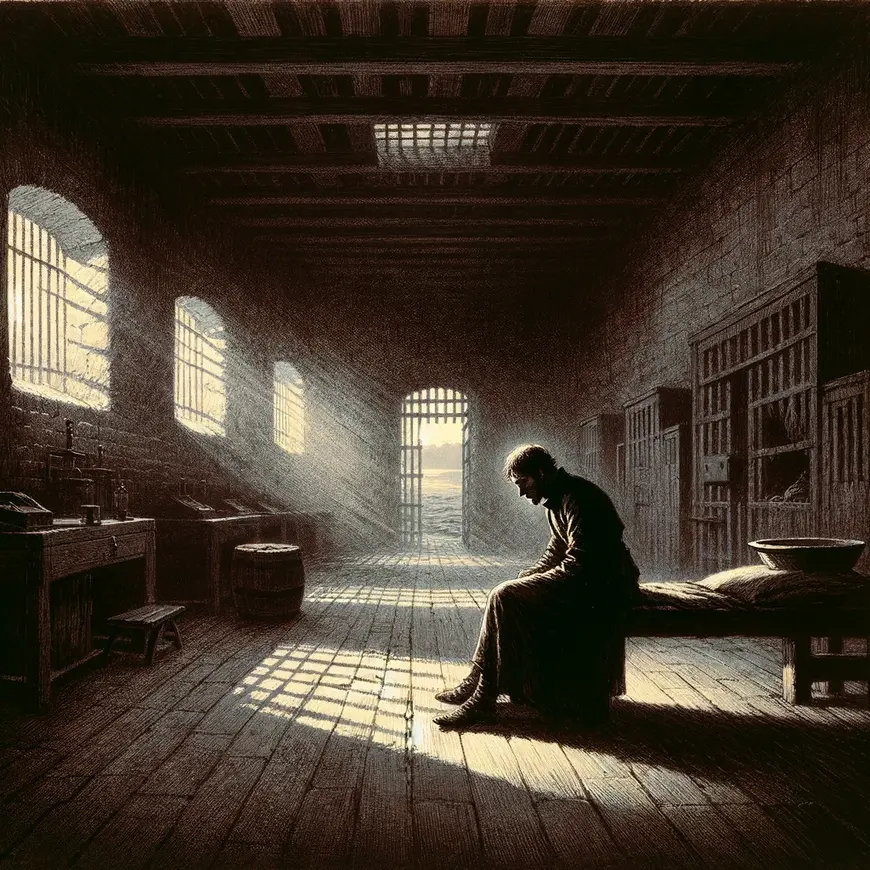
The story of The Last Day of a Condemned Man unfolds through a single, tormented voice. We never learn the narrator’s name. We never hear the details of his crime. What we receive is his fragmented, urgent record of the final six weeks of his life in prison. It reads like a diary but feels more like a fever dream. Every page is filled with fear, hope, bitterness, and small glimpses of humanity.
The novel opens with the man already convicted. The appeals have failed. The prison routines feel senseless. He describes the other inmates, the guards, the priests, and the agonizing sound of the scaffold being prepared. He fixates on sounds, smells, and the movements of people who are still free. His thoughts shift constantly, from despair to distraction, from hope to resignation. The result is not a structured narrative, but a stream of pain and observation.
Victor Hugo doesn’t give us suspense. Instead, he removes all doubt and replaces it with certainty: the man will die. This structure forces us to pay attention to his thoughts rather than events. We wait with him. We feel time stretch, then snap. And we learn that the horror of execution is not just the act itself, but the unbearable anticipation.
The narrator’s brief encounter with his daughter, who no longer recognizes him, cuts deepest. In just a few lines, he captures a lifetime of separation and shame. There are no heroes here. Only a man unraveling in slow motion. The book reminded me of 👉 The Waves by Virginia Woolf, another text that turns inner thought into a form of truth.
Victor Hugo Beyond the Barricades
Victor Hugo is often remembered for Les Misérables or The Hunchback of Notre-Dame, epic novels filled with action, love, and revolution. But The Last Day of a Condemned Man shows a different writer, more direct, more intimate, and more furious. He wrote this short novel at age 27, long before his reputation as France’s greatest novelist was secure. What’s striking is how little he cared about fiction’s traditional boundaries. This book is protest as literature.
The playwright was a lifelong opponent of the death penalty. He believed that state-sponsored killing dehumanized everyone involved. But instead of writing a political pamphlet, he chose the form of fiction. He gave readers no argument, no statistics, just a voice. A condemned man’s voice. In doing so, the novelist achieved something both literary and political: he made the issue personal.
The author’s life was filled with contradiction. He was a monarchist turned republican, a Catholic who often criticized the Church, and a celebrated man of letters who lived much of his life in exile. His fiction mirrored these tensions. While The Last Day of a Condemned Man is deeply emotional, it’s also filled with moral complexity. The writer doesn’t ask whether the man deserves to die. He only asks whether anyone should.
Reading this novel, I couldn’t help but think of 👉 Gertrude and Claudius by John Updike, another retelling that gives voice to the voiceless and reimagines judgment through the lens of human complexity. He did it first. And with fewer words, he may have said even more.
Facing Time, Death, and the Machinery of Justice
One of the central themes of The Last Day of a Condemned Man is the brutal passage of time. The narrator doesn’t fear death as much as he fears the hours leading to it. He fixates on clocks, footsteps, and sunrise, all reminders that his time is shrinking. Time becomes torture, stretched, broken, and meaningless. By the end, we understand that execution is not just a moment. It’s a process of psychological dismantling.
Another key idea is the anonymity of punishment. He strips the narrator of identity. We don’t know his name or crime. This forces us to see him as a man, not a symbol of guilt. It is a powerful critique of how society simplifies the condemned, not as human beings, but as cases to be resolved. Justice, in this novel, is mechanical and impersonal.
The book also explores the isolation of the individual. The narrator is surrounded by people — guards, priests, prisoners — but he is entirely alone. No one truly listens to him. His thoughts, fears, and memories exist in a private, unbearable space. That’s where his empathy lies: not in proving innocence, but in restoring voice.
This deep solitude reminded me of 👉 The Good Person of Szechwan by Bertolt Brecht. There, too, the main character faces an indifferent system while trying to hold onto dignity. In both cases, morality isn’t clear, but loneliness is.
One Voice, Many Echoes
The narrator of the work is nameless, faceless, and alone, yet he feels achingly real. What makes him compelling is not his backstory, but his unfiltered stream of thought. He is terrified, bitter, hopeful, and deeply human. His inner voice shifts constantly. At times, he tries to reason with himself. At other moments, he lashes out at the world. The author creates a full psychological portrait without revealing a single detail about the crime.
This character doesn’t try to win sympathy. He doesn’t ask for forgiveness. He speaks simply because he can, because no one else will. Through him, he examines how society strips people of complexity the moment they’re sentenced. The condemned man becomes a category, not a character. Yet in these pages, we see a life reduced to waiting and a mind unraveling with each tick of time.
What struck me most is how modern the voice feels. It’s not theatrical or overly literary. It’s urgent, vulnerable, and raw. This inner monologue reminded me of 👉 Mansfield Park by Jane Austen, where much of the tension lies in unspoken thoughts and quiet resistance. In both books, the voice becomes the action.
The narrator of this novel may be silenced by law, but his voice outlasts the sentence. That’s the triumph of the book: it turns the final moments into testimony, and the condemned into someone we can no longer ignore.
Sharp Simplicity in The Last Day of a Condemned Man
Victor Hugo’s language in The Last Day of a Condemned Man is stripped of ornament. Unlike the lyrical flourishes of Les Misérables, this novel speaks plainly, and that plainness carries power. The prose is direct, emotional, and sometimes repetitive, mirroring the narrator’s frantic mind. You feel every pause, every shift in tone, every moment of despair. He understood that simplicity can hit harder than rhetoric.
What makes the style memorable is how it mimics the structure of thought. The sentences trail off, double back, and circle the same fears again and again. The rhythm is broken, urgent, and unsettled, just like the narrator. It’s a rare case where the form perfectly matches the content. The style doesn’t just describe fear. It performs it.
This stylistic control reminded me of 👉 The Counterfeiters by André Gide. Both authors experiment with voice and narrative layers to reflect human instability. But while Gide builds a web, the novelist uses a single thread — and pulls it tighter with every page.
We also find moments of lyrical brilliance hidden in the bleakness. A memory of sunlight. A glimpse of a child’s face. A bird flying past the prison window. These quiet images burst out like color in a gray room. They don’t offer comfort, but they do remind us that the narrator once lived, once hoped. His brilliance here lies not in complexity, but in restraint. He says only what must be said, and leaves us to carry the silence.
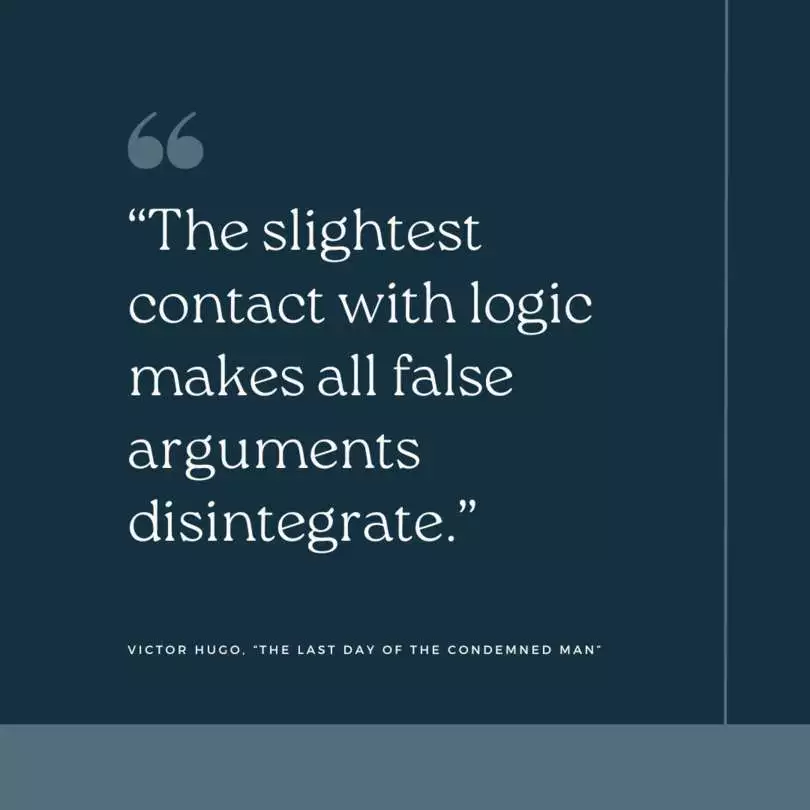
Haunting Quotes from The Last Day of a Condemned Man by Victor Hugo
- “I am alone. The jailer is gone. He fears me, perhaps.” This line introduces the narrator’s isolation. His only remaining companion is fear, his own, and that of others.
- “To be alone with one’s thoughts, when one’s thoughts are all of death, is a terrible thing.” The narrator expresses how reflection becomes torture when there’s no future left.
- “What matters it what crime I committed? I am going to die.” Victor Hugo removes the crime from the equation. What remains is a person, not a verdict.
- “They say I am a man. I was a man once.” Here, identity begins to dissolve. The condemned man no longer sees himself as fully human.
- “I shall die to-morrow. And I do not know whether I shall sleep to-night.” The tension between physical need and psychological terror comes to the surface.
- “Everything in me protests against death.” There’s no serenity here. Only the raw resistance of a human being to what feels unnatural.
- “One day less. One hour less. One minute less.” The steady, cold breakdown of time becomes its own form of violence.
- “A man is not entirely guilty — he did not begin the world.” He reminds us that guilt lives in context, and that no one creates themselves.
- “This punishment is not justice. It is vengeance.” A direct attack on the system. Justice implies balance. Execution implies finality.
Trivia Facts from The Last Day of a Condemned Man
- Written before Les Misérables: Victor Hugo published this novel in 1829, more than 30 years before Les Misérables. It was his first explicit political statement in fiction.
- Inspired by a real execution: He witnessed a public execution in 1829, which deeply disturbed him and directly inspired the emotional tone of the book.
- Preface added later: The original edition didn’t include a preface. The novelist added a powerful 20-page one later, directly addressing the morality of capital punishment.
- Praised by Dostoevsky: Fyodor Dostoevsky, who survived a mock execution, praised the novel for capturing the horror of waiting for death with frightening accuracy.
- Advocacy extended beyond books: In 1848, he spoke publicly in the French National Assembly against capital punishment, echoing the themes of this novel.
- Influence on Camus: The book influenced later existential works such as 👉 The Plague by Albert Camus, which also confronts death and absurdity.
- Continues to be studied in law and literature: Modern legal scholars often cite the novel when discussing ethics and punishment. See Stanford Law Review for related discussions.
- Adapted for the stage and radio: While not as well-known as his major works, it has been adapted multiple times in minimalist productions. See BnF Archives for documentation.
Why This Book Still Haunts Me
I didn’t expect The Last Day of a Condemned Man to affect me so deeply. It’s a short novel. It moves fast. And yet it left a lasting weight on my thoughts. What struck me wasn’t just the message, but the raw intimacy of the voice. The author places us in the mind of someone we’d usually avoid — someone society has erased — and asks us to listen. And the more we listen, the harder it becomes to look away.
There’s something terrifying about the way the book avoids drama. No courtroom and no flashbacks. No clear villain. Just hours ticking down. This simplicity makes it unbearable. It reminded me of 👉 The Flanders Road by Claude Simon, another book that turns silence and memory into its own battlefield. Both novels ask us to sit with what we usually rush past.
What I also loved is how little the book tries to manipulate us. He doesn’t excuse the condemned man or turn him into a martyr. Instead, he shows him scared, selfish, reflective, and fully human. He gives the condemned his dignity back, not through redemption, but through voice.
The themes may be heavy, but the novel never feels didactic. It reads like a whisper in the dark, asking: What if this were you? That question stays with me. It makes this short book one of the most profound things I’ve read.
A Voice That Still Demands to Be Heard
The Last Day of a Condemned Man is more than a novel. It’s an act of resistance. Victor Hugo gave a voice to someone who had none, and in doing so, challenged the moral comfort of his readers. The book doesn’t offer answers. It offers the unbearable weight of presence, a man facing death, aware of every moment, and asking not for pardon, but for understanding.
This novel made me reflect on how quickly society forgets people like him. When we talk about crime or justice, we often speak in numbers or categories. But the writer reminds us that behind every statistic is a story, a face, a mind unraveling in silence. The story might be fictional, but the pain is not. It still exists, in prisons and cells around the world.
I also thought of 👉 Of Mice and Men by John Steinbeck, another story that exposes how fragile justice can be when applied to the powerless. In both novels, the reader is made witness, not judge. And that’s what makes them unforgettable.
This book is not an easy read, but it’s a necessary one. It reminds us that listening is a form of resistance, and silence, especially the silence we impose on others, is never neutral. His message still matters. And the voice he captured still echoes today.