An Analysis of The Myth of Sisyphus by Albert Camus
My Summary on The Myth of Sisyphus by Albert Camus
Reading this book was eye-opening. I felt challenged by this ideas about life and absurdity. His words made me think about the meaning behind daily struggles. I kept asking myself, “Why do we push on?” His portrayal of Sisyphus felt relatable. I saw my own routines and efforts mirrored in his endless task. The message was clear yet unsettling: life might not have inherent meaning, but we still push forward.
As I read, I felt both heavy and motivated. His take on embracing life’s absurdity was new to me. His writing was deep but simple enough to follow. I paused often to reflect on my life. Each section made me see how choosing to continue is an act of defiance. By the end, I felt inspired to find joy, even in the struggle.

In the realm of existential thought, where questions of meaning and purpose loom large, Albert Camus‘ The Myth of Sisyphus emerges as a philosophical cornerstone that challenges conventional notions of existence. With prose that traverses the landscape of absurdity, the philosopher crafts a narrative that invites readers to confront life’s inherent contradictions and embrace the beauty that emerges from the very heart of the absurd.
Diving into the Abyss: The Myth of Sisyphus
Imagine a world where life’s search for meaning collides with the inherent futility of existence. The Myth of Sisyphus introduces us to the concept of the absurd – the seemingly illogical clash between human desire for meaning and the universe’s silence. Through a series of essays, the author explores the absurdity of life, delving into the tension between the human quest for significance and the universe’s apparent indifference.
The setting of this work transcends physical boundaries; it’s a realm of ideas and inquiries. His narrative mirrors the complexities of the human mind, as he grapples with questions that have haunted thinkers throughout history.
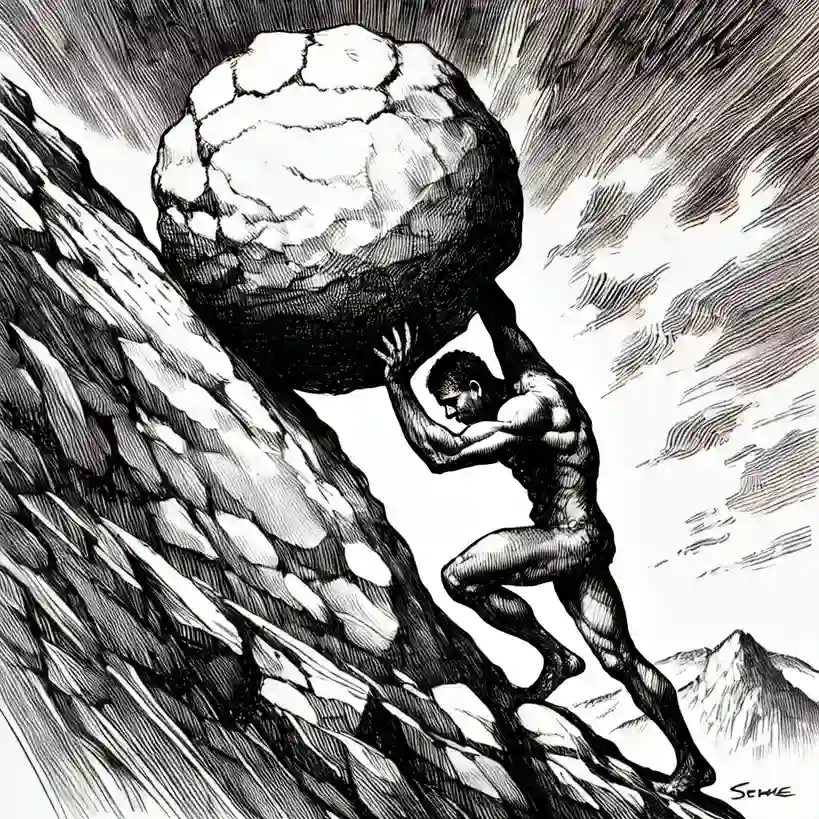
The heart of The Myth of Sisyphus lies within its essays, each a stepping stone on a philosophical journey into the heart of the absurd. The titular essay serves as the cornerstone of the work. Albert Camus uses the myth of Sisyphus – the figure condemned to eternally roll a boulder up a hill – as a metaphor for the human condition. Sisyphus’ futile task becomes a symbol of the absurd struggle for meaning in a world that often appears devoid of purpose.
The writer also explores the works of other philosophers, such as Kierkegaard and Nietzsche, weaving their ideas into his own discourse on the absurd. Through essays like “Absurd Creation” and “Philosophical Suicide,” he dissects the human tendency to seek out external sources of meaning and the pitfalls of attempting to escape the inherent absurdity of existence.
An Analysis: Embracing the Absurd
“Embrace the absurd,” Camus seems to whisper, as he delves into the themes that define his work. The concept of the absurd becomes a lens through which he examines human existence. The novelist contends that the absurd is not a negation of life’s value but rather an invitation to confront its complexities head-on. The tension between our search for meaning and the universe’s apparent indifference creates an absurdity that can either lead to despair or serve as a catalyst for embracing life’s inherent beauty.
The theme of rebellion is another thread that runs through the essays. The author asserts that acknowledging the absurdity of existence is an act of rebellion against the nihilism that can result from its contemplation. By choosing to embrace life despite its contradictions, humans rebel against the absurd and affirm their own existence.
Albert Camus’ writing style in this collection is both reflective and philosophical, a labyrinth of thought that mirrors the complexities of the ideas he explores. His prose is contemplative, inviting readers to engage with his concepts and ideas on a profound level. The essays often read like conversations with a brilliant mind, as the writer navigates the nuances of existential thought with clarity and precision.
His language is both poetic and precise, with a knack for capturing the essence of complex ideas in simple yet profound sentences. His writing style is an embodiment of his philosophy – the acknowledgment of life’s contradictions and the search for meaning amidst the absurd.
Relevance in an Absurd World
While The Myth of Sisyphus emerged in the mid-20th century, its themes remain deeply relevant in the present day. In an era marked by uncertainty, rapid change, and existential questioning, his exploration of the absurd takes on new significance. The human quest for meaning and the confrontation with life’s inherent contradictions are experiences that resonate with individuals across generations.
In a world that often feels fragmented and overwhelming, his philosophy offers a framework for grappling with the absurdity of existence. His invitation to embrace the absurd beauty of life encourages readers to find meaning not in external sources but within their own experiences and the connections they forge with others.
Discovering the Meaning of Life in The Myth of Sisyphus
Reading The Myth of Sisyphus felt like standing at the edge of a cliff, staring into the vast unknown. Albert Camus does not offer easy answers. Instead, he asks the hardest question of all: Does life have meaning?
The philosopher begins with a bold statement. The only real philosophical question is whether life is worth living. This hit me like a shockwave. He explores the idea of the “absurd”—the conflict between our desire for meaning and the silent, indifferent universe. No matter how hard we search, life refuses to give us clear answers.
At the heart of this book is the figure of Sisyphus, the man condemned to roll a boulder up a hill for eternity. His struggle seems pointless, yet the author argues something surprising: Sisyphus is happy. He embraces his fate, finding freedom in rebellion. This changed how I see life. We may never find ultimate meaning, but we can create our own.
The writer does not write for the hopeless. He writes for those who refuse to give up. He shows that even in a meaningless world, we can choose to live with passion and courage.
If you have ever questioned life’s purpose, read this book. It does not hand out easy solutions. Instead, it challenges you to think, to rebel, and to find joy in the struggle. And that, I realized, is what makes life worth living.
Famous Quotes from The Myth of Sisyphus by Albert Camus
- “There is but one truly serious philosophical problem, and that is suicide.” This quote opens the essay and sets the stage for his exploration of existentialism. He suggests that the fundamental question of philosophy is whether life is worth living, given its inherent meaninglessness. This reflects his focus on the absurd and the challenge of finding meaning in a seemingly indifferent universe.
- “The struggle itself toward the heights is enough to fill a man’s heart. One must imagine Sisyphus happy.” Albert Camus concludes that even in the face of absurdity, one can find contentment in the struggle. Sisyphus, condemned to an eternity of futile labor, represents the human condition. By embracing the struggle and finding joy in the effort itself, Sisyphus achieves a form of victory over his fate.
- “Happiness and the absurd are two sons of the same earth. They are inseparable.” This quote suggests that recognizing the absurdity of life does not preclude happiness. Instead, understanding and accepting the absurd can lead to a deeper appreciation of life’s fleeting moments of joy. The novelist argues that happiness and absurdity coexist and that one can find meaning through this acknowledgment.
- “Living an experience, a particular fate, is accepting it fully.” He emphasizes the importance of embracing one’s circumstances fully, rather than seeking escape or false hope.

Trivia Facts about The Myth of Sisyphus
- Influence of Paris: Albert Camus wrote The Myth of Sisyphus while living in Paris. The city’s vibrant intellectual atmosphere during the 1940s provided a stimulating environment for his philosophical explorations.
- Connection to Jean-Paul Sartre: He was friends with Jean-Paul Sartre, a leading existentialist philosopher. Both writers explored themes of absurdity and existentialism. Though they eventually had a public falling out due to differing philosophical views.
- Inspired by Greek Mythology: The essay is based on the Greek myth of Sisyphus This is a figure condemned to roll a boulder up a hill for eternity. Albert Camus uses this myth to illustrate his concept of the absurd and the human struggle for meaning.
- Response to Fyodor Dostoevsky: The writer was influenced by Fyodor Dostoevsky’s existential themes, particularly in works like Notes from Underground.
- Published in 1942: The Myth of Sisyphus was published in 1942, during World War II. The wartime context influenced his thoughts on human suffering and the search for purpose in a chaotic world.
- Link to Kafka: He admired Franz Kafka’s portrayal of absurdity in works like The Trial and The Metamorphosis. Kafka’s influence is evident in his depiction of the human condition and in his exploration of existential themes.
Final Thoughts – Embracing Life’s Paradoxes
Albert Camus’ The Myth of Sisyphus is a philosophical masterpiece that navigates the intricacies of existence with wisdom and depth. Through his essays, he invites readers to confront life’s paradoxes and contradictions, offering an alternative to nihilism and despair. He urges us to embrace the absurdity of existence. Within it, we find the potential for authentic living. We can rebel against meaninglessness and discover beauty in unexpected places.
As readers journey through his exploration of the absurd, they engage with life’s uncertainties. They embrace the contradictions that make them human. They find solace in knowing that the search for meaning is integral to the human experience. The work serves as a philosophical guide. It illuminates the path to embracing life’s complexities. It helps us find purpose amidst the heart of the absurd.