Reading Gabriela Mistral: cradle and light
Gabriela Mistral writes as if the world were a child she refuses to abandon. I start there because tenderness in her poems is active, not sweet. Care as responsibility shapes the voice. Orphans, rural classrooms, mountain paths, and mothers who keep vigil enter with the same dignity as cathedrals. Plain words, deep light is the effect on the page: nouns you know, feelings that arrive clean. She trusts images more than arguments. She chooses the small door to reach the largest room.
You do not need a scholar’s map to begin. Start with a handful of short poems where lullaby turns to prayer, then let a longer sequence show how grief, faith, and work can share one breath. Clarity before flourish keeps the line honest even when pain is close. The themes sound simple—love, loss, childhood, homeland—yet the craft keeps folding, so a second reading opens new weather.
If you like to pair voices, read 👉 Love in the Time of Cholera by Gabriel Garcia Marquez beside a group of love poems; you will hear devotion register in two different keys, one lyrical, one narrative. Feeling first, form revealed is the method I recommend: feel the cadence, then notice how image and syntax carry it.
Context matters, but it will not slow us down. We will touch on classrooms, diplomacy, and the long shadows of the Andes, then move back to the poems. Praise with restraint is her signature; even joy stands upright and pays attention. That is why these lines travel so far: they speak softly, hold firm, and keep faith with people who do ordinary work in hard places.
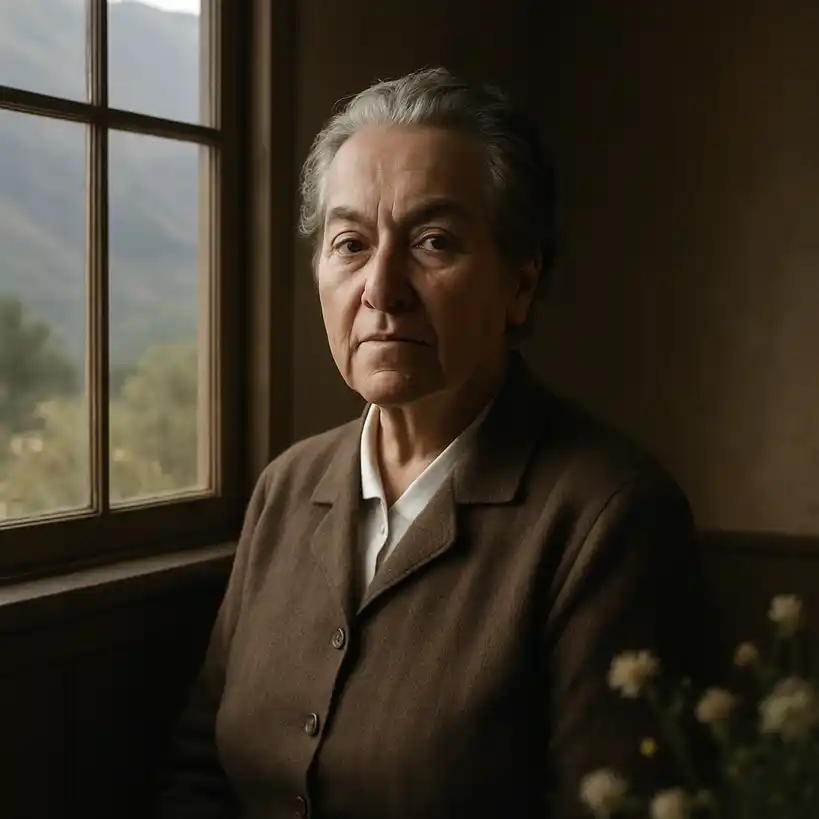
Profile of Gabriela Mistral – Works and Life
- Full Name and Pseudonyms: Lucila Godoy Alcayaga; wrote as Gabriela Mistral.
- Birth and Death: 7 April 1889, Vicuña, Chile; 10 January 1957, Hempstead, New York, USA.
- Nationality: Chilean.
- Father and Mother: Jerónimo Godoy Villanueva; Petronila Alcayaga Rojas.
- Wife or Husband: Never married.
- Children: One adopted son/nephew: Juan Miguel “Yin Yin” Godoy (d. 1943).
- Literary Movement: Latin American modernism (modernismo); civic and spiritual lyric.
- Writing Style: Spare, luminous diction, maternal address, biblical cadence, image-led clarity.
- Influences: Rubén Darío, Spanish mystics (Teresa of Ávila, John of the Cross), Scripture, folk hymnody.
- Awards and Recognitions: Nobel Prize in Literature (1945); Chile’s National Prize for Literature (1951); multiple honorary doctorates.
- Adaptations of Their Work: Poems widely set to music; selections staged and broadcast; school anthologies across the Spanish-speaking world.
- Controversies or Challenges: Lifelong scrutiny of private life; political disagreements around postings; grief over Yin Yin’s death; periods of exile/itinerancy.
- Career Outside Writing: Teacher and headmistress; education reformer; Chilean consul/diplomat; lecturer and cultural envoy.
- Recommended Reading Order:
1. Tenderness
2. Desolation
3. Tala
4. Winepress
Mountain schoolrooms and a borrowed library card
Vicuña and Montegrande give Gabriela Mistral her first map: high air, narrow paths, and small schools that feel like kitchens. A teacher mother, a father who leaves early, and a child who reads what the room can spare. Scarcity as teacher is the first lesson; it breeds clarity and makes praise cost something. Church bells mark the day. A river marks the season. Neighbors share books. Learning from little turns into a lifelong craft rule.
Work arrives before fame. The young woman takes posts in rural schools, then bigger towns. Classrooms become laboratories for the voice. Care turned practical means timetables, attendance, and children who need lunch before poetry. The poems listen to this reality and refuse ornament that would betray it. When awards and transfers come, the tone stays grounded. A poem about a cradle carries the same weight as a report about the school roof.
Reading widens through mentors and borrowed shelves. Guides without ceremony matter most: other teachers, local priests, traveling librarians. The influences range from Scripture and hymns to modern Spanish lyric. What she keeps is a steady cadence and images that can be understood by anyone who has waited by a sickbed. If you want a companion for memory’s quiet pressure, add 👉 Swann’s Way by Marcel Proust to your night stand; note how both writers follow small sensations until they find the soul of a place. Attention as devotion becomes the habit that shapes later books and the public life that follows.
By the time the name “Gabriela Mistral” circulates beyond the valley, the foundations are set: plain speech, careful praise, a teacher’s patience, and a refusal to look away from the hard parts of ordinary days.
Classrooms to consulates, a public lyric finds its task
Promotion came by train and boat, not by salons. New schools, new towns, and then official posts abroad kept the suitcase open. Schoolrooms turned into fieldwork because each appointment brought fresh faces, different hunger, and new hymns. Mexico widened the horizon. Educational reform needed hands, not slogans, and the poems learned that lesson too. Care became policy in the cadence of lines that still sound like prayer and report at once.
Books gathered the work and gave it a passport. Desolation reached readers who heard a teacher’s calm beside a mourner’s ache. Tenderness carried lullabies that refused to lie to children about the world. Praise with restraint stayed central; even joy stood upright and did the chores. Invitations followed. Lectures, magazines, diplomatic rooms. The poet brought rural clarity into places that liked polish. A simple noun often did more than a paragraph of ceremony.
Travel did not soften the gaze. Exile-adjacent itineraries taught patience and distance. Letters crossed oceans and returned with stories of villages and griefs that matched her own. The lyric kept its duty to those who rarely appear at the center of a page. In foreign capitals, the voice protected small Chilean rooms: desks, roofs, bowls, small hands asleep by a stove. The poems made those rooms visible without borrowing pity.
Recognition grew. Prizes opened doors while the schedule stayed strict. Mornings belonged to drafts, afternoons to responsibilities, evenings to notes and friends. Through it all, the line remained spare and luminous. A cradle, a mountain path, a school ledger. Ordinary objects held the light, and the poet kept them polished enough for readers to recognize their own lives in the grain.
Late clarity, long travels, and honors that never changed the room
Later years brought microphones and ceremonies. The voice did not swell to meet them. Fame stayed modest because the poems were written for small rooms first. Diplomatic work continued, with postings that demanded tact and long listening. Airports and rail stations supplied a new geography of waiting, which the poems translated into patience rather than pose. Lists of countries grew; the cadence did not.
Public recognition peaked. Awards named what readers already knew: this was a lyric that kept children, teachers, mothers, and the poor inside literature’s front door. Honor confirmed a duty to remain exact and kind. New pages appeared with the same clean joints as the early work. Lullaby met lament. Prayer met report. The vocabulary never drifted toward abstraction. When grief entered, it did so quietly, carrying water and bread.
Illness and fatigue arrived as they do for everyone. The poems answered with steadiness, not spectacle. Attention as devotion intensified. Landscapes turned elemental, and faces became further simplified until the gaze could hold without breaking. Friendships mattered. Letters mattered. The long through-line held: care first, clarity next, music as a means, not a mask.
Readers kept multiplying. Classrooms copied lines onto chalkboards. Households clipped stanzas for kitchen walls. Editors built new editions that crossed borders and languages. In the end, the pages returned to their beginnings. A teacher’s room, a child’s breath, a night watch. Those images outlived their circumstances. The late poems do not chase novelty. They protect what needs protecting, they praise what keeps us human, and they leave a quiet, durable light on the table for whoever comes in tired from the road.
Valleys, neighbors, and the weight of care
I place Gabriela Mistral within modernism with a teacher’s heart. She accepts the movement’s musical ear, then pares it down to plain words, deep light so a child or a tired worker can hear. Peers sketch her outline: Rubén Darío gives permission for music; César Vallejo proves suffering can be spoken without spectacle; Alfonsina Storni defends the intimate life in public; Juana de Ibarbourou celebrates body and season; Pablo Neruda widens the civic lyric. Mistral stands apart by making care a form of knowledge.
Themes circle back with fresh weather. Motherhood beyond biology anchors the address: lullaby, vigil, and blessing appear as duties, not poses. In Tenderness, affection carries truth without flattery. Grief as steady work shapes Desolation: the poem holds the room when a person cannot. Nature is not scenery; the Andes function like scripture—mountain, river, and stone teach patience and scale. Faith enters without noise. Prayer and report share a calm line, which lets the lyric protect classrooms, kitchens, and bedsides from neglect.
Exile and travel complicate belonging. Posts abroad widen the gaze; the voice stays Chilean in rhythm and mercy. Attention as devotion becomes her method: name the cradle, name the roof, count the absent, keep the ledger of love. You won’t find ornament for ornament’s sake. Images do the moral work: braid of hair, cold stove, school ledger, the dust of a road at dusk.
Read her beside neighbors to tune your ear. If you want tensile interiority, pair a sequence with Clarice Lispector in prose; for public tenderness, hold her against Neruda’s odes. Either way, Mistral’s center holds: care as ethics, clarity before flourish, and a lyric that refuses to abandon ordinary lives.
A listening voice that steadies the room – Style & Technique
Gabriela Mistral writes an attentive first person that often feels plural. The speaker tends a child, greets a village, and keeps watch for the poor. A hospitable “I” invites readers to stand inside the care rather than observe it. Perspective leans close, then quietly widens. We hear a cradle, then a classroom, then a country. Near focus, wide reach is the equilibrium that holds the page.
Point of view shifts with purpose. Prayers speak in second person to bless or console. Lullabies fold into a calm third person so the room can breathe. The poet keeps transitions soft. A line ends, a new image enters, and the vantage changes without fanfare. Seamless vantage shifts protect the clarity of feeling. Nothing showy. Nothing wasted.
Time moves like weather. A day begins with a bell. Work fills the hours. Night settles and memory returns. Reprise replaces repeat. A scene reappears from a different angle, and the sense deepens. Childhood returns as responsibility; grief returns as duty. Circular time, earned through image and cadence, lets short poems hold long lives.
Voice is more than sound here. Tone acts as an ethic. The poet refuses melodrama while refusing indifference. Plain address, firm mercy keeps pain legible and joy upright. When the line speaks of loss, it stays exact. When it praises, it keeps chores in view. That is why the poems work in classrooms and kitchens. The voice never leaves the room it is trying to hold together. Gabriela Mistral makes perspective a form of care, and time a form of patience, so feeling arrives clear and stays useful.
Plain nouns, radiant images, and a steady key
Sentences stay short enough to carry. Verbs do the work. Modifiers earn their keep. Clarity before flourish guides the line so meaning never blurs when feeling grows strong. Cadence comes from breath, not display. You can read these poems aloud without losing sense. Sayable music becomes a craft test the poet passes again and again.
Imagery does the moral labor. Objects arrive with weight and task. Cradle, roof, ledger name care, shelter, and duty. Mountains hold scale. Rivers set seasons. Food marks love that costs time. Nothing ornamental. When a metaphor appears, it feels owned by the village, not borrowed from a book. Shared images, clean light let readers from many places step in without a guide.
Tone blends tenderness with backbone. The poet grants comfort without lying. Kindness with structure keeps sentiment from spilling. A lullaby may forgive, but it still expects the fire to be tended and the door to be watched. Even praise stands at attention. The diction holds to common speech so a child and a teacher can meet on the same line. Accessible words, exact intent make the page democratic without flattening nuance.
Form follows purpose. Couplets and tercets calm the breath. Sequences stack like school days. Refrains keep the room together. When grief enters, syntax tightens. When blessing enters, vowels open and the pace loosens. Nothing is arbitrary. Everything answers to care. This is why Gabriela Mistral travels so easily across borders and generations. The poems give readers sturdy tools: plain nouns that shine, images that carry work, and a tone that refuses both cynicism and sugar.

Famous Works by Gabriela Mistral in chronological order
- 1914 — Sonetos de la muerte (Sonnets of Death); poem cycle. Early milestone that brought national attention with a spare, grieving clarity.
- 1922 — Desolación (Desolation); poetry. Lament, exile, and the teacher’s ethic fused into a luminous, disciplined voice.
- 1923 — Lecturas para mujeres (Readings for Women); anthology/prose. A curated school reader with introductions that reveal her civic and educational vision.
- 1924 — Ternura (Tenderness); poetry for children. Lullabies and rounds that honor childhood without sentimentality.
- 1938 — Tala (Felling); poetry. Major mature collection where praise and grief share one exacting cadence.
- 1938 — Todas íbamos a ser reinas (We Were All Going to Be Queens); poem (in Tala). A vow of girlhood widened into a lifelong ethic of dignity.
- 1954 — Lagar (Winepress); poetry. Late-mode precision; elemental images pressed into moral clarity.
- 1957 — Recados: Contando a Chile (Messages: Telling Chile); essays/prose. Letters and sketches that map people, places, and duties with a teacher’s eye.
- 1967 — Poema de Chile (Poem of Chile); long poem (posthumous). A guided return through landscapes and memory, written as an act of care.
- 1992 — Lagar II (Winepress II); poetry (posthumous). Further distilled sequences that keep the late register of restraint.
What taught her tenderness with backbone
Gabriela Mistral learned to make care a form of knowledge. I hear the sources as music, scripture, and schoolroom, all pulled toward clarity. Plain words, deep light becomes the shared lesson.
- Rubén Darío — permission for music: Azul… and later work opened Spanish to new cadences. Gabriela Mistral borrows the ear, then trims ornament so lullaby can carry truth.
- Spanish mystics — prayer with structure: Teresa of Ávila and John of the Cross model inward fire with disciplined line. From them she keeps ardor under control, turning devotion into steady attention.
- Biblical Psalms and folk hymnody — communal address: The psalm’s “we” and village hymns’ singable cadence shape her blessing voice, where comfort refuses lies.
- Chilean landscape and rural labor — scale and duty: Mountains set measure; classrooms set tasks. Work before rhetoric is a rule that keeps images useful: cradle, roof, ledger.
- Modern Spanish-language lyric — ethical restraint: Poets like Antonio Machado show how sobriety can deepen feeling. Gabriela Mistral adapts the restraint to teachers, mothers, and the poor.
- Pedagogy and public service — prose that earns trust: School reports, letters, and policy notes teach sayable clarity; later poems inherit the same joints and breath.
Across these shelves, she keeps three tools: a hospitable “I”, images that carry labor, and rhythms a tired reader can speak aloud. Ornament falls away; responsibility stays.
After Mistral: poets who found strength in care
Her example proved that tenderness can be public courage. I see three gifts traveling on: maternal address beyond biology, sayable music, and an ethic that keeps classrooms and kitchens inside literature’s front door. Care as ethics is the thread that holds.
- Pablo Neruda — public lyric with warmth: As a young writer he met Mistral’s standard for plain nouns with moral light; the early encouragement helped him trust clarity before flourish.
- Rosario Castellanos — feminism with pedagogy: Poems and essays unite classroom, home, and nation. You can hear Mistral’s firm mercy in the way care becomes argument.
- Julia de Burgos — dignity in intimate address: Maternal and civic tones blend; comfort that tells the truth echoes Mistral’s refusal of sugar.
- Claribel Alegría — witness in a human key: Elegy and lullaby share breath; soft register, hard facts keeps grief legible during conflict.
- Gioconda Belli — body, country, responsibility: Love and public risk meet in a voice that trusts tenderness with a spine.
- Idea Vilariño — stripped diction, steady sorrow: Minimal means carry maximum ache; restraint as intensity extends Mistral’s craft lesson.
Influence here is a license, not a template. These poets keep their weather, politics, and timbre. What carries forward is the right to speak gently without becoming vague, to praise ordinary labor without condescension, and to use cadence that an overworked reader can still breathe. That is Mistral’s durable bequest: a lyric sturdy enough for classrooms and strong enough for mourning.

Famous Quotes by Gabriela Mistral
- “Give me your hand and we shall dance.” An invitation that feels like shelter; tenderness becomes movement, and movement becomes trust.
- “We were all going to be queens.” The promise of girlhood widened into dignity for every life; hope is treated as a duty, not a fantasy.
- “Little child’s feet, blue with cold.” A single image makes care urgent; the poem asks adults to act, not simply to feel.
- “I am not alone.” Consolation that includes responsibility; presence is made by work—watching, feeding, guarding—more than by words.
- “Many things we need can wait. The child cannot.” Ethics in one breath: postpone the trivial and move now for those who are forming.
- “There are kisses that burn and brand.” Desire is named without coyness; affection can heal and also leave marks that teach.
- “The cradle asks for bread and light.” Domestic objects hold the moral horizon; a home becomes a small republic of care.
- “I learned the names of things so I could bless them.” Language as attention; praise arrives only after knowing, and knowing comes from daily work.
Trivia Facts about Gabriela Mistral
- First Latin American Literature Nobel: In 1945, Gabriela Mistral became the first Latin American to receive the Literature Nobel; the Academy praised her lyric power and symbolic role for the region.
Teacher’s room as workshop: Rural classrooms trained her line: attendance ledgers, lunch lists, and hymns shaped poems that favor plain nouns and sayable cadence.
A civic lyric that travels: Diplomatic posts turned care into policy; poems learned to speak clearly in many countries without losing Chilean rhythm.
Grief folded into duty: The death of her adopted son Yin Yin deepened late sequences; the tone stayed exact, refusing spectacle while honoring daily work.
Shelves that guided the ear: For a playful counterpoint of image and idea, sample 👉 The Book of Imaginary Beings by Jorge Luis Borges; pairing helps tune how metaphor can stay light yet precise.
A prose map of belonging: Recados: contando a Chile gathers notes and portraits of people and places; it shows the same ethics as the poems in a steady prose key. 🌐 Biblioteca Nacional / Memoria Chilena–
Faith and argument in dialogue: If you want a narrative mirror for conscience and clarity, read 👉 The Gospel According to Jesus Christ by Jose Saramago; the juxtaposition highlights Mistral’s restraint.
Museums that keep the light: The Museo Gabriela Mistral in Vicuña preserves documents, editions, and community memory; exhibitions continue to renew public access.
How readers embraced the quiet blaze
Early readers heard tenderness with backbone and argued about it. Some critics wanted greater formal rupture; many teachers, mothers, and students recognized themselves at once. The first collections traveled quickly across schools and civic halls, helped by a style that valued sayable music over ornament. Honors confirmed the reach. The 1945 Nobel citation fixed her as a continental voice, while later Chilean institutions expanded the archive and teaching editions.
Reception widened with translation. Editors favored selections that kept the clean line and maternal address, and anthologies placed her beside modernismo and twentieth-century civic lyric. A pattern emerged: classrooms adopted lullabies and vigils; universities taught the ethical clarity of the later books.
When tastes shifted toward maximal experiment, Mistral’s steadiness read as countercultural rather than simple. Plain words, deep light aged well. The poems still fit on a chalkboard and still hold in a hospital corridor. For concise overviews, Poetry Foundation and Memoria Chilena remain useful entry points that balance biography and craft.
A practical reading path helps newcomers. Start with Tenderness for the lullaby key; move to Desolation for grief held in form; add Tala to see praise and loss share one cadence; then taste the late pressure in Winepress and the posthumous Poem of Chile. Pair with selected prose from Recados to hear how the same ethic writes in paragraphs. Scholars can layer on letters and diplomatic writings; casual readers can simply read aloud and notice how the line carries breath.
What to keep, and where to start tonight
Gabriela Mistral makes care a way of knowing. The poems speak quietly, yet they do more than console. They keep lists, count absences, bless the living, and hold grief steady until a person can carry it again. Plain address, firm mercy defines the tone. Images stay useful: cradle, roof, ledger, river. The cadence remains sayable, built for breath rather than display. That is why these pages endure in schools and homes.
Start small and feel the method. Read three lullabies from Tenderness aloud. Notice how comfort refuses deceit. Add two laments from Desolation and watch how the diction tightens while hope keeps its seat at the table. Step into Tala for a balanced register where praise and pain share one light. Save a quiet hour for Winepress, then end with Poem of Chile to hear a homeland turned into patient guidance.
Pairings can clarify the ear. Hold one sequence beside a brief chapter of 👉 The Book of Imaginary Beings to see how metaphor stays nimble without stealing truth. Place one vigil poem near a page from 👉 The Gospel According to Jesus Christ to consider conscience in prose and lyric. These companions are optional; the poems stand alone.
Practical tips work. Read morning and night. Vary pace. Mark one object per poem and ask what task it carries. Keep a short list of verbs; you will see how work, not adornment, moves meaning. If a line seems simple, read it again after a day’s labor. The clarity will feel earned.
Leave with this: attention as devotion. The poems keep rooms together—classrooms, kitchens, and hearts—and they do so with words anyone can say and everyone can feel.
More Reviews of Works by Gabriela Mistral
Tenderness by Gabriela Mistral – Songs of Care and Light Gabriela Mistral writes with a teacher’s eye and a mother’s…
The Haunting Beauty of Desolation by Gabriela Mistral Desolation is a book born of pain. But it’s also a book…