Leo Tolstoy: your guide to the canon
Leo Tolstoy invites us into rooms where every choice counts. I start here because the scale is vast and the feelings are exact. A vast, human scale keeps history close to the heart while scenes stay grounded in gesture, food, work, silence. Curiosity is the right mood for page one. No jargon, just clarity remains our promise as we map life, themes, style, and the books that help you begin well.
Readers often ask where to start with Leo Tolstoy. A short gateway text lets you feel the voice without getting lost, then a big novel shows its full reach, and a final pair of deep cuts closes the loop. A simple path to the books is what you will get here, along with quick facts that actually help. Movement, peers, and places will anchor the context, and I will keep titles verified in Russian with official English translations in parentheses.
Style can be friendly even when the topics grow heavy. I will point to narrators, time shifts, and the rhythm of sentences, but I will do it in plain speech. Read to feel, then to see becomes our method: first the life in the scene, then the pattern behind it. By the end of this guide, you should be ready to open your first Tolstoy with confidence, knowing why it matters and what to watch for.
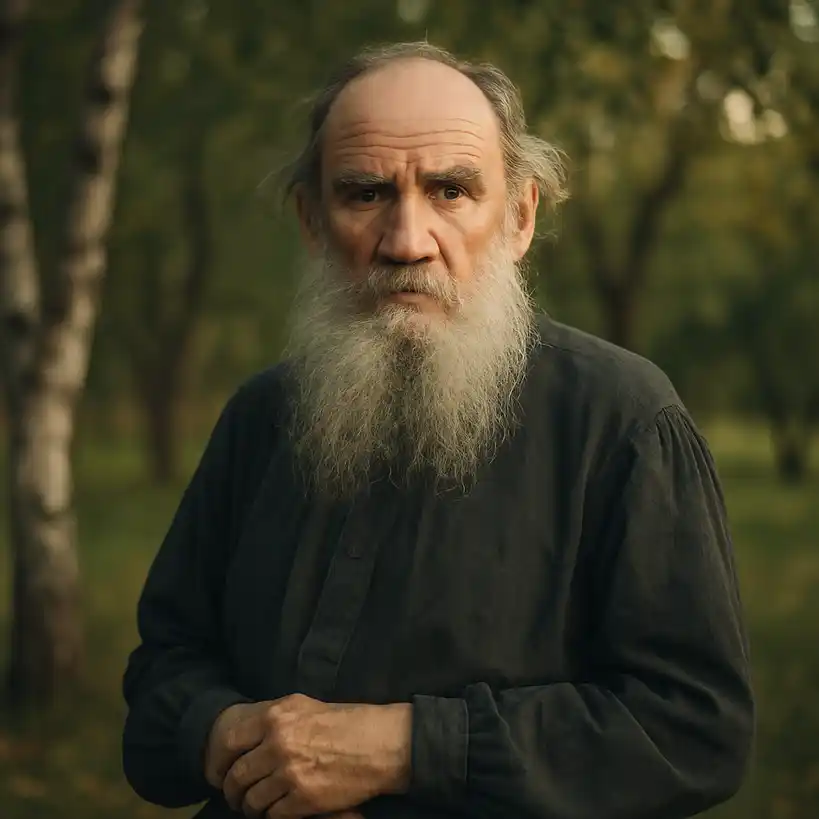
Profile of Leo Tolstoy
- Full Name and Pseudonyms: Lev Nikolaevich Tolstoy; widely known as Leo Tolstoy.
- Birth and Death: 9 September 1828, Yasnaya Polyana, Russian Empire; 20 November 1910, Astapovo (now Lev Tolstoy), Russian Empire.
- Nationality: Russian.
- Father and Mother: Nikolai Ilyich Tolstoy, landowner; Maria Nikolayevna Tolstaya (née Volkonskaya).
- Wife or Husband: Sophia Andreyevna Tolstaya (née Behrs), married 1862.
- Children: Thirteen; notable: Sergey, Tatiana, Ilya, Lev, Maria, Alexandra.
- Literary Movement: Russian realism; later religious and moral essays.
- Writing Style: Omniscient narration, free indirect discourse, precise social detail, moral inquiry.
- Influences: Homer; Jean-Jacques Rousseau; Alexander Pushkin; Nikolai Gogol; the Gospels.
- Awards and Recognitions: Multiple Nobel nominations; global canonization.
- Adaptations of Their Work: War and Peace; Anna Karenina; Resurrection; many film and TV versions.
- Controversies or Challenges: Excommunicated by the Russian Orthodox Church (1901); disputes over beliefs and copyrights.
- Career Outside Writing: Army service; educator and school founder; essayist and reformer.
- Recommended Reading Order:
1. The Death of Ivan Ilyich
2. Anna Karenina
3. War and Peace
4. Hadji Murat
Roots, losses, and first pages of Leo Tolstoy
Yasnaya Polyana sets the scene for Leo Tolstoy’s first memories. An old estate holds libraries, portraits, and habits that train the eye on small truths. Yasnaya Polyana beginnings give the writer a lasting sense of place and duty. Orphanhood arrives early and guardians keep the household moving. Tutors, relatives, and servants shape language and manners in different ways.
Schooling takes him to Kazan University. Oriental languages come first, then law, and neither keeps him long. Gambling and debt enter the picture and sharpen his view of chance, class, and self-control. Kazan, study, and drift become a rhythm that produces journals, plans, and self-critique. Reading turns serious. Rousseau’s candor, Pushkin’s line, and moral texts push him toward clear prose and ethical tests.
The army offers purpose and exposure. Service in the Caucasus supplies vast landscapes and strict codes. Sevastopol delivers noise, danger, and the need to watch. Notes from these fronts turn into early pages where character is shown by action rather than explained. War as apprenticeship is the honest name for these years. Back at the estate, experiments in teaching follow. Children learn with stories and games, while primers form in neat, tested lessons.
This mix of estate order, student drift, and military schooling sets his method. Scenes stay concrete, yet ideas keep pressing in. A reader can compare moral pressure across Russian fiction through peers and neighbors; for a brilliant counterpoint, see 👉 The Brothers Karamazov by Fyodor Dostoevsky. A seedbed for moral inquiry is what these early years finally become, and the novels will keep returning to that first soil.
Rooms, drafts, and a turning of the tide
Marriage steadied the workroom and sharpened the pages. Sophia Andreyevna copied drafts, queried commas, and protected hours so the long books could breathe. Marriage and method describe this stretch better than any slogan. Early acclaim from war sketches turned into broader confidence, and the desk at Yasnaya Polyana became a reliable engine.
Big books followed in close succession. War and Peace set households and armies on the same stage without losing the pulse of daily life. Anna Karenina tested private choice against public ritual with calm precision. New readers often need a route through those peaks. For history joined to intimacy, start with 👉 War and Peace by Leo Tolstoy; for love, law, and consequence, read 👉 Anna Karenina by Leo Tolstoy. Two landmark novels fixed his place in world literature while keeping the prose human and clear.
Not everything moved smoothly. Censors hovered over essays, and arguments about money and rights strained the household. A spiritual crisis redirected effort toward ethics, labor, and simplicity. Crisis and conscience became subjects and methods at once. Teaching experiments and primers kept the conversation practical, and letters carried his questions beyond Russia.
Cities, salons, and print networks widened the circle. Translators brought chapters to new languages, and the name traveled from drawing rooms to classrooms. Style shifted in quiet ways. The narrator stepped back more often, sentences trimmed when the argument demanded it, and scenes leaned harder on gesture over lecture. Craft serving judgment turned into a working rule, and the middle years closed with a clear path toward the spare force of the late period.
Snowlight, small rooms, steady flame
Late prose thinned the line and deepened the gaze. Short forms weighed power, guilt, and mercy without theatrics. Lean pages, full weight names the turn I feel most. Essays pressed for nonviolence and personal responsibility. Letters answered strangers with practical counsel rather than flourish.
Health faltered at times, and household tensions rose. Copyright and conscience collided with love and loyalty, testing the marriage and the circle around it. Visitors kept arriving at Yasnaya Polyana, curious about principles and process. Answers stayed simple. Read with care, work steadily, refuse cruelty. Principle before comfort guided both schedule and advice.
The fiction held its own weather. The Death of Ivan Ilyich showed how illness can clarify a life. The Kreutzer Sonata probed jealousy and marriage under severe light. Master and Man paired power with exposure to reveal character. Longer projects did not vanish. Resurrection took law and reform as central problems. Admirers found new doors into the work as translations multiplied and adaptations reached wider audiences. For a humane counterpoint in another tradition, revisit 👉 Great Expectations by Charles Dickens and notice how sympathy travels across borders. Quiet reach, wide echo describes the public standing of these years.
The final journey ended at Astapovo in 1910. Illness closed the road, and burial at Yasnaya Polyana returned the legacy to first soil. Archives, notebooks, and primers stayed on the tables that trained the craft. Readers still find a handhold in the late pages. Simple syntax, exact images, and moral light keep opening new starts. An ending that keeps opening is how this life now reads.
Circles, cities, and the questions that don’t let go
St. Petersburg journals, Moscow salons, and country roads all shaped Leo Tolstoy’s ear. I see Russian realism not as a club but as a running argument about truth in ordinary life. Russian realism in motion is the frame: observe closely, judge carefully, and let action speak. Editors at The Russian Messenger and debates with contemporaries kept the work honest and the bar high.
Peer pressure mattered. Ivan Turgenev’s elegance set a rival standard; their quarrels clarified aims on art and society. Fyodor Dostoevsky pushed the moral question inward, and reading him helps us hear Tolstoy’s steadier camera and cooler verdicts. Ivan Goncharov modeled patient social anatomy. Charles Dickens offered sympathy and crowd sense across the channel. Anton Chekhov, younger and spare, proved how much could be said with a glance. Peers in productive tension kept the prose brave and exact.
Themes return with variation rather than repetition. History and private choice meet on the same stage in War and Peace: individuals act, yet currents push back. Family, freedom, and law collide in Anna Karenina, where affection tests ritual and reputation without melodrama. Conscience turns from idea to practice in the late essays and stories; nonviolence and responsibility become daily work rather than slogans. Death is not a curtain but a clarifying light; short fiction shows how endings burn away vanity.
This context helps new readers. When you know the circles and arguments, scenes feel richer and the calm tone grows more thrilling. The writer asks us to watch people choose, then asks us to notice what those choices cost. That question never goes out of style.
Famous Works by Leo Tolstoy
- 1852 — Детство (Childhood); novella. A poised debut that seeds memory, class, and growth.
- 1855 — Севастопольские рассказы (Sevastopol Sketches); short-story cycle. War scenes turn observation into ethical pressure.
- 1857 — Юность (Youth); novella. A restless mind tests pride, shame, and self-invention.
- 1863 — Казаки (The Cossacks); novella. Border life contrasts nature’s pull with society’s claims.
- 1869 — Война и мир (War and Peace); novel. Family and history share one design; agency meets chance.
- 1877 — Анна Каренина (Anna Karenina); novel. Private love confronts law, ritual, and reputation.
- 1882 — Исповедь (A Confession); non-fiction. A spiritual crisis becomes a plain reckoning.
- 1886 — Смерть Ивана Ильича (The Death of Ivan Ilyich); novella. Illness strips a life to essentials.
- 1889 — Крейцерова соната (The Kreutzer Sonata); novella. Jealousy and marriage under severe light.
- 1894 — Царство Божие внутри вас (The Kingdom of God Is Within You); non-fiction. A clear case for nonviolence and conscience.
- 1895 — Хозяин и работник (Master and Man); short story. Power, weather, and sacrifice reveal character.
- 1899 — Воскресение (Resurrection); novel. Law, guilt, and reform drive a late social vision.
- 1912 — Хаджи-Мурат (Hadji Murat); novella. Empire and resistance compressed into vivid, unsparing scenes.
What fed the engine: Influences on Leo Tolstoy
The writer learned by testing styles against life. I see him borrowing tools, not poses, and turning them toward moral clarity. Epic scale with a human center stayed constant from his earliest pages to the great novels.
- Homer — Form and sweep: The Iliad models large movement with close human stakes. Tolstoy adapts that balance in battle chapters of War and Peace (1869), where armies move and a glance still matters.
- Jean-Jacques Rousseau — Education and conscience: Émile (1762) and Confessions (1782) sharpened his suspicion of social polish and his faith in sincerity. School experiments and primers aim at the same plain honesty.
- Alexander Pushkin — Line and control: Eugene Onegin (1833) taught pace, transitions, and the art of the telling detail. Tolstoy’s scenes keep that poise while widening the canvas.
- Nikolai Gogol — Social vision and comic sting: Dead Souls (1842) and “The Overcoat” (1842) showed how institutions warp the soul. The author keeps the satire cooler, yet the pressure on vanity feels just as real.
- Arthur Schopenhauer — Crisis and argument: The World as Will and Representation (1818/1844) helped name suffering’s engine. Tolstoy answers not with resignation but with practical ethics in A Confession (1882).
- Charles Dickens — Sympathy in crowds: David Copperfield (1850) proved how tenderness and critique can live together. City scenes and family tables in Tolstoy hold that same double truth.
These sources pull toward one outcome. Ethics in daily scenes becomes the method: show work, weather, and the face across the table, then let the judgment rise from what we witness. Plain style, deep pressure turns influence into a signature rather than a collage.
Aftershocks and new routes: Writers Tolstoy shaped
Tolstoy’s legacy is a grammar of seeing: steadiness, fairness, and moral nerve. Later novelists reuse those tools to ask their own hard questions. Technique as conscience is the through line I keep noticing.
- Anton Chekhov — The quiet test: Short fiction like “Ward No. 6” (1892) turns judgment into observation. Chekhov trims authorial comments and trusts gesture, a Tolstoyan habit at smaller scale.
- Thomas Mann — Family and fate: Buddenbrooks (1901) and The Magic Mountain (1924) weigh work, illness, and culture with wide social lenses. For a companion path, see 👉 The Magic Mountain by Thomas Mann.
- John Steinbeck — Work and dignity: The Grapes of Wrath (1939) treats labor and law with compassion that never blurs structure. The steady camera and ethical push owe a debt to the writer. Try 👉 The Grapes of Wrath by John Steinbeck.
- Aleksandr Solzhenitsyn — Witness and courage: One Day in the Life of Ivan Denisovich (1962) shows how institutional power grinds daily life; restraint on the page sharpens moral force.
- Orhan Pamuk — History and the self: Snow (2002) and Nights of Plague (2022) blend politics, memory, and intimate choice; the cool narrator and layered time feel like modern heirs to Tolstoy’s balance.
- Vasily Grossman — War and home: Life and Fate (written 1959) adapts the war-and-household braid to the twentieth century, insisting that history is a moral arena made of rooms and meals.
Influence here is not imitation. Each writer keeps local weather, language, and stakes. Large canvases, close hearts is the shared ambition: to make big systems visible without losing the person in the chair, the tool in the hand, or the promise that character is built, one choice at a time.
Who holds the camera, and how time breathes – Style and Technique
Tolstoy’s narrator watches with patience, then moves in close when conscience starts to speak. Closeness without noise is the core trick: we feel a mind at work, yet the sentence stays clear. Free indirect discourse lets thought rise inside third-person narration, so interior life arrives without heavy tags. In Anna Karenina, a quiet look across a room can turn into a reckoning; in War and Peace, a cavalry charge widens the lens so history and heartbeat share the same frame.
Distance shifts on purpose. Switches you can feel guide us from private worry to public consequence and back again. One page follows a hand on a doorknob; the next shows roads, councils, or a regiment’s line. The change is smooth because detail anchors the step: a smell, a coat, a chair being moved to make space. The camera never forgets the room even when a map appears.
Time works on two tracks. Long arcs, short beats—seasons, campaigns, marriages on one rail; a gesture, a breath, a single thought on the other. Memory enters cleanly and returns us to the present without fog. Suspense grows from accumulation rather than tricks: many small choices, each with a cost, build pressure until a life tilts. The Death of Ivan Ilyich shows this most starkly, the minutes tightening as insight grows.
Comparisons help new readers tune their ear. For a darker, close-quarters first-person, compare 👉 Crime and Punishment by Fyodor Dostoevsky. For voice-led growth and social observation, see David Copperfield by Charles Dickens. Point of view as ethics might be the shortest name for this system: the narrator grants dignity by giving each moment its proper distance.
Sentences that carry weight; images that return
Tolstoy writes in lines that look simple and feel inevitable. Plain syntax, hidden music keeps pace steady while meaning deepens. Clauses balance like steps on a road; lists appear when inventories matter—horses, dishes, tools—so the world feels handled, not merely seen. Repetition marks moral emphasis, but rhythm never shouts over the scene.
Images do the heavy lifting. Images that do real work—light on a sleeve, snow underfoot, doors half-open—carry theme without lecture. Fields and weather test patience and courage; rooms reveal order, rank, and strain. Motifs return quietly so recognition feels earned. When snow reappears later, it lands with memory attached rather than symbolism announced.
Dialogue shows class, intent, and pressure. Speech that reveals character avoids slogans and lets small hesitations tell the truth. Public voices differ from private ones; a polite phrase may hide a knife’s edge. Irony comes from contrast—what someone says against what someone does—so judgment happens in the reader, not in authorial scolding.
Tone stays humane even when the verdict is firm. Firm, never cruel might be the rule. A character can be wrong without being humiliated. That restraint lets hard scenes keep their light. In War and Peace, crowded chapters breathe because the voice refuses melodrama, while in Anna Karenina, domestic talk finds the exact temperature of hope and hurt. In The Death of Ivan Ilyich, short, pressure-bearing sentences meet a narrowing life.
I read these pages as craft serving mercy. Strong grammar, recurring images, and honest talk work together so ideas stay tied to bread, boots, and body heat. The result is prose you can walk through—room by room—without losing sight of why the walk matters.
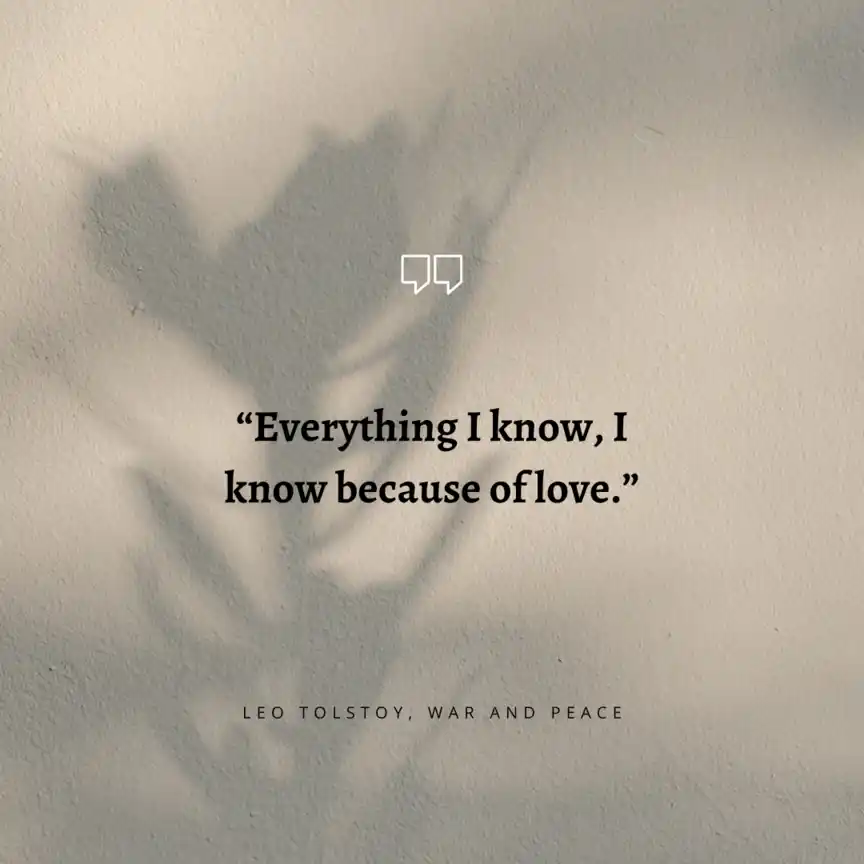
Lines that still breathe – Famous Quotes by Leo Tolstoy
- “All happy families are alike; each unhappy family is unhappy in its own way.” A calm opening that turns private life into a quiet test of law and custom.
- “It is amazing how complete is the delusion that beauty is goodness.” A warning from a jealous, uneasy mind; appearances mislead the heart.
- “. . . the desire for desires—boredom.” Restlessness names itself; wanting to want becomes its own trap.
- “Our body is a machine for living. . . . let it defend itself, it will do more than if you paralyze it by encumbering it with remedies.” A practical philosophy of health from a novelist who prized clear living.
- “Spring is the time of plans and projects.” Hope arrives with chores and checklists; renewal looks like work.
- “If you look for perfection, you will never be satisfied.” Perfection blocks joy; patience lets meaning arrive.
- “Ivan Ilyich’s life had been most simple and most ordinary — and therefore most terrible.” A plain sentence that cuts through denial and pride.
- “The strongest of all warriors are these two — Time and Patience.” Endurance wins battles of heart and history.
Trivia Facts about Leo Tolstoy – Small doors into a very large life
- Estate as workshop: The author was born and lived much of his life at Yasnaya Polyana, where manuscripts and family rooms form today’s museum and archive. 🌐 Yasnaya Polyana Museum confirms the estate’s history and collections.
- Teacher at home: He founded a free school for peasant children on the estate and wrote simple primers tested in class sessions that felt more like play than drill.
- Letters across continents: Leo Tolstoy corresponded with Gandhi; both argued for nonviolence grounded in conscience and daily practice.
- No Nobel on the shelf: Despite multiple nominations, he never received the Nobel Prize; the writer doubted the value of prizes and preferred moral results to honors.
- From salon to cinema: Novels and novellas inspired many film versions; The Last Station dramatizes his final year with attention to marriage and belief.
- Peer echoes: Curious how large family sagas travel? Try 👉 A Tale of Two Cities by Charles Dickens for crowd scenes and moral weather rendered with sympathy.
- Late style, quiet heat: Shorter works like The Death of Ivan Ilyich and Master and Man carry stark themes in compact form that still feel modern.
- Across Europe’s bookshelf: For a different path through family, trade, and time, see 👉 Buddenbrooks by Thomas Mann and notice how fate works through dinner tables, ledgers, and habits.
Reviews, classrooms, screens: how the world read Tolstoy
Early notices praised the war sketches for clarity, then argued about their moral calm. Early praise, later debate became the pattern. With War and Peace and Anna Karenina, reviewers marveled at scale while disagreeing about method. Some wanted tighter plots; others admired the patient truth of ordinary life. The religious turn complicated things. Excommunication sparked headlines, yet the novels never left the syllabus. A living classic is the status that stuck: read in schools, argued over by scholars, adapted for new audiences.
Modern criticism often highlights realism without rhetoric, point of view as ethics, and the dignity given to labor, family, and care. Translators continue to shape tone for English readers; introductions explain choices so newcomers can pick editions that match their taste. Films and miniseries widened reach and kept names and scenes in public memory. Screens extended the shelf life, but the books still lead.
If you want depth, a few guides stand out. Rosamund Bartlett’s biography (Tolstoy: A Russian Life) offers balanced archival detail. A. N. Wilson’s portrait (Tolstoy) moves briskly while admitting paradox. Henri Troyat’s classic stays useful for context. Essays and letters help with the late ethic; A Confession remains a short, essential statement. For comparison across traditions, try 👉 Nicholas Nickleby by Charles Dickens for crowd sense and stagecraft, or 👉 East of Eden by John Steinbeck for moral testing under pressure. Choose one guide, then read—the primary texts will do the rest.
What to take, and where to start tonight
Leo Tolstoy shows that big questions live inside small gestures. I come back for the steadiness: rooms, roads, and quiet glances that turn into choices. Plain style, deep pressure is the effect you’ll feel first. The narrator stays calm, yet lives tilt. History moves, yet the person across the table matters most.
The life arc explains the range. Early service sharpened attention to work and danger. Marriage and the long books proved how patience can carry meaning. A crisis redirected energy toward conscience and practical teaching. Late stories trimmed the line and kept the light. Craft serving judgment ties it all together without sermon.
Themes gather as you read. Family and freedom pull against law and reputation. History and agency share one stage where chance also plays a part. Conscience and nonviolence shift from theory to daily practice. Death clarifies rather than silences. These patterns return in different rooms, which is why rereading keeps paying off.
Start now with a short, strong piece. Begin with a short like The Death of Ivan Ilyich to hear the voice without fatigue. Then choose a big novel: Anna Karenina for private life under pressure or War and Peace for history joined to home. Save a deep cut like Hadji Murat for a compact echo of the whole method. When you want the ethical program in plain words, read A Confession.
Take ten quiet minutes and open the first chapter. Vary your pace, mark a line that hits you, and close the book only when a question forms. Read with attention, and the pages will meet you halfway.
More Reviews of Works by Leo Tolstoy
Anna Karenina by Leo Tolstoy – Desire and Duty Tolstoy starts Anna Karenina with movement, not thesis. Consequently, lives collide…
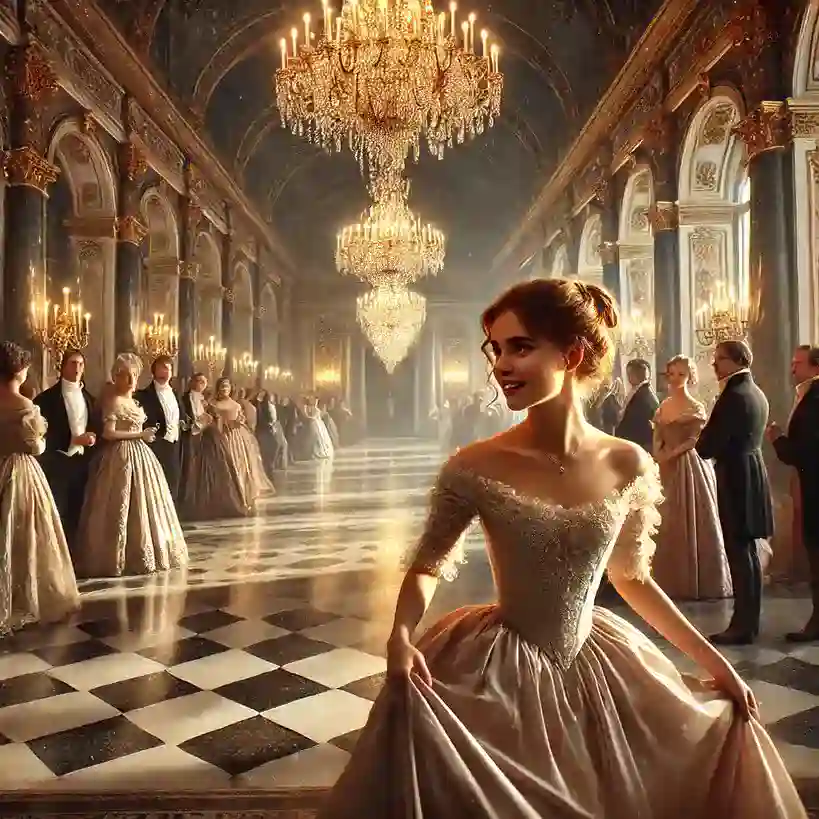
Inside War and Peace by Leo Tolstoy The first thing to know about War and Peace is this: it’s not…