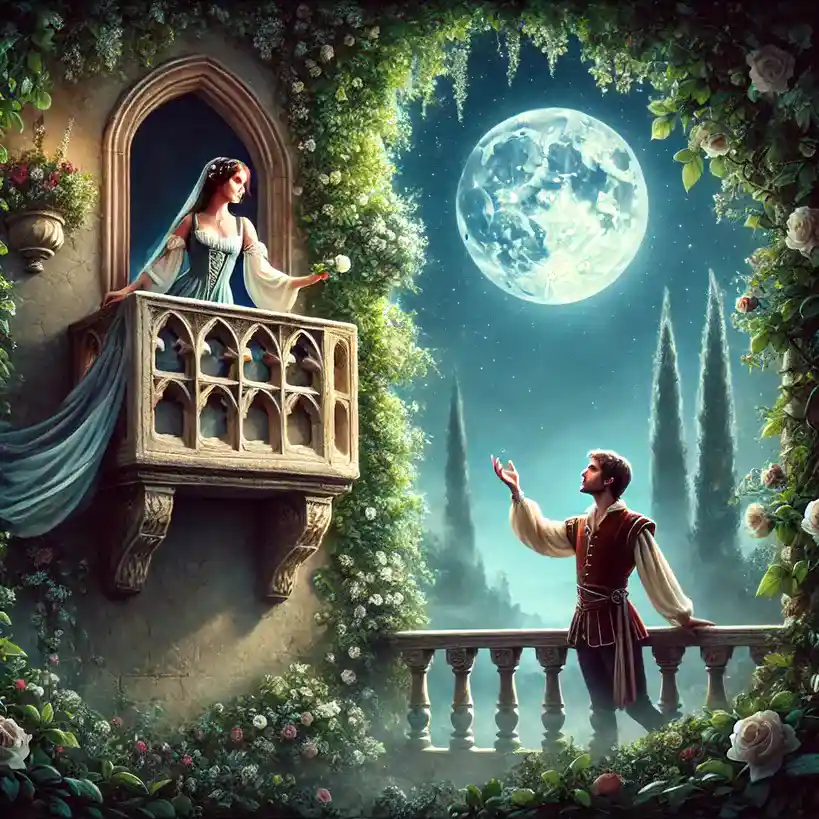
A Midsummer Night’s Dream – Shakespeare’s Wildest Comedy
Reading A Midsummer Night’s Dream is like falling into a lucid dream. The rules of logic blur, characters lose themselves, and language dances between sense and nonsense. When I first read this play, I was struck not by its romantic charm, but by its unruly energy. The author weaves a plot of colliding identities, mistaken desires, and theatrical trickery, all while laughing behind the curtain.
There’s something incredibly modern about the way this story unfolds. The play doesn’t march toward clarity; it spirals into confusion and emerges changed. Lovers fall in and out of love within hours. Kings and queens feud in forests. Fairies meddle, actors blunder, and yet every thread resolves with startling ease. That’s the genius of it. William Shakespeare creates disorder just to show how art, and maybe love can survive chaos.
What kept me turning the pages wasn’t just the plot. It was the tone. The play refuses to take itself seriously, and in doing so, it reveals truths with a light touch. Humor becomes a tool for seeing clearly. Puck’s final speech says it all: maybe it was only a dream. But if so, what a revealing one. One that mocks our pride, mirrors our folly, and still somehow offers joy.

A Midsummer Night’s Dream: Comedy in a Forest of Shadows
A Midsummer Night’s Dream is often called a romantic comedy, but that label barely captures its complexity. Yes, it’s filled with lovers and weddings, but it’s also about enchantment, manipulation, and power. The playwright sets the action not in courts or cities, but in a forest, a place where reality breaks open. In this wilderness, characters discover who they really are, or who they could be, if free from rules.
One of the most fascinating aspects is how the characters lose control. Helena chases Demetrius, Hermia defies her father, Lysander suddenly changes his heart. These shifts aren’t just funny; they’re psychological experiments. The forest acts like a dream state where true desires emerge, raw, messy, and unfiltered. And it’s all orchestrated by supernatural forces who seem both mischievous and wise.
The play reminded me of 👉 Three Early Stories by J. D. Salinger. In both, young people face confusing emotional landscapes where clarity comes through experience, not logic. In his world, transformation is everything. What you see in Act I might disappear in Act III. That instability keeps the audience leaning forward, waiting for the next trick of the eye or heart.
Ultimately, A Midsummer Night’s Dream works because it never pretends to be safe. Its comedy is wrapped in uncertainty. Its joy rises from the very things that unsettle us: love, change, and the wildness of the human mind.
The Lovers’ Labyrinth: Desire in Flux
What makes A Midsummer Night’s Dream so enduring is how seriously it takes love and how lightly it treats it at the same time. The four young lovers are constantly changing direction, falling for the wrong person, saying things they don’t mean, or meaning things they can’t explain. Watching them is like watching the heart work in real time: unpredictable, honest, and a little ridiculous.
Lysander and Hermia start as a unified couple, sure of their bond. But within a few scenes, he loves Helena. Demetrius, cold and cruel at first, later becomes doting and sincere. And Helena, poor Helena, spends half the play chasing someone who wants nothing to do with her. Their stories are emotional kaleidoscopes. Each twist reveals a new facet of desire, jealousy, or hope. It’s impossible to read this without cringing and smiling at the same time.
The humor never shields the emotion. When Hermia feels betrayed, or when Helena lashes out, it hurts. That’s what makes the comedy work, it’s never mean, but it’s always real. I found myself moved by how clearly Shakespeare saw the chaos of attraction, and how he gave it form without reducing its depth. The lovers stumble, but they grow. And in their mess, they become fully human.
Shakespeare’s Wildest Comedy: Performing the Ridiculous
If the lovers are the soul of A Midsummer Night’s Dream, the mechanicals are its beating heart. This ragtag group of amateur actors, led by the famously foolish Bottom, adds layers of satire and delight. Their play-within-a-play, “Pyramus and Thisbe,” is so wonderfully clumsy that it becomes a comic masterpiece. Yet beneath the slapstick lies something sincere, a celebration of the courage it takes to create.
These characters are deeply funny, not because they’re foolish, but because they’re so unaware of how funny they are. Bottom’s transformation into an ass-headed lover is one of the most famous moments in all of Shakespeare, and for good reason. It captures the play’s core tension: how quickly we can become absurd in the eyes of others and how little that changes who we think we are.
Their performance is a mirror of the main plot. Just as the lovers’ passions shift wildly, the mechanicals bungle their own attempts at storytelling. But through it all, there’s affection. The poet never mocks these characters cruelly. He lets them try, fail, and shine. Watching them, I was reminded of 👉 Mrs. Dalloway by Virginia Woolf, where everyday lives and performances carry unexpected weight. The mechanicals may be simple, but they’re authentically moving.
By the time the court watches their show, we laugh, but also feel a little proud. They dared to bring imagination to life, and that, in a play about magic and mischief, might be the bravest thing of all.
Fairy Power and Trickster Logic in A Midsummer Night’s Dream
The fairies in A Midsummer Night’s Dream are not gentle spirits, they are agents of disorder. Oberon and Titania’s feud, and Puck’s gleeful interference, drive much of the chaos in the play. But this isn’t just comic mischief. William Shakespeare gives these magical beings sharp edges. They control outcomes, bend emotions, and blur the lines between will and enchantment. They’re not cute. They’re delightfully dangerous.
What fascinated me most was how the fairies’ world overlaps with the human one. They don’t live in a separate mythological realm. They exist in the same forest, sometimes invisible, sometimes deeply involved. It’s as if the writer is showing us that our dreams, our instincts, and our desires are always under the influence of something unseen. And he gives those unseen forces names, voices, and charming, mischievous form.
Puck, especially, is unforgettable. He creates problems and solutions in equal measure. He’s not evil, just indifferent to structure. His logic is instinctive and erratic, like the mood swings of a child or the randomness of dreams. He reminded me that the comic can be chaotic, and that order often comes through trial, not plan. The fairies don’t resolve the story. They stir it, distort it, and let the pieces fall where they may.
Time, Illusion, and the Nature of Theatre
One of the most brilliant aspects of A Midsummer Night’s Dream is how it constantly reflects on its own artifice. It’s a play that knows it’s a play. Characters fall asleep and wake into new realities. Lovers change minds as if under a spotlight. The forest becomes a kind of stage where dreams are rehearsed, rewritten, and sometimes forgotten. This fluidity isn’t a gimmick, it’s a deep exploration of what art does.
The line between reality and illusion is always thin. Is Demetrius truly in love by the end, or still enchanted? Do the characters change, or are they just reset? The play never gives us certainty. And that ambiguity made me think of 👉 The Myth of Sisyphus by Albert Camus. Both works ask whether we can believe in our stories, even when we know they’re shaped by forces beyond our control.
There’s also a strong thread of theatrical commentary. He shows us actors rehearsing badly, audiences misinterpreting scenes, and characters stepping into roles they barely understand. It’s funny, but it’s also a meditation on storytelling itself. Who writes the endings? Who believes the illusions? I loved how A Midsummer Night’s Dream made those questions feel playful rather than heavy.
And in that, the play becomes not just about love or magic, but about theatre as a space of possibility. A place where time bends, characters transform, and the improbable becomes briefly, beautifully real.
Power Plays and Parental Pressure
While much of A Midsummer Night’s Dream is whimsical, the play begins with serious tension. Egeus wants his daughter Hermia to marry Demetrius or die. Theseus, Duke of Athens, supports that brutal choice. It’s easy to forget, amidst the comedy and fairies, that the stakes were life and death. The author uses this hard edge to show how quickly social power can become intimate tyranny.
What struck me most is how young people in the play resist control. Hermia’s refusal to marry against her will is not just romantic, it’s radical. She flees into the forest to protect her autonomy. And in doing so, she disrupts not only her fate, but the hierarchy around her. The forest becomes a space of personal rebellion, a world apart from legal threats and patriarchal rules.
Yet Shakespeare doesn’t solve this tension with revolution. Instead, he uses magic and misunderstanding to soften the outcome. By the time the lovers return to Athens, everything is allowed. Consent is restored. But the pressure lingers beneath the happy ending. I found that ambiguity fascinating. It asks whether change comes from magic or justice, and whether we ever escape the rules we momentarily break.
The Dream’s End: Illusion, Closure, and Renewal
The final act of A Midsummer Night’s Dream is a masterclass in controlled contradiction. The weddings conclude, the mechanicals perform their absurd tragedy, and the fairies bless the beds of newlyweds. All threads are tied, but not too tightly. There’s a lingering sense that not everything was real, or that reality might be less solid than it seems.
This tension between certainty and illusion makes the ending rich rather than tidy. Puck’s final speech, asking the audience to imagine it all as a dream, doesn’t erase the story, but asks us to reflect on it differently. It’s not closure; it’s a curtain call that doubles as a wink.
This reminded me of 👉 Eyeless in Gaza by Aldous Huxley, where structure collapses and time bends to reveal something more truthful than linear plot ever could. William Shakespeare does the same through comedy. His final act is less a conclusion than a release, of spell, tension, and expectation. The characters don’t just end the play; they wake up from it.
I appreciated how the playwright gives everyone what they want, but not without cost. What they remember, what they forget, and what they choose to believe remains unclear. And that’s what makes the play feel modern. It doesn’t settle into logic. It rests, lightly and knowingly, on the edge of the unreal.
Metatheatre and the Joy of Watching
The work constantly reflects on what it means to be a spectator. From the lovers wandering through illusions to the nobles watching the mechanicals perform, every layer of the play asks us to notice that we are watching. It’s one of the earliest examples of metatheatre, a play not just performed, but about performance itself.
I found this structure delightful. The characters shift between actors and audiences without ever acknowledging the change. They observe each other, react, misread, and reinterpret. The audience watching the nobles becomes the audience watching the actors, watching the lovers. It’s dizzying and smart, but never smug. Shakespeare builds layers of meaning, but always wraps them in laughter.
The play-within-the-play is both parody and tribute. “Pyramus and Thisbe” is ridiculous, but oddly touching. It shows us how even failed theatre can reveal truth, or at least produce joy. That, I think, is one of the play’s deeper lessons. Art isn’t about perfection. It’s about daring to show something real through something false. And in that way, A Midsummer Night’s Dream becomes a celebration of the audience, of everyone willing to dream with their eyes open.
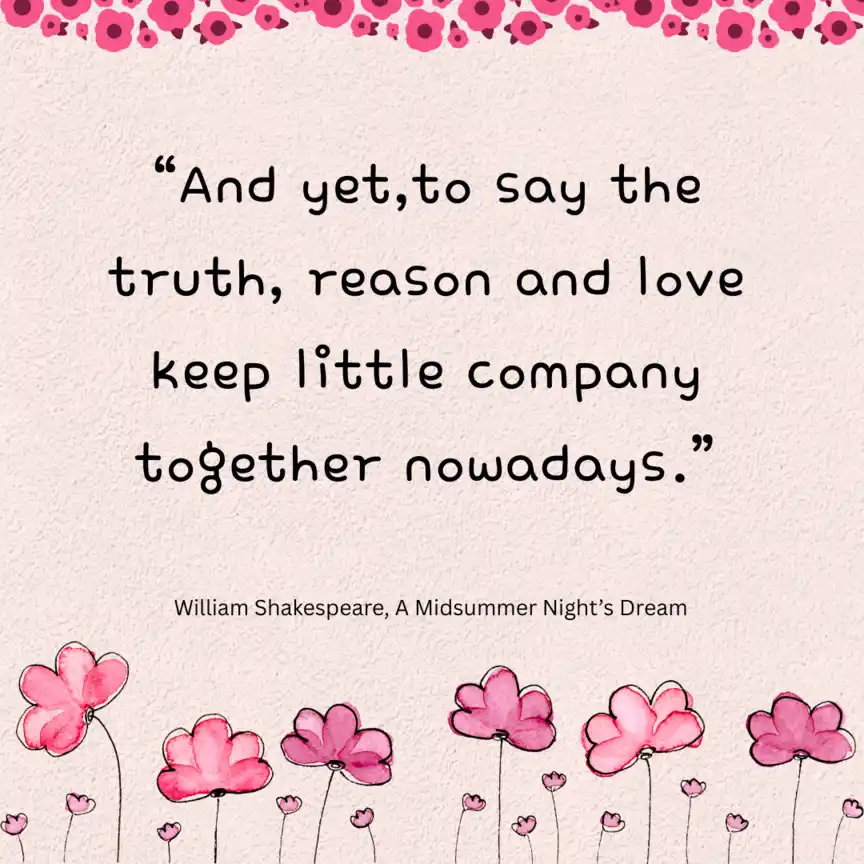
✒️ Thoughtful Quotes from A Midsummer Night’s Dream by William Shakespeare
- “The course of true love never did run smooth.” One of William Shakespeare’s most quoted lines, it captures the romantic chaos at the heart of the play with clarity and charm.
- “Lord, what fools these mortals be!” Puck’s laughter at human folly reminds us that comedy can be a form of truth, sharp, amused, and strangely affectionate.
- “Love looks not with the eyes, but with the mind.” Helena’s insight reflects the central tension of the story: desire often ignores reason and reality alike.
- “Though she be but little, she is fierce.” This defense of Hermia becomes a declaration of character, a compact line that celebrates strength without size.
- “I’ll follow thee and make a heaven of hell.” Helena’s desperation becomes poetic obsession. It’s both moving and unsettling in how far she’s willing to go for love.
- “My soul is in the sky.” A line from Bottom in performance, delivered with accidental grandeur, it shows how even foolishness can produce beauty.
- “Are you sure that we are awake? It seems to me that yet we sleep, we dream.” This moment of questioning reflects the play’s deep interest in blurred boundaries.
- “So quick bright things come to confusion.” Lysander expresses the fragility of youthful passion. What starts with promise often ends in disorder.
- “I am that merry wanderer of the night.” Puck introduces himself with glee, immediately establishing his role as mischief-maker and guide through the dream.
- “If we shadows have offended, think but this and all is mended.” Puck’s epilogue softens the entire experience, inviting forgiveness and reflection, a perfect theatrical bow.
📚 Trivia Facts from A Midsummer Night’s Dream
- Written in the 1590s: Scholars date the play to around 1595–96, during a prolific period when he also wrote Romeo and Juliet and Richard II.
- Performed at weddings: A Midsummer Night’s Dream was likely first staged as part of a noble marriage celebration, which fits its themes of love and union.
- Used in schools worldwide: Today, it remains one of the most-taught Shakespearean works across Europe and North America, alongside 👉 David Copperfield by Charles Dickens.
- Adapted into ballets and operas: Felix Mendelssohn composed a famous overture and incidental music, including the iconic “Wedding March.”
- Influenced magical realism: Its layered narrative and dreamlike shifts have been cited as an influence on authors like 👉 Three Comrades by Erich Maria Remarque.
- Bottom’s name is a pun: “Bottom” refers both to his status as a fool and to weaving terminology, as he’s a weaver by trade, another layer of theatrical wordplay.
- Echoes in modern theatre: Its metatheatrical elements resonate in works like 👉 Dandelion Wine by Ray Bradbury, where memory, time, and imagination intersect.
- Fairies rooted in folklore: The poet draws on English folk tales and courtly traditions, blending mischief and mystery in his depiction of the fairy world.
- Studied at global institutions: The play is part of core curriculum in places like The Folger Library, and featured in academic programs at University of Oxford’s Faculty of English.
Theatrical Afterlives and Cultural Echoes
What keeps A Midsummer Night’s Dream alive is not just its language or humor, but how endlessly it can be reimagined. I’ve seen it set in forests, factories, nightclubs, and digital landscapes. Its world is elastic, and its logic invites directors to play. Because the play already questions reality, it welcomes reinterpretation. Each staging becomes part of the dream.
The characters feel strangely modern, too. They resist identity, shift roles, and adapt. This makes them ideal for adaptation. Watching a recent version that set the forest scenes in a neon-lit rave, I realized just how timeless the story is. The lovers’ confusion, the fairies’ games, it all works, no matter the frame.
It reminded me of 👉 I am the Wind by Jon Fosse. Both works explore dislocation, identity, and emotional rawness inside stripped-down or dreamlike settings. But where Fosse leaves us in existential stillness, the writer offers momentum. His dream moves, laughs, and returns, not to reality, but to renewed possibility.
The play’s echo lives not just in the theatre, but in art, film, and even social media, anywhere people remix fantasy with form. This writing remains relevant because it already knows how fleeting meaning is. And still, it believes in the value of trying to catch it, if only for a night.
Language as Spellcraft
One of the most enduring qualities of A Midsummer Night’s Dream is its language. William Shakespeare moves between rhymed verse, blank verse, and prose with startling ease. Every character speaks in a way that reveals their inner world. The lovers, for example, often rhyme when emotions peak. The fairies sing in fluid couplets. The mechanicals, in contrast, speak with a clunky, broken rhythm that parodies the grandeur of high drama.
This musicality is not just decorative. It works like a spell. Characters change feelings mid-line, or wake into altered realities mid-sentence. The language mirrors the transformations of the plot. I found myself rereading passages just to hear the cadence out loud. It reminded me that he wasn’t just writing dialogue, he was composing experiences.
Even in its humor, the language holds weight. Helena’s speeches are full of pain, Titania’s monologues are full of dignity, and Puck’s closing lines feel like a whisper to the audience’s subconscious. The text moves seamlessly between comedy and poignancy, often within a single line. This fluidity gives the play emotional richness without slowing its pace. It’s poetry that’s alive, not frozen on the page.
And most of all, it proves that style matters. That how something is said is never separate from what is said, especially in a story where illusion and language share the same stage.
Why A Midsummer Night’s Dream Still Matters
If I had to describe A Midsummer Night’s Dream in one word, it would be transformation. Not just for the characters, but for the audience. It invites us into a world where logic loosens, where identities shift, and where love, for all its absurdity, remains strangely hopeful. The play doesn’t moralize or explain, it lets us experience confusion as something magical.
This is why it keeps living across centuries. It offers freedom. Freedom from strict plots, from realism, from the heavy burden of reason. And in return, it gives us wonder, laughter, and renewal. That’s rare. Most comedies entertain. This one awakens.
It reminded me of 👉 Don Quixote by Miguel de Cervantes, another work where illusion becomes the key to emotional truth. Both are playful, but profound. Both ask whether fantasy might actually bring us closer to honesty than logic ever could.
In the end, the story is more than a dream. It’s a blueprint for how to engage with art, with each other, and with the chaotic theater of love. It teaches us to believe in transformation, not just for a night, but always.