Virginia Woolf’s Mrs. Dalloway – Labyrinth of the Human Mind
Mrs Dalloway begins with an ordinary task. Clarissa Dalloway will buy the flowers herself. From that small decision, Virginia Woolf opens a novel that moves through London, memory, marriage, war, illness, and death without abandoning the span of a single June day.
Clarissa is preparing an evening party at her Westminster home. The event supplies a destination, but the novel does not build suspense by asking whether the guests will arrive. Instead, it follows what preparations awaken in Clarissa and the people who cross her path. A shop window, a familiar street, or an unexpected visitor can release a past that remains emotionally unfinished.
The party is both a social ritual and a method of composition. It gathers separate lives into one room while preserving the distance between them. Clarissa values these gatherings because they create connection. She also understands their artificiality. Invitations reveal rank, exclusion, and obligation. A prime minister can enter as a symbol before anyone responds to him as a person.
That movement explains why very little conventional action can support such a rich book. The icon of English literature treats perception as event. Clarissa crosses the city, Peter Walsh returns from India, and Septimus Warren Smith sits with his wife in Regent’s Park. Their routes rarely meet directly, yet the narrative creates correspondences among them. One day becomes large because no moment belongs to only one time.
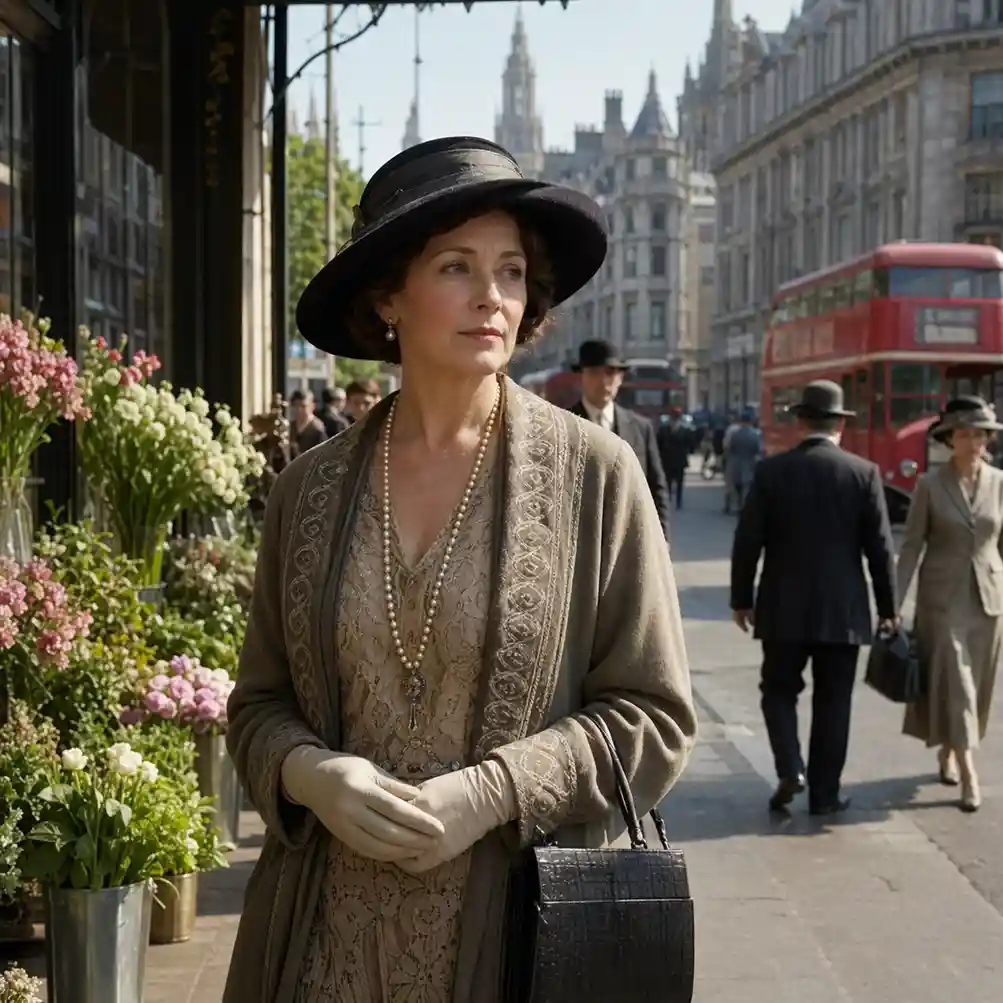
Big Ben measures hours that memory refuses to obey
Clocks sound throughout Mrs Dalloway. Big Ben marks the public hour with authority, while other clocks answer from different parts of London. Their strokes divide the day into measurable units. Yet the characters do not experience those units evenly. A few seconds can open decades of memory, while an entire conversation can pass under the pressure of what remains unsaid.
Clarissa’s present repeatedly touches Bourton, the country house where she spent an important summer in her youth. Peter’s visit restores old arguments and affections with unsettling speed. Sally Seton returns first as a remembered possibility before she appears as an older woman at the party. Clock time advances, but emotional time folds.
Time also carries historical pressure. The First World War has ended, yet its effects remain in bodies, institutions, and social habits. London appears busy and ceremonial, as if continuity itself could prove recovery. Septimus’s suffering interrupts that confidence. The city moves forward by the clock while one veteran remains trapped in consequences that public routine cannot absorb.
Readers interested in another work where measured time opens toward spiritual and historical layers may continue with 👉 Four Quartets by T. S. Eliot. Eliot’s poetry pursues a more explicitly philosophical path, but both works distrust a simple line from past to future.
The clocks do not defeat memory. They make its freedom more audible. Every chime reminds the characters that the shared day is disappearing, even as inner life resists the pace imposed from outside.
Clarissa’s composure protects more than social privilege
Clarissa can look, at first, like the perfect hostess of an unequal world. She knows how to arrange a room, place guests, manage tone, and maintain relationships across social divisions. Her life depends on servants, inherited habits, and proximity to political power. The novel never asks readers to forget these privileges.
However, social performance is not merely vanity for Clarissa. It is a form of protection. Illness has made her aware of physical fragility. Age has sharpened her sense of separation. She retreats to a narrow attic room and sleeps apart from Richard, partly because of her health. The public woman who creates crowded gatherings also guards a private space that even those closest to her cannot fully enter.
Her reserve contains fear, discipline, and desire. Clarissa remembers the intensity of her feelings for Sally, especially a kiss that still seems complete in a way much of adult life does not. She also recalls why Peter’s emotional demands felt dangerous. Richard offered steadiness and room to remain herself, although that freedom came with its own forms of loneliness.
The power of remembered places and intellectual awakenings also shapes 👉 The Torch in My Ear by Elias Canetti. Canetti writes autobiography rather than fiction, yet his account similarly shows how earlier encounters continue to organize a later self.
Clarissa becomes compelling when her elegance stops looking effortless. The hostess does not erase the solitary woman. She is the form that woman has learned to inhabit.
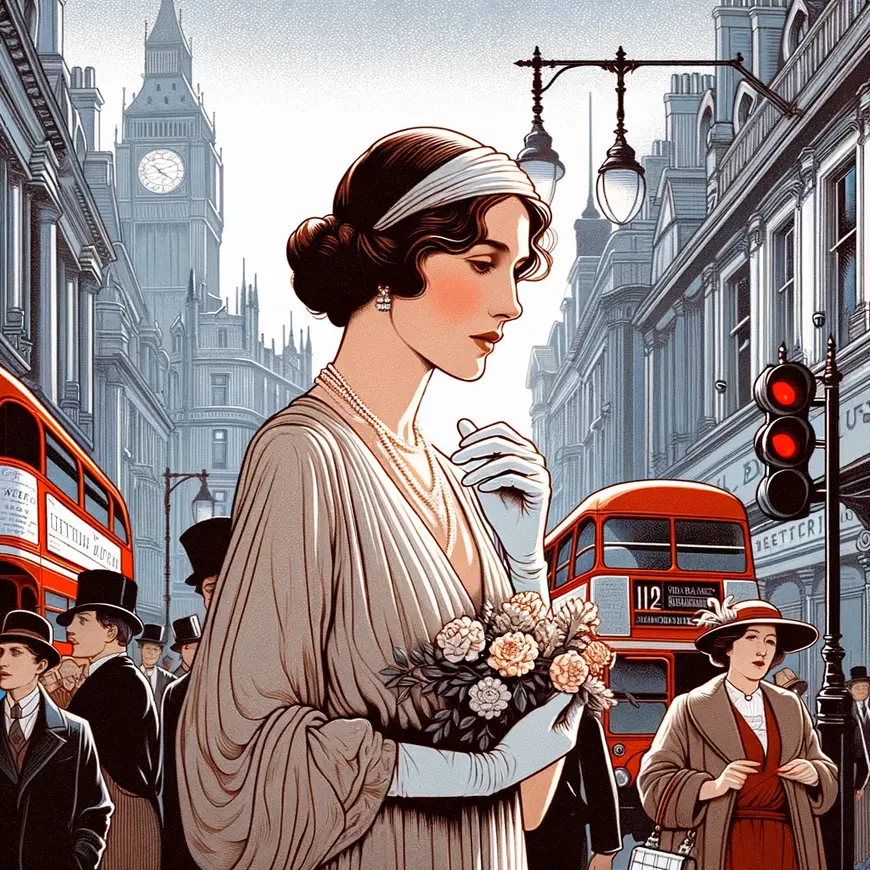
Septimus reveals the war beneath London’s recovery
Septimus Warren Smith occupies a different social position, but the novel binds his inner life to Clarissa’s through recurring images and emotional parallels. He served in the First World War and lost his friend Evans. At first, he took pride in feeling little. After the war, numbness gives way to terror, guilt, visions, and an unstable sense that the world is sending him messages.
The doctors fail Septimus in different ways. Dr Holmes treats his condition as a matter of attitude and urges ordinary habits. Sir William Bradshaw recognizes illness, yet responds with control, separation, and his ideal of “proportion.” The medical system values compliance more than the patient’s account of his own experience. The novelist exposes authority that calls coercion care.
This part of Mrs Dalloway requires careful language. Septimus is not simply a misunderstood rebel, and the novel does not present suffering as a path to superior truth. His perceptions can contain beauty, fear, insight, and delusion at once. The narrative gives them form without asking readers to treat the illness as romantic.
War’s damage receives a more direct narrative frame in 👉 The Train Was on Time by Heinrich Böll. Böll follows a soldier toward almost certain death. The writer studies the violence that continues after a soldier has returned.
Without detailing the decisive scene, Septimus’s response to threatened confinement carries the novel’s most painful judgment. A society that celebrates survival has made his life unlivable. His story breaks through the polished image of a city that believes the war is over.
Perspective passes through London without warning
The phrase “stream of consciousness” often describes Mrs Dalloway, but it can make the novel sound like one continuous private monologue. Woolf’s method is more mobile. The narration enters a character’s thoughts, touches the external world, and then follows a sound, object, or glance into another mind. Free indirect discourse lets a sentence carry a person’s vocabulary and judgment without quotation marks or a formal announcement.
A motorcar or airplane can therefore connect people who never meet. The object remains public, while meaning changes from observer to observer. London functions as a network of partial perceptions. Streets, parks, shops, bells, and doorways create transitions that feel fluid but follow exact spatial and acoustic cues.
This mobility prevents Clarissa from owning the book simply because her name supplies its title. Peter, Rezia, Septimus, Richard, Miss Kilman, Elizabeth, and minor passersby all alter the emotional field. Even brief entries into another consciousness can correct or complicate the judgment formed by the previous one. A person who looks absurd from outside may become vulnerable from within.
Readers drawn to radical interiority may also appreciate 👉 Near to the Wild Heart by Clarice Lispector. Lispector concentrates more intensely on one unstable self, while she distributes attention across a social landscape.
The transitions demand focus, especially during a first reading. Pronouns and impressions can shift before a reader identifies the new observer. Yet that difficulty serves a clear purpose. The novel asks us to notice how quickly a world becomes someone’s world.
Marriage offers intimacy without complete access
Several relationships in Mrs Dalloway challenge the belief that love should produce perfect understanding. Clarissa and Richard share affection, habit, social position, and a long history. Richard decides to bring his wife flowers and tell her that he loves her. Once he arrives, he cannot say the words. The failure is gentle rather than catastrophic, but it reveals the limits of their emotional language.
Peter appears to offer the opposite. He demands intensity, questions Clarissa’s choices, and continues to measure her against the young woman he remembers. His tears during their visit show real feeling. They also remind Clarissa why his need for closeness once threatened her independence. Passion can recognize a person and still leave too little room for her.
Rezia and Septimus face a more brutal separation. She sits beside her husband but cannot enter the logic of his visions. For a brief period, they work together on a hat and recover a shared rhythm. The scene matters because care appears through making rather than explanation. Intimacy becomes possible for a moment without curing the illness.
Woolf treats privacy as a need, not merely a failure. People cannot surrender every interior space to spouses, friends, or children. At the same time, excessive distance can harden into isolation. The novel values connection without imagining transparency. Its relationships feel modern because they allow love, frustration, gratitude, and unknowability to occupy the same room.
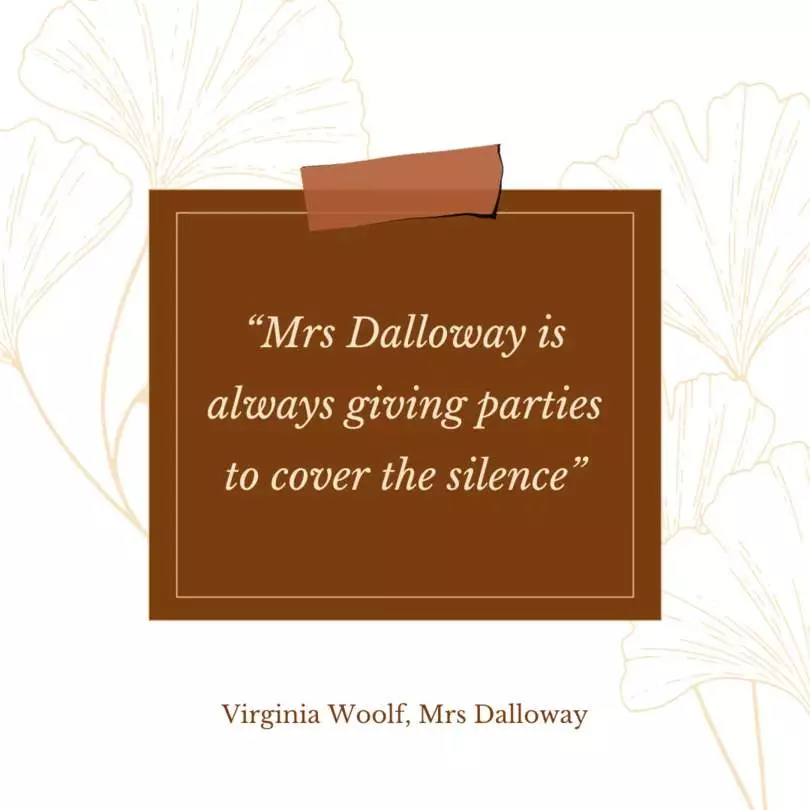
Famous Quotes from Mrs. Dalloway
- “She had the perpetual sense, as she watched the taxi cabs, of being out, out, far out to sea and alone.” This quote reflects the novel’s exploration of isolation and the individual’s internal experience. Despite being surrounded by the bustle of London, Clarissa Dalloway feels detached, highlighting the theme of loneliness amidst a crowd and the separation between an individual’s external world and their inner life.
- “Life is made intolerable; they make life intolerable, men like that.” The novel addresses the restrictions placed on women and critiques the social structures that limit their freedom and self-expression.
- “Fear no more, says the heart in the body; fear no more.” This is a reference to William Shakespeare‘s Cymbeline, and in the context of Mrs. Dalloway, it speaks to a desire for peace and the end of suffering.
- “She always had the feeling that it was very, very dangerous to live even one day.” This quote encapsulates the novel’s exploration of the precariousness of existence and the value of each moment.
- “Moments like this are buds on the tree of life. Flowers of darkness they are.” This metaphor speaks to the transient, yet profound, moments of beauty and insight that punctuate our lives.
Trivia Facts about Mrs. Dalloway
- Innovative Stream-of-Consciousness Technique: She employs a stream-of-consciousness narrative style in this work that was revolutionary at the time. This technique allows readers to experience the thoughts and feelings of characters in real-time. Blurring the lines between thought and action, and between different characters’ perspectives.
- Influenced by her Own Life: Virginia Woolf’s own struggles with mental health. And her experiences in London society are reflected in Mrs. Dalloway. The novelist, like her character Septimus, experienced periods of profound psychological distress. And she infused the novel with her own insights into the complexities of the human mind.
- Critique of British Society: The story is also a critique of British society in the aftermath of World War I. Through her characters, she examines the changing social order, the role of women, and the disillusionment with traditional values that followed the war.
- The Hours: The novel inspired the Pulitzer Prize-winning novel “The Hours” by Michael Cunningham in 1998. Which was later adapted into an Academy Award-winning film.
- A Day in the Life: The entire novel takes place over the course of a single day. A structural choice that was quite innovative at the time of its publication. This format allows her to delve deeply into the interior lives of her characters. Making ordinary moments feel expansive and significant.
The party succeeds by exposing its own limitations
Clarissa creates occasions where people who would otherwise remain separate can appear together. That act has value, even if it cannot dissolve class or loneliness. Hospitality becomes her imperfect art. She composes relations for a few hours, knowing that some combinations will fail and that every guest carries a private life beyond her control.
The news of a stranger’s death enters this celebration through the Bradshaws. Clarissa withdraws to an empty room and imagines the event without knowing the dead man. Her response can feel troubling because she turns another person’s crisis into part of her own reflection. The novel does not hide that distance. Instead, it creates a formal connection between two characters whom society kept apart.
Clarissa recognizes in the stranger’s final act something about privacy, pressure, and the fear of losing the self. She then returns to her guests. This return does not resolve the moral or emotional difficulty. It affirms life while leaving the conditions that destroyed Septimus unchanged. Celebration and death remain adjacent rather than reconciled.
The party therefore succeeds on limited terms. Peter and Sally wait for Clarissa, old attachments reappear, and the room briefly holds many strands of the day. No revelation transforms everyone. Presence itself becomes the fragile achievement. The writer gives the social event dignity without pretending that elegant rooms can repair trauma, erase regret, or make one consciousness fully available to another.
Its difficulty is real, but so is its emotional clarity
Mrs Dalloway rewards readers who enjoy novels driven by voice, perception, and hidden connections rather than a large external plot. Its single-day structure creates momentum, but the frequent shifts in time and perspective require attention. Readers who prefer stable narrators or clearly signposted scenes may need time to adjust.
The novel’s strongest achievement is its ability to hold social comedy and profound vulnerability together. Clarissa’s party can look trivial, meaningful, exclusive, and generous within the same chapter. Peter can be perceptive and self-dramatizing. Septimus can suffer from delusions while also perceiving the cruelty of those who control him. She protects complexity without sacrificing emotional force.
For readers fascinated by texts that disturb ordinary ideas of sequence and finitude, 👉 The Book of Sand by Jorge Luis Borges offers a shorter, more openly fantastic experiment with the impossible shape of time.
This is not a novel to rush. Its repetitions become meaningful only after images, phrases, and sounds begin to echo across different minds. A second reading often feels clearer without making the characters simpler. Mrs Dalloway remains powerful because it discovers vast distances inside an ordinary day. The difficult form serves a compassionate idea: every visible life contains more than society has learned to see.
My learnings from Mrs Dalloway – Labyrinth of the Human Mind
I found the novel to be an read. Right, from the start I was captivated by the story of Clarissa Dalloway as she got ready for her party. The way the author writes with a stream of consciousness style really brought me close to Clarissas thoughts and memories.
As I followed Clarissa through her day I was struck by the relationships between characters and their inner worlds. Each characters reflections on their past and present gave me insights into their struggles and desires. I particularly felt a connection to Septimus Warren Smith, whose experiences with trauma added a layer to the story.
By the time I finished the book I was moved by her skill in portraying emotions and complexities in her characters. The book prompted me to contemplate time passing connections between people and the beauty in moments. The beautiful writing style made a lasting impact, on me turning this book into an read.