Fahrenheit 451 – a Dystopian Future
Ray Bradbury opens Fahrenheit 451 with Guy Montag enjoying his work. He does not enter the story as a secret dissident or a reluctant servant of the state. He loves the kerosene, the flames, and the power to reduce difficult objects to ash. That pleasure gives the novel its first disturbing insight. Oppression can feel satisfying to the person who performs it.
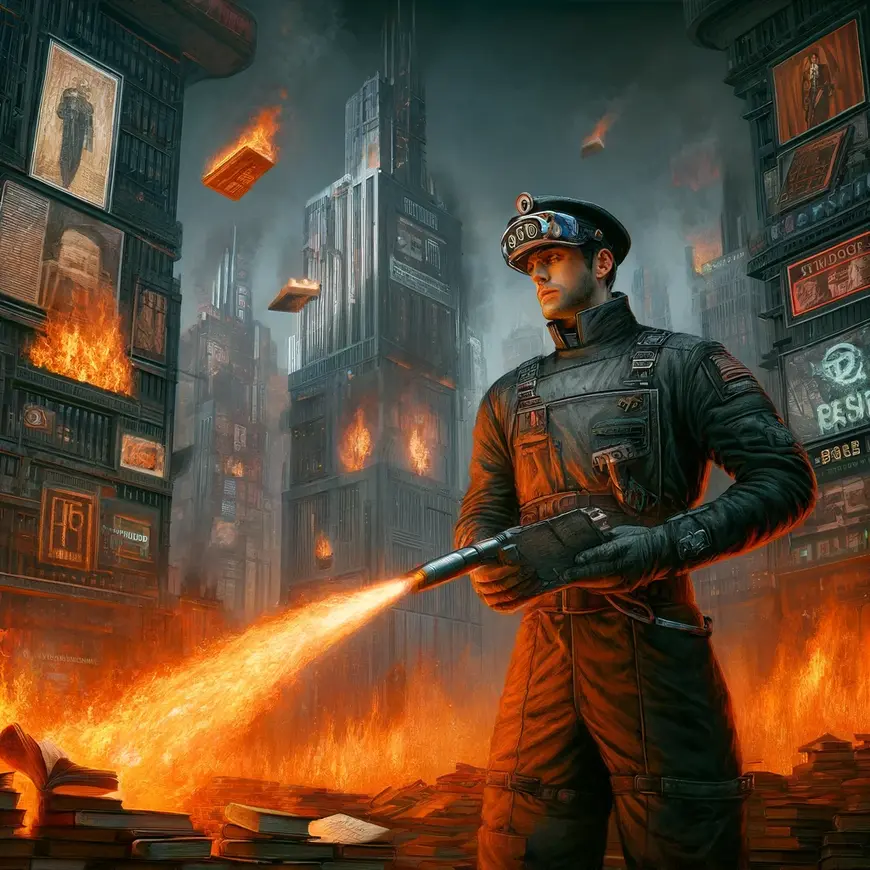
Montag works as a fireman in a society that fireproofed its homes and reassigned his profession. Firemen now find books and burn them. Their uniforms, schedules, machinery, and official history make destruction look like a public service. It only needs routine, pride, and obedience.
The opening also makes censorship physical. Books do not vanish through a quiet change in a catalogue. Authorities invade houses, soak private rooms in fuel, and turn punishment into a spectacle. Fire destroys evidence while displaying state power. Neighbors can watch and learn what resistance costs.
A society also protects stability by controlling thought in 👉 Brave New World by Aldous Huxley. Huxley places pleasure, consumption, and conditioning at the center of social control. The author adds the excitement of destruction itself. Montag enjoys the violence before he begins to question its purpose.
His later rebellion matters because Fahrenheit 451 never grants him moral innocence. Montag first helped create the fear he eventually feels. Every book he saves carries the memory of other books he burned without hesitation.

Clarisse asks the question Montag has learned to avoid
Clarisse McClellan changes Montag through attention rather than argument. She walks slowly, notices dew, smells leaves, watches people, and remembers conversations with her family. Her habits appear harmless, yet the state treats them as antisocial because they interrupt speed and expose neglected experience.
She asks Montag whether he feels happy. The question unsettles him because it cannot fit the role he performs. He has a job, a home, a wife, and the technological comforts his culture promises. However, Clarisse asks about inward life rather than visible possession. One direct question breaks through years of routine.
Her difference does not come from reading alone. She values observation, memory, and unplanned conversation. She knows that billboards grew longer because cars moved faster. She has heard that firemen once stopped fires instead of starting them.
Clarisse also exposes how this culture defines normality. Schools fill students with information, noise, sport, and aggression but discourage debate. Her uncle faces arrest for walking. A psychiatrist wants to correct her interest in people. Institutions call her strange because she notices what they need citizens to ignore.
Bradbury idealizes her at times. Clarisse functions less as a fully developed person than as the catalyst for Montag’s awakening. Her disappearance strengthens that limitation. The novel removes her once she has opened his doubt and lets other characters report her probable death.
Still, her influence reaches beyond plot. Clarisse restores the value of an unproductive moment. She shows Montag that perception needs time, and that a person cannot question society while moving at the speed it demands.
Mildred lives inside a family that cannot love her
Mildred Montag reveals the emotional cost of the social order more completely than any official speech. She spends her days among wall-sized screens and calls their performers her family. Small radios fill her ears at night. The devices prevent silence, yet they do not create meaningful companionship.
Her overdose brings this emptiness into the body. Montag finds her unconscious after she takes too many sleeping pills. Two technicians arrive with machines, pump her stomach, replace her blood, and leave without surprise. They perform the same procedure repeatedly across the city. Private despair has become a routine service call.
Mildred denies the event the next morning. She may not remember it, or she may refuse the knowledge that it offers. Pain receives chemical and mechanical treatment, while nobody asks what produced it.
Technological regulation of health and social conduct shapes 👉 The Method by Juli Zeh. Zeh makes institutional control explicit through a system that turns health into civic duty. Bradbury’s society rarely needs such formal arguments. Entertainment and medication keep many citizens from recognizing their own distress.
Mildred does not simply suffer as a passive victim. She protects the system that diminishes her. She wants another screen, rejects books, and reports Montag’s collection. Yet her betrayal does not prove that she feels nothing. It shows that the screen family has replaced the obligations of marriage with a safer imitation.
Montag eventually understands that he cannot remember where they met. Their marriage contains no shared story strong enough to resist the noise. Mildred has constant company and almost no human connection.
One woman’s death gives books a human cost
Montag has stolen books before he openly admits his doubts. The old woman who refuses to leave her library changes the meaning of that secret impulse. She chooses to ignite the house herself and dies among the books that the firemen came to destroy.
Her act does not prove that every idea inside her library deserves preservation. Nor does Fahrenheit 451 ask readers to imitate her death. The scene matters because it joins books to a human decision that Montag cannot classify as ignorance. Someone values these objects more than survival.
Until this moment, fire has supported distance. Montag sees illegal possessions, not individual reading lives. The woman refuses that separation. She remains inside the house and forces the firemen to burn a person as well as paper. The state can call her irrational, but it cannot make her choice emotionally insignificant.
Montag steals another book during the raid. Clarisse’s questions, Mildred’s overdose, and the woman’s death have made his profession impossible to view as ordinary.
Beatty tries to contain the event by explaining that fanatics often seek martyrdom. His interpretation may contain some truth, yet it cannot answer Montag’s central question. Books must hold some form of experience if a person will die rather than surrender them.
The woman’s death therefore changes his relation to every earlier fire. He cannot restore the lives or libraries he helped erase. He can only stop treating destruction as weightless. Censorship acquires a victim with a face, and Montag finally sees his work from inside the burning house.
Beatty explains how comfort can produce censorship
Captain Beatty understands books far better than the men who burn them. He quotes literature, anticipates Montag’s questions, and gives a coherent account of how the culture abandoned sustained thought. His intelligence makes him more dangerous than a simple enforcer.
Beatty describes several pressures working together. Media became faster and shorter. Citizens preferred immediate pleasure to demanding reflection. Social groups resisted works that offended them. Publishers and institutions simplified culture to avoid conflict. Firemen arrived after these changes and enforced a consensus that society had already helped create.
The state completes a voluntary retreat from complexity. This history prevents a narrow reading of Fahrenheit 451 as a warning only about officials banning books. Citizens choose screens, speed, and emotional comfort before authorities remove the remaining alternatives.
Public narratives destroy an individual’s reputation in 👉 The Lost Honor of Katharina Blum by Heinrich Böll. Böll examines how a sensationalist press converts suspicion into accepted truth. Beatty describes a culture that has gone further. It no longer wants the difficulty of competing truths at all.
His explanation also manipulates Montag. Beatty combines real social criticism with a false conclusion. Because books contradict one another and cause discomfort, he argues that burning them preserves happiness. He treats intellectual conflict as a defect instead of a condition of freedom.
Beatty may recognize the emptiness of his own position. His learning has not liberated him, and his final confrontation suggests a desire for destruction that includes himself. He knows what the system erased and chooses to defend it anyway.
Faber refuses to treat books as magical objects
Montag turns to Faber because he needs guidance, but the retired English professor corrects his first assumption. Books do not possess magic as physical objects. Their value comes from the quality of experience they preserve, the time readers need to examine that experience, and the freedom to act on what they learn.
This distinction strengthens the novel’s defense of reading. A society could own many books and still avoid thought. It could turn literature into decoration, prestige, or disconnected information. Reading matters only when it changes attention and choice.
Faber also complicates the image of resistance. He has knowledge but lacks courage. He watched the culture narrow and withdrew rather than oppose it. When Montag arrives, Faber first responds with caution. He agrees to help only after Montag forces the issue by tearing pages from a Bible.
Their partnership combines complementary weaknesses. Montag acts without a stable plan. Faber thinks without acting. The small communication device in Montag’s ear lets the professor guide him from a safe distance, but it also repeats the novel’s pattern of mediated voices. Technology can support resistance as well as conformity. Its moral meaning depends on the relationship behind it.
Planting books in firemen’s houses copies the system’s use of fear, evidence, and anonymous accusation. Bradbury does not develop the scheme because events move faster than either man expects.
Faber becomes useful when he stops presenting caution as wisdom. He gives Montag practical help and prepares to contact a printer. Knowledge gains force when its keeper accepts risk. Even then, the professor cannot save Montag. He can only help him choose a direction.
Fire, the salamander, and the sieve keep changing meaning
Bradbury builds the novel around symbols that refuse one stable definition. Fire first represents institutional power and Montag’s pleasure in destruction. The salamander on his uniform connects him to the mythical creature that survives flames. Yet Montag does not remain untouched. Fire reshapes his identity before he learns to use it differently.
The hearth in the first section’s title suggests domestic warmth, but the Montag home offers screens, medication, and emotional coldness. Later, the campfire outside the city gives heat without consuming books or people. Fire can destroy, warm, reveal, or renew. Human purpose determines its meaning.
The sieve and the sand create a different image of failure. Montag remembers trying to fill a sieve with sand as a child. On the subway, he attempts to retain lines from the Bible while an advertisement repeats through the carriage. The faster he tries to hold the words, the more completely they escape.
Intellectual culture becomes an elaborate refuge from ordinary life in 👉 The Glass Bead Game by Hermann Hesse. Hesse asks whether disciplined learning can serve society when institutions isolate it. Montag faces the opposite problem. His world leaves almost no protected space for concentration at all.
Jets scream above domestic conversations. The Hound sleeps inside the firehouse. Screens fill rooms with artificial intimacy. Water carries Montag away from the city. These patterns prevent the story from becoming a simple contest between good books and bad technology. The same element changes with its use. Fahrenheit 451 defends forms of attention that let people discover those differences.
The Mechanical Hound turns punishment into entertainment
The Mechanical Hound joins surveillance, automation, and animal terror. It can identify a person by chemical traces, pursue without fatigue, and inject its victim with a lethal needle. The firemen also use it for amusement by releasing animals and betting on the result.
That entertainment reveals the institution’s moral culture. Violence does not remain a regrettable necessity. The firemen turn domination into a game, just as public broadcasts later turn Montag’s pursuit into mass entertainment. Punishment needs spectators as well as machines.
The Hound appears to distrust Montag before his open rebellion. Whether Beatty programmed it or merely allowed it to threaten him, the encounter makes surveillance feel anticipatory. The system notices hesitation before Montag forms a plan. Fear then pressures him to return to obedience.
After he kills Beatty and escapes, a second Hound pursues him while cameras and helicopters create a national spectacle. When Montag reaches safety, the authorities cannot admit failure. They select another pedestrian, direct the cameras toward him, and announce Montag’s death. The audience receives narrative closure instead of truth.
The substitution exposes the political purpose of the chase. The state wants to preserve confidence in its speed and total vision. A random death matters less than an unresolved story. Citizens who accept the broadcast help transform murder into proof of order.
The novelist accurately anticipates a culture in which live images can make performance feel more real than events outside the frame. However, he gives the Hound almost unlimited precision until the plot needs Montag to escape. The Hound cannot judge the order it executes. The greater danger comes from people who enjoy the chase and never ask whom the camera has chosen.

Quotes from Fahrenheit 451
- “It was a pleasure to burn.” This opening line introduces us to the novel’s dystopian world. Where firemen burn books. Which are banned because they’re considered sources of unhappiness and dissent. The phrase reflects the protagonist, Montag’s initial satisfaction with his role and the broader societal acceptance of destruction over knowledge.
- “You don’t have to burn books to destroy a culture. Just get people to stop reading them.” This quote speaks to the core theme of the novel—the suppression of thought and the elimination of dissent through the eradication of literature. It suggests that the end of reading and critical thinking is equivalent to the destruction of culture. This is achieved not only through active censorship but also through fostering indifference.
- “There must be something in books, things we can’t imagine, to make a woman stay in a burning house; there must be something there. You don’t stay for nothing.” This realization by Montag marks the beginning of his questioning of society’s norms. It highlights the power and value of books, suggesting that the knowledge contained within them are worth more than life.
- “We need not to be let alone. We need to be really bothered once in a while. How long is it since you were really bothered? About something important, about something real?” Through this quote, the author criticizes the complacency and apathy of society. He underscores the importance of being disturbed by ideas. Suggesting that true engagement is essential for personal growth.
- “If you hide your ignorance, no one will hit you and you’ll never learn.” This quote emphasizes the value of admitting ignorance and the importance of education and growth. It criticizes a society that punishes curiosity, arguing that such an environment stifles learning and personal development.
Trivia facts about Fahrenheit 451
- Title’s Significance: The title Fahrenheit 451 refers to the temperature at which book paper catches fire and burns. The novelist chose this title after contacting a chemical company to ask at what temperature paper ignites. The answer he received was “451 degrees Fahrenheit,” which he found perfect for the novel’s theme.
- Inspired by Historical Book Burnings: His inspiration for Fahrenheit 451 came from the historical instances of book burnings, most notably the Nazi book burnings of the 1930s. The novel was also related to the McCarthy era in the United States, during which there was a significant fear of communism and a tendency to censor dissenting ideas.
- Originally a Short Story: The story began as a short story called “The Fireman,” published in Galaxy Science Fiction magazine in 1951. He expanded the story into a novel over the course of nine days in UCLA’s Powell Library, typing on a pay-per-hour typewriter.
- Technology Predictions: The author astonishingly predicted several future technological advances in Fahrenheit 451, including the advent of flat-screen televisions, earbud headphones, and the idea of an interactive, reality TV-style entertainment.
- Comic Book Censorship: His inspiration to write Fahrenheit 451 was during a period of significant comic book censorship in the United States. The 1954 publication of “Seduction of the Innocent” by Fredric Wertham and the subsequent U.S. Senate hearings on juvenile delinquency fueled fears that comic books were a bad influence on children, leading to the establishment of the Comics Code Authority.
The river and the book people offer an uncertain renewal – Fahrenheit 451
Montag escapes the city by entering the river. Water interrupts the novel’s dominant element and removes the chemical scent that guides the Hound. The current carries him beyond roads, screens, and the rigid speed of urban life. For the first time, he experiences darkness without electronic noise.
The book people whom he meets do not preserve physical libraries. Each person memorizes a work and waits for a future in which society may need it again. Memory can fail, individuals can die, and no central archive guarantees survival.
They preserve knowledge without claiming ownership of it. Granger explains that they do not consider themselves superior vessels. They expect one day to pass the works back into print and then step aside. This humility contrasts with Beatty’s certainty and Montag’s earlier hunger for a single solution.
Fragments of inherited culture also persist after social collapse in 👉 The Hollow Men by T. S. Eliot. Eliot’s poem offers broken voices and spiritual exhaustion rather than Bradbury’s tentative communal purpose. Both works ask what language can retain when a civilization loses confidence in meaning.
The city’s destruction prevents an easy victory. War has remained at the edge of the story while citizens ignore it. Bombs erase the urban world in seconds, including people whom Montag wanted to awaken. Mildred probably dies while facing a screen.
Granger’s phoenix image carries warning as well as hope. Humanity repeatedly destroys itself, but memory could interrupt repetition. Renewal depends on remembering causes, not merely preserving texts.
A lyrical dystopia whose warnings exceed its limitations
Fahrenheit 451 endures because it connects censorship to a larger ecology of distraction. Governments burn books, but citizens also abandon difficulty, replace conversation with performance, and treat unhappiness through noise. Bradbury makes these forces reinforce one another.
So Fahrenheit 451 moves with exceptional speed. Clarisse awakens doubt, the old woman gives it moral urgency, Faber supplies language, and Beatty forces action. Recurring images create unity across that rapid plot. The prose makes intellectual loss feel physical.
The writer gives little depth to most women. Clarisse serves as an idealized guide, Mildred embodies cultural emptiness, and her friends become targets of Montag’s contempt. The book people preserve a canon that Fahrenheit 451 rarely questions. Montag’s transformation also relies on sudden encounters more than sustained self-examination.
The politics can appear inconsistent. Beatty describes decentralized pressure and voluntary simplification, while the Hound, firemen, and televised execution reveal a powerful coercive state. Cultural surrender and political force do not exclude each other. One can prepare the ground for the other.
He does not finally argue that books will save society by themselves. Faber rejects that belief, and the ending places responsibility on fallible human memory. Readers must seek substantial experience, protect time for thought, and act on what they discover.
The novel’s strongest question therefore concerns desire. What happens when people experience complexity as an insult and constant stimulation as freedom? Control succeeds when comfort makes resistance feel unnecessary. The flames arrive after a culture has already stopped wanting what they destroy.
Fahrenheit 451 – My Take Aways
Reading Fahrenheit 451 was such an experience. The liveliness of the imagery is like fire against books; it has affected me to emphasize very much how society is without knowledge, with their loss, and emptiness. The book really left me angry, not sad, at how easily the richness of books was being given away for comfort and conformity.
The main character, Guy Montag, and his way from ignorance to that of aroused consciousness simply made me ponder the role of critical thinking. And how dangerous media consumption can be in our world. This novel challenged me intellectually and emotionally.
It focused on censorship and individual thought. It reminded me of literature that highlights the crucial role of maintaining our freedom to think and dream.
Further Reviews of his Works