Fear and Trembling by Amélie Nothomb – When Yumimoto becomes a descent
Fear and Trembling is a short novel with a brutal vertical structure. Amélie enters Yumimoto, a prestigious Japanese corporation, hoping to belong to the country she has idealized since childhood. Instead of rising through work, language, and devotion, she moves steadily downward. Each mistake costs her status. Each attempt to help becomes another reason to be humiliated.
Amélie Nothomb turns a one-year office contract into a ritual of abasement. The plot looks simple: a young Belgian woman works in Tokyo and fails to understand the invisible rules around her. Yet the effect is sharper than a light culture-clash comedy. The office becomes a closed world where hierarchy defines reality before talent, sincerity, or effort can speak.
The comedy is built on humiliation. That is what gives Fear and Trembling its strange force. The narrator often sounds witty, lucid, and absurdly calm. However, the events she describes reveal a workplace where obedience matters more than competence. Her fall is ridiculous, but never harmless. The laughter catches in the throat because every joke is also a loss of dignity.
Fear and Trembling inside the hierarchy
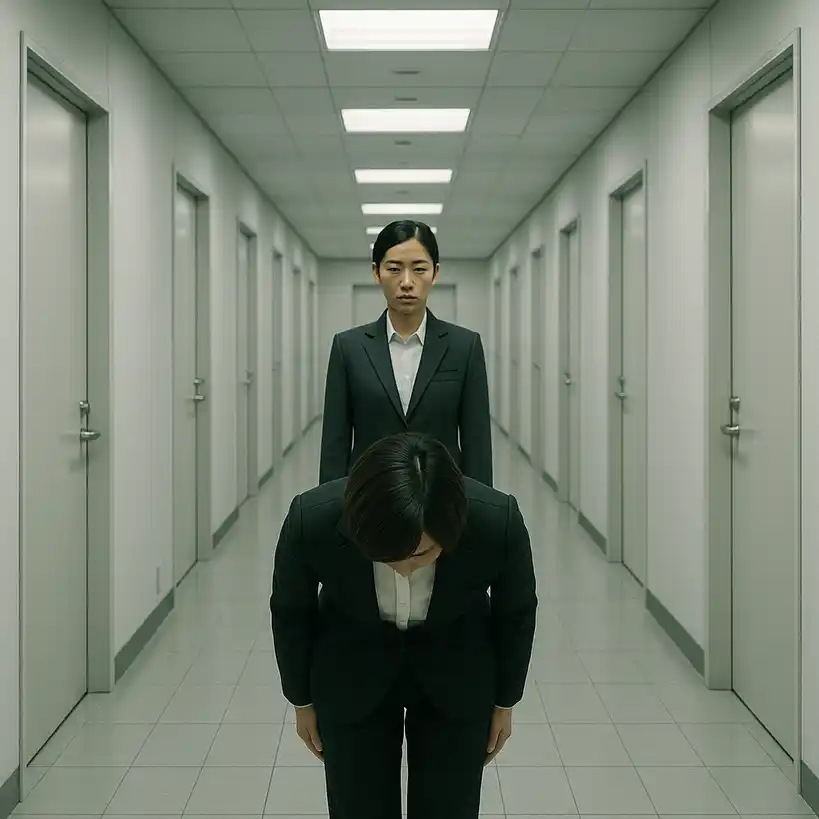
Fear and Trembling depends on rank. Yumimoto is not just a setting. It is a structure of command in which everyone knows who stands above whom. The narrator begins at the lowest rung and soon discovers that even this low position can be lowered further. That is the novel’s cruelest joke.
The chain of authority matters because it makes personal judgment almost irrelevant. Amélie may speak Japanese, know foreign languages, and want to work well. None of that protects her. In Yumimoto, initiative can be read as arrogance. Help can become intrusion. Compassion can become insult. The rules are not explained clearly, but their punishments arrive with precision.
Hierarchy replaces conversation. Once that happens, every gesture becomes dangerous. Amélie is not simply incompetent. She is trapped inside a system where the meaning of her actions belongs to others. What she intends matters less than how a superior chooses to interpret it.
This pressure connects well to 👉 The Lost Honor of Katharina Blum by Heinrich Boell. Böll writes about media, suspicion, and institutional pressure, not corporate ritual. Still, both works show how quickly a person can lose control of her public meaning once a hostile system begins to define her.
Amélie-san and the comedy of falling
The narrator of Fear and Trembling is one of the novel’s main pleasures. She describes degradation with elegance, irony, and a kind of theatrical self-awareness. Her voice turns failure into performance. That does not make the failure less real. It makes it more readable.
Amélie often sees herself from outside. She knows when she looks absurd. She also knows when the office has turned absurdity into discipline. This double awareness gives the book its pace. The reader watches a young woman become clerk, intruder, nuisance, scapegoat, and finally toilet cleaner, while the narration remains brisk and controlled.
The fall is narrated like choreography. Each demotion feels staged. Nothomb understands that workplace humiliation often works through repetition. A person is not broken by one command alone. She is reduced by many small commands, corrections, silences, and public reversals.
The comic rhythm may remind readers of 👉 Auto-da-Fé by Elias Canetti. Canetti’s world is more grotesque and more extreme, but both books use absurd social logic to reveal the violence hidden inside order. In Fear and Trembling, the office looks rational from the outside. From within, it becomes a theatre of controlled degradation.
Fubuki Mori as beauty and judgment
Fubuki Mori is the novel’s most fascinating figure after Amélie herself. She is beautiful, disciplined, ambitious, and trapped. At first, Amélie admires her with almost devotional intensity. Fubuki appears as the perfect image of grace within the company. Yet that image soon darkens.
Their relationship becomes the emotional center of Fear and Trembling. Fubuki is Amélie’s superior, but she is also a woman whose own position depends on obeying the hierarchy that humiliates her. When Amélie sees her vulnerable, the moment should create solidarity. Instead, it becomes a violation. To witness another person’s hidden shame is, in this world, almost an act of aggression.
Fubuki is both victim and enforcer. That complexity keeps her from becoming a simple villain. She suffers under male authority, then redirects humiliation downward. Her cruelty toward Amélie is real, but the novel also shows the structure that has shaped it.
This is one of Nothomb’s strongest insights. Oppression does not always move only from obvious villains to innocent victims. It can pass through people who have already been wounded. Fubuki’s power is narrow, but within that narrow space she uses it fiercely.
Translation fails before language does
Amélie’s language skills should make her useful at Yumimoto. Instead, they become almost irrelevant. This is one of the book’s quiet ironies. Fear and Trembling is not mainly about failing to translate words. It is about failing to translate codes of power, shame, gender, obedience, and face.
Amélie understands Japanese, but she does not understand enough about what must remain unsaid. She assumes that competence can justify initiative. She assumes that kindness can soften embarrassment, she assumes that a workplace values productivity in ways she recognizes. Again and again, Yumimoto proves her wrong.
Fluency does not guarantee belonging. This idea gives the book a deeper sadness. Amélie returns to Japan because it matters to her imagination and identity. Yet the Japan she enters as an adult refuses her fantasy. Her childhood attachment cannot protect her from being marked as foreign.
This makes the novel more than a satire of office life. It is also a story about failed return. The narrator wants cultural intimacy, but receives institutional distance. She knows the language, yet the social grammar punishes her. That gap gives Fear and Trembling its most painful comedy.
The toilet assignment in Fear and Trembling
The toilet-cleaning assignment is the novel’s most memorable stage of humiliation. By the time Amélie reaches it, the reader has watched her lose almost every professional function. Yet this final demotion still shocks because it turns the office hierarchy into bodily symbolism. She is not merely useless. She is placed at the level of waste.
Nothomb handles this material with sharp control. The scenes could become crude, but they remain pointed. Cleaning toilets becomes a grotesque form of clarity. The company has finally found a role that expresses what it thinks of her. Amélie’s professional identity has been stripped away, leaving only endurance.
The lowest task becomes a test of pride. Amélie refuses to resign before her contract ends. That refusal can look absurd, noble, stubborn, or self-punishing. The novel allows all those readings at once. Is she preserving honor, or participating in her own abasement? Is endurance victory, or just another form of obedience?
The social descent here has a distant link to 👉 Down and Out in Paris and London by George Orwell. Orwell writes nonfictional poverty and labor, while Nothomb writes stylized office humiliation. Still, both texts force the reader to notice how work can reorder the body, the self, and social visibility.
Japan through a wounded gaze
A careful reading of Fear and Trembling must address the problem of perspective. The novel is funny, sharp, and often brilliant, but it presents Japan through one wounded narrator’s experience. That does not make the book false. It does mean the reader should avoid treating Yumimoto as a complete map of Japanese society.
Nothomb writes from exaggeration, satire, and personal mythology. Her Japan is partly corporate world, partly remembered dream, partly nightmare of hierarchy, and partly stage for self-abasement. The book gains energy from that compression. It also risks reducing cultural complexity to a series of humiliating rules.
The narrator is not neutral. That is important. Amélie is intelligent, but she is also proud, theatrical, and sometimes naïve. She idealizes Japan before the office breaks that ideal. Her disappointment shapes the tone. The novel should be read as literary testimony, not sociological proof.
This tension makes the book more interesting, not less. The reader can admire its precision while asking what it leaves out. The best parts of Fear and Trembling come from that unstable mix of affection, resentment, fascination, and injury.
Office life as existential theatre
The office in Fear and Trembling is almost existential. People appear trapped in roles they did not fully choose. Their freedom exists, but only inside severe limits. Amélie can obey, misread, endure, or leave. None of these options gives her full dignity.
The absurdity of Yumimoto comes from its seriousness. Tiny tasks acquire enormous moral weight. A photocopy can become a disaster. A cup of coffee can become a violation of rank. Consoling someone can become unforgivable. The ordinary office becomes a stage where invisible rules decide identity.
The absurd lives in procedure. This is why the novel’s comedy feels so controlled. Nothomb does not need surreal events. She only needs a system in which everyone accepts that humiliation is normal because it has a place in the hierarchy.
That aspect connects naturally to 👉 No Exit by Jean-Paul Sartre. Sartre’s characters are trapped in a room and in one another’s gaze. Nothomb’s narrator is trapped in an office and in the gaze of superiors. The genres differ, but both works understand that hell can be made from social perception.
Shame as the secret currency – Fear and Trembling
Shame circulates through Fear and Trembling more powerfully than money, talent, or ambition. People try to avoid it, hide it, redirect it, and impose it on others. Amélie’s greatest mistake is not a technical failure. It is seeing Fubuki’s private shame and responding as if kindness could cross the boundary.
From that moment, the book becomes harsher. Fubuki cannot forgive being seen in weakness. Amélie cannot understand why compassion has made things worse. The reader sees both sides and feels the trap close. In this world, shame does not ask for comfort. It demands concealment.
Shame governs what can be seen. That rule explains much of the novel’s cruelty. The office does not merely assign tasks. It controls visibility. Who may speak? Who may cry and who may fail? So who may be witnessed failing? These questions drive the emotional violence of the book.
The result is a satire that cuts deeper than its short length suggests. Nothomb shows a workplace where the real punishment is not bad work. It is exposure. Once a person has been placed in the wrong light, every action confirms the judgment.
A slim novel with sharp limits
Fear and Trembling is powerful because it is short. The brevity helps the descent feel concentrated. There is no broad social panorama, no long backstory, and no attempt to balance every perspective. The reader enters the office, watches the fall, and leaves with the narrator’s bruised irony still active.
That narrowness is also the book’s limit. Some characters remain symbolic rather than fully developed. Yumimoto can feel less like a company than a ritual machine designed to crush Amélie. Readers looking for a more rounded cultural or psychological novel may find the satire too sharp and too selective.
Yet this selectiveness is part of the design. Nothomb writes the office as an ordeal. The book does not want moderation. It wants intensity, compression, and memorable humiliation. Its world is stylized because its emotional truth is stylized.
The narrowness creates pressure. The novel’s small scale allows every demotion to matter. Each scene adds another step downward, and the ending feels less like release than survival.
A useful comparison is 👉 The Fall by Albert Camus. Camus uses confession to expose moral self-division. Nothomb uses workplace comedy to expose social self-erasure. Both rely on a voice that knows how to turn humiliation into art.
Sharp Quotes from Fear and Trembling by Amélie Nothomb
- “I am ordering you not to understand Japanese anymore.” This absurd command captures Fear and Trembling at its cleanest: language becomes power, and comprehension itself turns punishable.
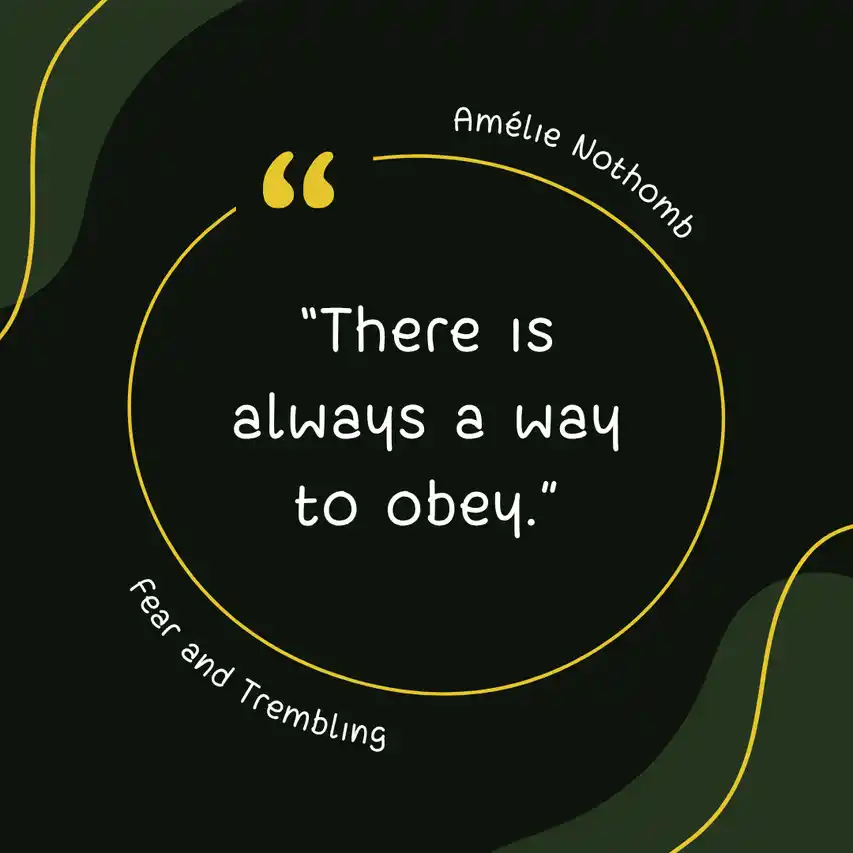
- “There is always a means to obeying.” The line sounds comic; however, it exposes the novel’s darkest office logic, where obedience must exist even when reason cannot.
- “Japanese women live in fear of making the least sound.” Nothomb links gender, shame, and silence; consequently, Fear and Trembling makes the body part of corporate discipline.
- “Japanese men pay no attention to the subject whatsoever.” The contrast is brutal and dry; therefore the book turns social asymmetry into a single cool sentence.
- “If you admire yourself in the mirror, let it be in fear.” Beauty becomes risk rather than pleasure, and Fear and Trembling shows how visibility can punish women twice.
- “The only thing that beauty will bring to you is terror.” The thought lands like office wisdom turned poisonous; moreover, it connects Fubuki’s elegance to dread, envy, and surveillance.
- “So long as your work consisted of updating calendars.” The phrase shrinks ambition into approved usefulness; as a result, Fear and Trembling makes harmless tasks feel like a cage.
- “Why denounce me?” The question cuts through hierarchy for one second; nevertheless, the answer lies in the system, not only in one rival’s cruelty.
Context-Rich Trivia from Fear and Trembling by Amélie Nothomb
- Office as theater: Fear and Trembling turns the Yumimoto Corporation into a stage where every bow, task, and silence carries rank; consequently, comedy becomes a method for reading power.
- Descent instead of promotion: Amélie starts low and somehow sinks lower; therefore Fear and Trembling reverses the career novel by making failure sharper than ambition.
- Hierarchy as plot: The novel’s tension comes less from events than from who may speak, move, understand, or take initiative. For a more informations on institutional crushing, compare 👉 Beneath the Wheel by Hermann Hesse.
- Language becomes forbidden: Because Amélie’s Japanese fluency threatens the office order, Fear and Trembling turns translation into danger rather than advantage.
- Bathroom humiliation: The cleaning assignment matters because it makes rank physical; moreover, Nothomb shows how shame can be administered through space, gesture, and repetition.
- Seniority logic: The Fubuki-Amélie conflict depends on status and tenure; for context on workplace hierarchy and seniority norms, see 🌐 Japanese workplace hierarchy.
- Role performance: Amélie survives partly by acting the role expected of her; for more about ethics under social role pressure, see 👉 The Good Person of Szechwan by Bertolt Brecht.
- Workplace context: Japanese corporate life has often carried expectations of hierarchy, long hours, and company loyalty; for broader background, see 🌐 Japanese work environment.
- Title logic: The title points to reverence before authority; consequently, Fear and Trembling treats fear as ritual, comedy, and survival technique.
- Satire with discomfort: Finally, the book remains sharp because its humor never cancels humiliation; laughter arrives, but the office still keeps the keys.
Why Amélie’s abasement still stings
The lasting force of Fear and Trembling lies in its precision about humiliation. Many readers will never work in a company like Yumimoto. Yet many will recognize the experience of being misread by a system that has already decided their place. That recognition gives the novel its reach beyond its Japanese setting.
The book also captures the strange intimacy of workplace power. Offices are not battlefields, but they can still injure the self. A title, a desk, a task, a supervisor, or a correction can define how a person is allowed to exist. Nothomb turns that quiet violence into comedy without making it harmless.
The office becomes a social microscope. Through it, the novel examines gender, foreignness, pride, shame, obedience, and fantasy. Amélie’s dream of Japan does not survive Yumimoto intact. Yet her narrative voice does survive, and that matters. The company reduces her function, but not her ability to transform the reduction into story. That is the book’s hidden victory. Amélie may lose status inside the office, but she gains form outside it. The humiliation becomes literature.
The final bow beneath the hierarchy – Fear and Trembling
Fear and Trembling ends with endurance rather than triumph. Amélie completes the year. She does not overthrow Yumimoto, reconcile with Fubuki, or expose the company’s cruelty in a dramatic scene. Her victory, if it is one, lies in not leaving before the ritual ends.
That ending is fitting. A more explosive conclusion would betray the book’s logic. Yumimoto is not defeated because systems like this rarely collapse for one person’s dignity. Instead, the narrator exits with the knowledge of what happened and the ability to tell it.
The novel remains memorable because it turns subordination into style. Amélie’s body may be sent to the toilets, but her voice rises above the company’s hierarchy. That contrast gives the book its final irony. Yumimoto can define her as useless, but it cannot control the narrative she later makes from that judgment.
Fear and Trembling is therefore more than a comic account of cultural failure. It is a study of how pride survives degradation by changing shape. The narrator bows, obeys, trembles, and descends. Then she writes. And in that act, the lowest point of the office becomes the highest point of the book.
More Reviews of French Literature