In Search of Lost Time – A Literary Odyssey
Marcel Proust begins In Search of Lost Time before the narrator can locate himself securely. Waking in darkness, he confuses rooms, years, habits, and identities. The body remembers an arrangement before the mind establishes where and when it has awakened.
This opening does more than introduce memory. It questions the idea of one continuous self moving calmly through chronological time. Each room summons a different body and set of expectations. Sleep dissolves the structures that daytime consciousness treats as stable. Identity returns through place and habit.
The narrator then approaches childhood at Combray through fragments. His need for his mother’s goodnight kiss carries emotional force far beyond the small domestic event. Anticipation stretches time, while disappointment makes a staircase, a bell, and the presence of guests feel decisive.
War memory fractures chronology more violently in 👉 The Flanders Road by Claude Simon. Simon lets images repeat and mutate after trauma. His disruptions often begin in ordinary sensation, yet both writers make the past active inside the syntax of the present.
Readers should not simply identify the narrator with Proust. Biographical material enters the novel, but selection, rearrangement, invention, and retrospective design create a literary consciousness. The first-person voice knows more at the end than the child or young man knew while living each scene.
That double perspective shapes the entire work. Experience arrives once as confusion and again as narration. The later voice can interpret earlier error, but it cannot restore the person who first felt it.
Identity survives through a changing relation to time. Before the madeleine appears, waking already shows that recovery will require form rather than simple recollection.
The madeleine reveals what deliberate memory cannot reach
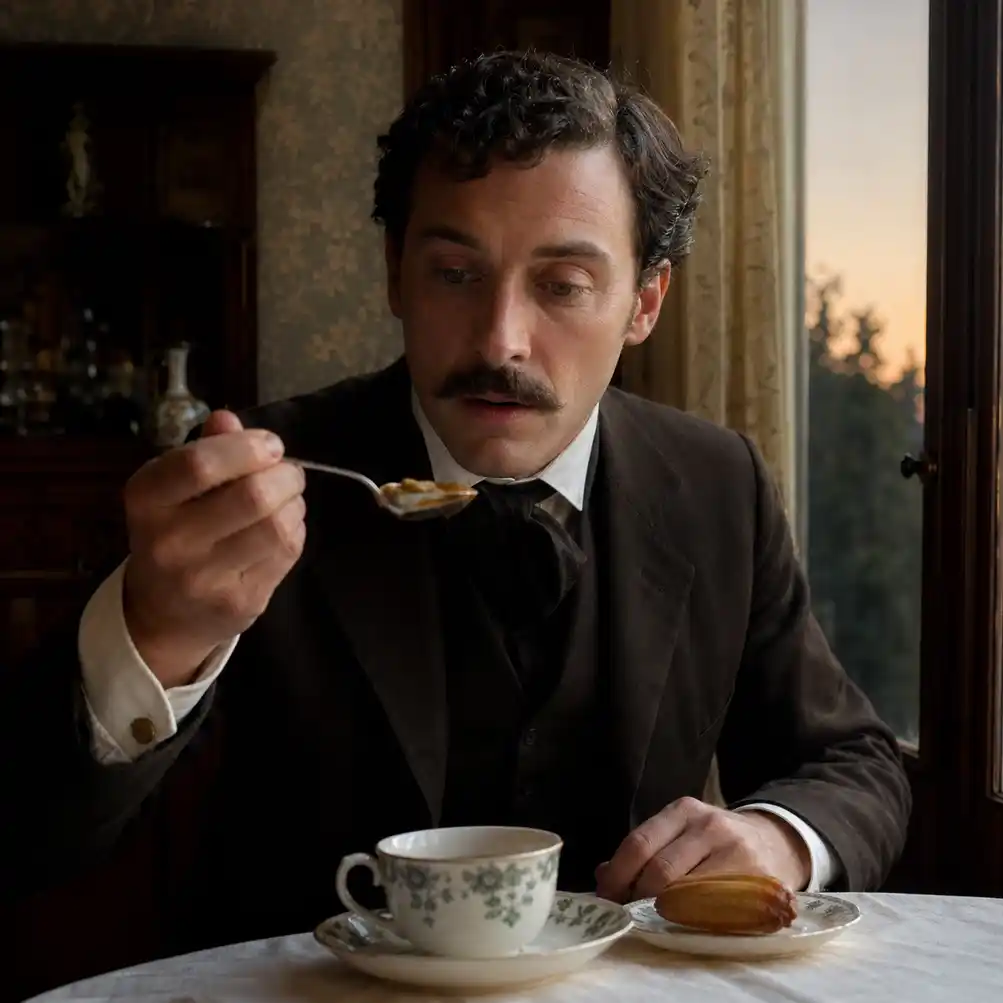
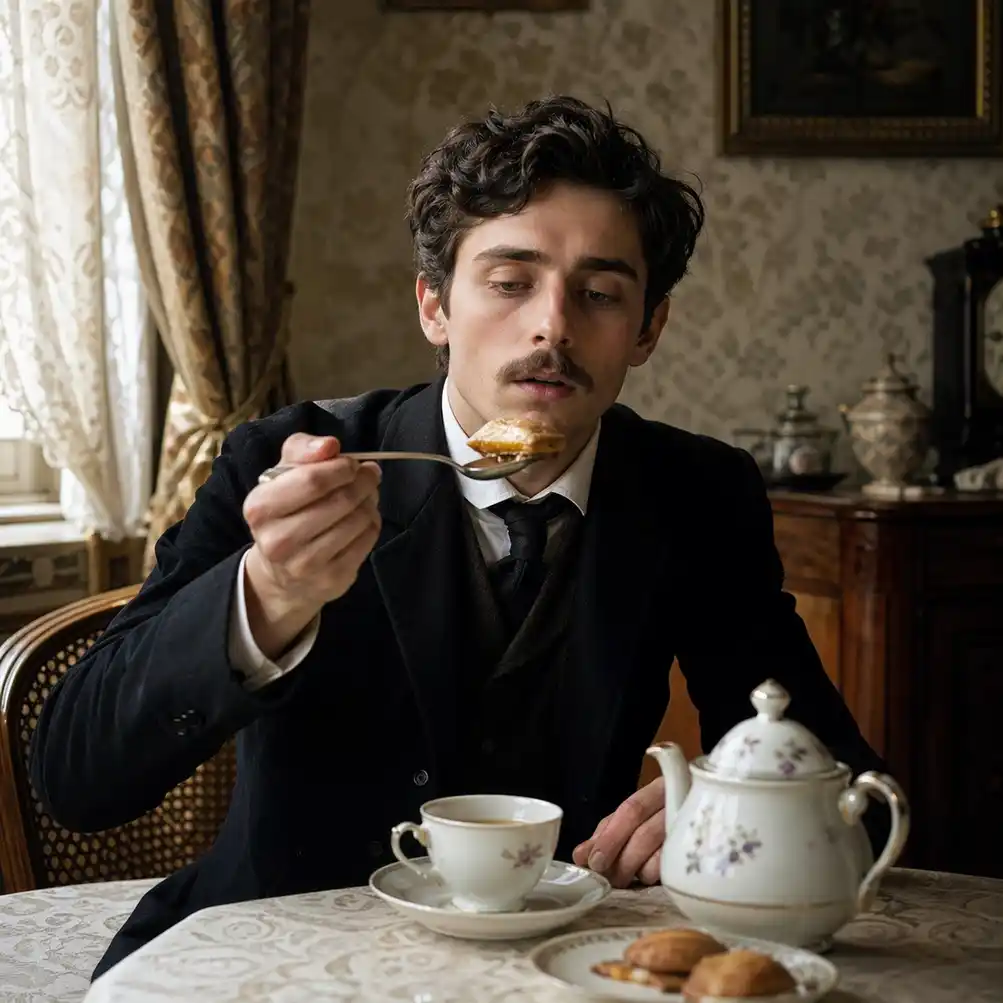
The famous madeleine episode begins with failure. Its sight produces nothing. Only after the small cake’s taste mixes with tea does an unexpected pleasure enter the narrator before he understands its source. He then tries repeatedly to recover the connection without frightening it away through force.
This distinction separates involuntary memory from nostalgia. The narrator does not choose a charming childhood image and polish it through affection. A bodily sensation breaks through habitual consciousness and restores not one fact but a whole relation among rooms, streets, people, weather, and a former self.
Sensation opens a structure of time. The past does not return as information about Combray. For a moment, the person who tasted tea with Aunt Léonie and the person tasting it now occupy the same experience.
Fragmented voices reconstruct a suppressed colonial past in 👉 A Mercy by Toni Morrison. Morrison refuses one controlling memory and reveals how ownership separates people from their own histories. The author concentrates on an individual consciousness, but both works show that the past changes with the form that releases it.
The madeleine cannot serve as an easy formula. Smell and taste often trigger memories, yet most recollections do not abolish time. The scene gains power from the narrator’s analysis of hesitation, repetition, and recognition, not from the pastry alone.
Later involuntary memories involve uneven paving stones, the sound of a spoon, and the texture of a napkin. Their recurrence turns the first revelation into part of an architecture. Memory needs a material accident and an interpreting mind. The sensation arrives without command, but art must discover what the recovered interval can mean.
Swann provides the pattern the narrator will repeat
“Swann in Love” interrupts the narrator’s childhood and moves backward into a story he could not have witnessed directly. Charles Swann possesses social ease, artistic knowledge, and access to elite circles, yet his relationship with Odette exposes the fragility beneath that competence.
At first, Odette does not match his taste. Desire grows through association, absence, music, and uncertainty. A phrase from Vinteuil’s sonata gives the relationship an aesthetic form that neither lover can control. Swann gradually turns incomplete knowledge into obsessive interpretation.
Jealousy makes absence productive. A missed evening, an unclear remark, or an unknown social visit generates possibilities more powerful than evidence. Swann does not simply love Odette. He constructs versions of her and suffers because none can secure the inaccessible person.
The embedded story gives In Search of Lost Time a model in advance. Later, the narrator repeats Swann’s patterns with Gilberte and, most destructively, with Albertine. Recognition does not create immunity. He can analyze another man’s obsession with precision and still reproduce its logic.
Swann also connects private desire to public identity. His Jewish background, artistic judgment, marriage, political position during the Dreyfus Affair, and shifting social reception alter how salons classify him. No distinction between intimate and social life remains stable.
The narrative distance creates moral ambiguity. Swann’s suffering receives extraordinary attention, while Odette’s inner life stays less available. His interpretation can therefore look like depth even when it serves possession.
The pattern explains without excusing. The writer shows how love can become a system for producing knowledge about another person and why that system repeatedly manufactures its own uncertainty.
Salons turn class into a changing performance
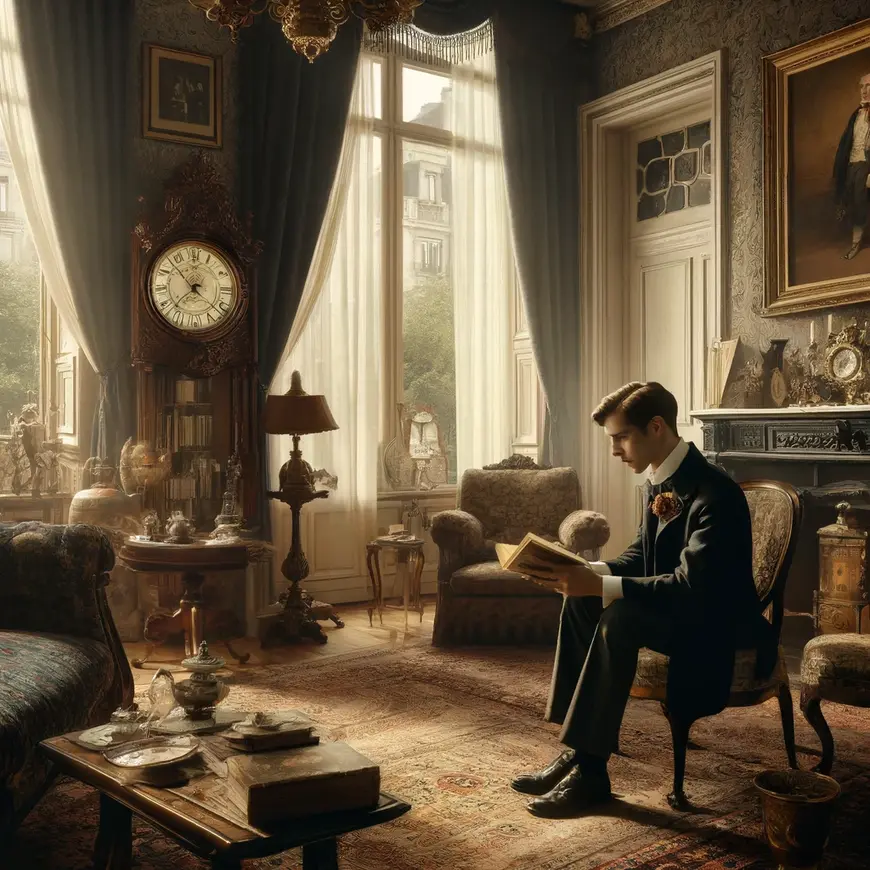
Two rival salons organize much of the novel’s social world. The Verdurin circle appears bourgeois, possessive, and aggressively contemporary. By contrast, the Guermantes circle carries aristocratic prestige through names, ancestry, manners, and inherited spaces. Neither remains fixed.
Guests perform taste, loyalty, wit, boredom, and political conviction before audiences capable of changing their rank. Madame Verdurin demands devotion from her “faithful” circle and punishes independent relations. The Guermantes convert privilege into apparent naturalness, although constant labor protects their position.
Family decline also unfolds through social ritual in 👉 Buddenbrooks by Thomas Mann. Mann follows bourgeois status across generations. Proust moves between rival rooms and reveals how quickly a name, marriage, scandal, war, or fashion can reorganize value.
Society edits its own memory. A person once dismissed can become desirable, while an admired figure can lose relevance without changing inwardly. By the final volume, former boundaries have crossed through marriages and new alliances.
The Dreyfus Affair exposes the violence beneath conversational elegance. Characters reveal antisemitism, opportunism, courage, and tribal loyalty as they discuss the wrongly convicted Jewish officer. Political history enters through dinner talk because prejudice reproduces itself in ordinary social judgment.
He satirizes these circles without pretending that the narrator stands outside them. He longs for entry, mistakes rank for mystery, and learns slowly that aristocrats contain the same vanity and cruelty as other people. Yet he also needs salons as laboratories of gesture, speech, and reversal.
Performance creates real consequences. A social fiction can decide who receives attention, credibility, intimacy, or exclusion, even when everyone privately knows that the hierarchy rests on changing agreements.
Love repeatedly becomes surveillance and possession – In Search of Lost Time
The narrator’s relationship with Albertine expands the structure introduced through Swann. Attraction depends on uncertainty. Because Albertine belongs to a group of young women at Balbec before she becomes an individual to him, desire begins among interchangeable possibilities and imagined lives.
Once intimacy grows, knowledge does not calm him. Each answer creates another question about Albertine’s movements, friendships, desires, and possible relationships with women. The narrator hires others to observe her, controls journeys, tests statements, and eventually keeps her within his household.
Possession destroys the freedom that produced desire. When Albertine remains near, boredom competes with jealousy. After she leaves, absence restores intensity. Her death cannot end the investigation because memory keeps generating new versions of what she may have concealed.
Social expectation places quieter pressure on desire in 👉 Night and Day by Virginia Woolf. Woolf gives women more room to examine the futures available to them. Proust deliberately restricts Albertine through a narrator who treats her opacity as both threat and artistic material.
That restriction demands criticism. The novel understands the cruelty of surveillance, but it still gives the controlling consciousness most of the language. Albertine’s possible lesbian relationships intensify male anxiety while her own desires remain difficult to separate from rumor, confession, and coercion.
Love in In Search of Lost Time often means loving an internal construction. This insight has psychological force, but it narrows affection toward jealousy and loss. Care, trust, and mutual recognition receive less sustained attention. The beloved remains a person beyond the story. His failure to accept that limit produces some of the novel’s sharpest knowledge and its deepest ethical unease.
Sentences make revision part of thought
Proust’s long sentences do not merely decorate a large novel. They stage consciousness as a process of assertion, comparison, correction, qualification, and delayed recognition. A perception begins, encounters an exception, gathers an image, and returns altered by everything the syntax has held together.
Readers can lose the main clause, especially when a sentence passes through several dependent structures. Yet that temporary disorientation often serves the subject. Social judgment and memory rarely move in straight lines. Syntax preserves the route of discovery.
Formal experiment becomes visible from another angle in 👉 The Counterfeiters by André Gide. Gide places a novelist inside the novel and exposes competing versions of authenticity. The novelist keeps a more continuous retrospective voice, but his expanding sentences reveal how narrative manufactures coherence from unstable experience.
Metaphor performs analytical work. A social room becomes a theater, a face becomes a landscape, jealousy behaves like an illness, and music creates a relation that ordinary explanation cannot secure. These images do not replace argument. They allow one structure to clarify another.
Humor also matters. The narrator can spend extraordinary verbal energy exposing a tiny act of vanity or a conversational misunderstanding. Without this comedy, the psychological analysis would become oppressive.
Translation changes rhythm, punctuation, titles, names, and degrees of formality. No English version can provide a neutral Proust. Readers encounter interpretive choices about how far a sentence can stretch before clarity breaks. Difficulty produces a distinctive pace. Such prose asks readers to remain inside developing thought long enough for an early certainty to reveal its hidden conditions.
Famous Quotes from In Search of Lost Time
- “The real voyage of discovery consists not in seeking new landscapes, but in having new eyes.” This quote encapsulates his belief that true understanding comes from seeing things in a new way rather than just exploring new places.
- “Let us be grateful to the people who make us happy; they are the charming gardeners who make our souls blossom.” Marcel Proust highlights the importance of those in our lives who bring us joy and help us grow.
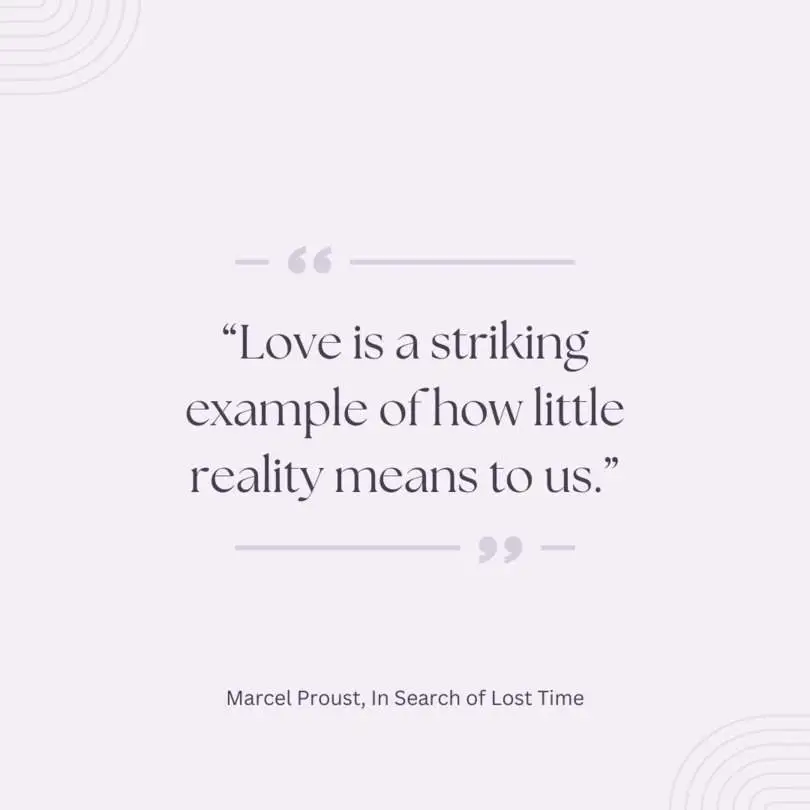
- “Love is a striking example of how little reality means to us.” This reflects his contemplation on the nature of love and how it often involves our perceptions and fantasies more than actual realities.
- “The only real voyage of discovery consists not in seeking new landscapes, but in having new eyes.” Similar to the first quote, this reiteration emphasizes the transformative power of new perspectives over new experiences.
- “We are healed from suffering only by experiencing it to the full.” The writer speaks to the idea that embracing our suffering is a path to overcoming it.
- “Time, which changes people, does not alter the image we have retained of them.” This quote dives into the theme of memory and perception, suggesting that our initial impressions of people often remain fixed even as they themselves change.
Trivia Facts about In Search of Lost Time
- Length and Composition: In Search of Lost Time is one of the longest novels ever. Containing about 1.2 million words spread across seven volumes. Marcel Proust started writing it in 1909 and continued until his death in 1922.
- Writing Conditions: The novelist was known for his unusual writing habits. He often wrote at night and slept during the day.
- Publication Struggles: The first volume of the novel, “Swann’s Way,” was initially rejected by several publishers. He eventually had to pay for its publication himself in 1913.
- Real-Life Inspirations: Many characters in the novel are based on real people from his life.
- Famous Madeleine Scene: One of the most famous scenes in all of literature—the moment where the taste of a madeleine dipped in tea evokes a flood of memories for the narrator—is in the first volume. This scene has become a pivotal example of involuntary memory in literature.
- Health and Writing: The author suffered from severe asthma throughout his life, which made him increasingly reclusive. His health struggles often influenced the themes of illness and suffering in his work.
- Posthumous Completion: The last three volumes of In Search of Lost Time were posthumously. The novelist was still editing the manuscript on his deathbed, making the final volumes a reconstruction from his notes and drafts by his brother, Robert, and friend, Jean Paulhan.
Seven volumes change every earlier meaning
The seven volumes appeared between 1913 and 1927. The author saw the first four into print before his death in 1922. His brother Robert then organized the publication of The Captive, The Fugitive, and Time Regained from manuscripts, drafts, and proofs that still contained layers of revision.
This history matters because the work often feels perfectly circular. Images from Combray return near the end. Social paths once treated as opposites converge. Characters age, die, marry, change allegiance, or acquire new reputations. The narrator finally understands experiences that seemed incidental when they occurred.
Recurrence transforms rather than repeats. The same name, musical phrase, place, or gesture carries a different history each time it returns. Readers also change during the long journey and may remember an earlier scene imperfectly.
A writer’s formation through remembered cities drives 👉 The Torch in My Ear by Elias Canetti. Canetti presents a declared memoir of intellectual apprenticeship. Proust gives his narrator a fictional education whose final artistic purpose reorganizes the life already narrated.
Historical time enters the design. The Dreyfus Affair divides society, and the First World War changes Paris, language, bodies, and status. Private memory never floats outside politics, even when the narrator concentrates on desire or art.
The posthumous volumes also resist the fantasy of a completely settled monument. Editors and translators must choose among textual states. He built the ending toward recognition, but material incompletion remains part of the book’s history. The architecture holds change without erasing it. Its unity comes from relations discovered across distance, not from a plan that makes every part equally finished.
Art recovers time without reversing it
In Time Regained, several involuntary memories arrive close together and reveal the narrator’s vocation. Sensory correspondences release moments from chronological sequence. He recognizes that a work of art can discover the relations ordinary life contains but habit prevents consciousness from seeing.
This conclusion does not mean that writing defeats death. Lost people do not return, Albertine cannot answer, and the narrator’s own body has weakened. Art converts loss into form, not presence.
The distinction protects the ending from easy consolation. Art makes the past available through selection, arrangement, rhythm, and metaphor. A book can preserve patterns that life concealed, yet it cannot restore every voice equally. The narrator still controls the representation of people whom he misunderstood.
In Search of Lost Time therefore ends by revealing the conditions of its own beginning. The long novel readers have nearly completed becomes the work the narrator now resolves to write. This circularity makes reading itself part of the recovered time because earlier scenes acquire their artistic purpose only afterward.
The achievement remains immense. Marcel Proust joins bodily sensation, social comedy, jealousy, historical rupture, sexuality, class, and aesthetic theory without reducing them to one message. His method rewards slowness because significance develops through echoes across thousands of pages.
Its limitations remain visible too. Servants, working people, and especially Albertine often receive less inward freedom than the narrator grants himself. Psychological insight can coexist with possessive vision.
Recovery requires ethical resistance as well as admiration. The novel teaches readers to discover time inside form while asking whose experience that form can preserve, transform, or silence.
My Thoughts on In Search of Lost Time – A Literary Odyssey
Reading this work was truly captivating and immersive for me from the beginning. The detailed descriptions of memories and emotions by the author drew me in completely. His words transported me into the mind of the narrator where I felt each memory vividly and intensely.
Through my journey with his work I found his exploration of the concepts of time, love and art within moments truly captivating. The eloquent prose and profound musings encouraged me to pause reflect on lifes beauty and contemplate the march of time.
Each page seemed to transport me to days brimming with rich symbolism and significance. By the conclusion I was deeply touched by the poignant observations, on behavior. Reading this was quite a task. It was definitely worth it as it made me contemplate my own memories and life experiences.