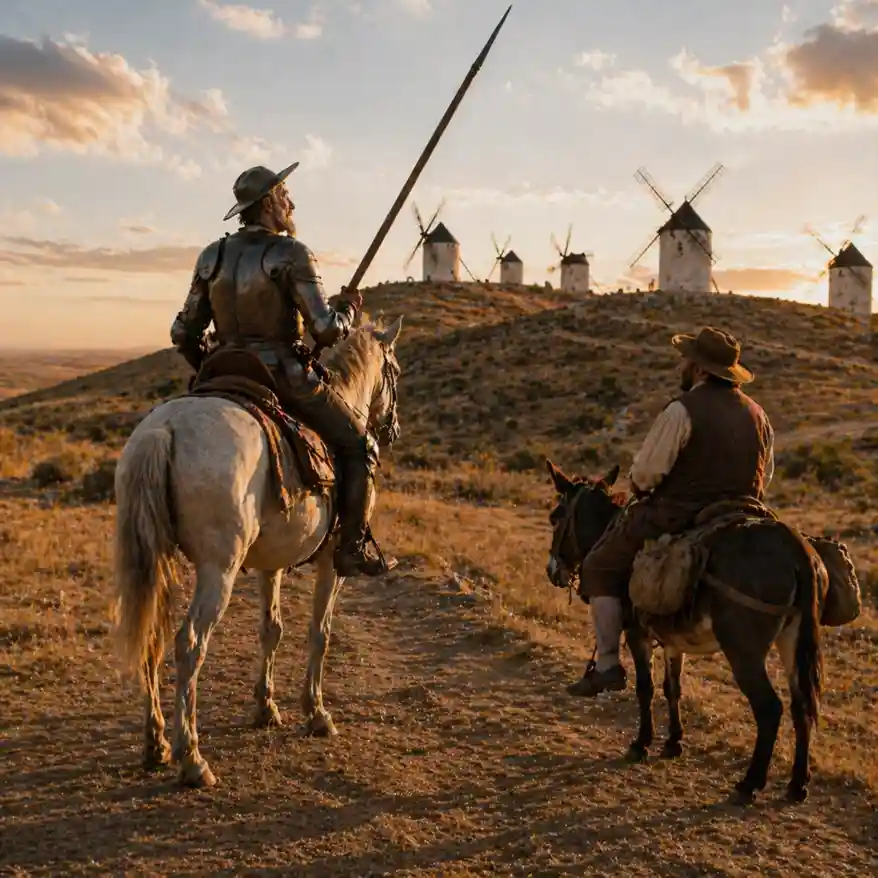
La Numancia by Miguel de Cervantes
La Numancia begins with an ending its audience already knows. The Celtiberian city of Numantia cannot defeat Rome. In 133 BCE, the forces of Scipio Aemilianus completed a siege that ended the city’s resistance. Miguel de Cervantes transforms that historical defeat into a tragedy about what remains possible when survival has almost disappeared.
Written during the early 1580s and divided into four jornadas, the play circulated under titles including El cerco de Numancia and La destrucción de Numancia. English versions often use The Siege of Numantia or Numantia. The original title preserves its place within Spanish Golden Age drama.
The plot moves toward catastrophe without relying on uncertainty about the outcome. Knowledge of defeat sharpens every decision. Roman victory appears inevitable, but its meaning remains unsettled. Can conquest count as triumph if the conqueror receives neither willing submission nor the spoils he expected?
This question makes the city the center of La Numancia. No single protagonist contains the tragedy. Soldiers, lovers, mothers, children, allegorical beings, and enemies contribute to a collective catastrophe.
A very different political drama appears in 👉 Danton’s Death by Georg Büchner, but both plays resist the comfort of a single heroic life. Public history moves through crowded voices, while individual courage remains trapped inside forces larger than intention.
La Numancia therefore offers no simple lesson about bravery. The play turns survival into a moral conflict. Its citizens seek freedom from enslavement, but the means by which they deny Rome also destroy the community they wish to protect.
Scipio Builds a Wall Around Time
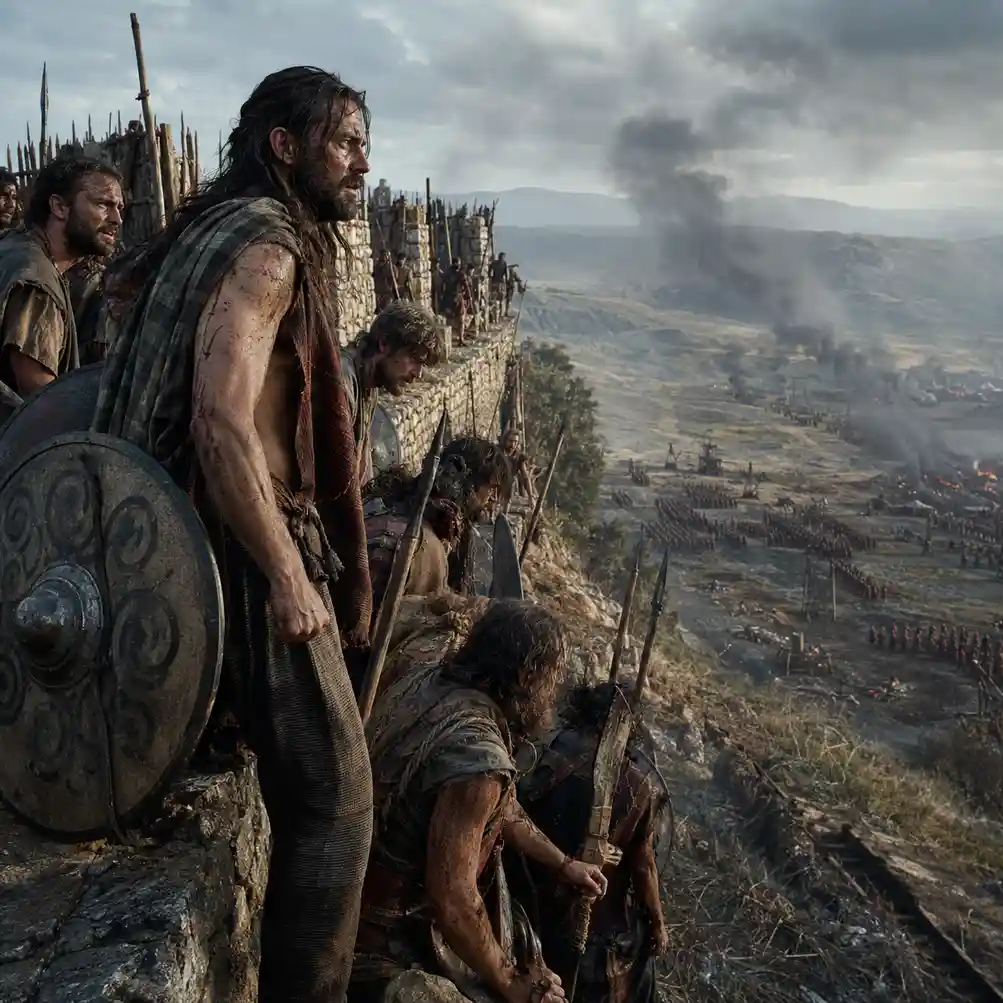
The Roman camp opens the drama. Scipio restores discipline, then rejects the terms sought by Numantian representatives. Rather than risk another assault, he surrounds the city and lets deprivation complete the conquest.
This strategy changes the nature of violence in La Numancia. Combat becomes waiting. Roman power operates through enclosure, supply, calculation, and control of time. The wall turns hunger into a weapon. The besiegers can remain outside the suffering they create while claiming that no direct blow compels surrender.
Scipio’s discipline makes him effective, yet the play does not present effectiveness as moral innocence. His refusal of peace narrows every later choice inside the city. The catastrophe may be enacted by Numantian hands, but Roman policy constructs its conditions. Responsibility crosses the wall even when soldiers do not.
The military and political machinery of 👉 Wallenstein by Friedrich Schiller offers a useful comparison. Schiller’s trilogy explores command through intrigue and divided loyalty, while Cervantes concentrates it in a siege. Both show generals attempting to control events that acquire a moral life beyond strategy.
Time under siege belongs unequally to the two sides. For Rome, delay reduces military risk. For Numantia, each day consumes food, physical strength, and the possibility of choice. La Numancia makes this asymmetry visible before Hunger appears as an allegorical figure.
Scipio believes enclosure guarantees possession. Yet perfect control produces an empty victory. Treating the city as an object prepares the refusal that denies him captives and uncomplicated glory.
The City Becomes the Hero
Inside Numantia, public decision and private suffering continually intersect. Councils debate strategy, soldiers consider battle, women confront the prospect of enslavement, and families face the disappearance of food. The city does not speak with one voice, yet the pressure of siege forces its inhabitants toward a collective fate.
The women play a decisive role. When the men consider a final battle, the women argue that this would abandon them and the children to Rome. Their intervention redirects courage toward a terrible communal resolution. Those excluded from military command reshape the decision.
This complicates heroic unity. The population agrees under extreme coercion, not free deliberation. Fear of slavery, loyalty, hunger, vulnerability, and honor converge. La Numancia asks audiences to admire resistance while seeing collective ideals demand individual bodies.
The large social canvas of 👉 Les Miserables by Victor Hugo belongs to another genre and century, but it also allows historical conflict to emerge through people divided by class, age, duty, and private attachment. In both works, a community becomes visible through unequal exposure to suffering.
No character can save Numantia because the tragedy has no private exit. Lovers cannot withdraw into romance. Parents cannot protect children outside the city’s fate. Leaders cannot produce a strategy that restores meaningful alternatives. The collective hero is also a collective victim.
Through this structure, La Numancia rejects a narrow tragedy of elite downfall. The destruction reaches kitchens, streets, temples, and families. History enters every household before Fame can turn it into legend.
Hunger Takes the Stage – La Numancia
The play gives abstractions bodies and voices. Spain mourns, the Duero speaks, and War, Sickness, Hunger, and Fame enter. These allegories enlarge the siege while exposing its mechanisms. Violence is distributed through elemental agents.
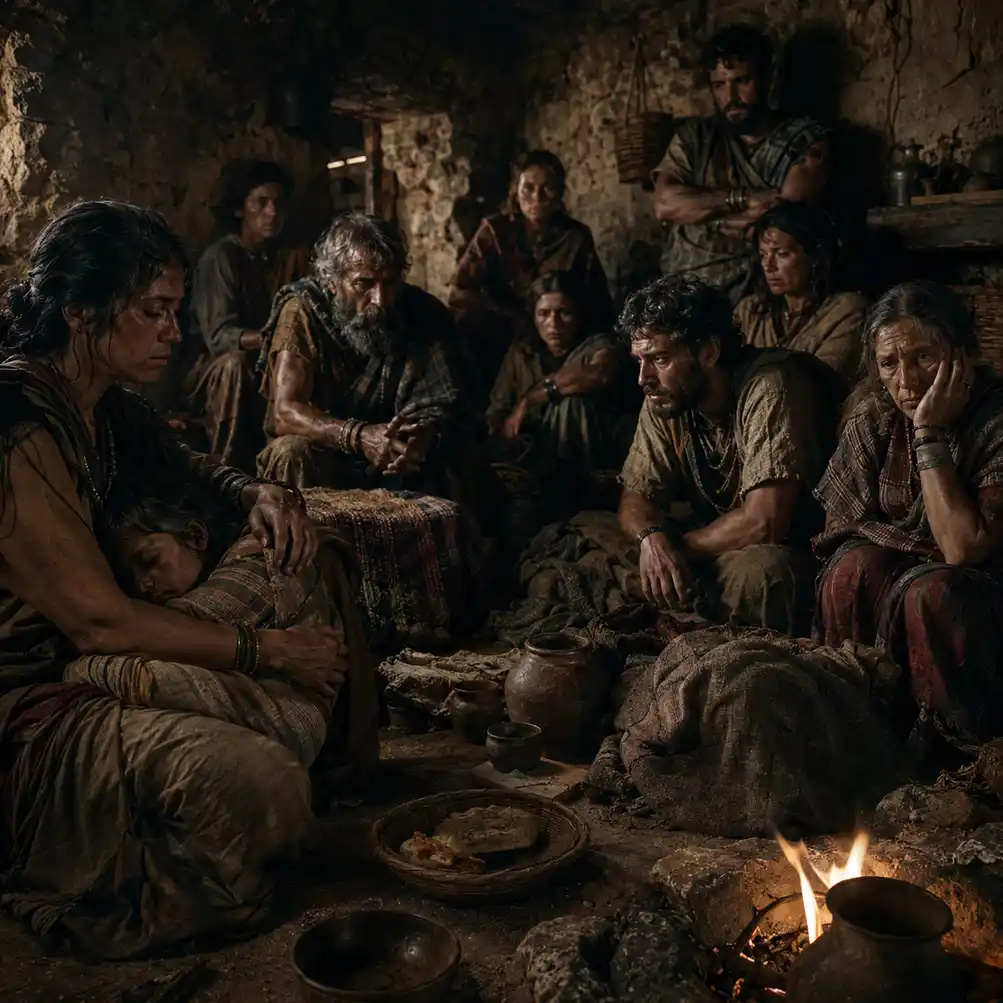
Hunger proves especially important because it converts Roman strategy into intimate physical decline. It acts inside the walls without belonging to the community. Empty stomachs weaken judgment, transform relationships, and reduce time to the search for food. The siege becomes present in every body.
The allegorical figures may seem remote to modern readers accustomed to psychological realism. On stage, however, they can create a second scale of perception. Individual characters experience pain, while the personified forces explain how that pain participates in war, geography, disease, and future memory.
La Numancia also includes failed ritual and necromancy. A sacrifice produces ominous signs, and the magician Marquino raises a dead man in search of knowledge. The answer confirms disaster. These scenes do not restore control. Religion and magic reveal the future without opening a path away from it.
That dramatic knowledge intensifies helplessness. The city understands its approaching destruction, while the audience has known it from the beginning. Prophecy becomes another form of enclosure. No character can claim ignorance, yet knowledge offers no rescue.
The movement between starving bodies and speaking abstractions shapes the tragedy. Hunger afflicts families and addresses the audience as a historical force. The metaphor becomes literal because ordinary language cannot hold the catastrophe.
Bread Arrives Covered in Blood
Against the collective scale, the relationship between Marandro and Lira creates an intimate center. Their love cannot escape public disaster, but it shows exactly what the siege destroys. Lira’s hunger turns the need for bread into a test of affection, courage, and physical limit.
Marandro enters the Roman camp with his friend Leonicio to obtain food. The mission offers no strategic victory. It seeks only to keep one person alive. Love reduces heroism to a piece of bread. That small objective makes the danger more immediate than speeches about national glory.
When Marandro returns mortally wounded, the bread is marked by the blood spent to secure it. Nourishment and death arrive together. The image condenses the moral economy of La Numancia: every remaining resource has become inseparable from sacrifice. Lira can receive the food, but not the future that gave food its ordinary meaning.
The Spanish setting and the bond between private love and collective struggle create a thematic route toward 👉 For Whom the Bell Tolls by Ernest Hemingway. Hemingway’s modern war novel differs sharply in form, yet it likewise tests intimacy inside a conflict that gives lovers almost no independent time.
Marandro’s action combines patriotic sacrifice, friendship, and devotion. His death belongs to the city but remains a personal loss that legend cannot repay. The scene refuses abstraction. The cost of siege can be held in two hands. Bread should sustain life. Here it proves that the structures of ordinary life have collapsed.
Bariato Denies Rome Its Prize
The final movement carries destruction through the city until Bariato remains as the last surviving youth. Scipio wants him captured as proof and prize of Roman victory. Bariato instead throws himself from a tower. His death leaves the conqueror without the living emblem he expected to display.
The action completes the paradox. Rome controls the territory, but Numantia controls surrender by refusing it. The defeated city authors the conqueror’s shame. Scipio recognizes a victory unavailable to his army.
Yet the scene should remain disturbing. Bariato’s death can become a powerful symbol of freedom, but he is also a child shaped by a collective decision and a world without survivable alternatives. Celebrating the act too easily risks repeating the logic that treats young bodies as material for national glory.
La Numancia keeps both responses active. The Roman demand for possession is morally repellent. So is the condition in which death appears as the only remaining form of agency. The tragedy does not offer a humane solution because imperial violence has systematically removed humane choices.
Fame enters to preserve Numantia’s name and connect its sacrifice with Spain’s future. This promise converts extinction into historical immortality. Memory rescues significance, not life. The distinction matters because later glory cannot undo the suffering witnessed on stage.
Bariato denies Rome a captive, but he cannot restore the city. His final freedom exists at the edge of annihilation. The scene endures because it makes resistance admirable and unbearable at the same time.
Patriotism Meets Imperial Unease
The play was written during the reign of Philip II, when Spain possessed imperial power far beyond the ancient city it claimed as an ancestor. Allegorical speeches by Spain, the Duero, and Fame connect Numantian resistance with future national greatness. From this angle, La Numancia can appear to transform a local defeat into a foundation myth.
That patriotic movement does not settle the politics. Rome surrounds a weaker community, rejects negotiation, weaponizes hunger, and seeks bodies as proof of power. A Spanish audience could celebrate Numantia while recognizing imperial methods. The victim’s future heirs may become conquerors themselves.
This tension makes the drama richer than uncomplicated national praise. The Roman perspective is not excluded, and Scipio’s final recognition prevents him from remaining a flat villain. Nevertheless, military discipline and historical success cannot cleanse his strategy of its human consequences.
👉 Cassandra by Christa Wolf revisits an ancient war through a voice that challenges heroic memory. Wolf’s modern perspective differs from Cervantes’s allegorical history, but both works reveal how national legend can organize suffering into a usable story.
La Numancia invites that use through Fame, yet its stage images resist complete conversion. Starving families, failed rituals, bloodied bread, and Bariato’s body remain more troubling than prophecy. Spectacle unsettles the ideology that explains it.
The play supports patriotic, anti-imperial, tragic, and critical readings. It shows collective memory turning defeat into identity, then asks what must be forgotten for that identity to feel pure.
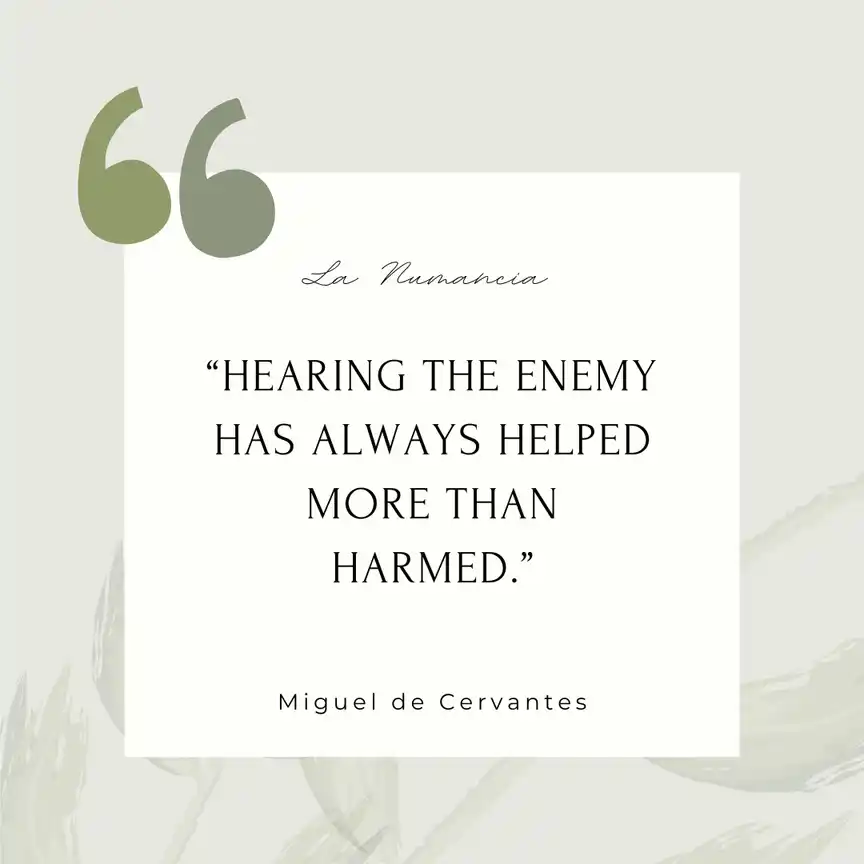
Quotes for La Numancia
- “Cada cual se fabrica su destino, no tiene aquí Fortuna alguna parte: la pereza fortuna baja cría; la diligencia, imperio y monarquía.” Scipio’s maxim joins self-command to political power. However, the drama soon tests its confidence, because Roman discipline can control an army but cannot dictate how the besieged will understand defeat. The sentence therefore introduces agency as both military doctrine and tragic problem.
- “Desesperación notoria es esta que hacer queréis, adonde sólo hallaréis breve muerte y larga gloria.” Lira challenges the men’s proposed sortie by naming its bargain plainly: a short death purchased for enduring fame. Moreover, her intervention changes the deliberation. Women do not merely symbolize suffering here; they reason publicly about survival, honor, and the consequences that male heroics impose on the whole city.
- “No de la muerte la feroz guadaña, ni los cursos de tiempos, tan ligeros, harán que de Numancia yo no cante el fuerte brazo y ánimo constante.” Fame closes the tragedy by promising that death and time cannot silence Numantia’s courage. Consequently, annihilation becomes remembrance, while Rome’s material victory yields to the defeated city’s narrative control. The sentence crystallizes the unsettling triumph at the center of La Numancia: nobody survives, yet memory refuses conquest.
Trivia for La Numancia
- The play waited nearly two centuries for print: Miguel de Cervantes composed La Numancia around 1581 to 1585, yet Antonio Sancha issued it only in 1784. The 🌐 Community of Madrid has digitized that landmark volume.
- History enters through popular tradition: The tragedy dramatizes Scipio Aemilianus’s siege of Numantia in 133 BCE. However, a 1573 ballad about the city’s destruction supplied its immediate inspiration.
- A city replaces the solitary hero: Across four jornadas, soldiers, women, children, and civic leaders share the dramatic burden. Consequently, La Numancia makes communal endurance its protagonist.
- Allegory walks beside history: Spain, the River Duero, War, Sickness, Hunger, and Fame appear as speaking figures. Thus, the siege becomes both an embodied catastrophe and a prophetic national myth, while 👉 The Flies by Jean-Paul Sartre offers another useful model of civic myth recast for resistance.
- Later crises revived the tragedy: Rafael Alberti adapted the play during the Spanish Civil War in 1937. Furthermore, the 🌐 Teatro Nacional Cervantes archive records a 1961 Buenos Aires production, demonstrating its antifascist reach.
- Women redirect the action: When the men plan a fatal sortie, wives and daughters demand a shared fate and force reconsideration. Therefore, domestic voices determine the city’s collective strategy rather than merely mourning its consequences.
- The final child denies Rome its spectacle: Young Viriato leaps from a tower rather than become Scipio’s captive. As a result, Rome wins the territory but loses the triumph, a paradox that resonates with the political theater of 👉 Don Carlos by Friedrich Schiller.
Why the Tragedy Still Disturbs
The verse forms, allegories, and ceremonial speeches may feel less accessible than the novelistic Cervantes. Yet La Numancia has concentrated theatrical power. With the outcome fixed, attention shifts from suspense to image and moral pressure.
The play’s strongest achievement is its collective perspective. It refuses to let war remain a contest between commanders. Strategy becomes hunger, patriotism becomes a demand placed on families, and victory becomes an argument over bodies and memory. History is measured from inside the walls.
Its most difficult element is the treatment of collective death. The refusal of slavery carries political dignity, but the elevation of sacrifice can become coercive. Productions and readings must decide whether Fame’s final promise consoles, glorifies, or exposes the need to turn unbearable loss into national purpose.
That openness keeps La Numancia from becoming a monument alone. Its siege speaks to later encirclement, deprivation, occupation, and resistance. Distinct conflicts should not be flattened, yet the play understands how power forces civilians into choices later called heroic.
The title survives because Numantia becomes more than a location. It names the terrible freedom of refusing possession when every ordinary freedom has been removed. The phrase contains admiration and grief together.
La Numancia ends with Rome holding the ruins and Fame holding the story. Neither possession is complete. The dead escape Roman ownership, but later generations inherit the responsibility to remember them as people rather than instruments of glory. That unresolved obligation gives the tragedy its continuing force.