The Sound and the Fury: Time, Caddy, and Family Collapse
Published in 1929, The Sound and the Fury reconstructs the decline of the once-prominent Compson family through four dated sections. William Faulkner begins with Benjy’s sensory consciousness, moves backward to Quentin’s final day at Harvard, returns to Jason during Easter weekend in 1928, and closes with an external narrator whose attention shifts among Dilsey, Jason, and Benjy. The sequence makes family history available only through conflicting forms of perception.
The work is a Modernist novel with strong elements of Southern Gothic, the psychological novel, and multigenerational family tragedy. Its formal difficulty is not ornamental. That difficulty makes The Sound and the Fury a test of interpretive attention. Every voice turns time, Caddy, money, race, gender, and inheritance into a different structure of experience. Family collapse becomes a crisis of narration itself throughout the novel.
Four Dates Break Chronology Without Destroying It
The four headings in The Sound and the Fury provide firm dates even when consciousness disrupts sequence. Their precision matters greatly. Benjy’s section occurs on April 7, 1928, the day before Easter. Quentin’s takes place on June 2, 1910, eighteen years earlier. Jason speaks on April 6, 1928, and the external final section unfolds on April 8. The calendar remains stable while every narrator experiences time differently.
The Sound and the Fury therefore does not abandon chronology. It requires readers to reconstruct it from recurring scenes, changed names, ages, objects, and relationships. The death of the children’s grandmother, Caddy’s sexual awakening and pregnancy, Quentin’s suicide, Mr. Compson’s death, Benjy’s castration, and Miss Quentin’s escape emerge in fragments. Knowledge grows through comparison rather than a single authoritative account.
Historical fracture takes another radically nonlinear form in The Flanders Road by Claude Simon. Simon lets war, memory, desire, and repeated images unsettle causal sequence. William Faulkner’s dates offer more visible anchors, yet both novels make reconstruction part of reading rather than information supplied before interpretation begins.
The dates also locate the Compsons beyond a vague postwar South. Their present belongs to the Jim Crow era, while Quentin’s day extends the family’s crisis from Mississippi to Cambridge, Massachusetts. Easter structures three of the four sections, but religious sequence does not guarantee renewal. In The Sound and the Fury, Good Friday, Holy Saturday, and Easter Sunday frame theft, resentment, exhaustion, and temporary formal order. Sacred chronology remains legible while the family proves unable to inhabit its promise.
Benjy Experiences Memory as an Undivided Present
In The Sound and the Fury, Benjy is thirty-three, nonverbal, and dependent on others for care when his section begins. A golf player’s call for a caddie, the fence around former Compson land, firelight, smells, voices, and physical movement trigger earlier scenes without warning. Past and present do not appear to him as separate categories. Sensation opens directly into memory without explanatory distance.
This structure makes The Sound and the Fury difficult before readers know the family, but Benjy’s narration is not random. Particular stimuli repeatedly lead to related experiences, especially those involving Caddy’s presence or loss. Her smell is associated with emotional security, while changes in her body and behavior produce distress he cannot interpret conceptually. His cries communicate disturbance even when the household refuses or fails to understand its cause.
Family history and nonlinear time expand across generations in One Hundred Years of Solitude by Gabriel García Márquez. Márquez uses repetition, prophecy, and recurring names to make history feel cyclical. Benjy’s section is more radically individual: several decades coexist because immediate perception continually reactivates them.
Benjy also reveals what more articulate narrators conceal. He cannot explain sexual morality, property, or family reputation, yet he registers quarrels, absences, cruelty, and changing patterns of care. His limitations require interpretation, but they do not make Jason’s confident language more truthful. The Sound and the Fury begins with a consciousness excluded from authority and asks readers to build knowledge from sensory fidelity. Confusion becomes an ethical test of whether attention can replace the demand for conventional explanation.
Quentin Turns Southern Honor into a Fatal Fiction
Quentin spends June 2, 1910, moving through Cambridge while preparing to drown himself. He breaks the hands from his watch but continues hearing clocks and bells, so rebellion against measured time becomes another form of obsession. Memories of Caddy, his father, Dalton Ames, and family decline repeatedly overtake the present. He cannot stop time because he has converted the past into identity.
His idea of honor centers on Caddy’s sexuality. Quentin imagines protection as control, proposes death as a way to preserve purity, fights a man connected to her sexual experience, and claims that he committed incest with her. The confession is not a disclosure of an actual relationship but an attempt to create a transgression grand enough to remove Caddy from ordinary time and social judgment. In The Sound and the Fury, honor is a destructive fiction that makes a sister’s life serve a brother’s metaphysical need.
Traumatic memory and racial history govern family relationships in Beloved by Toni Morrison. Morrison gives historical violence a supernatural and psychological return while preserving the enslaved woman’s central consciousness. Quentin’s suffering, by contrast, grows partly from inherited white Southern myths and his inability to recognize Caddy as a person beyond them.
The novelist gives Quentin extraordinary verbal intensity without validating his ideals. His father’s weary relativism offers no sustaining alternative, but Quentin’s absolutism is not thereby noble. He treats female autonomy as family catastrophe and imagines suicide as a victory over change. The section of The Sound and the Fury ends not with recovered honor but with a mind whose elaborate language cannot accept time, sexual agency, or the limits of possession.
Jason Converts Loss into Money, Control, and Hatred
Jason’s section initially seems easier because it moves more linearly through Good Friday in 1928. His sentences follow practical errands, business calculations, domestic conflicts, and a pursuit through town. Yet clarity of sequence does not produce moral clarity. Linear narration becomes the instrument of a profoundly distorted grievance.
Jason blames Caddy for the bank position he lost when her marriage failed, then uses that injury to justify years of theft. He intercepts money Caddy sends for her daughter, Miss Quentin, deceives both women, and converts guardianship into private profit. He also speculates in the commodities market while presenting himself as the only practical member of an irresponsible household. The Sound and the Fury exposes calculation as compulsion rather than competence.
A dysfunctional family also reveals itself through incompatible interests and resentments in The Corrections by Jonathan Franzen. Franzen distributes failure among several consciousnesses. Jason monopolizes his section so aggressively that other people appear mainly as obstacles, expenses, racial stereotypes, or objects of sexual contempt.
His misogyny and racism are not incidental flaws attached to an efficient realist voice. They organize what he notices and how he explains every defeat. When Miss Quentin takes the hoarded money and escapes, Jason pursues her, but anger, pain, and his inability to ask for help frustrate him. This judgment soon collapses. In The Sound and the Fury, the family’s self-declared realist proves as trapped as the dreamers he despises. He measures value constantly because no amount of control can convert his losses into a coherent life.
Caddy Governs the Novel Through Her Absence
Caddy never receives a narrative section, yet the first three sections organize themselves around her. Benjy remembers her care and the sensory signs of change. Quentin turns her sexuality into a crisis of honor and time. Jason converts her failed marriage and continuing motherhood into grounds for punishment. The absent sister remains the novel’s most powerful structural presence.
The childhood scene of Caddy climbing a tree captures this position. She acts, looks into the forbidden room, and gains knowledge, while her brothers remain below and see the mud on her underwear. The image anticipates how they will interpret her body without sharing her perspective. The Sound and the Fury makes her visible through the consequences of male attention, but it withholds the interior voice that could challenge those interpretations directly.
A silenced woman’s recovery of interpretive authority drives Cassandra by Christa Wolf. Wolf revises an inherited story by allowing Cassandra to narrate the political system that used and disbelieved her. Caddy receives no comparable reclamation, so readers must infer her resistance and vulnerability through hostile, dependent, or nostalgic accounts.
Her daughter, also named Quentin, extends the pattern without simply repeating it. Raised in a household that condemns her mother, the younger Quentin faces Jason’s surveillance, insults, and financial exploitation before stealing his hidden money and leaving. Her escape defeats his control but does not guarantee safety or freedom. In The Sound and the Fury, Caddy’s absence is produced by family exclusion, then turned into proof against her. The novel exposes that mechanism while making readers confront its own refusal to grant her a section.
Dilsey Endures Without Receiving Her Own Narration
The final section begins with Dilsey’s labor on Easter morning, but Dilsey is not its narrator. An external third-person voice follows her preparations, the Compson household, the journey to church, Reverend Shegog’s sermon, Jason’s pursuit, and Benjy’s carriage ride. Perspective shifts, and Jason’s thoughts become accessible in ways Dilsey’s often do not. Moral centrality does not become narrative ownership.
Dilsey sustains routines, protects Benjy, confronts Jason, and recognizes the beginning and end of the Compson family’s decline. Her endurance contrasts with the white family’s self-absorption, but The Sound and the Fury does not place her outside history as a simple emblem of loyalty. Her labor is required by a racial order that gives the Compsons dependence without gratitude and gives her responsibility without equal power.
That narrative distance is especially important in a novel so concerned with failed authority. He gives Dilsey ethical weight and greater historical understanding than the Compsons, but he does not reproduce her consciousness with the sustained intimacy granted to the three white brothers. Later readers must examine that limit rather than mistake moral admiration for complete access.
The Easter service provides the section’s strongest collective experience. Shegog’s sermon moves Dilsey to tears and places suffering within a sacred history larger than Compson pride. Still, no resurrection repairs the household. The phrase commonly associated with Dilsey’s endurance belongs to the Compson Appendix written in 1945, not to the final lines of the 1929 novel. The distinction matters because The Sound and the Fury ends with unresolved life, not an authorial epitaph that explains her.
Famous Quotes from The Sound and the Fury
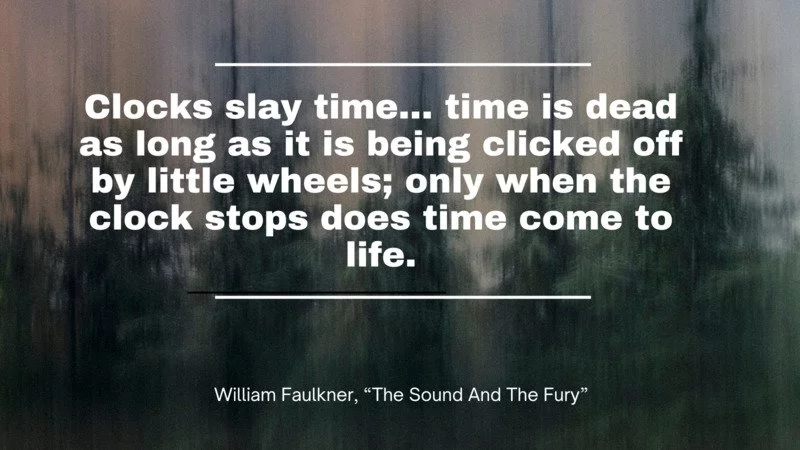
- “I give you the mausoleum of all hope and desire; I give it to you not that you may remember time, but that you might forget it now and then for a moment and not spend all your breath trying to conquer it.” This quote, spoken by Quentin’s father, Mr. Compson, reflects the theme of time and its relentless passage. He suggests that humans should occasionally forget about time to relieve themselves from the constant struggle against its inevitability.
- “Caddy smelled like trees.” This quote is from Benjy’s perspective and is a simple yet profound reflection of his sensory perception and deep emotional attachment to his sister Caddy. For Benjy, the scent of trees represents comfort and stability, highlighting Caddy’s role as a nurturing figure in his life. The repetition of this line throughout Benjy’s narrative underscores his longing for the past and the innocence lost.
- “I don’t hate it! I don’t hate it!” In traditions. Quentin’s struggle with his identity and his inability to adapt to change are core aspects of his character. This quote encapsulates his internal conflict and denial of the profound dissatisfaction he feels with his life and surroundings.
- “They endured.” This line, which concludes Dilsey’s section, signifies resilience and the ability to withstand hardship. Dilsey represents strength and continuity in the Compson family, enduring despite the family’s decline. This quote emphasizes the theme of endurance amidst chaos and decay, contrasting with the other characters’ struggles and failures.
- “I seed de beginnin, en now I sees de endin.” Spoken by Dilsey, this quote highlights her awareness of the family’s decline. Dilsey has witnessed the rise and fall of the Compson family, and her statement underscores the cyclical nature of time and history within the novel.
Trivia Facts about The Sound and the Fury
- Title’s Origin: The title The Sound and the Fury is derived from William Shakespeare‘s play Macbeth. In Act 5, Scene 5, Macbeth delivers a soliloquy in which he describes life as “a tale told by an idiot, full of sound and fury, signifying nothing.” This reference underscores the themes of chaos, existential angst, and the search for meaning within the novel.
- Symbolism of Easter: The events in this work take place over the course of three days around Easter, a time symbolizing death and resurrection in the Christian tradition.
- Publication History: Its complexity and experimental style contributed to its initial lukewarm reception. However, it eventually gained recognition and critical acclaim, solidifying hiss reputation. As one of the most important authors of American Literature of the 20th century.
- Oxford, Mississippi: The author spent most of his life in Oxford, Mississippi. Where he wrote much of his work, including The Sound and the Fury. His home, Rowan Oak, is now a museum and a site of literary pilgrimage.
- Influence on Gabriel García Márquez: Nobel laureate Gabriel García Márquez cited the writer as a significant influence on his work. Márquez’s novel One Hundred Years of Solitude shares his interest in creating a richly detailed, fictional world that explores complex family dynamics. And the passage of time, echoing the style and themes found in The Sound and the Fury.
- Color-Coded Manuscript: The writer originally wanted to use different colored inks to represent the various time shifts in Benjy’s section to help readers navigate the non-linear narrative. However, this idea was not feasible at the time of publication due to printing limitations. Later editions and scholarly works have sometimes used color-coding or formatting techniques to illustrate the temporal shifts in Benjy’s narrative.
The Writing Style Makes Each Consciousness a Form
The Writing Style of The Sound and the Fury does more than alternate narrators. Each section creates a different relation among language, time, and knowledge. Benjy’s sensory transitions collapse decades, Quentin’s syntax fragments as obsession overtakes control, and Jason’s comparatively linear speech turns prejudice into common sense. The final external narration changes tone as its attention moves among Dilsey, Jason, the church, and Benjy. Consciousness is not described from outside but built into form.
The author originally wanted different colors to mark the time levels in Benjy’s section. Conventional production made that design impractical, and italics became the principal visible signal, although they cannot explain every transition. The unrealized color scheme confirms that difficulty was organized rather than accidental. Readers are meant to feel temporal confusion while gradually recognizing its patterns.
Repetition connects the separate voices of The Sound and the Fury. Caddy’s name, clocks, shadows, smells, fire, money, doors, clothing, and remembered phrases acquire different meanings as they pass from one consciousness to another. The Sound and the Fury withholds a neutral vocabulary that could settle those meanings. Even the external section does not erase perspective, because its access and tone remain selective.
The title, taken from Macbeth, invokes a life reduced to sound and fury without significance, yet the novel tests that verdict rather than simply adopting it. Benjy’s sounds communicate loss, Quentin’s verbal fury creates destructive meaning, Jason’s certainty exposes moral emptiness, and Dilsey’s world exceeds Compson interpretation. The Writing Style asks readers to distinguish failed communication from meaningless experience. Form becomes the means by which lives denied full authority still exert pressure on every attempted account.
The Final Carriage Restores Order Without Redemption
After Miss Quentin escapes with Jason’s money, his pursuit fails and the novel returns to Benjy. Luster drives the carriage toward the cemetery but takes an unfamiliar side around the town square and its Confederate monument. Benjy begins to howl until Jason violently redirects the carriage onto the expected route. Restored pattern replaces moral resolution.
The scene condenses the logic of The Sound and the Fury. Benjy depends on repetition and suffers when spatial order changes, while Jason can impose the familiar route through force. Objects then appear to return to their accustomed places. Nothing in that alignment restores Caddy, protects Miss Quentin, reforms Jason, returns the sold pasture, or relieves Dilsey of the household’s burdens.
Family decline unfolds through a more conventional historical arc in Buddenbrooks by Thomas Mann. Mann traces inherited status across generations as economic, physical, and cultural energies alter. He compresses the Compsons’ fall into fractured days and memories, making collapse perceptible through disordered narration before it can be summarized as history.
The Confederate statue gives the route a political dimension. The town’s ordinary circulation is organized around a monument to the defeated slaveholding order whose values still shape race, property, gender, and family prestige. Easter Sunday offers a language of resurrection, but the closing movement circles inherited power rather than transcending it. The Sound and the Fury ends with compositional closure and human continuation, not redemption. The carriage moves correctly, Benjy grows quiet, and the patterns responsible for suffering remain securely fixed in place.