The Threepenny Opera: Crime, Music, and Capital
First performed at Berlin’s Theater am Schiffbauerdamm in 1928, The Threepenny Opera places a stylized London underworld immediately before Queen Victoria’s coronation. Bertolt Brecht developed the text from Elisabeth Hauptmann’s German translation of John Gay’s The Beggar’s Opera, while Kurt Weill composed a score built from ballad, cabaret, popular dance, chorale, and jazz-inflected sonorities. The work is best described as a play with music in three acts.
Crime, begging, marriage, policing, and public ceremony all operate as businesses whose respectable and disreputable forms reflect one another. Songs interrupt the action instead of simply deepening its emotion, and the last-minute royal pardon announces its own theatrical fraud. Pleasure and criticism depend on the same seductive machinery. The Threepenny Opera remains compelling because its entertainment never becomes separable from the economic order it invites audiences to judge.
A Wedding Built from Stolen Bourgeois Respectability
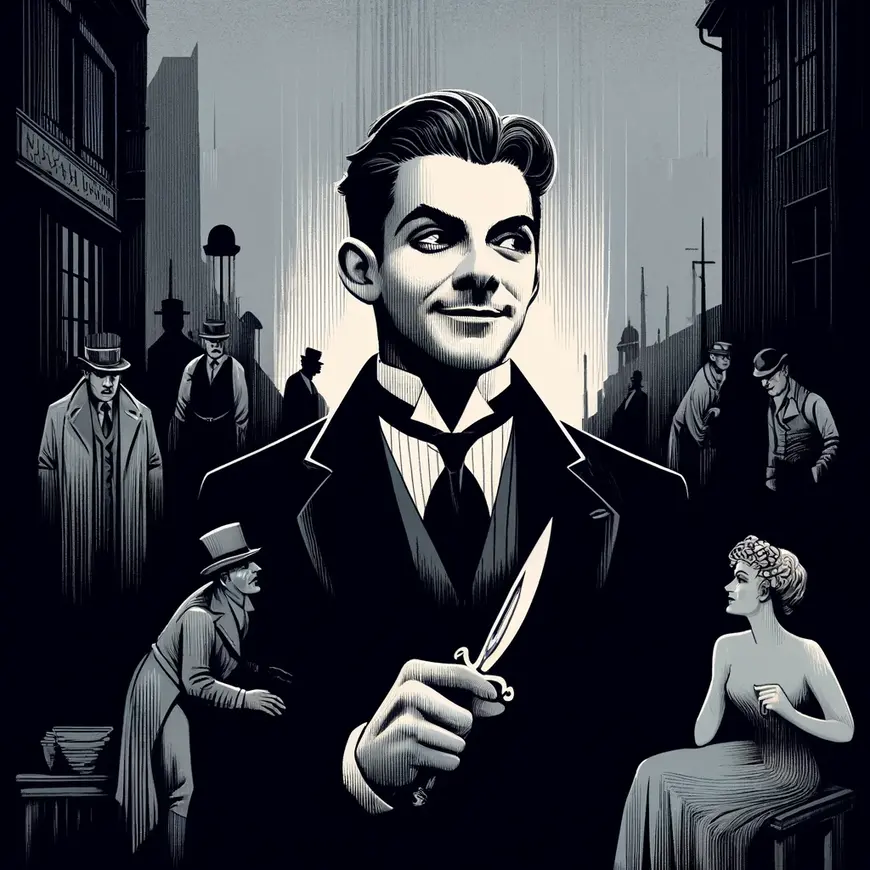
Macheath marries Polly Peachum in an empty stable furnished by his gang with stolen goods. Food, clothing, furniture, and ceremony imitate a prosperous bourgeois wedding, but every elegant surface carries evidence of acquisition by force. The Threepenny Opera begins its central action by making respectability look like property arranged for display. The thieves reproduce the social world they appear to reject.
The gang’s uncertainty about manners strengthens the satire. Its members can steal expensive objects but cannot make them fit together tastefully, and their attempts at polite behavior repeatedly expose aggression. A clergyman gives the ceremony an institutional blessing, while Tiger Brown’s eventual appearance supplies approval from the police. Macheath wants recognition as a gentleman and businessman, not liberation from hierarchy.
Social identity also becomes a comic performance in The Importance of Being Earnest by Oscar Wilde. Wilde’s characters manipulate names, manners, courtship, and pedigree within an elite marriage market. The stable wedding is more materially violent, yet it similarly reveals that convention depends on collective performance rather than inner worth.
The author does not present Polly as merely deceived by theatrical glamour. She chooses Macheath against her parents’ plans and soon proves capable of managing his organization. Nevertheless, the ceremony incorporates her into a male economy of possession, secrecy, and exchange. In The Threepenny Opera, marriage does not civilize crime. It shows that domestic legitimacy and criminal enterprise can share rituals, gender roles, and a desire to transform ownership into social honor.
Peachum Turns Poverty into a Profitable Industry
Jonathan Jeremiah Peachum operates “The Beggar’s Friend,” a business that licenses beggars and equips them with costumes designed to produce specific forms of pity. Visible suffering is classified, rehearsed, and placed where it can earn the highest return. In The Threepenny Opera, even destitution requires professional management. Compassion becomes a market response engineered for profit.
Peachum understands that genuine misery alone may fail because spectators grow accustomed to it. His enterprise therefore packages need into recognizable images, turning donors into consumers and beggars into controlled workers. He condemns Macheath less from moral outrage than because Polly’s marriage threatens his property and succession. Family authority, charitable feeling, and business interest become different languages for the same claim.
Organized exploitation of London’s vulnerable also structures Oliver Twist by Charles Dickens. Fagin trains children to steal within a network that profits from poverty, while institutions claiming respectability often deepen their exposure. Peachum’s operation is more openly theatrical and administrative, but both works connect criminal enterprise to a society that produces disposable people.
Bertolt Brecht makes Peachum’s strongest weapon the public visibility of those people. He threatens to assemble crowds of beggars during the coronation, where their bodies would interrupt the state’s ideal image of unity and abundance. The plan does not abolish exploitation, since he deploys workers he still controls. The Threepenny Opera grants him political leverage precisely because spectacle governs both charity and monarchy. Poverty matters to power when it threatens to appear in the wrong composition.
Macheath and Tiger Brown Connect Crime with Authority
Macheath’s survival depends less on secrecy than on his relationship with Police Chief Tiger Brown. The men recall military service together, celebrate comradeship, and treat official information as a favor that can be exchanged. Brown’s office protects the criminal organization until Peachum makes that protection politically dangerous. The Threepenny Opera presents corruption as a stable relationship between institutions, not a single bribe corrupting an otherwise healthy system.
The charismatic outlaw dominates The Robbers by Friedrich Schiller, where Karl Moor’s rebellion combines idealism, violence, and theatrical self-conception. Macheath has no comparable revolutionary dream. He adopts the language of friendship, business, and gentlemanly ease while his power rests on theft, sexual exploitation, and privileged access to police.
Military memory is crucial because it joins patriotic service to underworld brutality. The men’s shared past implies that organized state violence and private criminal violence draw on similar loyalties and skills. Authority and outlawry recognize themselves in each other. The contrast is therefore not between lawful discipline and chaotic crime, but between enterprises whose legitimacy is distributed unequally.
The Threepenny Opera never claims that every policeman and thief is interchangeable. Brown experiences fear, divided loyalty, and humiliation when competing pressures become impossible to reconcile. Yet his discomfort produces no principled break with the arrangement. Macheath is arrested when political calculation changes, not when justice awakens. Within The Threepenny Opera, the alliance exposes law as an institution responsive to reputation and power, while the criminal learns that personal connections remain valuable only as long as they do not threaten a larger public performance.
Polly, Lucy, and Jenny Negotiate a Male Economy
Polly’s marriage appears to remove her from parental control, but it places her inside Macheath’s unstable network of business and desire. When he must hide, she takes command of the gang with practical confidence that challenges everyone’s assumptions about her. The Threepenny Opera grants her intelligence without pretending that competence abolishes the structures surrounding her. Female agency operates inside contracts written by men.
Lucy Brown confronts Polly as a rival claimant to Macheath, and their conflict turns his deception into competition between women. Marriage promises, pregnancy claims, jealousy, and access to a prison become tools within that struggle. The comedy gives both women verbal force, yet Macheath benefits when their attention remains directed at one another. Sexual betrayal is organized by the same scarcity and concealment that shape the businesses elsewhere.
Poverty, song, and gendered vulnerability converge in Woyzeck by Georg Büchner. Büchner’s fragmentary drama exposes bodies controlled by military, medical, and economic power, with Marie judged inside conditions she cannot master. Polly and Lucy possess different resources, but their choices are likewise interpreted through sexual standards that leave male conduct comparatively mobile.
Jenny’s relationship with Macheath adds labor and memory to the pattern. As a sex worker and former lover, she understands both his habits and the market value of betraying him, while remaining exposed to forces more powerful than either intimacy or revenge. The Threepenny Opera does not create a simple alliance among its women. It shows them bargaining, performing, competing, and retaliating in an economy where affection has a price and male mobility depends on keeping promises unenforceable.
The Songs Interrupt the Plot They Seem to Entertain
The opening ballad announces Macheath through crimes that his elegant appearance conceals. Its memorable tune makes danger pleasurable before the character enters the action. Later wedding songs, love songs, chorales, military numbers, and finales interrupt dialogue with changes of address, rhythm, and perspective. The Threepenny Opera uses music to expose contradictions rather than supply a seamless emotional atmosphere.
Kurt Weill’s score combines recognizable popular forms with sharp instrumentation and unexpected harmonic turns. A song can attract the audience while its words describe hunger, violence, sexual dependence, or moral compromise. Musical pleasure refuses to guarantee moral agreement. The listener may hum what the scene demands be judged.
“Pirate Jenny” offers an especially concentrated fantasy of reversal as humiliation gives way to imagined destruction and command. Its dramatic force does not merely advance the wedding plot, and productions have varied in how they assign or frame it. Other numbers similarly suspend ordinary action so a character can display a social attitude larger than immediate psychology. The break creates room for comparison between what someone does and what the performance reveals.
The playwright and Weill did not use interruption to eliminate feeling. Seduction, comedy, shock, sympathy, and discomfort remain essential to The Threepenny Opera. The point is to prevent any single emotion from settling into passive identification. A spectator can enjoy Macheath’s charm and simultaneously see its dependence on violence, or feel for the poor while recognizing Peachum’s manufacture of pity. Music becomes critical because it divides response without dissolving its intensity. That fracture defines The Threepenny Opera.
The Royal Pardon Makes Justice Look Like Theatre
Peachum’s plan to disrupt the coronation forces Brown to act, and Macheath moves through arrest, escape, renewed capture, and preparation for execution. At the gallows, the play appears ready to make punishment restore moral order. The Threepenny Opera then stops that expectation through a messenger who announces a royal pardon, a title, a castle, and a pension. The happy ending displays privilege in its purest form.
Punishment follows an opposite trajectory in Crime and Punishment by Fyodor Dostoevsky. Raskolnikov’s crime leads through concealment, psychological disintegration, confession, and penal consequence. Macheath receives no comparable moral or spiritual reckoning because external authority simply changes his legal status.
The pardon is intentionally implausible rather than a careless escape from the plot. A royal command converts the condemned criminal into a favored gentleman without changing his conduct, demonstrating how sovereignty can manufacture innocence and rank. It also parodies theatrical convention, where an audience may desire mercy for the protagonist it has enjoyed despite everything it knows. The Threepenny Opera makes that desire part of the evidence.
The finale’s appeal for leniency does not offer a consistent legal program. It leaves a harsher contradiction between ordinary people punished for survival and powerful offenders protected by institutions. Macheath’s rescue resembles the coronation itself: both are public acts that clothe authority in ceremony. Justice becomes another spectacle whose ending depends on status, timing, and narrative convenience. The gallows remain real for those who cannot summon a mounted messenger.
Quotes from The Threepenny Opera
- “Oh, the shark, babe, has such teeth, dear. And it shows them pearly white. Just a jackknife has old MacHeath, babe. And he keeps it, ah, out of sight.” – “Mack the Knife”
- “First comes a full stomach, then comes ethics.”
- “In the dark times, will there also be singing? Yes, there will also be singing. About the dark times.”
- “A man lives for himself— dies for the family.”
- “What is the robbing of a bank compared to the founding of a bank?”
Trivia about The Threepenny Opera
- Based on John Gay’s The Beggar’s Opera: The Threepenny Opera is an adaptation of John Gay’s “The Beggar’s Opera,” first performed in 1728 in London. The novelist and composer Kurt Weill transformed this 18th-century ballad opera into a modern critique of capitalist society.
- Premiered in Berlin: The opera premiered in Berlin in 1928 at the Theater am Schiffbauerdamm. Berlin was a cultural hub during the Weimar Republic, and the city’s vibrant arts scene greatly influenced his work.
- Collaboration with Kurt Weill: He collaborated with composer Kurt Weill to create the music for The Threepenny Opera. Weill’s wife, singer Lotte Lenya, famously played Jenny, one of the main characters. This partnership combined his sharp social commentary with Weill’s innovative music.
- Influence on Orson Welles: The famous filmmaker Orson Welles was influenced by the writer’s work. Welles’s interest in innovative theater and film techniques can be traced back to the avant-garde style of productions like this writing.
- Connection to George Grosz: German artist George Grosz, known for his critical and satirical depictions of Berlin, shared his leftist political views. Grosz’s artwork and the playwright’s theater both critiqued the social and economic injustices of their time.
- Performed in New York: The musical was performed in New York City in 1933.
The Writing Style Makes Contradiction Visible
The Writing Style of The Threepenny Opera combines prose dialogue, verse, ballad, projected titles, episodic scenes, direct address, and musical interruption. Elevated biblical echoes collide with commercial calculation, criminal slang, romantic formulas, and political aphorism. Each register exposes another without producing a neutral language above them. Contradiction becomes something audiences can hear and see.
Gestus is central to this construction. A line, rhythm, posture, transaction, or vocal delivery can reveal a social relationship rather than merely express private emotion. Characters display how they sell pity, command workers, negotiate sex, invoke friendship, or seek respectability. The performance asks what economic position becomes visible in a gesture that conventional theatre might treat as personality alone.
Bertolt Brecht’s later accounts of epic theatre and alienation should not be imposed mechanically on the 1928 work. The Threepenny Opera already separates elements and blocks complete illusion, but it also depends on suspense, star presence, comic timing, and musical attraction. Distance does not mean emotional absence. It means preventing theatrical effects from pretending to be natural life.
The text’s authorship also belongs to its form. Elisabeth Hauptmann discovered and translated Gay’s ballad opera, participated substantially in the adaptation, and received a contractual share in the text rights, while Kurt Weill’s music transformed what the scenes could do. Material from earlier writers and song traditions entered the work as well. This collaborative history remains audible throughout The Threepenny Opera and resists single-author mythology. The Writing Style is therefore layered, even though his name has often dominated its reception.
Entertainment and Critique Refuse to Separate
The work became famous partly because its songs, characters, humor, and theatrical audacity function as entertainment of unusual power. That success creates an apparent paradox. Audiences can enjoy Macheath, detach songs from their dramatic arguments, and consume anticapitalist satire as fashionable style. The Threepenny Opera anticipated the ease with which critique itself can become a profitable commodity.
Performance as social criticism takes a more solitary form in The Clown by Heinrich Böll. Böll’s professional clown uses routines and bitter observation to expose religious, economic, and emotional hypocrisy in postwar Germany. Both works make entertainment an unstable position from which systems can be attacked and reproduced.
The writer does not solve the paradox by making pleasure suspect in itself. The catchiness of Weill’s music gives contradictions a public life beyond a narrowly political audience, while theatrical charm allows viewers to experience their own attraction to power, glamour, and absolution. Seduction becomes evidence rather than an escape from judgment. A joyless production can therefore weaken the analysis as surely as an uncritical one.
The Threepenny Opera endures because it refuses a safe division between corrupt characters and innocent spectators. Begging, crime, marriage, policing, monarchy, and theatre all depend on arranging appearances for an audience whose response has material value. The final pardon offers satisfaction and exposes satisfaction at the same instant. Entertainment does not deliver a message from outside the market. It reveals how readily beauty, sympathy, outrage, and rebellion can circulate within it.
Other Reviews of Works by the well-known German playwright