Oliver Twist by Charles Dickens – A Tale of Innocence
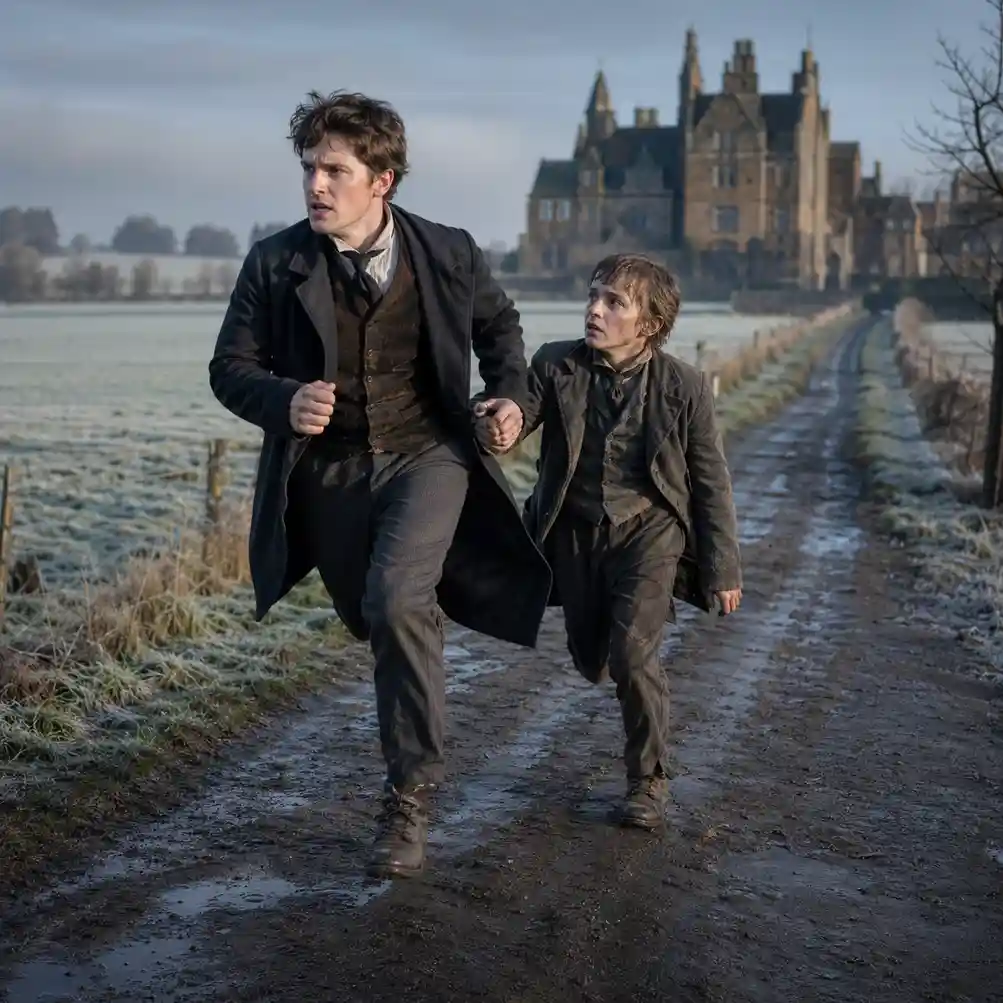
Charles Dickens introduces in Oliver Twist the main character without family protection, property, or even a secure name. His mother dies after giving birth in a parish workhouse. Officials find no documents and learn nothing about her identity. Mr. Bumble gives the child a surname through an alphabetical naming system. Bureaucracy replaces kinship from the first chapter.
The parish treats Oliver as an administrative burden rather than a person with claims upon the community. Mrs. Mann receives money to care for pauper children but keeps much of it while they remain hungry and neglected. Official inspections protect appearances because everyone in the system benefits from not looking closely.
When Oliver reaches the workhouse, the institution presents deprivation as discipline. This logic reflects the New Poor Law of 1834, which aimed to make institutional relief so harsh that only the desperate would seek it. He turns that policy into satire by letting officials praise arrangements that clearly injure children.
Poverty also exposes the distance between official categories and lived experience in 👉 Down and Out in Paris and London by George Orwell. Orwell records precarious labor and homelessness through adult experience. The author uses a child whose needs no honest observer can call a moral failure.
Oliver’s infancy establishes the novel’s central conflict. Institutions claim legal authority over him while refusing the obligations that authority should create. The parish feeds, houses, and employs him only at the lowest level compatible with survival. Need becomes evidence against the needy. Before Oliver encounters a criminal gang, respectable officials have already taught him that power can call cruelty care.
Asking for more exposes the logic of the workhouse
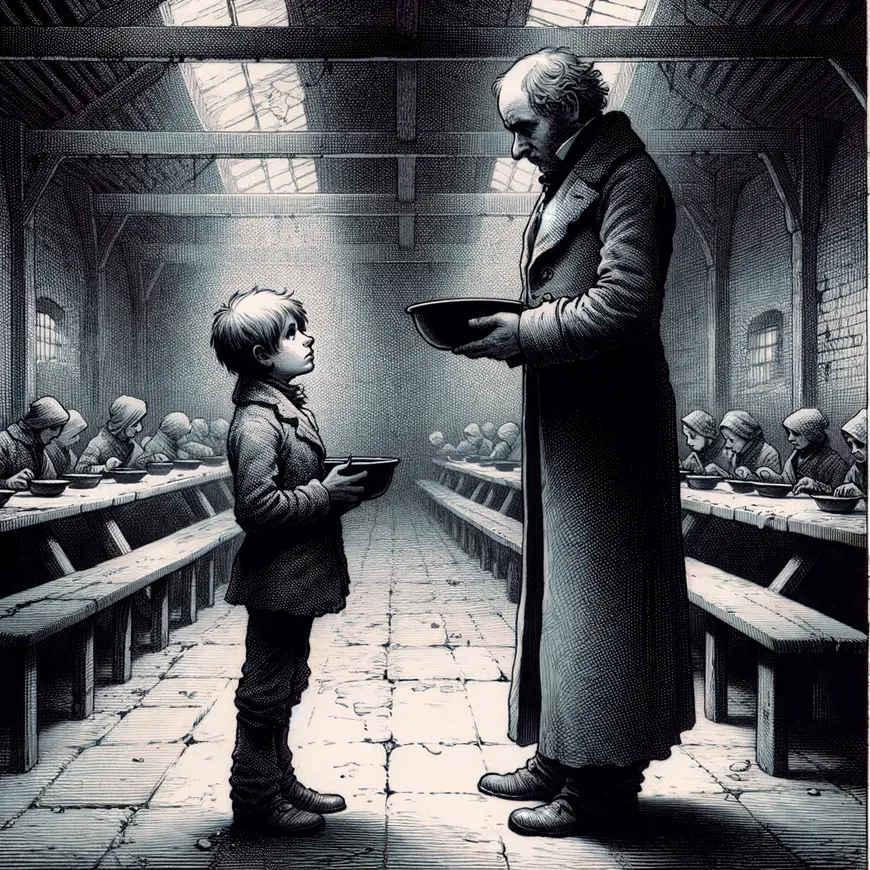
The workhouse boys receive so little food that hunger controls their thoughts. They draw lots, and Oliver must ask the master for another portion of gruel. His request has become one of the most famous moments in English fiction because the writer builds an immense official reaction around a basic physical need.
The master strikes Oliver. The board treats the request as rebellion and predicts that he will end on the gallows. Officials advertise money to anyone willing to take him away. Hunger becomes a criminal tendency in their account.
He sharpens the satire through language. The narrator often adopts the vocabulary of administrators and lets its moral absurdity reveal itself. Authorities call starvation economical, coercion useful, and premature death an unfortunate irregularity. Their euphemisms do not hide violence from readers. They expose how institutions make violence respectable.
The episode also challenges the idea that the poor always manipulate relief. Oliver does not demand comfort, pleasure, or special treatment. He asks for enough food to quiet extreme hunger. The board responds as if any concession would destroy social order.
Mr. Gamfield, a chimney sweep, almost acquires Oliver as an apprentice. His work has already caused the deaths of boys, yet the parish considers the arrangement because it removes a financial obligation. A magistrate finally notices Oliver’s terror and refuses approval. Individual attention briefly interrupts the machinery.
That rescue remains accidental. The system has no reliable safeguard because its central goal conflicts with the child’s welfare. The request for more tests whether policy recognizes a human minimum. Dickens delivers the verdict through comedy, but nothing in the scene feels harmless.
The undertaker’s household turns childhood into labor
Mr. Sowerberry takes Oliver into his undertaking business after the parish fails to place him elsewhere. The move removes him from the workhouse but does not grant him a home. He sleeps among coffins, eats scraps, and enters another hierarchy built on dependence.
Sowerberry sees commercial value in Oliver’s thin body and sorrowful face. He trains the boy to accompany children’s funerals as a mute. Even Oliver’s suffering becomes a marketable appearance. Dickens joins poverty, labor, and death without needing an explicit political speech.
The funeral scenes widen the social criticism. One dead woman’s family lacks money, food, and emotional support. Clergy and officials hurry through the burial. Grief must follow the schedule of people who possess greater authority. Oliver observes how poverty reduces dignity after death as well as during life.
A long struggle for an independent home also shapes 👉 A House for Mr Biswas by V. S. Naipaul. Naipaul’s adult protagonist fights dependency through work, marriage, and property. Oliver has far less agency. Every household decides his status before he enters it.
Noah Claypole recognizes that vulnerability and attacks Oliver through his dead mother. Oliver finally responds with physical force. The household punishes him, while Noah’s cruelty carries little consequence because hierarchy supports him.
Oliver’s escape to London begins after this conflict. He has endured hunger longer than an insult to his mother’s memory. Loyalty creates the resistance that self-preservation could not. Yet the road offers no secure freedom. It only moves him beyond the parish’s immediate control.
London offers Oliver another institution of exploitation
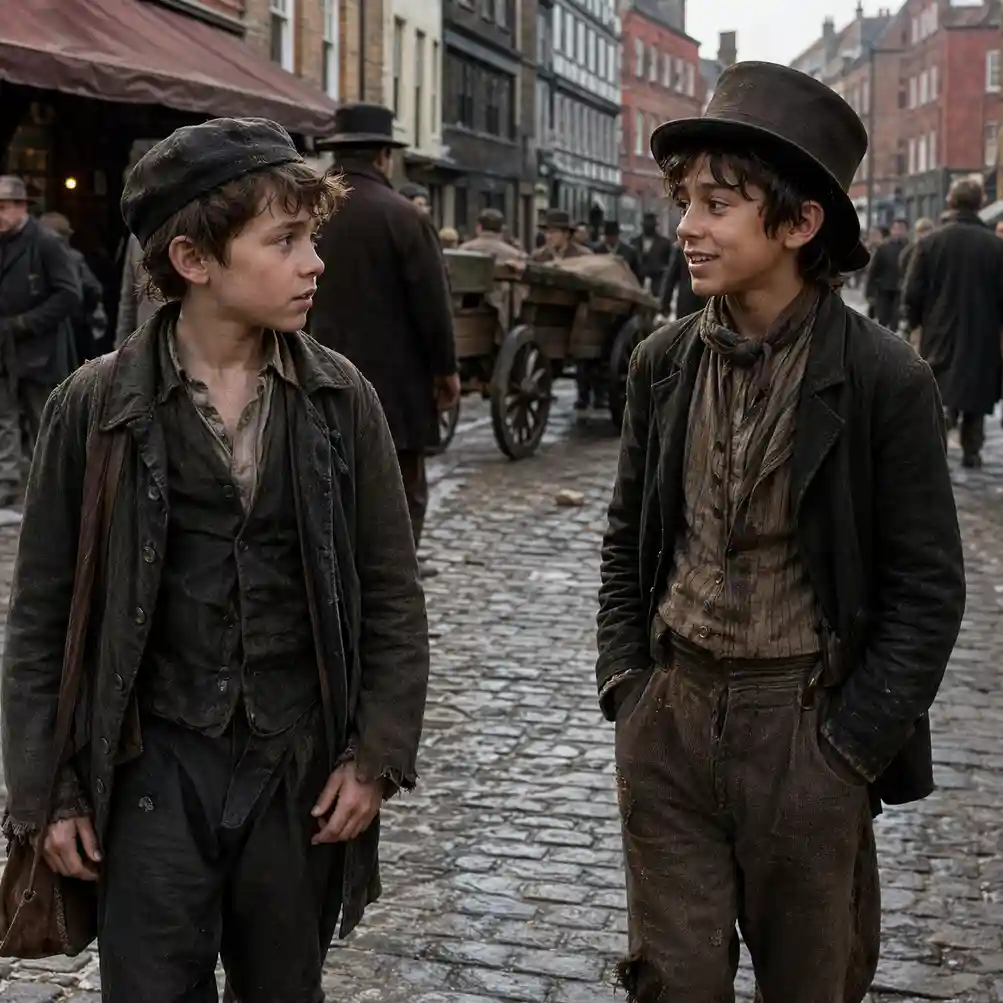
Oliver walks toward London because the city promises distance from those who own his labor. Exhaustion and hunger leave him easy to approach. Jack Dawkins, known as the Artful Dodger, offers food and shelter before bringing him to Fagin.
The gang initially resembles a strange household. Boys share jokes, meals, clothes, and a language of belonging. Fagin leads games that teach them to remove objects from his pockets. Oliver does not understand the lesson at first. Readers see how hospitality prepares recruitment.
The criminal household mirrors the respectable one. Both systems feed children in exchange for usefulness. Both assign roles, punish resistance, and keep resources under adult control. Fagin offers more warmth than the workhouse, but that warmth supports exploitation rather than care.
A youthful journey becomes a comic education in risk and moral choice in 👉 The Reivers by William Faulkner. Faulkner’s privileged narrator can return home and reinterpret his adventure. Oliver enters London without a safe household behind him. Every mistake threatens his survival.
The novelist makes the city both real and theatrical. Narrow streets, markets, courts, pubs, and ruined buildings create a dense social map. Coincidence governs the plot, but geography governs Oliver’s immediate fear. He cannot judge where Dodger leads him or find his own way back.
London does not corrupt a securely protected child. It receives someone whom public institutions have already abandoned. Crime recruits where care has failed. The gang’s existence does not excuse its violence, but it exposes the conditions that make vulnerable children available to adults who can use them.
Fagin tries to convert innocence into criminal usefulness
Fagin manages the boys through rewards, secrecy, humor, and fear. He trains them to steal, sells what they bring home, and controls the knowledge that could expose the group. His power comes from understanding children whom other adults ignore.
Oliver’s first outing with the Dodger and Charley Bates reveals the true purpose of their lessons. They steal Mr. Brownlow’s handkerchief and escape, while Oliver freezes in horror and then runs. Bystanders chase the wrong child because movement looks like guilt. Public judgment follows appearance faster than evidence.
The courtroom continues that danger. Mr. Fang treats Oliver with contempt and seems ready to punish him despite his illness. A bookseller arrives and identifies the actual thieves before the legal system completes another injustice. Brownlow then takes Oliver home.
Fagin wants him back partly because Oliver might reveal the gang and partly because Monks has a hidden interest in corrupting him. These motives turn criminal training into an attack on identity. If Fagin can make Oliver steal, respectable society will read criminality as his natural character.
Oliver Twist protects Oliver through near-perfect innocence. He does not knowingly participate and resists when he understands the plan. That purity strengthens his accusation against adults. It also simplifies the child. The Dodger and Charley possess more behavioral complexity because they have adapted to survive.
Fagin’s institution succeeds by offering what the parish withheld: food, recognition, and a group. It then converts those goods into debt. Belonging becomes another instrument of control. Oliver escapes not because society provides a path out, but because coincidence brings Brownlow to the courtroom.
Brownlow and Rose replace public duty with private rescue
Mr. Brownlow responds to Oliver as an individual. He sees the child’s illness, doubts the easy assumption of guilt, and offers shelter. Later, Rose Maylie listens when Oliver explains how criminals forced him into a burglary. Their attention repeatedly saves him from identities that powerful adults assign.
Private care transforms Oliver’s health. Food, rest, clean rooms, and patient conversation accomplish what punishment never could. Kindness reveals capacities that deprivation concealed. The novelist shows that environment affects conduct even though he preserves Oliver’s exceptional moral purity.
The Maylie household enters his life after Sikes forces him to assist a burglary. A servant shoots Oliver, and his companions abandon him. He crawls back to the house they tried to rob. Mrs. Maylie and Rose choose compassion despite the evidence against him.
An innocent man also depends on private loyalty after public injustice in 👉 The Black Tulip by Alexandre Dumas. Dumas uses romance and adventure to challenge wrongful punishment. Dickens places similar faith in virtuous individuals who look beyond official conclusions.
That solution carries limits. Brownlow and Rose possess the money, time, homes, and social authority that make rescue possible. Other workhouse children never meet such protectors. Oliver Twist attacks a public system but often answers it with benevolent private households.
Oliver also appears worthy of rescue through speech, manners, gratitude, and eventually birth. The writer wants readers to recognize innate goodness beneath poverty. Yet the plot risks suggesting that the child deserves care because he never resembles the poor people whom respectable society fears. Compassion corrects one injustice, not its machinery. Brownlow saves Oliver, but the workhouse remains ready for the next parish child.
Nancy becomes the novel’s most difficult moral character
Nancy belongs to Fagin’s criminal world and lives under Bill Sikes’s violent control. She helps return Oliver to the gang after Brownlow first rescues him. Later, she risks her life to reveal Monks’s plan. No simple division between innocence and guilt can contain her.
The author suggests that exploitation shaped Nancy from childhood. She recognizes the gang’s methods because she endured them. Her attachment to Sikes combines love, fear, dependency, habit, and a damaged sense of possibility. She understands her prison without believing she can leave it.
When Rose offers help, Nancy refuses a new life. Modern readers may find the decision frustrating, but Oliver Twist has shown why rescue cannot operate as a single open door. Nancy has no secure identity outside the relationships that harm her. Shame and loyalty reinforce material danger.
Her moral courage does not erase her earlier actions. Instead, it grows from her recognition of Oliver’s vulnerability. She knows what his future will become if Fagin and Monks succeed. Her meetings with Rose and Brownlow turn knowledge into risk.
Sikes murders Nancy after Fagin arranges for him to learn about her betrayal. The killing brings domestic abuse into the center of the criminal plot. Sikes does not kill a stranger during a robbery. He destroys the person most loyal to him because he treats loyalty as possession.
Nancy’s death produces the novel’s deepest tragedy because she changes through choice rather than recovered ancestry. Oliver remains good; Nancy acts against the world that formed her. Her compromised life makes her courage meaningful. Dickens grants her moral agency, then denies her the future that private charity grants Oliver.
Monks and the inheritance plot complicate the social criticism
Monks wants Fagin to turn Oliver into a criminal because the boys share a father. A will favors Oliver if he avoids disgrace. Monks therefore tries to manufacture the conduct that will disinherit his half-brother and leave him in control of the family property.
The plot draws Mrs. Bumble into the conspiracy. She sells Monks the locket and ring that once belonged to Oliver’s mother, and Monks throws them into the river. Brownlow later reconstructs the family history through testimony, recognition, and pressure.
Ancestry converts a social victim into a displaced heir. The revelation rewards Oliver, but it narrows the force of the earlier criticism. He does not remain an ordinary parish child whom society owes care regardless of origin. The plot restores him to a respectable family line.
Identity and social status also depend on performance and hidden origins in 👉 Confessions of Felix Krull by Thomas Mann. Mann lets his protagonist manipulate hierarchy through charm. Oliver never designs his own role. Other people fight to define whether he belongs among heirs or criminals.
Monks gives the gang’s interest in Oliver a melodramatic explanation. Without him, Fagin could still recruit an abandoned child for profit. With him, the novel turns that general danger into a targeted family conspiracy.
The inheritance structure also makes virtue financially consequential. Oliver receives security because he has preserved the goodness that the will requires. Poor children who steal under pressure receive no comparable restoration. The mystery resolves Oliver’s identity but not the social problem. Dickens secures one child’s place in a family while leaving birth as a powerful measure of destiny.
Key quotes from Oliver Twist
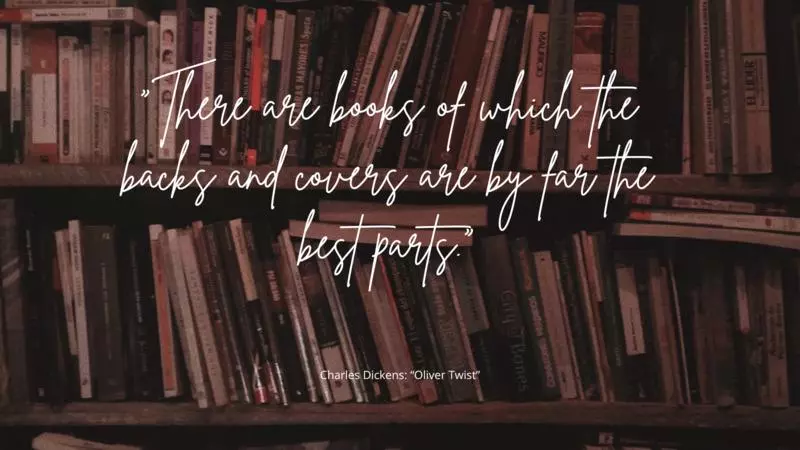
- “Please, sir, I want some more.” This famous quote is spoken by Oliver when he asks for more food in the workhouse. It symbolizes his innocence, his daring to ask for what he needs, and his audacity to question the harsh realities of his world.
- “You are a great deal better, are you not?” Mr. Bumble’s ironic comment to the main character after he’s punished for asking for more food. This highlights the cruelty and absurdity of the workhouse system that mistreats the young and vulnerable.
- “I see it is your intention to insult me.” Mr. Bumble’s self-important response when misunderstood by others. This highlights his hypocrisy and the arrogance of those in power.
- “Where is my boy? Turn him out! He shall not stop here.” Mrs. Mann’s heartless response when the protagonist falls ill. This shows her disregard for the well-being of the children under her care.
- “Please, sir, I want some books.” Oliver’s request to Mr. Brownlow, showcasing his yearning for education and self-improvement despite his disadvantaged circumstances.
- “Gentleness and care: words which would sounds strange in my ears.” Nancy’s lament about her harsh life, highlighting the absence of kindness and compassion in her world.
- “I am the resurrection and the life, saith the Lord!” Spoken during a burial service, this quote encapsulates the somber atmosphere of death and the presence of religion as a solace for those living in adversity.
Trivia Facts about Oliver Twist
- First Novel with a Child Protagonist: Oliver Twist was Charles Dickens’s second novel and the first in English literature. To have a child’s perspective as its central character throughout a substantial part of the narrative.
- Serialized Publication: Like many of his works, Oliver Twist was originally published in serialized form. It appeared in monthly installments in the magazine Bentley’s Miscellany between February 1837 and April 1839.
- Social Commentary: The novel is a scathing critique of the Poor Law Amendment Act of 1834, which he believed perpetuated the cruel treatment of the poor. It highlights the inhumane conditions of the workhouse system and the underbelly of London’s criminal world.
- Introduction of a Criminal Underworld: The book was groundbreaking for its portrayal of the criminal underworld, introducing one of literature’s most notorious villains, Fagin. This portrayal brought the darker side of London into the public eye in a new way.
- Controversy and Accusations of Anti-Semitism: The character of Fagin has been the subject of much controversy over the years. Due to his repeated reference to him as “the Jew,” which reflected and potentially perpetuated anti-Semitic stereotypes. The author later expressed regret over this portrayal.
- Innovative Legal and Moral Themes: Oliver Twist features complex moral dilemmas and legal issues. Such as the question of inheritance and legitimacy, which would continue to appear in his later works.
- First Use of the Word “Bumbledom”: In this story, the writer coined the term “bumbledom.” It refers to the pompous incompetence of Mr. Bumble, the beadle.
Fagin remains powerful because the stereotype is inseparable from him
Fagin ranks among his most memorable creations. He combines theatrical charm, patience, fear, greed, calculation, and moments of panic. His final hours in prison reveal a mind collapsing under the approach of execution. Yet the novel constructs this complexity through an antisemitic stereotype that readers cannot treat as incidental.
The narrator repeatedly identifies Fagin through his Jewishness, often substituting ethnic identity for his name. Physical descriptions draw on hostile caricature. His greed, secrecy, corruption of Christian children, and association with hidden wealth echo long traditions that represented Jewish people as a social threat.
The prejudice shapes the character’s narrative function. It helps mark Fagin as alien before his actions establish guilt. Other criminals possess individual names and motives, while the text often turns his identity into a category.
Victorian London also produces memorable criminals in 👉 The Adventures of Sherlock Holmes by Arthur Conan Doyle. Doyle’s stories contain their own period prejudices, but their case structure usually separates criminal identity from one permanent ethnic designation. Dickens repeatedly fuses the two.
Fagin’s complexity does not neutralize the problem. A stereotype can acquire psychological detail and remain a stereotype. Nor does the novel’s attack on Christian hypocrisy excuse its treatment of Jewishness. Social criticism loses moral consistency when it dehumanizes one minority while demanding sympathy for another excluded group.
Readers can still analyze Fagin’s manipulation, terror, and final isolation. They should do so without pretending that the character exists apart from the language that created him. Imaginative power and prejudice occupy the same figure.
Oliver Twist – Satire, melodrama, and coincidence compete for control
Oliver Twist combines several kinds of novel. The workhouse chapters use savage institutional satire. London supplies criminal suspense and urban movement. Nancy’s story approaches tragedy. Monks brings inheritance mystery, while Brownlow and the Maylies support domestic melodrama.
These modes give the book enormous energy. The writer can move from grotesque comedy to physical danger within a few pages. Memorable scenes turn policies into experiences: a bowl of gruel, a coffin workshop, a stolen handkerchief, a bridge meeting, and a bloodstained room. Oliver Twist makes social systems visible through bodies and objects.
The variety also creates tension. Coincidence repeatedly saves Oliver and connects characters across London. Hidden parentage explains his resemblance to a portrait. Virtuous households offer refuge, while major criminals meet punishment. These devices satisfy the moral design but weaken the systemic critique.
Oliver himself changes less than Nancy, Sikes, or even Mr. Bumble. His stable innocence lets Dickens show how thoroughly adults misjudge him. However, that design restricts his agency and implies that sympathy needs an unusually pure victim.
The ending distributes justice through exposure, inheritance, imprisonment, death, and domestic security. It does not reform the Poor Law or create protection for other exploited children. Oliver gains a family and a home, which provides emotional closure rather than a public solution.
Yet the novel never lets respectable society stand completely outside the criminal world. Parish officials trade children, courts rush judgment, employers exploit weakness, and bystanders trust appearances. Crime begins inside accepted institutions as well as hidden rooms. That insight survives the coincidences, sentiment, and prejudice that complicate his achievement.
My Thoughts on Oliver Twist
I found Oliver Twist to be an deeply moving read. Right from the beginning I was drawn into Olivers life as an orphan in Victorian England. The writer detailed descriptions of the circumstances and somber settings transported me to his world allowing me to empathize with his hardships.
As I followed his path I was touched by his innocence and compassion despite the adversities he encountered. The diverse array of characters ranging from the Fagin to the Mr. Brownlow kept me engrossed in the story. Every twist in the narrative filled me with concern for Olivers well being while also fostering hope, for his future.
Ultimately witnessing the protagonist discover joy and a nurturing home brought me relief. The story conveyed a narrative of resilience and the indomitable human spirit that resonated deeply with me.