Wilhelm Meister’s Apprenticeship by Goethe and the Modern Self
Reading Wilhelm Meister’s Apprenticeship feels like witnessing the origin of a genre. Johann Wolfgang von Goethe didn’t just write a story, he mapped a literary structure we still use today. The “coming-of-age” novel, the search for identity through experience, the slow shedding of illusions, it all begins here. But what struck me most was not the innovation. It was the novel’s stillness.
He isn’t swept away by war or catastrophe. His crisis is internal. He is a young man surrounded by culture, poetry, and privilege, and yet he’s achingly unsatisfied. He’s not rebelling against something obvious. He’s drifting, uncertain what to do with his own mind. He captures this spiritual restlessness with such clarity that it still stings today.
The novel opens not with a bang, but a yearning. The protagonist believes in the theater, in art, in love. He believes that life can be shaped like a play. And it’s precisely this belief that the author sets out to unravel. Watching Wilhelm learn that beauty alone can’t order the world, that reality doesn’t wait for the curtain to fall, is both painful and illuminating.
What makes the beginning so compelling is that he thinks he’s on a path toward greatness. But what he’s really on is a slow, painful path toward disenchantment and maturity.
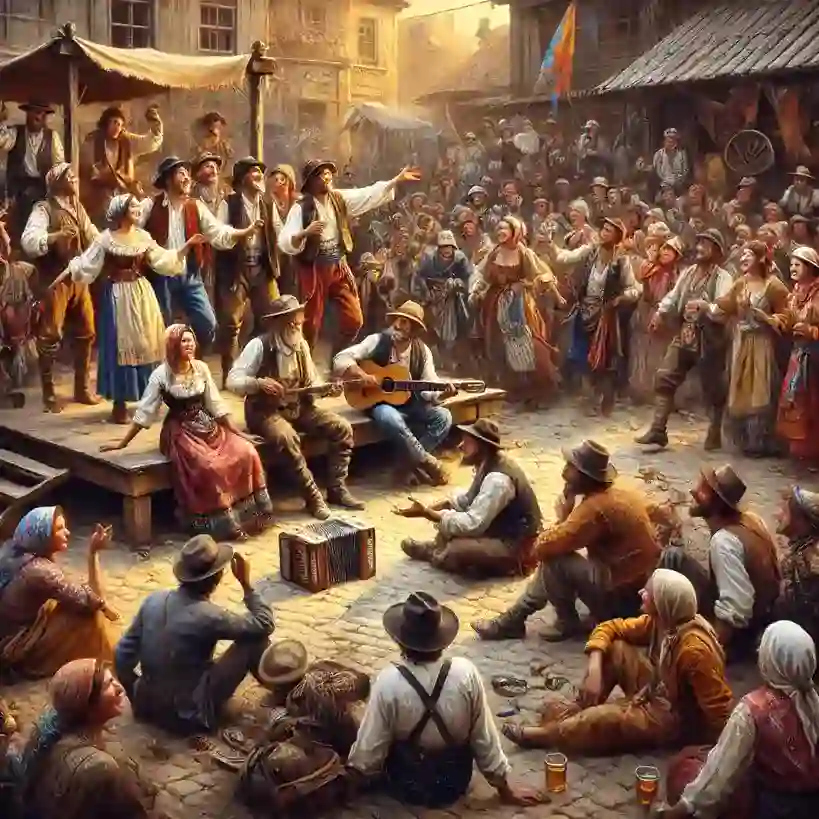
Theater, Illusion, and the First False Calling in Wilhelm Meister’s Apprenticeship
Wilhelm’s obsession with the theater is not just youthful vanity, it’s a worldview. He thinks life can be lived like a script. That every person has a role. That meaning comes from performing it well. In this sense, the novel isn’t just about a young man’s mistake. It’s about the mistake of mistaking life for art.
Goethe draws this illusion out masterfully. The stage is everywhere in Wilhelm Meister’s Apprenticeship. Love becomes performance. Identity becomes costume. Even grief feels choreographed. The people around him — Mariane, Serlo, Melina — reflect back his fantasies. They play along, and sometimes exploit him, because they too are caught in the dream.
It reminded me deeply of 👉 A Certain Smile by Françoise Sagan, where charm and elegance conceal emotional fragility. In both books, appearance dominates — and truth comes later, if at all.
As Wilhelm plunges into theatrical life, we see a slow unraveling. The theater doesn’t offer depth. It offers repetition. It feeds the ego but not the soul. And Wilhelm begins to feel that itch, the sense that what he’s doing doesn’t match who he is. This is his quiet genius. He doesn’t condemn his love of art. He simply shows us its limits. The very thing that once gave Wilhelm direction now becomes his prison.
The Wanderer in the Social Machine
As the main character leaves behind the theater, the novel opens into something broader, a landscape of travel, trade, politics, and fate. He meets craftsmen, beggars, nobility, and scholars. The world is suddenly dense, chaotic, and unromantic. The writer masterfully contrasts his idealism with the real structures of society. No one cares about his dreams. They care about power, status, money and survival.
Wilhelm’s education isn’t in books anymore. It’s in mistakes, encounters, and humiliations. And this is where the novel becomes deeply modern. He doesn’t just suffer, while he observes. He begins to realize that his feelings, however noble, are not enough to build a life.
I found myself admiring how the poet creates a slow awakening. There’s no one moment of truth. Instead, he notices how his desires change. He grows out of certain attachments. He fails to find words for new ones. It’s not dramatic, but it’s true to life. What’s especially moving is that Wilhelm never becomes cynical. He becomes quieter. More watchful. And in doing so, he begins to discover a different kind of strength, one rooted not in fantasy, but in perseverance.
Toward a Different Kind of Purpose
By the midpoint of Wilhelm Meister’s Apprenticeship, we’re no longer watching a young artist. We’re following a man in search of alignment, someone trying to match his inner life with the outer world. He still stumbles, but the stumbles feel different now. Less theatrical. More intimate.
Johann Wolfgang von Goethe introduces rich philosophical currents here, conversations on education, responsibility, and the role of the individual in society. These are not abstract digressions. They’re seeds. The protagonist absorbs them slowly, letting them shape his thinking. The influence of Enlightenment thinkers is everywhere, but never heavy-handed.
It reminded me of 👉 A Christmas Carol by Charles Dickens, where personal transformation grows out of exposure to others’ lives and suffering. But unlike Scrooge, Wilhelm isn’t visited by ghosts. He must listen — really listen — to people who live differently from him.
A key shift happens when he starts to see his journey as one of service, not self-expression. It’s not about proving himself. It’s about being useful. Finding where he belongs, not at the center, but as a part of something larger. This doesn’t come easily. He resists it. He doubts it. But the change is underway. And by now, the novel has quietly reshaped itself, from a tale of ambition to a study in humility.
The Women Who Change Wilhelm
Throughout Wilhelm Meister’s Apprenticeship, Wilhelm’s path is deeply shaped by the women he encounters. But he avoids easy archetypes. None of these women are just “love interests.” They’re mirrors, tests, and revelations. Mariane represents the fragility of youthful passion. Philine embodies sensuality without attachment. Therese offers reason, and the Countess brings moral complexity.
Each of them challenges his assumptions. They confront his tendency to idealize, to turn women into characters in a play. And slowly, he begins to see them not as roles, but as real people with agency.
What impressed me is how the author lets these relationships evolve without dramatic flair. There’s no grand heartbreak. Instead, there’s confusion, regret, tenderness, and growth. Wilhelm’s capacity to listen deepens. He becomes less reactive. More attentive to the lives of others.
It’s tempting to read this as proto-feminist. But the writer isn’t making an argument. He’s observing a process: a young man learning that his world is not the world. That women, too, have desires, limitations, and their own forms of knowledge. This shift feels essential to his moral development. It teaches him not only how to relate, but how to respect, and that’s a lesson he never treats lightly.
Encounters That Redefine Belief
Wilhelm’s most powerful transformations come not from events, but from dialogue. He talks to thinkers, monks, scientists, and soldiers. Each one offers a sliver of insight, a different way of seeing the world. And each conversation leaves a trace.
Johann Wolfgang von Goethe turns this into a kind of spiritual apprenticeship. It’s not about mastering a trade or memorizing facts. It’s about learning to live more consciously, to question not only what one believes, but why one believes it.
This reminded me of 👉 A Happy Death by Albert Camus, where a character’s interior philosophy becomes more important than his external choices. Both novels explore what it means to act with intention, not out of instinct or duty, but from a place of awareness.
One of the most striking realizations he has is that his “journey” may not lead to any revelation. There is no promised land. No final answer. But there is a deepening, a greater clarity, a slow erosion of illusion.
He allows this idea to emerge gently. It’s not cynical. It’s clear-eyed and human. Wilhelm’s belief isn’t replaced, it’s re-formed. What he once sought in performance, he now seeks in purpose.
A Society in Fragments in Wilhelm Meister’s Apprenticeship
By this stage of Wilhelm Meister’s Apprenticeship, he no longer clings to one grand ideal. Instead, he moves through a world that feels unresolved, fragmented, and plural. His Germany is not a tidy place. It’s a patchwork of social classes, shifting allegiances, and competing philosophies. No single viewpoint dominates. And Wilhelm, now wiser, begins to grasp this.
The old certainty — that a single path or truth could guide a life — fades. What replaces it is harder to name. Not despair, but complexity. Not apathy, but discernment.
Goethe populates the second half with characters who blur easy categories: the Harper, the mysterious Tower Society, the quiet Lothario. They’re not symbols. They’re enigmatic lives, shaped by loss, duty, and sometimes silence. The main character begins to ask different questions. Not “What do I want to be?” but “How can I live with integrity in a world like this?”
That question gives the novel its lasting weight. The drama of self-realization becomes intertwined with the reality of collective life, of how one belongs not just to art or family, but to history and to others.
Toward a New Form of Maturity
The final chapters of Wilhelm Meister’s Apprenticeship unfold not with closure but with balance. Wilhelm has not solved life. But he has, for the first time, committed to it. He accepts the need for work. For community. For responsibility, not as burdens, but as grounding forces.
There is something deeply moving about the quiet way the novelist stages this transformation. No one crowns him a hero. No one applauds. But his choices gain coherence. His relationships deepen. He’s no longer seeking meaning in escape, but building it through action.
It reminded me of 👉 A Murder is Announced by Agatha Christie, in which a disrupted social order reveals hidden truths about people’s values. While wildly different in tone, both novels show that real growth often follows unmasking, not of others, but of the self.
The playwright doesn’t reduce this maturity to resignation. On the contrary, Wilhelm ends not disillusioned but aware. He sees the world’s limits, and yet still chooses to engage with it. Not as a stage, not as an audience, but as a participant. One who has learned to observe, to serve, and to endure.
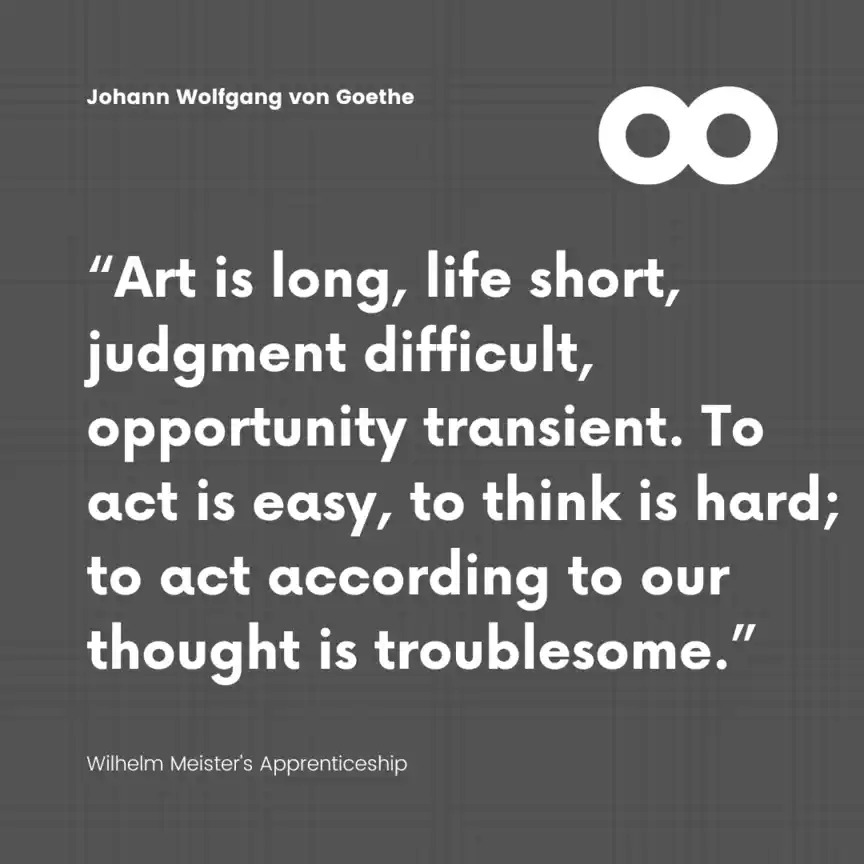
Thoughtful Quotes from Wilhelm Meister’s Apprenticeship by Goethe
- “A talent is formed in stillness, a character in the world’s torrent.” This line expresses the novel’s core belief: that solitude shapes potential, but only life itself shapes who we become.
- “The conflict of duty and inclination is the essence of all morality.” Joahnn Wolfgang von Goethe recognizes that maturity involves choices between what we want and what is right, and it’s this tension that defines ethics.
- “Know thyself? If I knew myself, I should run away.” Both ironic and sincere, this quote reveals Wilhelm’s fear of true self-awareness, a fear that many readers will recognize in themselves.
- “No one is more of a slave than he who thinks himself free without being so.” He critiques false autonomy here, exposing how illusions of freedom can trap us more than external rules.
- “He who has art and science also has religion; but he who does not have them, let him have religion.” This provocative line shows his Enlightenment view: true understanding may transcend traditional faith.
- “It is not doing the things we like to do, but liking the things we have to do, that makes life blessed.” He learns that fulfillment doesn’t come from freedom, but from embracing necessity with grace.
- “What we agree with leaves us inactive, but contradiction makes us productive.” A brilliant insight into learning, suggesting that intellectual growth depends on challenges, not affirmation.
- “Every limitation is, to a degree, also an expansion.” Goethe urges us to rethink boundaries, often what restricts us also pushes us into deeper dimensions of selfhood.
Trivia Facts from Wilhelm Meister’s Apprenticeship
- The first true Bildungsroman: Wilhelm Meister’s Apprenticeship is widely credited with creating the Bildungsroman genre, a narrative form focused on personal development and self-discovery.
- Based on his life: Much of Wilhelm’s artistic longing and disillusionment reflects Goethe’s own youth, particularly his struggles between poetry, responsibility, and public life.
- The Tower Society is mysterious by design: The author never fully explains the Tower Society’s purpose, fueling speculation among scholars and 👉 readers of The Castle by Franz Kafka, who also used enigmatic bureaucracies.
- Schiller’s input shaped key chapters: Friedrich Schiller encouraged Goethe to continue the novel during its long composition period and helped sharpen its philosophical edge.
- The Harper’s role is symbolic: The character of the Harper represents emotional trauma and the isolation of the artist, a theme echoed in 👉 The Waste Land by T. S. Eliot.
- Cambridge includes it in core courses: The novel is part of several global literature syllabi, including Cambridge University’s foundational reading list for European literary studies.
- The novel influenced Hesse: 👉 Siddhartha by Hermann Hesse carries the structure and spiritual questioning of his journey, reshaped into Eastern philosophy.
- Featured in German school curricula: Wilhelm Meister’s Apprenticeship remains required reading in many German secondary schools and is promoted by institutions like the Deutsche Nationalbibliothek.
The Role of Secrecy and Brotherhood
As Wilhelm nears the end of his journey, a strange and almost mystical layer emerges: the Tower Society. These secretive men have been observing him, testing him, even guiding him from the shadows. It would be easy to read this as a conspiracy twist. But Goethe doesn’t treat it that way. The Society is less about power and more about structure, the idea that maturity includes invisible scaffolding.
What’s fascinating is how this shift reframes his experience. It wasn’t just a random walk. It was part of a larger pedagogical design, a kind of moral apprenticeship. But even here, he avoids easy triumph. The revelation doesn’t come with answers. It comes with responsibility.
What matters is not that Wilhelm has been chosen. It’s that he must now choose, to act, to guide, to carry forward what he’s learned. The very forces that once confused him now require his participation.
This is his quiet revolution. He’s not writing a novel of fate. He’s writing a novel of education, where freedom lies in informed choice, not emotional impulse. And secrecy, here, becomes not about control but humility. Some truths can’t be taught, they must be earned.
The Bildungsroman Completed
In the final movements of Wilhelm Meister’s Apprenticeship, we see what the novel has truly accomplished. It hasn’t told a story, it has created a form. One that would echo through centuries of literature, from Stendhal to Joyce. His gift is that he doesn’t shout this achievement. He lets it unfold with modesty and care.
Wilhelm does not end up with everything he once desired. He ends with understanding. His illusions are gone, but not his spirit. He no longer sees the world as a stage, he sees it as a web of duties, choices, and real relationships. That might sound dull to a romantic. But in Goethe’s hands, it’s profound.
The novel’s arc reminded me of 👉 A Tale of Two Cities by Charles Dickens, another story where personal growth intersects with history and sacrifice. And it’s no accident that both conclude with acts of moral clarity.
Goethe’s lesson is not that youth is foolish. It’s that youth must be outgrown, not by abandoning dreams, but by rooting them in reality. Wilhelm’s apprenticeship doesn’t end in mastery. It ends in readiness. And that, I believe, is the most grown-up thing any novel can offer.