What Is the Most Translated Book in the World?
What Is the Most Translated Book in the World? It depends on how you ask the question.
If we include religious texts, the answer is clear: the Bible is the most translated book in the world. As of the latest figures, the full Bible has been translated into over 750 languages, the New Testament into more than 1,740, and portions of it into another 1,260+. That makes over 3,700 languages in total — no other text comes close. It’s a record that keeps growing every year, thanks to ongoing translation work across every continent.
But if you’re asking about non-religious literature, there’s a different winner: The Little Prince by Antoine de Saint-Exupéry. First published in 1943, this poetic French novella has reached an astonishing number of people. It’s been officially translated into more than 500 languages, making it the most translated work of fiction in human history.
Both books share something special. They travel across cultures and they speak simply, but deeply. They inspire translators everywhere. Whether it’s a sacred text passed down for centuries or a quiet tale about a boy and a fox, each has found a place in the hearts of millions.
So what’s the most translated book in the world? The answer is: both — depending on how you define “book.” But either way, the result is a powerful reminder: stories can speak every language when they speak to something human.
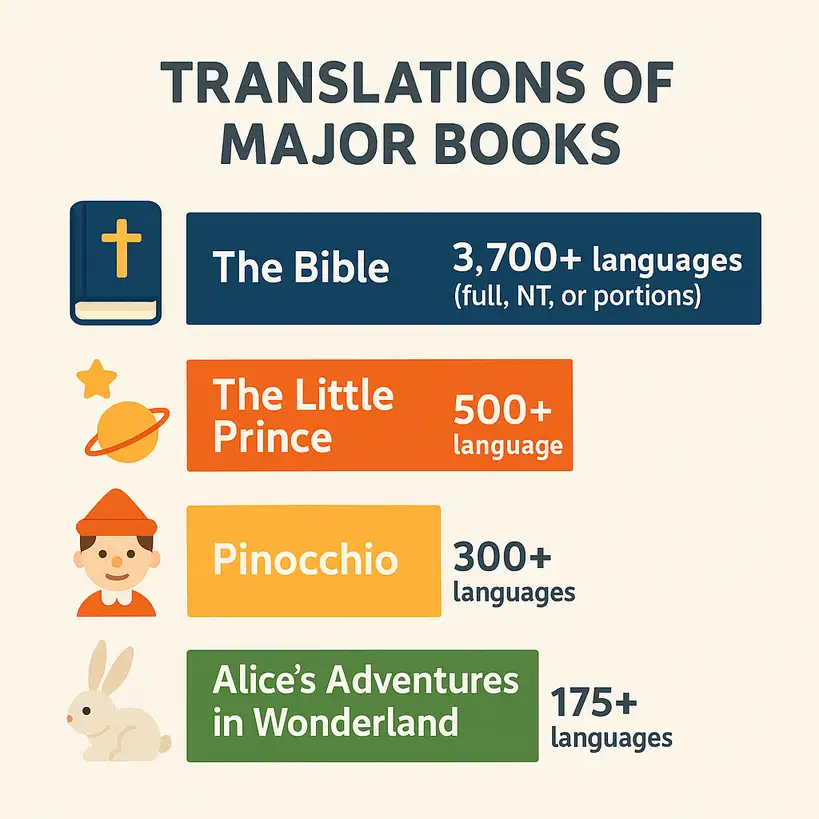
📘 The Bible holds the official title as the most translated book in the world
And it’s not even close. The full Bible is available in over 750 languages, the New Testament alone in more than 1,740, and portions of it in another 1,260+. That adds up to more than 3,700 languages total — a number that grows every year.
This vast translation effort is the work of centuries. Religious missions, cultural preservationists, and scholars have poured their lives into making sure people all around the world can read the Bible in their native language. It’s not just about faith — it’s about language diversity, literacy, and access.
To hold that many versions of one book is mind-blowing. I sometimes imagine a single shelf filled with all those translations. Different scripts, alphabets, dialects — all carrying the same ancient stories. Whether you’re religious or not, this fact shows how deeply literature can reach into the heart of culture.
So yes, the Bible is more than a religious text. It’s also a living example of the most widely translated book humanity has ever known.
📖 The Little Prince: A Literary Translation Marvel
Now let’s talk about The Little Prince. If the Bible is the most translated book overall, then this small, poetic tale is the most translated literary work in history. First published in 1943 by Antoine de Saint-Exupéry, it has been translated into over 500 languages — some sources say even more.
That makes The Little Prince a quiet phenomenon. It’s not a blockbuster, not a franchise, not even very long. But it speaks to something simple and true — about love, loneliness, and seeing the world with open eyes. That’s why it spreads so easily. From major languages like Spanish, Chinese, or Arabic, to small regional tongues and endangered dialects, The Little Prince keeps finding new readers.
I think part of its magic is how easily it crosses cultures. A child talking to a fox, asking about meaning — it sounds like something everyone has wondered, no matter where they’re from.
It’s not just a sweet story. It’s a universal parable that belongs to the world. And the number of translations proves it: literature doesn’t have to be loud to be powerful — just human.
📚 Sagan, Simplicity, and the Secret of Universal Stories
Françoise Sagan didn’t write fables. Her stories were sharp, modern, and full of emotional undercurrents. But if you look closely, Bonjour Tristesse has something in common with The Little Prince: it says a lot in just a few short lines.
Sagan believed in writing simply — and she did it beautifully. That’s exactly why The Little Prince has traveled so far. It’s not a complicated book. It speaks softly. The words feel familiar, even when you’re reading them in a new language. That kind of clarity helps a story cross borders.
Sagan’s debut was published when she was only 18 and her work was quickly translated into dozens of languages, even though it didn’t follow big trends. Like The Little Prince, it relied on something else: honesty, clarity, and emotional truth. That kind of writing doesn’t need explaining. It just works.
Both Saint-Exupéry and Sagan showed that a quiet voice can echo across the world. They didn’t shout. They whispered — and people listened in hundreds of languages.
✒️ Hesse and the Languages of the Soul
Hermann Hesse is one of the most translated German authors of all time. Siddhartha, his most famous book, has been read on every continent. It’s been translated into more than 60 languages — not bad for a book written in 1922.
Like The Little Prince, Siddhartha explores deep questions with simple words. What is the meaning of life? Why do we search for something more? These questions make sense everywhere — whether you’re reading in German, Hindi, Portuguese, or Japanese.
Hesse admired Eastern thought and spiritual writing. He knew that language can be a bridge, not a barrier. And that’s why his stories travel so well.
It’s also why The Little Prince works the same way. It doesn’t matter where you’re from — the story touches something human. When a book feels like it’s talking to you directly, in a soft and personal tone, translation becomes a kind of magic.
Hesse’s quiet, thoughtful style helped open minds. And in its own gentle way, The Little Prince does the same. They both show how literature can speak to the heart — even in a hundred different tongues.
📖 Salinger’s Silence and the Power of What’s Unsaid
J.D. Salinger didn’t want his books to be turned into movies. He didn’t even want too much public attention. But somehow, his stories — especially The Catcher in the Rye — spread across the world.
That book has been translated into more than 40 languages. And it’s not just because of plot. It’s because of voice. Salinger’s narrator, Holden Caulfield, talks like a real person. He sounds confused, smart, sad, and funny all at once. Readers connect to that — even through translation.
Now compare that to The Little Prince. It’s totally different in tone. Quieter. Softer. But the connection is the same. You feel like the narrator is talking just to you. That personal, almost whispered tone makes both books feel private, like a secret being shared.
Even though Salinger resisted fame, his words traveled anyway. That’s the power of emotional honesty. When a story feels real, it doesn’t matter what language it’s in — the feeling survives.
Just like Saint-Exupéry’s little prince found readers around the world, so did Holden. And even if they’d never get along in real life, their voices both remind us: the best stories speak every language.
You asked: “What is the most translated book in the world?” Here’s what else is worth knowing

How many Harry Potter books are there?
🧙 How many Harry Potter books are there? Sometimes the question arises: How many Harry Potter books are there? There…
📚 Famous Book Series: Facts & Figures Some stories don’t end after one book. They expand and they build worlds….
What are the most lucrative book genres?
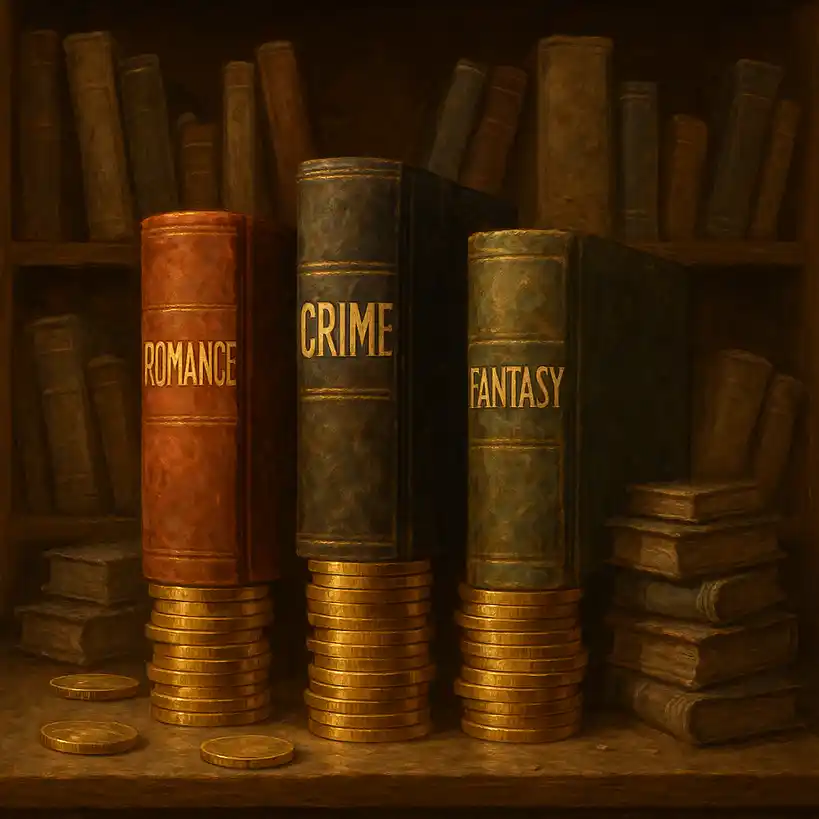
💰 What are the most lucrative book genres? When we look at the most lucrative book genres, three categories dominate…
What is the least popular genre of books?
📚 What is the least popular genre of books? When people ask about the least popular genre of books, the…

What is the most popular genre of books?
What is the most popular genre of books? The most popular genre of books in the world is romance. Year…
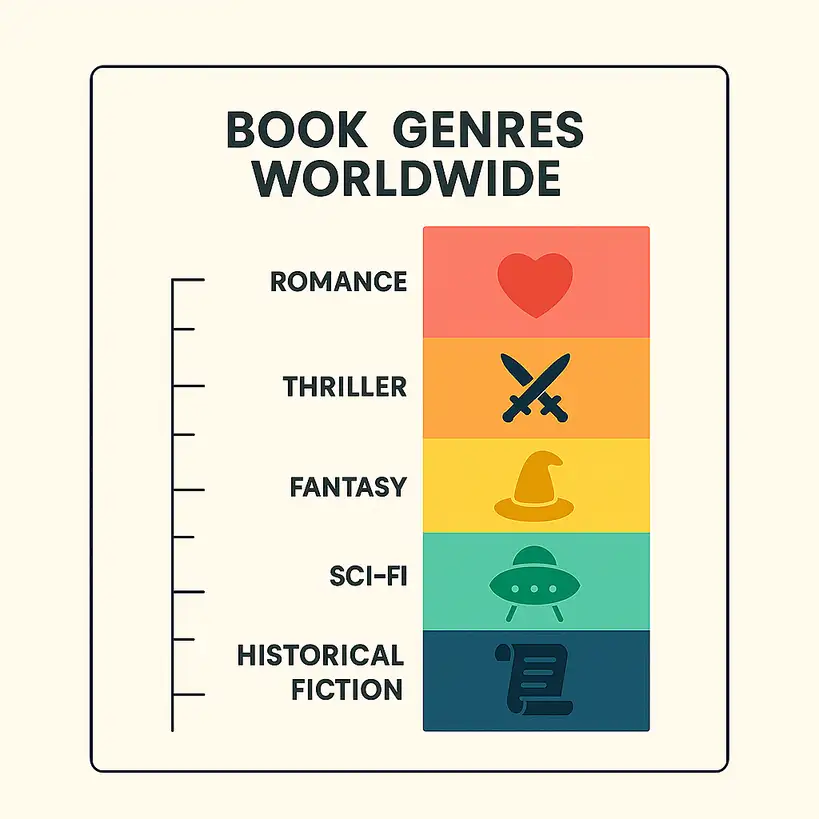
What Makes a Book Genre So Useful? When we talk about a book genre, we’re really talking about patterns. Stories…
Loved learning “What is the most translated book in the world?” — Now discover the stories behind the stats

The Mother by Bertolt Brecht – the Struggles of Working-Class My View on The Mother – A summaryBertolt Brecht’s play…

Herzog – Saul Bellow’s Intellectual Odyssey of Love, Madness, and Redemption What I take away from HerzogWhen I read the…

The Glass Bead Game by Hermann Hesse – A Symphony What I have learned from reading The Glass Bead GameReading…

Salome by Oscar Wilde: A Seductive Dance of Desire and Doom Oscar Wilde’s Salome captivated me from the very first…
The Grapes of Wrath – John Steinbeck’s Masterpiece My Thoughts on The Grapes of WrathI was deeply intellectually challenged by…

Jean-Paul Sartre’s The Flies – through Existential Freedom My Takeaways from Reading The Flies – A SummaryEngaging with Jean Paul…

Raise High the Roof Beam, Carpenters and Seymour
Raise High the Roof Beam, Carpenters and Seymour What I take away from Raise High the Roof Beam, Carpenters and…

Gaming Instinct by Juli Zeh – The Dark Abyss of Virtual Reality Gaming Instinct by Juli Zeh – What I…

David Copperfield – Dickens’ Masterpiece Unveiled My Thoughts on David CopperfieldI found the novel written by Charles Dickens to be…

Toni Morrison’s Jazz – A Mesmerizing Symphony of Words My Summary on Jazz by MorrisonReading the novel by Toni Morrison…
Orlando by Virginia Woolf: Through Gender and Identity Quick Summary: My Thoughts on OrlandoReading Virginia Woolfs semi-biographic work was truly…

The Immoralist by André Gide – A Journey of Self-Discovery My Thoughts on The ImmoralistAfter diving, into André Gides novel…