Who Is the Most Translated Author of All Time?
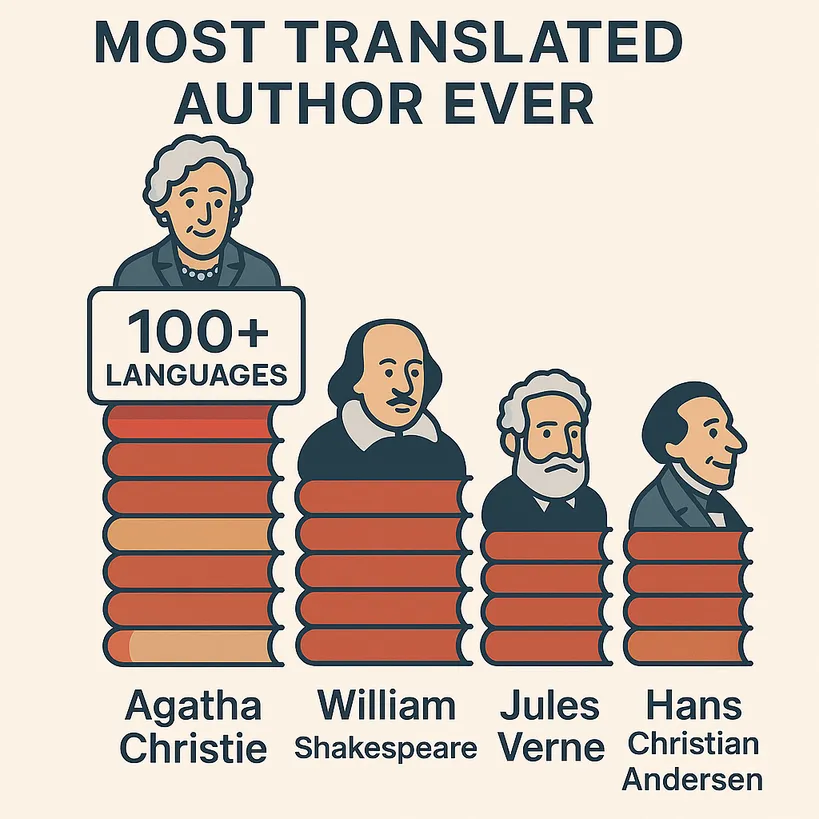
The most translated author of all time is Agatha Christie. Her detective novels have been translated into over 100 languages, more than any other fiction writer in history. According to UNESCO’s Index Translationum, she ranks first — above names like Jules Verne, William Shakespeare, or Enid Blyton.
What makes Agatha Christie stand out is her universal appeal. Her stories speak to something every reader enjoys: the thrill of solving a mystery. Whether it’s a train stuck in the snow or a quiet English village hiding secrets, her settings may change — but the suspense never fades.
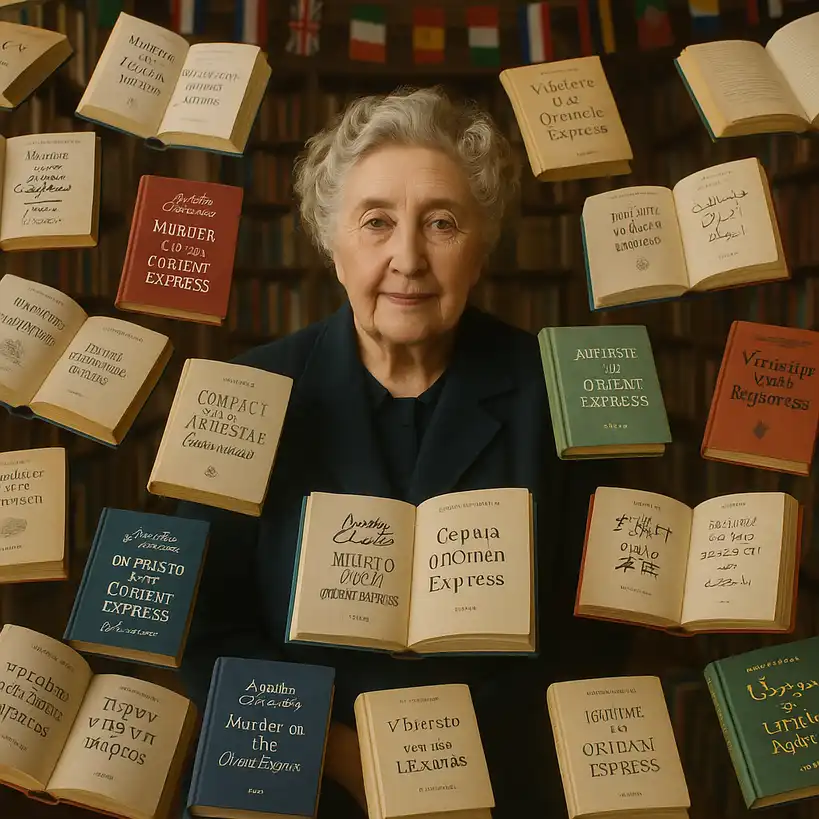
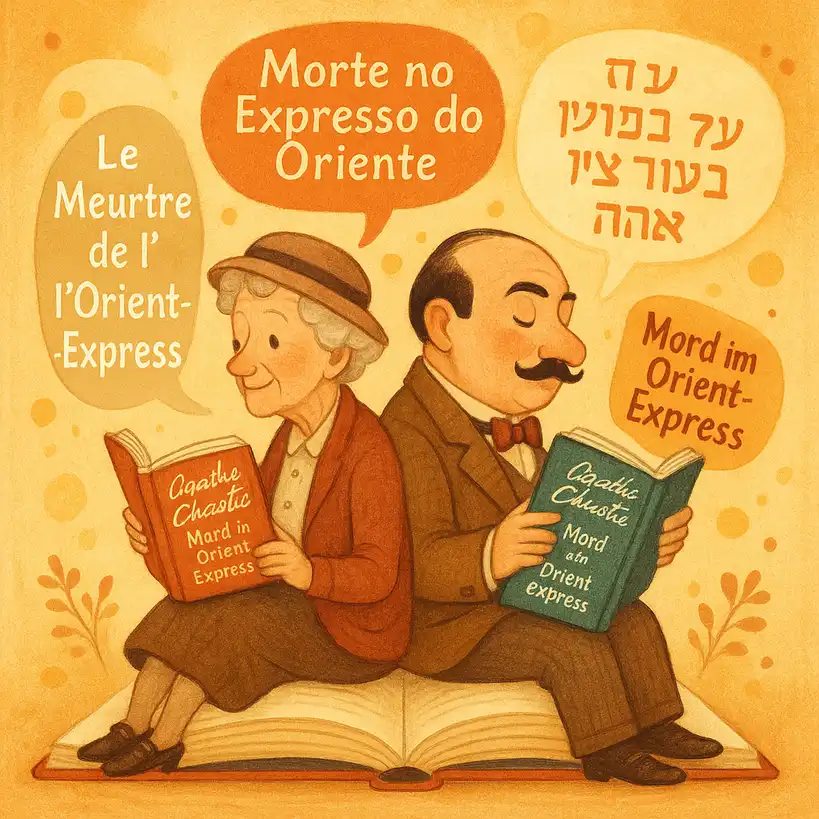
Books like Murder on the Orient Express, And Then There Were None, and The Murder of Roger Ackroyd are read in dozens of countries. Her characters — especially Hercule Poirot and Miss Marple — have become icons far beyond the English-speaking world. They’re clever, curious, and surprisingly human.
Christie’s success also comes from her ability to write with precision. Her language is direct, her clues are fair, and her endings often surprise. That clarity makes her work easy to translate — and hard to forget.
So, who is the most translated author of all time? The answer is Agatha Christie — the queen of crime whose books continue to cross borders, decades after she first put pen to paper.
🌍 Translation as a Passport: Victor Hugo and the Global Stage
Agatha Christie holds the crown, but Victor Hugo comes close in spirit. His Les Misérables has been translated into more than 60 languages — without ever needing a detective. Hugo didn’t write puzzles; he wrote the human condition. Still, his stories reached readers far beyond France.
In fact, translators championed Hugo early on. His books traveled through Europe and across the Atlantic almost immediately after publication. The Hunchback of Notre-Dame appeared in English just two years after the French original. The novel moved readers in places where Notre-Dame was just a name.
Hugo’s writing challenges translators more than Christie’s. His sentences expand. His ideas soar. Still, they followed him — through revolutions, republics, and censorship. Translators often said his stories felt urgent, like they needed to leave France and speak to the world.
Christie’s genius was in clarity and structure. Hugo’s was in emotion and ambition. Both found global readers — but in very different ways. Hugo showed that you could write a deeply national book and still be universally understood. Today, Les Misérables lives in every language that knows suffering, injustice, or hope. And that’s almost all of them.
✒️ A Question of Voice: Sagan, Simplicity, and Style
When it comes to translation, Françoise Sagan poses an interesting challenge. Her novels — crisp, ironic, and deeply French — rely more on tone than plot. A translator once said that Bonjour Tristesse had to “sound like a teenager with a cigarette.” That’s not easy in any language.
Sagan never chased international fame like Christie. But her work quietly slipped across borders — first into German, then English, then dozens of other tongues. What made that possible? Her simplicity. Like Christie, she kept her sentences short and direct. That helped. But where Christie aimed for structure, Sagan captured mood.
A book like Those Without Shadows doesn’t need a murder. It needs the right shrug. That’s why Sagan remains a translator’s puzzle. Do you carry over the irony? The laziness? The cool detachment? Or do you lose her voice entirely?
Christie gives you rules. Sagan gives you rhythm. That difference shapes how each author travels. But both remind us: a book isn’t just a story — it’s a sound. And when that sound can echo in many languages, you’ve written something worth keeping.
🔍 The Quiet Detective: Fernando Pessoa and Hidden Translations
Agatha Christie may be the most translated, but Fernando Pessoa is perhaps the most reinterpreted. His work, written mostly in Portuguese, wasn’t even widely published during his lifetime. Yet today, you can read Pessoa in nearly every major language — and each version feels slightly different.
Pessoa created heteronyms — fictional authors with their own styles, biographies, and even handwriting. Translating one Pessoa means translating four or five voices. Some of them contradict each other. Others write about the same moment from opposite perspectives.
That makes translation less like a bridge and more like a chess game. What does it mean to bring Pessoa’s The Book of Disquiet into Japanese? Or German? Or English? You’re not just moving a story. You’re moving a mind split into fragments.
Christie offers readers logic. Pessoa offers mirrors. But both prove that translation isn’t just a service — it’s an art. Translators become co-authors, choosing what tone survives and what must be let go. So yes, Agatha Christie tops the list. But Pessoa lingers in its corners — translated, re-translated, and rediscovered again and again.
From “Who Is the Most Translated Author of All Time?” to more facts that spark curiosity



“Who Is the Most Translated Author of All Time?” makes you wonder what else is worth reading