Murder on the Orient Express: Evidence and the Limits of Justice
A stopped train ought to make a murder easier to solve. In Murder on the Orient Express by Agatha Christie, confinement instead gives uncertainty a precise shape. Hercule Poirot has a body, a carriage full of possible witnesses, and a restricted field of movement. What he lacks is a trustworthy way to connect the facts. The luxurious surroundings promise order while the evidence refuses to behave as expected.
This detective novel offers the pleasure of a carefully arranged puzzle, but its lasting interest reaches beyond the identification of a murderer. It asks what knowledge permits a person to decide, and whether discovering the truth automatically settles the question of justice. Those concerns develop through the investigation rather than arriving as an unrelated moral discussion afterwards.
The train is particularly well chosen because travel makes temporary intimacy plausible. Passengers share meals, corridors, and sleeping arrangements without necessarily knowing one another. Their proximity supplies information, but it also produces assumptions about class, nationality, respectability, and the boundaries of private life.
Murder on the Orient Express makes those assumptions useful and dangerous at once. A convincing manner can support a misleading account. An apparently minor remark can become important when its relation to other testimony changes. The reader joins Poirot in learning how much interpretation already enters the act of noticing.
The following discussion leaves the identity of the murderer unrevealed. That preserves the first reading’s central discovery while allowing attention to the book’s construction, humour, and ethical pressure. Murder on the Orient Express deserves more than praise for a famous surprise. Its surprise works because the investigation has trained us to expect a particular kind of answer, then asks us to reconsider the expectations through which we have been reading.
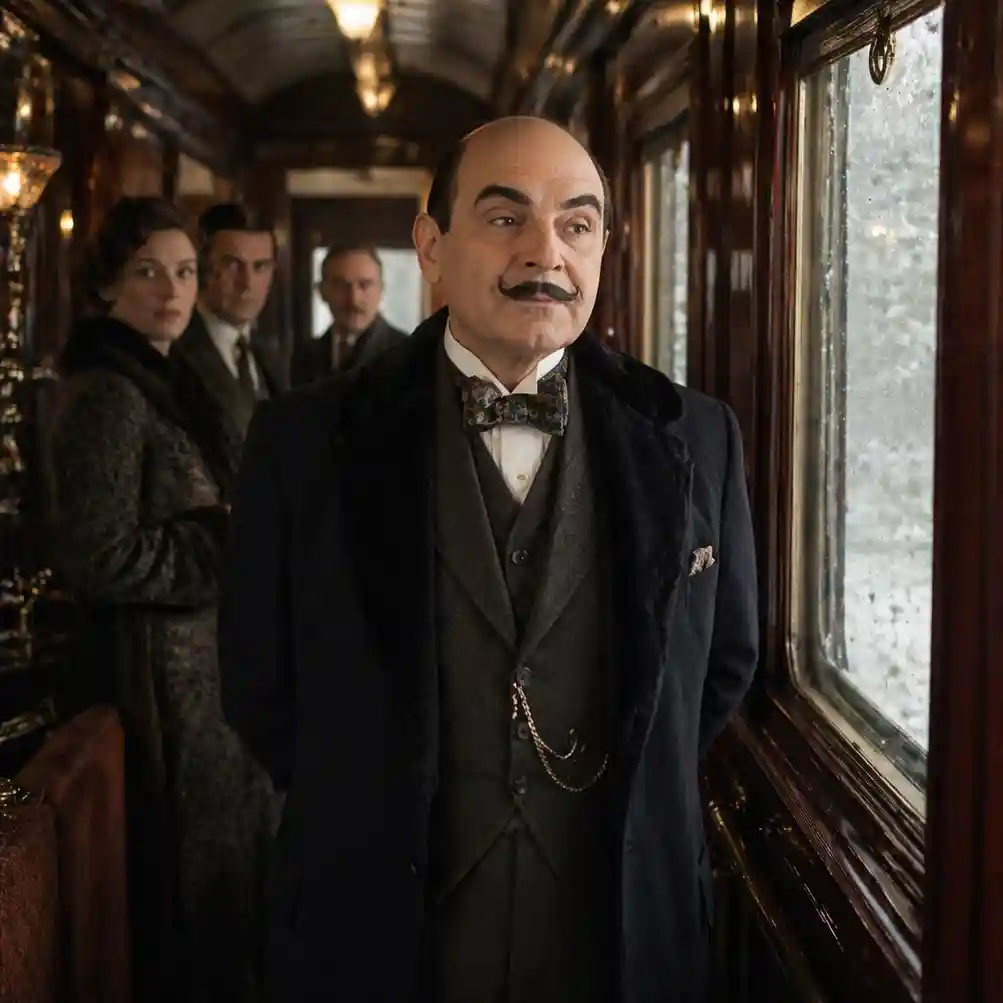
Murder on the Orient Express Turns Travel into Confinement
Poirot’s journey begins on the Taurus Express before he joins the train on which the murder occurs. That preliminary movement matters: the passengers do not first exist as names on an investigator’s list. They enter through travel, conversation, and observation, before suspicion gives ordinary details another significance.
Ratchett, an American travelling under an unsettling appearance of wealth and confidence, is found dead in his compartment. Snow has halted the train. Poirot must investigate without the usual freedom to check backgrounds or pursue leads elsewhere. The setting concentrates his attention on what people say and on what the carriage can reveal.
The timetable becomes a structure for uncertainty. Journeys depend on reliable sequences, but an investigation must ask whether the sequence described by witnesses corresponds to what occurred. Murder on the Orient Express uses that tension between scheduled movement and disputed movement to make its enclosed setting intellectually active.
A different arrangement of detection appears in A Study in Scarlet by Arthur Conan Doyle. Both books connect present evidence with a history that exceeds the immediate crime scene. Here, temporary isolation makes the detective work especially dependent on comparing accounts gathered in the same small space.
Confinement magnifies interpretation. A corridor or compartment is not merely atmospheric decoration. It establishes possibilities and limits that testimony must accommodate. Yet the physical boundary does not simplify the human motives within it.
The strength of Murder on the Orient Express lies in that combination. The reader receives enough spatial order to follow a problem, while the meaning of the people occupying that space remains unstable. Snow narrows the world without making it easier to understand.

Witnesses Speak in Social Roles
The passengers are memorable partly because their speech gives them recognisable social positions. Mrs. Hubbard’s expansive conversation differs from Mary Debenham’s restraint. Titles, occupations, manners, and accents help organise the cast before the investigation can establish how much those outward distinctions actually explain.
A manner is evidence, but never a verdict. Poirot listens to the way a person answers as well as to the information supplied. Confidence may reveal something, although confidence is not the same as accuracy. An apparently candid speaker can direct attention through emphasis, repetition, or an account that seems too ordinary to question.
The interviews in Murder on the Orient Express consequently operate on two levels. They add facts to the case while showing how people invite an investigator to see them. The reader can enjoy these performances without assuming that every national or social label provides a reliable guide to character.
That aspect also marks a limitation. Some humour depends on broad types rather than on fully independent interior lives. The novel often needs a passenger to be immediately distinguishable more urgently than it needs a sustained account of that passenger’s experience.
The stereotypes help and restrict the puzzle. Their usefulness to recognition does not make them neutral. Reading must remain open to revision. The detective’s ability to look past an initial category becomes particularly important in a cast introduced through such categories.
Murder on the Orient Express is strongest when a social role changes its significance under questioning. A detail first registered as charming, irritating, or conventionally respectable may require a second reading. The investigation makes our own habits of classification visible, including the temptation to mistake familiarity with a type for knowledge of an individual.
An Earlier Crime Changes the Present Case
The Armstrong kidnapping brings an absent household into the investigation. A child was abducted and killed, and the consequences extended beyond the immediate victim. This earlier crime supplies a different emotional scale from the polished routines of the train. The case Poirot is examining cannot be understood only through the circumstances of one night.
History changes the weight of a fact. Information about Ratchett’s past alters how readers understand his death. It does not automatically justify violence against him. The novel instead places the wish for retribution beside the detective’s obligation to identify what has happened.
Murder on the Orient Express gains depth from this movement between a present puzzle and an earlier failure of protection. The train remains the investigative setting, but it no longer contains everything that the murder means. Loss has travelled into it from elsewhere.
The moral pressure around a killing takes a different form in Crime and Punishment by Fyodor Dostoevsky. That novel follows a killer’s rationalisation and suffering at length. Here, the reader approaches moral judgment through an investigator’s reconstruction rather than through prolonged access to the criminal consciousness.
Explanation is not acquittal. Understanding a motive can make an act more intelligible while leaving its legitimacy unresolved. The distinction keeps Murder on the Orient Express from becoming a simple story in which a wicked victim makes every subsequent decision easy.
Its emotional design nevertheless guides sympathy forcefully. The earlier crime is devastating enough to make a detached response difficult. Readers can acknowledge that power while examining how the book arranges the conditions under which compassion begins to influence judgment. The argument matters because the facts carry pain, not because pain makes argument unnecessary.
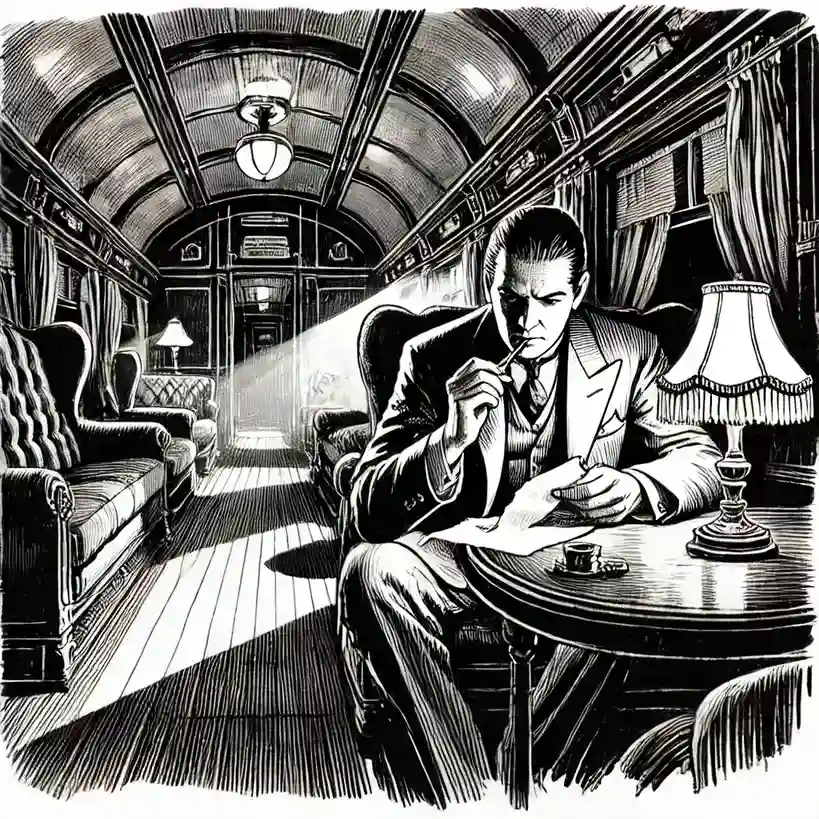
What a Solution Can and Cannot Settle
Detective fiction often promises that a correct explanation will restore order. An investigator separates appearance from reality, identifies responsibility, and makes the world readable again. This novel retains the pleasure of explanation while questioning whether restored readability also restores a trustworthy moral arrangement.
Knowing and judging are different achievements. Poirot’s task requires both, but the second cannot simply be calculated from the first. Evidence can establish a sequence of actions without deciding every question about punishment, mercy, or the authority of a legal response.
The contrast with The Trial by Franz Kafka helps clarify that distinction. Its accused man confronts an authority whose workings resist explanation. In Murder on the Orient Express, explanation remains attainable, but the relation between an intelligible case and a just outcome becomes difficult in another way.
The ending’s force should not be confused with a general endorsement of private vengeance. A fictional situation can make a particular response emotionally persuasive without establishing a safe principle for every comparable case. The narrative’s careful arrangement is part of what produces that persuasion.
The reader inherits a decision. We are invited to consider what kind of satisfaction the completed investigation offers, and what remains troubling within it. That question survives even when the solution has become familiar through an adaptation or an earlier reading.
Murder on the Orient Express therefore rewards attention beyond the final disclosure. Its ethical complexity lies in the distance between a story that can be explained and a harm that explanation cannot undo. The detective may organise the facts, but the reader still has to examine the terms under which that organisation feels sufficient.
Writing Style: Clarity That Makes Doubt Productive
The Writing Style of Murder on the Orient Express gives a complicated case an accessible surface. Conversations, observations, and investigative summaries help readers keep track of the material. That clarity does not eliminate difficulty. It allows difficulty to emerge from conflicting meanings rather than from an inability to follow the sentences.
Repetition changes what we notice. An interview can revisit a period already described by somebody else, adding a detail or altering its emphasis. The reader must compare accounts instead of treating every new passage as wholly new information. The method makes attention cumulative.
The opening also uses comedy to adjust perception. Poirot appears heavily wrapped against the cold, with a conspicuous moustache and an appearance Mary Debenham finds difficult to take seriously. The distance between how he looks and what he can do establishes a small lesson in misjudgment before the principal investigation begins.
Reconstructing a violent event through testimony provides a point of comparison with Chronicle of a Death Foretold by Gabriel García Márquez. That book announces the death and examines the surrounding failures. Here, uncertainty about responsibility directs the reader through a more conventionally investigative sequence.
The interviews can feel deliberately arranged. Readers seeking extensive psychological intimacy may find their precision more compelling than their depth. The arrangement is also the source of pleasure. Distinct voices and a manageable field of evidence let us participate without pretending we possess Poirot’s interpretive confidence.
Murder on the Orient Express rarely needs decorative language to sustain its atmosphere. Its strongest effects come from placement: a remark before its significance is clear, a testimony beside another testimony, or a familiar social impression that suddenly becomes less secure.

Five Brief Passages from the Passengers’ World
These fragments from Murder on the Orient Express appear in the official quotation selection published by Agatha Christie Limited. Their speakers and situations matter more than their usefulness as detached sayings. Each points towards a different difficulty in reading appearances, testimony, or social confidence.
- “evil had passed me by” Poirot describes his disturbing impression of Ratchett. The language is morally charged before an investigation can establish the facts of a crime. It reveals the detective’s human response without making instinct a substitute for evidence. The difference between an impression and a demonstrated conclusion remains essential to understanding his work.
- “these strangers to one another” Bouc reflects on the mixed company brought together by a train journey. His phrase expresses a plausible everyday assumption about travel. Murder on the Orient Express invites readers to inspect the assumptions through which they organise a group before they know its members.
- “a man in my compartment” Mrs. Hubbard describes her claimed encounter during the night. The particular location makes her statement relevant to the investigation. Her emotional presentation also illustrates how testimony can direct attention towards a speaker’s fear while requiring the listener to examine its practical implications.
- “I do not like your face” Poirot addresses Ratchett with striking bluntness. Courtesy does not guarantee cooperation. The detective can recognise the offer of a professional engagement and still refuse the relationship it would create. His refusal gives the later investigation an uneasy personal background.
- “very amusing” Poirot comments on an angry Englishman. The short description introduces humour into a situation governed by social tension. It also shows that the investigator observes national behaviour through categories of his own, making his confidence interesting rather than entirely free from the habits he examines in others. Source: Official quotation selection and speaker contexts.
Publication, Journeys, and Screen Versions
- The 1934 novel: Murder on the Orient Express appeared as a novel in 1934, after a US serial publication in 1933. The earlier serial belongs to its publication history and should not be mistaken for a separate later adaptation. The familiar book date does not describe the work’s very first appearance.
- An American title: The story also appeared under Murder on the Calais Coach. The official account explains the American title through the potential confusion with another train novel marketed as Orient Express. This is a documented regional title variation, rather than a reason to alternate titles throughout a review of the current English edition.
- Travel supplied material: The author’s own journeys contributed observations of passengers and railway travel. The official account distinguishes those experiences from a snowbound train incident she did not personally witness. That distinction preserves the difference between lived observation and an event that could be used imaginatively.
- The writing location remains uncertain: The Pera Palace association should not be presented as a securely established account of where the novel was written. The official discussion also considers Arpachiyah in Iraq, while acknowledging uncertainty. A famous hotel connection and a demonstrated composition history are different kinds of claim.
- Two major film interpretations: Sidney Lumet’s 1974 film stars Albert Finney as Poirot; Kenneth Branagh directed and played Poirot in the 2017 film. These versions belong to the work’s adaptation history. Their performances and emphases can shape expectations, but dialogue encountered on screen still needs checking before it is quoted as wording from the novel.
Returning to Murder on the Orient Express
The novel’s best quality is the connection between an enjoyable problem and a judgment that remains worth discussing after the problem is solved. Its enclosed world gives readers a clear field of attention, then demonstrates that a clear field need not produce simple knowledge about the people within it.
A rereading changes the pleasure. Once the central answer is known, attention can move towards how conversations establish expectations and how ordinary remarks acquire another significance. Murder on the Orient Express has enough deliberate construction to support that change of emphasis.
For a broader examination of how human groups and authority organise behaviour, consider Crowds and Power by Elias Canetti. Its analytical scale differs greatly from this novel’s carriage, but the comparison encourages attention to the relationship between individual appearances and collective arrangements.
The limitations remain visible. Some characterisation relies on social shorthand, and the final design requires a willingness to accept an unusually exact configuration of circumstances. Those features can make the book feel more like an accomplished construction than an open account of unpredictable lives.
Yet its construction serves an intelligible purpose. The puzzle makes judgment personal. We have spent time suspecting, comparing, and revising, so the question of what should follow discovery becomes part of our own reading activity.
Murder on the Orient Express suits readers who enjoy organised clues, distinctive dialogue, and a detective whose intellectual assurance meets a morally demanding situation. Its lasting appeal comes from the train’s double function: it restricts the possible movements of bodies while creating room for a much less restricted argument about responsibility, sympathy, and the limits of justice.
Reviews of other Works by the famous writer


Was this article helpful?
…One vote per user. No account needed.