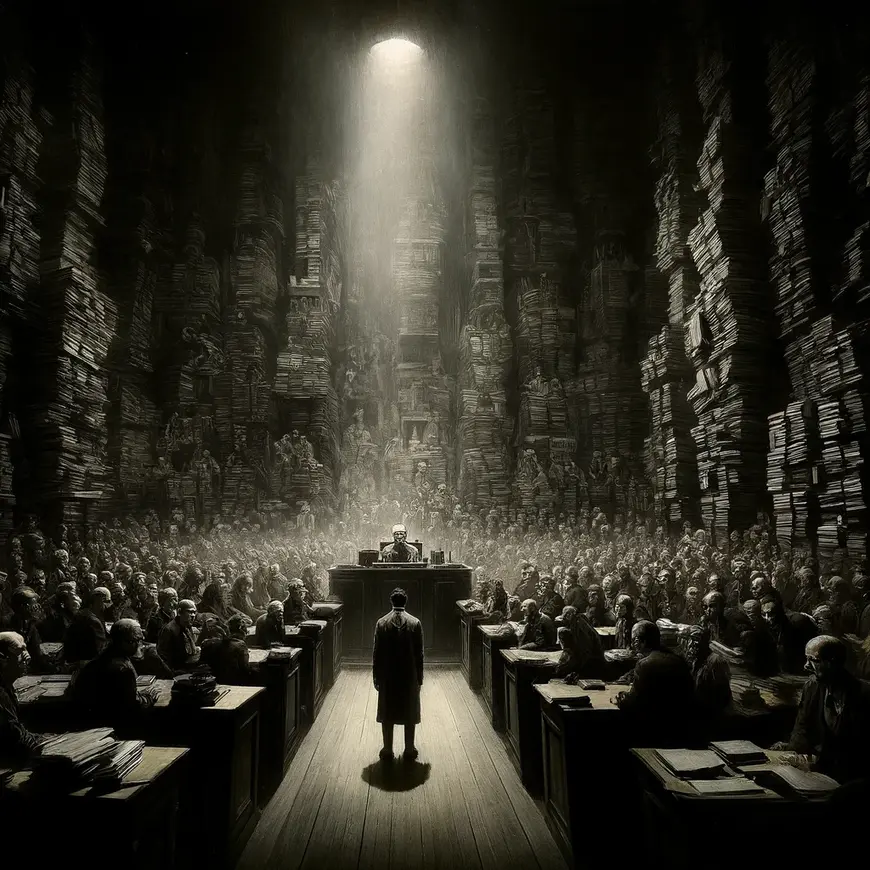
Aldous Huxley’s Brave New World – A Dystopian Masterpiece
My Thoughts on Brave New World
Reading Aldous Huxleys work was an eye opening experience, for me. From the beginning I found myself captivated by the depiction of a society where everyone appeared content yet something felt off. His portrayal of a world governed by technology and conditioning immediately drew me in.
As I delved into the lives of the characters I was both fascinated and unsettled by the absence of identity and liberty. The notion that individuals were molded from birth to conform to predetermined roles left me feeling uneasy. The narrative revealed how this flawless society masked a level of oppression.
The stark contrast between the regulated community and John known as the “Savage” underscored the price of losing autonomy. Ultimately it led me to contemplate the balance between comfort and freedom. The novel prompted reflections, on the perils of a reality where joy is artificially manufactured and uniqueness is sacrificed.

Aldous Huxley‘s Brave New World has stood the test of time as a chilling and thought-provoking dystopian novel. Published in 1932, his visionary work paints a disturbing picture of a future society dominated by technology, consumerism, and the eradication of individuality. In this review, we will delve into the unsettling narrative, the thought-provoking themes, and the enduring relevance of this writing, a cautionary tale that warns us of the dangers that lie ahead if we do not question our path.
Brave New World – Unveiling the Dark World of Huxley’s Imagination
The novel Brave New World presents a future where humanity has reached new heights of technological and scientific advancements. The story primarily follows Bernard Marx, an Alpha Plus, and Lenina Crowne, an attractive and conformist Beta. As they navigate their lives in this dystopian society, they encounter John, a man raised outside their controlled world who challenges their beliefs and ideals.
The narrative paints a vivid and unsettling picture of a society devoid of human connection and individuality. The pursuit of pleasure, instant gratification, and the suppression of emotions are the guiding principles of this brave new world. The chilling portrayal of a society built on conformity, consumerism, and the control of its citizens is a stark reminder of the potential consequences of unchecked technological progress.
Prophetic Themes that Resonate
Brave New World tackles a myriad of thought-provoking themes that continue to resonate with readers today. The novel explores the perils of technological advancement and the dangers of sacrificing personal freedoms in exchange for stability and comfort. His prescient warning about the dehumanizing effects of a society obsessed with instant gratification and shallow pleasures feels eerily relevant in our modern world.
One of the central themes in the novel is the loss of individuality and the suppression of human emotion. Aldous Huxley’s portrayal serves as a stark reminder of the importance of individuality, critical thinking, and the preservation of personal autonomy in the face of societal pressures.
The novel also delves into the dangers of consumerism and the commodification of human relationships. In this dystopian society, humans are treated as mere objects, and relationships are reduced to superficial encounters devoid of emotional depth. The critique of a society driven by materialism and instant gratification serves as a cautionary tale, urging us to question the values we prioritize in our own lives.
Complex Characters and Moral Dilemmas
The work features a cast of complex and memorable characters that add depth and nuance to the narrative. Bernard Marx, with his insecurities and longing for true connection, stands as a symbol of the internal struggle between conformity and individuality. Lenina Crowne, initially content with the society she inhabits, begins to question its flaws as she experiences emotions and desires beyond the scope of her conditioning.
The character of John, also known as “the Savage,” serves as the embodiment of the outsider challenging the established order. Raised on a reservation outside the controlled world, John’s journey of self-discovery and his clash with the realities of the dystopian society are both heart-wrenching and thought-provoking. These characters navigate moral dilemmas, grappling with the conflict between societal expectations and their own desires for authenticity and meaning.
The characters in Brave New World are diverse and thought-provoking. Each one represents different aspects of the dystopian society and its effects. Bernard Marx, the protagonist, is a dissatisfied member of the ruling elite who questions the status quo. His journey encourages readers to consider the cost of conformity and the desire for individuality.
John the Savage, an outsider from a “savage” reservation, serves as a catalyst for exploring the conflict between the World State and traditional values. His struggle with identity, emotions, and resistance to the system underscores the importance of human connection and reveals the flaws of a sterile, controlled existence.
The novel explores deep themes, such as the loss of individuality, the dangers of a pleasure-driven society, and the consequences of sacrificing freedom for stability. His examination of social conditioning, the suppression of real emotions, and the manipulation of human desires prompts deep reflection and urges readers to question their own societal values.
Writing Style and Narrative Techniques
Huxley’s writing style in Brave New World is both eloquent and disquieting. His vivid descriptions and evocative language create a sense of unease, underscoring the novel’s underlying darkness. The author employs a skillful blend of dialogue, inner monologues, and narrative devices to provide multiple perspectives and enrich the reading experience.
One of the notable narrative techniques used by the writer is the juxtaposition of characters and ideas. The contrast between the “savages” and the World State, the conflict between individual freedom and societal control, and the clash between human desires and technological advancements all contribute to the novel’s depth and complexity.
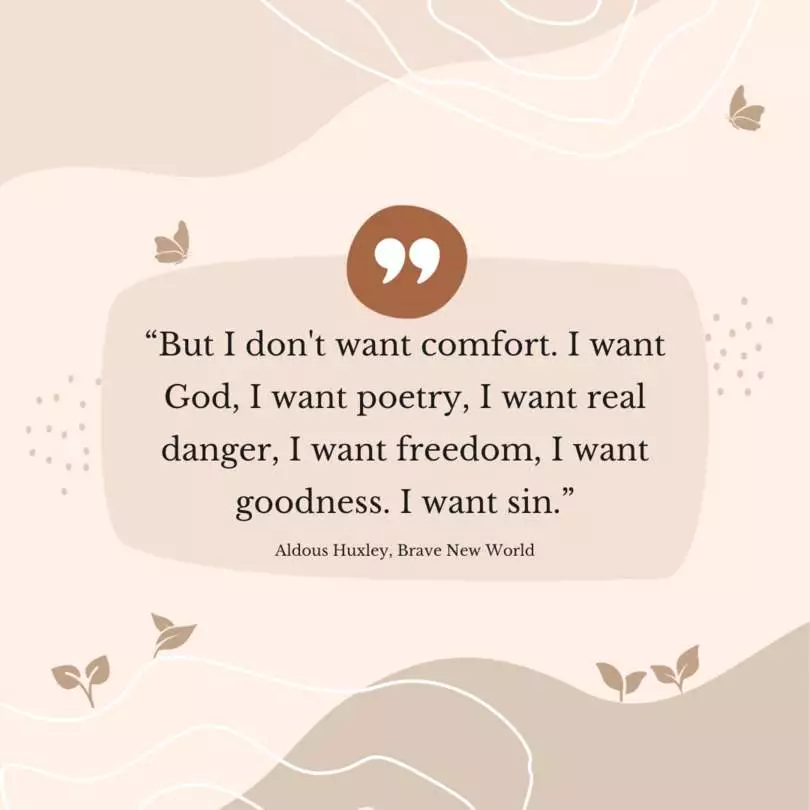
Famous Quotes from Brave New World by Aldous Huxley
- “Community, Identity, Stability.” This quote is the World State’s motto. It encapsulates the foundational principles of Aldous Huxley’s dystopian society. “Community” refers to the social cohesion achieved through artificial birthing processes and conditioning, “Identity” to the predefined roles each individual occupies, and “Stability” to the societal equilibrium maintained by these measures. Together, these principles reveal the novel’s critique of sacrificing individuality and freedom for societal control and uniformity.
- “Everybody belongs to everyone else.” This phrase reflects the World State’s approach to relationships and sexuality, which are devoid of emotional depth or exclusivity to prevent personal attachments that could challenge social cohesion. It critiques the commodification of human relationships and the erosion of individual rights in the name of communal stability.
- “The more stitches, the less riches.” Another maxim taught to citizens, encouraging the consumption of new rather than mended goods, reinforcing the society’s consumerist values. It parallels “Ending is better than mending,” promoting the continuous cycle of consumption as a means of controlling the populace and discouraging the accumulation of wealth that might lead to individual power or status.
- “I don’t want comfort. I want God, I want poetry, I want real danger, I want freedom, I want goodness. I want sin.” This declaration by John, the “Savage,” encapsulates his rejection of the World State’s values. John craves the depth of human experience that the World State suppresses, including religion, art, and the capacity for individual choice—even if it includes suffering. This quote embodies the novel’s critique of a society that sacrifices human depth and complexity for superficial happiness and stability.
Trivia Facts about Brave New World
- Inspired by a Visit to the US: His trip to the United States in the 1920s partly inspired this book.
- Title from Shakespeare: The title Brave New World is a quote from William Shakespeare‘s play The Tempest.
- Initial Reception: Upon its release in 1932, the novel received mixed reviews. Some praised its originality and daring exploration of societal issues. While others criticized its pessimism and portrayal of a world. Where freedom and moral values are compromised for stability and comfort.
- Comparison with Orwell’s 1984: The story is often compared to George Orwell’s 1984. As both are seminal dystopian novels. However, they present contrasting visions of dystopia. Orwell’s world is maintained through surveillance and brutality, while Huxley’s through engineered happiness and societal conditioning. The novelist himself argued that a tyranny of enforced happiness could be more effective than one upheld by force.
- Influences on Later Works: The novel has influenced countless works of science fiction and dystopian literature. Including Ray Bradbury’s Fahrenheit 451 and Margaret Atwood’s “The Handmaid’s Tale.”
- Adaptations: Brave New World has been adapted into several forms of media, including radio broadcasts, television movies, and series. Each adaptation interprets the novel’s themes and characters differently, reflecting the concerns of its time.
- Foreseeing Technological Advancements: His novel anticipated many future technological advancements and societal changes. Such as reproductive technology, sleep-learning, and the power of pharmaceuticals to control and pacify populations.
- Final Request: On his deathbed in 1963, Aldous Huxley asked for LSD. A psychedelic drug he had experimented with and written about in his later years.
Relevance and Impact – A Timeless Warning
Brave New World remains as relevant today as it was when first published. Huxley’s exploration of a society driven by consumerism, instant gratification, and the suppression of critical thinking resonates with contemporary concerns. The novel serves as a cautionary tale. Reminding us of the dangers of sacrificing individuality, genuine connections, and intellectual curiosity in pursuit of comfort and stability.
The vision of a future controlled by technology and social engineering makes us think. About our own relationship with modern advancements. We see parallels in genetic engineering, social media, and the loss of privacy. The book urges us to question the limits of progress. It pushes us to consider the cost of conformity and the true essence of being human.
This writing remains a powerful and timely piece of literature. It encourages readers to reflect on their world and consider humanity’s direction. The author skillfully predicts the impact of unchecked technological progress and the decline of personal freedoms. His insights demonstrate his keen foresight and critical thinking.
Overall, the novel is a dystopian classic. That challenges us to face the risks of a society focused on instant pleasure, conformity, and the loss of individuality. His gripping story, deep themes, and layered characters still strike a chord today. They push us to examine our choices, both personally and as a community. As technology continues to evolve, Brave New World reminds us to protect our humanity, maintain our uniqueness, and seek meaningful relationships.