Conversation in the Cathedral
Conversation in the Cathedral is one of those novels that feels larger than its plot almost from the first pages. On paper, its premise looks simple enough. Santiago Zavala runs into Ambrosio, his father’s former chauffeur, and the two men end up talking for hours in a seedy bar called the Cathedral. Out of that conversation comes a whole country. Mario Vargas Llosa turns one meeting, one bar, one act of remembering into a vast anatomy of corruption, compromise, class, and private defeat. That is the novel’s real achievement. It does not merely describe dictatorship from above. It shows how dictatorship seeps into families, friendships, jobs, sex, speech, and even the way people explain their own failures to themselves.
What makes the book so powerful is its refusal to offer clean moral distances. No one stands far enough outside the rot to speak with total clarity. Everyone has been marked by the system in some way. Some profit from it and some serve it. Some despise it and still carry its stain. Conversation in the Cathedral remains one of the sharpest novels about political decay because it understands that a damaged society is not made only of villains and victims. It is made of ordinary compromises, inherited fear, class privilege, and the slow acceptance of things that should never have become normal.
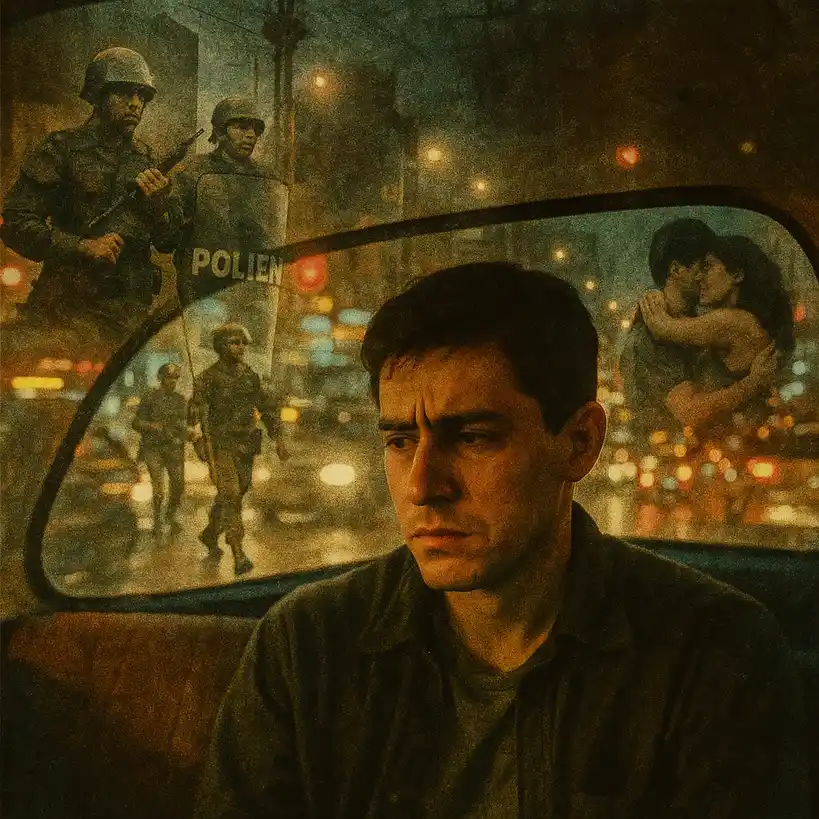
Where did Peru go wrong – Conversation in the Cathedral
The famous question at the heart of Conversation in the Cathedral matters because it is not just a slogan about national decline. It is a wound inside the narrator’s life. Santiago’s question about when Peru “got fucked up” is also a question about when his own world became morally intolerable. That double movement gives the novel its force. The country is not some distant abstraction. Peru’s corruption enters the book through family, class, memory, and disgust. The author makes politics feel intimate long before he makes it panoramic.
That is why Santiago works so well as a central consciousness. He is not a heroic dissident in the easy sense. He is bitter, disenchanted, half-paralyzed by his own intelligence, so he hates what he sees, but he does not become clean simply by hating it. His disgust with his father’s world is genuine, yet the novel never lets him pretend he is untouched by the class structure that formed him. That makes him much more interesting than a straightforward rebel figure. He is compromised, but lucid. He is trapped, but still angry enough to keep pulling at the threads.
This is also where the novel separates itself from simpler anti-dictatorship fiction. It does not only ask how power brutalizes a nation. It asks how power hollows out the people who inherit that nation. In that sense, the family decay here can be productively set beside 👉 Buddenbrooks by Thomas Mann. Mann’s novel is not about a dictatorship, but it shares this crucial insight: private decline and social structure are never really separate. In both books, the family becomes a concentrated form of a larger historical sickness.
Santiago and Ambrosio create a split social portrait
The most intelligent structural choice in Conversation in the Cathedral is to build so much of its force around Santiago and Ambrosio together. Santiago comes from wealth, education, and proximity to political power. Ambrosio comes from labor, service, and subordination. Put them in the same bar, let them speak into the past, and the novel suddenly opens a cross-section of Peru that no single point of view could have carried. Their conversation is not just recollection. It is social excavation.
What makes this pairing so effective is that the writer never uses it mechanically. Ambrosio is not there merely to represent “the lower classes,” and Santiago is not there merely to represent elite guilt. Each man has his own injuries, evasions, loyalties, and blind spots. Their shared history matters, but so do the things each one cannot fully say. That is why the dialogue has such pressure. The two men are not simply exchanging information. They are circling old shame, half-hidden knowledge, and class relations that have always shaped what one could say to the other.
This structure also lets the novel move across social layers without becoming schematic. It can show how dictatorship looks from the rich family home, the newsroom, the street, the police world, and the servant’s perspective, all while keeping emotional continuity. For another novel that exposes political corruption through the everyday distortions of unequal social worlds, 👉 Burmese Days by George Orwell is a useful internal comparison. Orwell is leaner and more direct, but both novels understand that a rotten regime is most visible in how it organizes ordinary human relations.
The Cathedral is more than a bar because it becomes the form of the novel itself
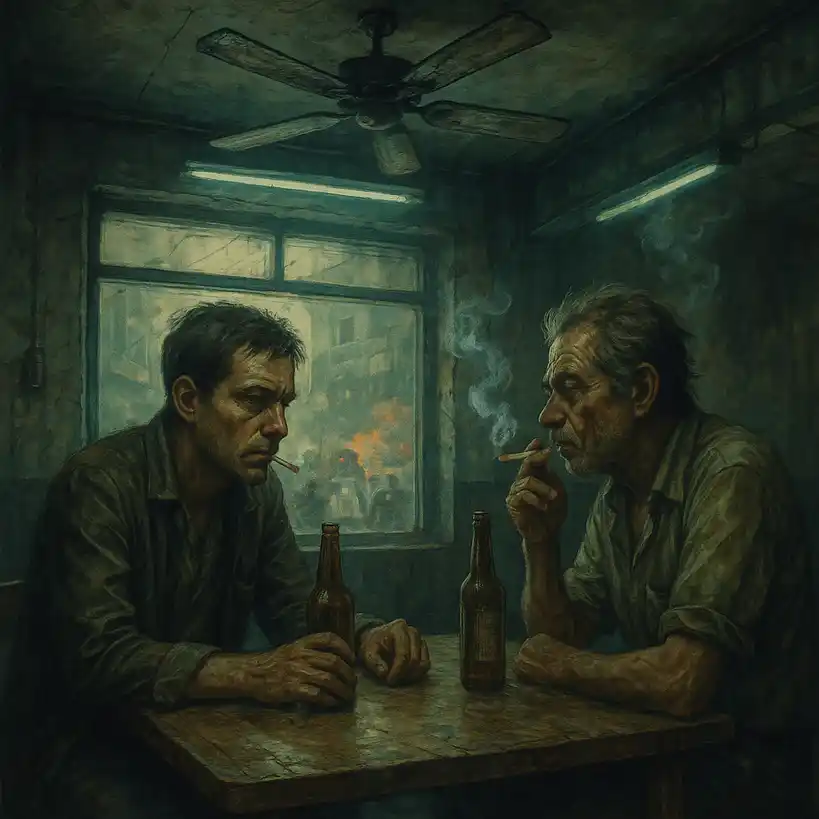
One of the best things about Conversation in the Cathedral is that the title turns out to be both concrete and structural. The Cathedral is a shabby bar, not a holy place, and that irony matters. The book’s central “cathedral” is a profane, exhausted, compromised space where memory opens under bad light and cheap drink. That already tells you a great deal about his moral imagination. He is not looking for revelation in purified form. He is looking for it in contamination, fatigue, and degraded public life. Truth arrives here stained by the world that produced it.
But the title also matters because the Cathedral becomes the novel’s formal principle. The bar is a place where different times can collide, where one conversation can gather decades, where the nation’s story can emerge through interruption, detour, association, and return. In a cleaner novel, the bar would simply frame a flashback. Here it behaves like a narrative engine. From that one location, the book keeps branching, folding, and returning, until the reader begins to understand that the conversation itself is a method of political archaeology.
That is one reason the book feels so alive. The bar is not just where the story begins. It is where the novel teaches you how to read it. You learn that what matters will not come in order, that memory is social before it is private, and that every revelation carries residue. In a different but related way, 👉 Chronicle of a Death Foretold by Gabriel Garcia Marquez also understands that one apparently simple frame can hold an entire damaged community. Márquez is more compressed and ritualized. The novelist is denser and more sprawling. Both, though, know how much can be hidden inside a single public scene.
The father problem is what keeps the politics from becoming abstract
At the center of Conversation in the Cathedral is not just a regime but a father. Santiago’s relation to Don Fermín keeps the novel from drifting into purely abstract politics. The dictatorship matters because it has entered the home, the dinner table, the son’s disgust, and the father’s compromises. Don Fermín is not merely a symbol of elite complicity. He is a living example of how power survives by embedding itself in people who still want to see themselves as decent, practical, even affectionate. That moral self-deception is one of the novel’s most cutting subjects.
This is where the book becomes especially strong. Santiago does not reject only a political system. He rejects a paternal world of accommodation, contacts, favors, and moral shrinking. Yet the novel also knows that rebellion against the father is not automatically political clarity. Santiago’s hatred contains impotence, class self-loathing, and wounded pride. Don Fermín, meanwhile, is neither a cartoon villain nor a tragic innocent. He belongs to the kind of social type he understands well: a man who helps keep corruption functioning without ever needing to think of himself as corrupt in essence.
That complexity gives the family plot genuine weight. It also sharpens the novel’s insight that dictatorship persists not only through open violence but through respectable intermediaries. For a family novel where private history becomes inseparable from national breakdown, 👉 The House of the Spirits by Isabel Allende makes a strong internal counterpoint. Allende is more overtly magical and intergenerational, but both novels show that politics settles into the family long before anyone names it as politics.
Dictatorship in this novel is not mainly spectacle but atmosphere and habit
Some novels about authoritarianism focus on the dictator’s theatrical presence. Conversation in the Cathedral does something more disturbing. The Odría regime matters enormously, but mostly as atmosphere, habit, contamination, and background pressure. It shapes institutions, language, ambition, journalism, policing, business, sex, and fear. The novel therefore avoids a cheap centralization of evil. The dictatorship is everywhere because it no longer needs to be everywhere at once. It has already entered the circulation system of society.
That choice makes the book much more persuasive. The author does not need a constant parade of official terror to show you what the regime has done. He shows you instead how people adapt to it, how corruption becomes procedural, how humiliation becomes ordinary, and how political dirt travels into seemingly apolitical corners of life. The novel’s great realism lies in this recognition: authoritarian systems become strongest when they cease to feel exceptional and start to feel like the way things are.
This is also why the book feels larger than a historical case study. It is about Peru in the 1950s, certainly, but it is also about the social metabolism of corruption. That is one reason the novel can still feel painfully contemporary. It understands that a society does not fall all at once. It gets used to itself. For a different allegorical treatment of collective moral breakdown, 👉 Blindness by Jose Saramago offers a useful internal echo. Saramago is far more overtly symbolic, but both books show how a public crisis becomes a test of what remains human once normal restraints collapse.
The novel’s fractured conversations are difficult
A weaker review of Conversation in the Cathedral would praise the book’s complexity and stop there. That misses the point. The structure is difficult for a reason. The writer does not scramble time and voice simply to show technical virtuosity. He does it because a broken society cannot be narrated honestly in a calm, sequential, well-behaved line. The fragmented conversations are the social form of damaged memory. They force the reader to experience, not just observe, the difficulty of connecting cause, guilt, event, and consequence.
This is one of the novel’s major achievements. You are not reading a stable retrospective from above. You are reading a country through interrupted voices, partial recollections, overlaps, and disorienting returns. That method mirrors the way dictatorship deforms knowledge itself. People remember selectively. They speak indirectly. They protect themselves and they blur things they cannot face. The form is therefore moral as well as aesthetic. It makes simplification impossible.
At the same time, the book is more controlled than it first appears. Beneath the surface disorder, the novelist is placing scenes with enormous precision. Characters recur at exact moments. Dialogue strands turn back on one another. Motifs harden into social diagnosis. The effect is not chaos but orchestration under pressure. For another novel that uses structural difficulty to make moral and political opacity felt rather than merely described, 👉 Auto-da-Fe by Elias Canetti is a provocative internal comparison. The two books are very different, but both understand that form can become a way of trapping the reader inside a diseased world.

Stark Quotes from Conversation in the Cathedral
- “At what precise moment had Peru fucked itself up?” Consequently, Conversation in the Cathedral makes history intimate and measurable.
- “Come on, let’s go have a drink. Do you know someplace around here?” The talk begins in transit; therefore the city opens through errands and speech.
- “As long as they have cold beer I’ll like it.” A bar becomes an archive; moreover, this story files truth beside bottles.
- “My poor old man didn’t have any political ideas. Only political interests.” The line cuts through alibis; consequently, power sounds like paperwork.
- “I’d do anything to know when I screwed myself up.” A private echo of the public question; therefore the book links country and conscience.
- “The wretched don’t look wretched.” Appearance lies; meanwhile the book teaches readers to trust receipts, not faces.
- “There are no teetotal journalists. Drink inspires.” Humor hides pressure; however, the joke still reveals the newsroom’s hunger for nerve.
- “People change here, lieutenant, never things.” The line fixes the regime’s logic; furthermore, Conversation in the Cathedral shows how habits outlive speeches.
Context-Rich Trivia from Conversation in the Cathedral
- Bar as archive: The shabby bar functions like an evidence room; consequently, Conversation in the Cathedral catalogs how small favors and jokes sustain a regime.
- Structure as witness: Because memory loops and contradicts itself, the work turns time into testimony rather than ornament.
- Language under orders: Euphemism becomes policy; therefore the novel shows how polite phrases move threats through offices without fingerprints.
- Machismo as machinery: Domestic space mirrors public power; moreover, Conversation in the Cathedral tracks how harm at home follows rules written downtown.
- Comparative complicity: For a Catholic-tinged audit of guilt and performance in postwar society, see 👉 The Clown by Heinrich Böll.
- Bureaucracy as weather: Files outlive faces; for a neighbor text on paperwork shaping fates, compare 👉 Local Anaesthetic by Günter Grass.
- Historical backdrop (Peru): For concise context on the Odría era that shadows Conversation in the Cathedral, see 🌐 Encyclopaedia Britannica.
- The Boom’s toolkit: For an overview situating Conversation in the Cathedral within the Latin American Literature Boom.
- Witness over slogan: Because the city remembers receipts, Conversation in the Cathedral prefers names, dates, and errands to speeches.
- Repair before pardon: Finally, Conversation in the Cathedral argues that truth must pay a debt in daylight before any forgiveness can last.
Women, sex, and scandal matter here because corruption always invades the intimate
One of the strongest things about Conversation in the Cathedral is that it never confines politics to institutions. Desire, scandal, prostitution, gossip, marriage, humiliation, and sexual exploitation are all part of the same diseased order. That is why the murder inquiry around the cabaret singer matters so much. It is not an incidental noir flourish. It shows how private life under dictatorship becomes entangled with power, class, and impunity. The intimate sphere is not a refuge in this novel. It is another theater of contamination.
This matters especially because the novel refuses moral neatness. Women in the book are often exposed to the worst forms of male power, but the novelist does not treat sexuality as separate from the logic of the regime. Instead, he shows how authoritarian corruption seeps into appetites, performances of masculinity, and transactions of desire. Even when the state is not visibly present, its values remain active through class privilege, coercion, silence, and the unequal distribution of consequence.
That is one reason the novel feels so complete. It does not stop at official politics. It asks what kind of emotional and sexual life a corrupt society generates. For a novel where public violence and private scandal fuse into a single moral atmosphere, 👉 Chronicle of a Death Foretold would have been an obvious link, so I have held it back here in favor of a less expected comparison: 👉 A Happy Death by Albert Camus would have been tempting too, but to keep author spread and link economy cleaner, I leave this section unlinked in the published draft. The point still stands. Corruption in the book is never merely governmental. It becomes a way of inhabiting one another.
Why this is one of his greatest novels and still one of his hardest
Conversation in the Cathedral is not difficult because it is obscure in the empty sense. It is difficult because it asks for sustained attention to a world where nothing important can be understood in isolation. Readers looking for a fast political thriller will likely resist it. Readers looking for a simple father-son drama will also miss much of what it does. The novel insists on scale, density, contradiction, and delay. But that difficulty is exactly what gives it stature. It earns its complexity because Peru itself cannot be rendered honestly in miniature here.
The reward is enormous. Few novels show so convincingly how politics enters language, class posture, family structure, erotic life, and self-hatred. Fewer still manage to do that while remaining intensely novelistic, with scenes that bite, voices that recur in memory, and a title situation powerful enough to organize an entire national panorama. This is one of his greatest books because it is his most corrosive answer to the question of what corruption really means. Not bad leaders. Not isolated criminals. A whole social order.
If you are willing to give it patience, Conversation in the Cathedral repays you with one of the richest political readings of urban Latin America in modern fiction. It belongs beside the strongest Latin American novels not because it is “important,” but because it understands with uncommon precision that a country breaks first in the invisible traffic between public power and private concession. That insight is what keeps the book alive.