Eva Luna by Isabel Allende turns survival into stories
Eva Luna is the kind of novel that feels alive almost at once. It moves fast, yet it never feels thin. It is rich in incident, but it also leaves room for tenderness, humor, memory, and reflection. In this book, Isabel Allende creates a world shaped by poverty, longing, class difference, political unrest, and imagination. However, the novel never turns into a cold social panorama. It stays close to feeling. It stays close to voice. That is one of its greatest strengths.
What impresses me most is the way the book joins hardship and invention. The heroine suffers, adapts, watches, and learns. Yet she never becomes passive. Her instinct for stories gives her a kind of inner motion even when the world around her tries to trap her. Because of that, the novel never reads like a simple catalogue of struggle. It feels instead like a work about the making of a self. That process matters more than any single event.
The book also has a wonderful sense of narrative openness. It keeps widening without losing emotional focus. New settings, new people, and new tensions enter the story, yet the novel still feels centered. That balance is not easy to achieve. Here it works. The result is a work that is highly readable, emotionally warm, and quietly ambitious. It gives the reader a lot, but it carries its weight lightly.
A life story that keeps widening – Eva Luna
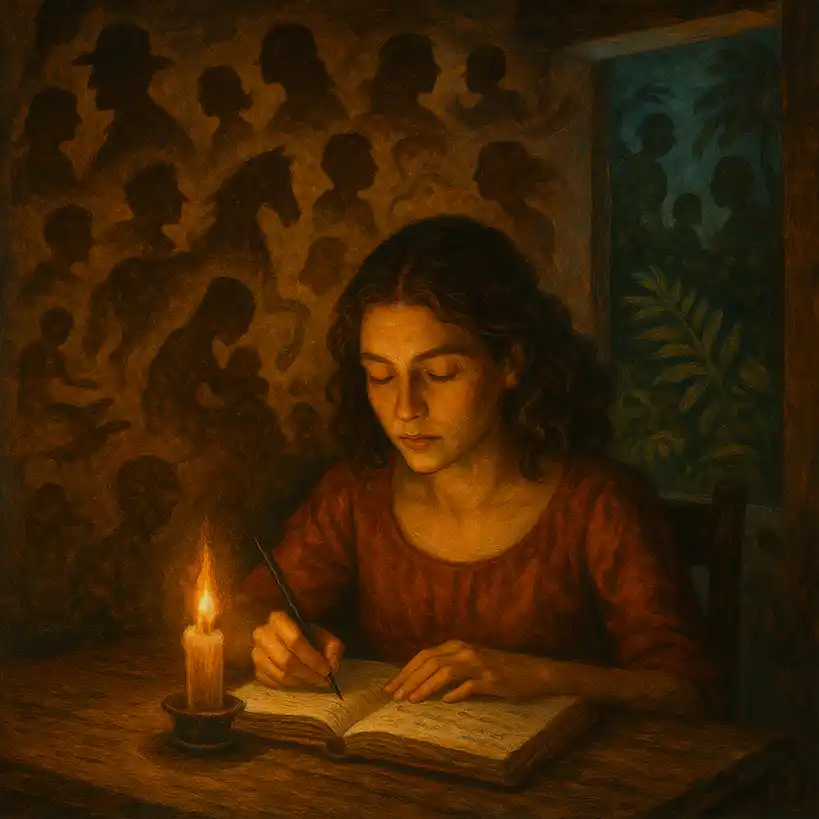
At first glance, the novel seems easy to describe. It follows a girl from a difficult childhood into adulthood. Yet that summary is too narrow. The book is not built around one straight line of action. Instead, it unfolds through encounters, sudden turns, changes of household, and shifts in social environment. That gives the narrative a strong sense of movement. More importantly, it allows the heroine’s life to become a way of seeing a much larger world.
This is where Eva Luna becomes especially interesting. The story keeps expanding beyond the boundaries of one private struggle. It moves through class difference, unstable power relations, political fear, and emotional improvisation. As a result, the work becomes both intimate and social at the same time. It does not leave the heroine behind, but it refuses to isolate her from history. That is a major reason why the novel feels so substantial without becoming heavy.
I also like the fact that the book does not force every episode into a rigid structure. It trusts accumulation. One phase leads into another. One encounter leaves a trace that matters later. That makes the whole work feel organic. In this way, the novel sometimes recalls 👉 The Green House by Mario Vargas Llosa, another book in which individual lives unfold inside a wider and unstable social landscape. However, this novel stays warmer and more immediate. Its breadth never overwhelms its human center. That center remains vivid from start to finish.
Eva as heroine, observer, and self-maker
The central character is the main reason Eva Luna holds together so well. She is alert, imaginative, emotionally quick, and often more perceptive than the people around her realize. Yet she is not written as a simple symbol of strength. That would have flattened the book. Instead, she is vulnerable and resourceful at the same time. She learns how to survive, but she also learns how to interpret what she sees. That second skill matters just as much as the first.
For me, one of the best things about the novel is that her resilience never feels abstract. It grows out of concrete conditions. She has to read rooms, judge danger, and adjust quickly. At the same time, she keeps an inner life that is active and creative. Because of that, the book never turns her into a passive victim of circumstances. Even when she has little control over events, she continues to shape meaning. That gives the novel emotional energy.
The character also stays human because she is not idealized. She can be naïve, strategic, romantic, practical, wounded, and bold, sometimes in the same chapter. That mixture gives the work credibility. The reader can believe in her because she is never reduced to one quality. In that sense, the novel belongs to a larger tradition of fiction in which a woman’s voice carries memory, pain, and invention at once. A strong internal parallel here is 👉 Beloved by Toni Morrison. The two books are very different, but both understand that voice can be a form of power even when the surrounding world is violent or unstable.
Storytelling as survival, freedom, and force
The deepest thread in the book is storytelling. Not as a decorative feature, and not as a charming extra, but as a way of living. The heroine does not simply enjoy stories. She uses them. They help her endure uncertainty, attract attention, build connection, and understand what would otherwise feel chaotic. Because of that, storytelling in the novel is not separate from survival. It becomes one of the central tools through which life is carried forward.
That theme gives the work a special kind of unity. The same imaginative force that shapes the heroine’s life also shapes the novel itself. Language becomes action. A story can change the mood of a room. It can create intimacy and it can open possibility. So it can also protect the self from humiliation or disorder. The novel understands all of this. It never treats storytelling as innocent fantasy. Stories can seduce, redirect, exaggerate, and conceal. Yet they still remain one of the most important resources the heroine possesses.
This is the point where the novel becomes more than a broad social narrative. It becomes a work about creation itself. It shows how people make inner space even when outer space is limited or dangerous. That is why the book feels so alive. A useful contrast here is 👉 The Trial by Franz Kafka. Kafka shows language turning into confusion, accusation, and entrapment. This novel moves in the opposite direction. Here, narrative becomes a form of motion. It does not erase suffering, but it helps transform it into something livable.
Love, desire, and emotional instability
Eva Luna would not be nearly as strong if it only dealt with hardship, class, and survival. It also needs emotional weather, and it has plenty of it. Love in this book is not clean, stable, or purely redemptive. It appears mixed with longing, fantasy, dependence, tenderness, fear, and misunderstanding. That complexity gives the emotional life of the novel its credibility. Relationships matter deeply here, but they never float free of social or historical pressure.
What I appreciate most is that the work does not reduce love to rescue. That would have been the easy version. Instead, it shows affection as something that can offer recognition while also exposing fragility. Desire can deepen a life, but it can also unsettle it. Because of that, the emotional arc never becomes simplistic. Feeling remains unstable, and that instability makes the novel more convincing. It knows that intimacy can offer comfort without solving everything else.
The book also understands that romance is shaped by setting, class, and danger. People do not love in a vacuum. They love through timing, inequality, memory, fear, and hope. That gives the novel maturity. It allows tenderness without sliding into sentimentality. A natural internal bridge here is 👉 Love in the Time of Cholera by Gabriel García Márquez. That novel is more fully centered on the endurance of desire across decades, while this one keeps a broader social field in view. Even so, both works understand that love is shaped by time as much as by feeling.
Politics, class, and the pressure of history
One of the most impressive things about the novel is the way it handles politics. Political unrest is not just there to decorate the background or give the plot a historical setting. It changes what daily life feels like. It affects danger, mobility, trust, speech, and silence. Eva Luna knows that public instability enters private spaces very quickly. Because of that, the work gains weight without becoming stiff or programmatic.
This matters because the novel never treats social pressure as abstract. It stays close to bodies, jobs, rooms, and small acts of adjustment. History is felt through daily life. That makes the political dimension more convincing than in many novels that rely too much on explanation. Here, power shows itself through atmosphere, vulnerability, and sudden shifts in what is possible. The result is a social world that feels alive rather than diagrammed.
I also think the book is strong because it keeps people messy. No one becomes a simple thesis. Motives stay mixed. Fear and desire often overlap. Private need and political reality push against each other. This gives the work depth. It also helps explain why the novel remains readable. It is serious, but it never turns its characters into mere examples. In that respect, there is a useful connection with 👉 Orlando by Virginia Woolf. The two books are very different in tone and design, yet both are interested in how identity shifts under social structures and historical pressure. Here, though, class and danger remain more immediate and materially grounded.
Structure, pace, and the pleasure of movement
The book has a wide range, yet it remains remarkably easy to read. That is not a small achievement. Large social novels often grow heavy because they carry too much explanation or too much architecture. This one rarely feels burdened. It keeps moving. Scenes begin quickly. Characters arrive with force. Settings change at the right moment. As a result, the narrative offers constant forward motion while still preserving emotional and thematic weight.
This has a lot to do with Eva Luna’s handling of structure. The work is built from episodes, but those episodes do not feel random. They accumulate into a life. Each phase leaves a mark on the heroine, and that accumulation gives the book form. The novel trusts sequence and rhythm more than rigid design. That trust pays off. It gives the reader both pleasure and momentum.
I also like the way the work shifts between tones. It can move from danger to humor, from tenderness to tension, from hardship to sensuality, and still stay coherent. That flexibility is one of the reasons the novel reaches so many readers. It is serious, but not solemn. It is rich, but not dense in a punishing way. There is an interesting contrast here with 👉 Nausea by Jean-Paul Sartre. Sartre’s novel contracts inward and grows philosophically tighter. This one moves outward into society, relation, and circulation. That difference helps clarify what is distinctive here. The pleasure lies in expansion, not in inward claustrophobia.
Style, readability, and lasting power in Eva Luna
The style is one of the book’s biggest advantages. It is vivid, fluid, and welcoming without becoming shallow. The prose carries emotion, atmosphere, and social observation with real ease. That ease is important. It allows the reader to stay close to the material even when the material grows dark. The work does not rely on difficulty for its seriousness. Instead, it trusts clarity, rhythm, and vividness. I think that trust is one reason the novel continues to appeal to so many readers.
The writing also has a valuable sense of proportion. It knows when to move quickly and when to linger. It knows when detail will deepen a scene and when it will only slow it down. Because of that, the novel feels full but not clogged. Its readability is a strength, not a weakness. The book proves that accessibility and richness can exist together.
If I had to be critical, I would say that the same openness that makes the novel generous can also make it slightly diffuse in places. Not every section carries the same pressure. Even so, I do not see that as a serious flaw. It belongs to the amplitude of the design. The work wants breadth. It wants to gather a whole life, not cut it into a single hard line. That ambition gives Eva Luna its warmth and its range. In the end, that range is one of the strongest reasons to read it.
Vivid Quotes from Eva Luna by Isabel Allende
- “There is no death, daughter. People die only when we forget them.” Consequently, memory becomes protection, and Eva Luna turns grief into a practice that keeps love present.
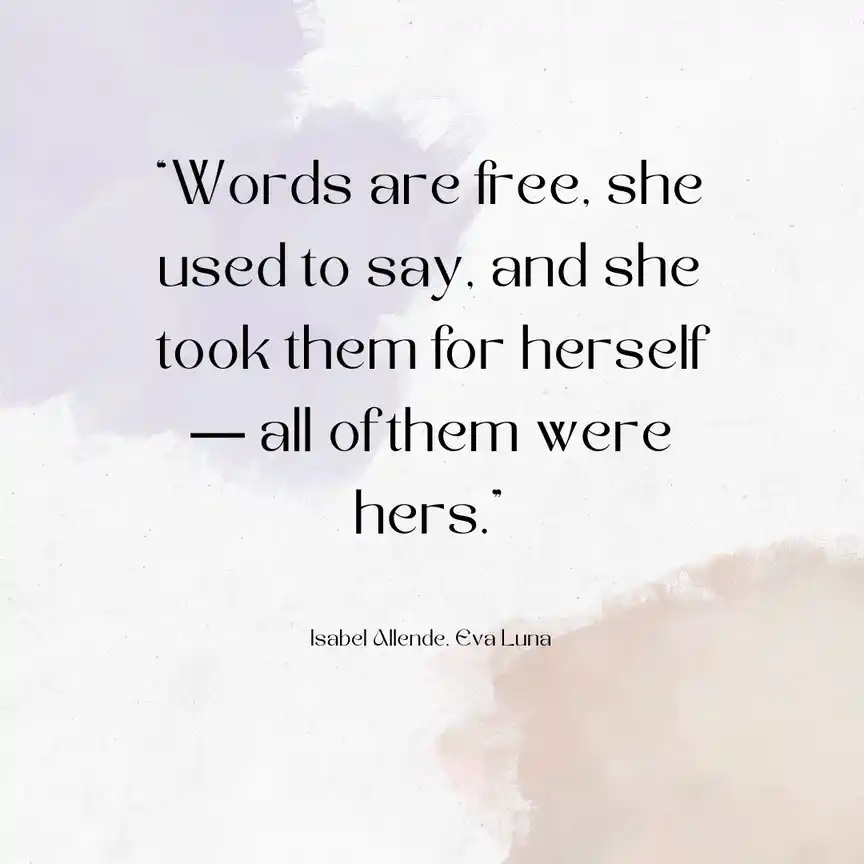
- “Words are free, she used to say… reality… has a magical dimension as well.” Therefore, language licenses invention, and Eva Luna treats storytelling as usable work.
- “…when everything else fails, we communicate in the language of the stars.” Moreover, the book links wonder to care, not to spectacle that abandons daylight.
- “My name is Eva, which means ‘life’… I was born in the back room of a shadowy house.” However, beginnings stay concrete, so myth serves bodies, not the other way around, in Eva Luna.
- “At times I felt that the universe… had stronger and more lasting contours than… flesh-and-blood.” Meanwhile, imagination builds shelter that facts must still verify.
- “The names of persons and living creatures demand respect.” In fact, naming is ethics, and Eva Luna shows how careful words guard dignity.
- “Although stunned and hungry, many sang, because it would have been pointless to aggravate misfortune by complaining.” By contrast, resilience chooses chorus over complaint and keeps communities moving.
- “On that long journey she wept all the tears stored in her soul.” Finally, sorrow empties in motion, and Eva Luna lets travel become slow repair.
Context-Rich Trivia from Eva Luna by Isabel Allende
- Story as livelihood: Eva Luna treats invention as paid work; consequently, stories buy shelter and safety rather than serving as ornaments.
- Voice against power: Because names can wound, the novel turns renaming into defense; moreover, Eva Luna shows how careful language keeps harm from scaling.
- Domestic scale of politics: The book frames upheaval through kitchens, rooms, and markets; therefore public risk stays legible in private spaces.
- Craft before miracle: Although fable shimmers, Eva Luna insists on labor, tools, and ledgers; consequently, wonder answers to costs and aftermath.
- Comparative civic pressure: For a sharper ledger of city rumor, police, and entanglements, see 👉 The Green House by Mario Vargas Llosa.
- Communities that count: Markets become archives of favors and debts; by contrast with spectacle, Eva Luna prizes repeatable help. For a classic portrait of networks and money shaping love, compare 🌐 Our Mutual Friend by Charles Dickens.
- Magical realism as method: The book uses the marvelous to test ethics, not to escape them; for a concise primer on the mode that frames Eva Luna.
- Regional context: Allende writes within the late-20th-century current of Latin American narrative that blends politics and myth; for background that situates Eva Luna, see 👉 Latin American literature.
- Consent as rule: Desire learns limits and timing; consequently, promises in Eva Luna stand only if tomorrow’s work can bear them.
- Account, not decree: Finally, the book reads like usable method—listen, name harm, revise, and keep the room safe enough that stories can keep people alive.
Why the novel still matters
The novel still matters because it combines qualities that rarely sit together this well. It is accessible, but not thin, while it is political, but not doctrinaire. So it is emotional, but not sentimental. It is also deeply interested in how a woman makes herself through language, memory, and improvisation. That combination gives the work durability. It speaks to readers who want story, but also to readers who want history, social texture, and a strong narrative intelligence.
For me, the most lasting thing about the novel is its faith in imagination as a living force. The book does not separate invention from reality. It shows that invention can be one of the ways reality is endured, interpreted, and reshaped. That insight keeps the work fresh. It stops the novel from becoming merely picturesque or merely political. Instead, it stays dynamic. It remains a book about voice under pressure.
The heroine also continues to matter because she resists simplification. She is poor, vulnerable, adaptive, desiring, observant, and inventive, but she never becomes a flat emblem. That complexity is worth returning to. So is the novel’s understanding that identity is not something fixed and discovered once and for all. It is narrated, revised, and tested. In that sense, the book remains emotionally and artistically persuasive. It still offers a world that feels vivid, but it also offers a self that feels in motion.
Conclusion to Eva Luna
Eva Luna is a warm, agile, and emotionally intelligent novel. Its strength lies in the way it joins storytelling, social pressure, desire, and self-invention without losing readability. The book has range, yet it also has a center. That center is the heroine’s voice. Because that voice is so active and so adaptive, the work can move through very different worlds without losing shape or force.
I think that is the clearest reason to read it. The novel turns voice into destiny without making that destiny feel fixed. It understands hardship, but it never loses motion. It understands politics, but it keeps faith with feeling. And it understands romance, but it refuses easy consolation. That combination gives the work its special energy.
Readers who want a narrow, tightly controlled minimalist novel may prefer something stricter. This work is more generous and more expansive than that. Yet if you want fiction that combines narrative momentum with heart, and social breadth with a memorable central presence, this book has a great deal to offer. It remains one of those novels that feels inviting on the surface and richer the longer you stay with it.