The Adventures of Sherlock Holmes: Evidence and Power
Published as a book in 1892, The Adventures of Sherlock Holmes gathers twelve cases narrated by Dr. John Watson. Arthur Conan Doyle had already introduced Holmes in two novels, but the short-story sequence established the recurring pattern through which millions of readers came to know him. Clients enter Baker Street with strange problems, ordinary objects become evidence, and the detective reconstructs actions hidden beneath respectable appearances.
The collection does not present twelve identical victories. The protagonist is deceived, arrives too late, releases offenders, and sometimes serves a justice distinct from the law. Across The Adventures of Sherlock Holmes, uncertainty remains essential to detection. Detection reveals social power as well as criminal method. The book is a detective short-story collection and a major work of mystery fiction, crime fiction, and Victorian periodical literature.
Twelve Strand Stories Establish a Detective Rhythm
The stories in The Adventures of Sherlock Holmes first appeared in The Strand Magazine from July 1891 to June 1892 and were collected in book form later in 1892. Holmes was not a new character. A Study in Scarlet had appeared in 1887 and The Sign of Four in 1890. The monthly sequence nevertheless transformed an existing detective into a dependable cultural event. Repetition creates familiarity without requiring sameness.
The puzzle tradition develops another ingenious form in The Murder of Roger Ackroyd by Agatha Christie. Christie makes the conventions of narration part of the mystery itself. He builds an earlier rhythm in which Watson’s limited knowledge, a visitor’s account, physical inspection, andhis explanation repeatedly reorganize what readers thought they understood.
The format was ideal for periodical reading. Each case offers relative closure, while Baker Street, Watson’s friendship, and his habits create continuity across months. The order also supplies meaningful variation. “A Scandal in Bohemia” opens with a woman defeating the detective’s plan, while later tales move among attempted murder, theft, disappearance, blackmail, fraud, and situations that are strange without fitting a simple criminal category. “The Five Orange Pips” even ends with a client’s death and justice delivered by chance rather than detection.
The work therefore establishes a pattern it is willing to disturb. Readers return for the method, but suspense depends on the possibility that the method may prove incomplete. The collection’s rhythm makes him recognizable while preserving limits that prevent recognition from becoming mechanical certainty.
Watson Controls What the Reader Is Allowed to See
Watson appears to be the transparent recorder of The Adventures of Sherlock Holmes, yet he carefully controls access to every case. He selects incidents from a larger archive, announces when names or dates have been altered, summarizes periods of domestic familiarity, and withholds his private reasoning until explanation becomes dramatically useful. The faithful witness is also a narrative editor.
The construction of knowledge around a crime works differently in In Cold Blood by Truman Capote. Capote moves among victims, investigators, offenders, and communities to create a documentary narrative with contested ethical boundaries. Watson restricts the field to what he saw, heard, later learned, or chooses to report, giving fictional detection the authority of personal testimony.
His limitations make Holmes’s intelligence visible. Because Watson notices details without grasping their relation, readers can compare their own attention with the detective’s. The device is fair only in a qualified sense. Holmes often possesses chemical knowledge, prior cases, disguise work, or offstage inquiries that neither Watson nor the reader could reproduce. The pleasure lies less in independently solving every puzzle than in watching familiar material acquire a new structure.
Watson also protects him from abstraction. He records boredom, excitement, humor, vanity, physical energy, and occasional failure. His admiration creates the heroic image, but his emotional and social intelligence identifies consequences that pure analysis might ignore. In The Adventures of Sherlock Holmes, Watson is not merely slower than his friend. He creates the distance from which Holmes can appear extraordinary, then supplies the human scale against which extraordinary reasoning can be judged.
He Observes Before He Claims to Deduce
Holmes describes his method as deduction, but the cases in The Adventures of Sherlock Holmes rely on a mixture of close observation, inference, specialized knowledge, experiment, disguise, and verification. Mud, clothing, handwriting, ash, damage to objects, and patterns of behavior become meaningful only when placed within plausible sequences. A detail is evidence only inside an argument.
Reading visible signs can also produce dangerous error in Northanger Abbey by Jane Austen. Catherine Morland interprets ordinary life through Gothic expectations and must learn where imagination outruns evidence. The novelist gives him unusual success, yet the detective also proposes hypotheses, tests them, and revises his position rather than receiving truth through intuition.
The distinction matters because popular memory can turn him into a machine who instantly knows everything. In the stories, he works. He visits scenes, questions witnesses, sends telegrams, consults indexes, follows suspects, stages traps, and sometimes waits for events to clarify uncertainty. His rapid readings of new clients function as demonstrations, but the longer cases depend on accumulated information. Even a brilliant inference can fail when another person anticipates his intervention.
The Adventures of Sherlock Holmes also shows that observation is shaped by prior categories. His expertise lets him identify occupations and habits from traces, but confidence can narrow attention. Irene Adler succeeds partly because he underestimates the range of action available to her. His method is strongest when observation disciplines assumption and weakest when assumption decides in advance what a person can do. Detection becomes an active negotiation between signs and theories, not a magical alternative to evidence.
Irene Adler Places a Limit on Infallibility
“A Scandal in Bohemia” gives The Adventures of Sherlock Holmes its most famous reversal. The King of Bohemia hires Holmes to recover a photograph that could threaten his marriage. Irene Adler recognizes the detective beneath his disguise, follows him in another disguise, removes the photograph, and leaves a message explaining how she defeated the trap. She wins by reading the reader of others.
Respectable surfaces hide another divided identity in The Picture of Dorian Gray by Oscar Wilde. Wilde makes portraiture preserve the evidence society cannot see. The Holmes story centers on a photograph whose power comes from what it can prove, but Adler controls both the image and the interpretation attached to it.
Her victory should not be reduced to romantic chemistry. Watson reports Holmes’s admiration, while also insisting that love is not the explanation. Adler has married Godfrey Norton and seeks security from a powerful former lover who sends agents into her home. Her withheld photograph functions as protection, not a plan to ruin the king. He ultimately recognizes the justice of her position more clearly than his client does.
The story still views Adler through male narration and preserves her as an exceptional “woman” rather than developing her interior life. Yet that limitation helps reveal the collection’s structure of power. A monarch assumes that rank entitles him to seize her property, and he initially accepts the assignment. Adler defeats both surveillance and social presumption without institutional support. By placing this case first, this book establishes fallibility as part of the detective’s identity. The mind that reads others can itself be read.
Women Expose the Violence Inside Respectable Homes
Several women in The Adventures of Sherlock Holmes bring cases to Baker Street because family and property structures leave them exposed. Mary Sutherland in “A Case of Identity” is deceived by a stepfather who wants to retain control of her income. Helen Stoner in “The Speckled Band” fears the man who controls her home and inheritance. Violet Hunter in “The Copper Beeches” accepts suspicious employment because unusually high wages promise independence. Domestic authority repeatedly conceals coercion.
Institutional control over a woman’s public identity drives The Lost Honor of Katharina Blum by Heinrich Böll. Böll examines how police and sensational media manufacture a suspect through language. The writer focuses on Victorian households where fathers, stepfathers, employers, and prospective husbands can exploit legal, financial, and social advantages.
The main character often recognizes the danger more quickly than official institutions would. He believes Helen’s fear, warns Violet, and sees through James Windibank’s disguise. Recognition does not always produce adequate justice. Windibank leaves without legal punishment, and his threat of physical retaliation cannot repair Mary Sutherland’s emotional manipulation. Helen survives only after Dr. Roylott’s murderous device turns back upon him. The stories expose a gap between proving harm and securing remedy.
Women in in this work are not represented uniformly. Some act decisively, some remain trapped, and others appear mainly through male accounts. Their cases nevertheless reveal that the apparently private home is political terrain. Money, marriage, reputation, and obedience determine who can leave, speak, or be believed. The detective enters these spaces because respectable authority has failed to protect the person asking for help.
Justice Does Not Always Follow the Law
Holmes is often imagined as an informal extension of the police, but The Adventures of Sherlock Holmes repeatedly separates legal procedure from personal judgment. He cooperates with inspectors when their powers are useful, mocks them when they reason poorly, and withholds offenders when he believes prosecution would create no meaningful justice. Detection gives him power that law has not granted.
The conflict between crime, punishment, and moral responsibility receives a different philosophical scale in Crime and Punishment by Fyodor Dostoevsky. Dostoevsky follows guilt and justification from inside the offender’s consciousness. The Holmes stories usually reconstruct actions from outside, then let the detective decide whether truth should enter a courtroom.
In “The Blue Carbuncle,” the protagonist releases James Ryder after exposing his role in a theft and attempted framing. He argues that prison might harden a terrified first offender and that the season invites mercy. In “The Boscombe Valley Mystery,” he protects a dying killer whose act followed years of blackmail. Elsewhere, danger defeats him. John Openshaw dies after seeking help in “The Five Orange Pips,” and the criminals apparently perish at sea without a legal reckoning.
These outcomes give The Adventures of Sherlock Holmes moral flexibility and a serious problem. He can correct rigid law, but his private authority receives little external review. Compassion, class judgment, intuition, and personal preference can enter the decision together. The collection often trusts his discrimination while showing enough failure to make that trust unstable. Solving a case answers what happened. It does not automatically answer who should judge, what punishment should accomplish, or whose safety deserves priority.
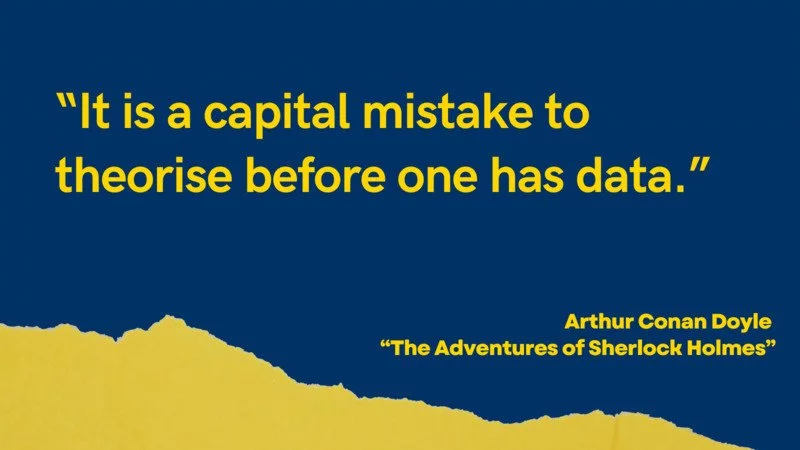
Notable quotes from The Adventures of Sherlock Holmes
- “When you have eliminated all which is impossible, then whatever remains, however improbable, must be the truth.” This quote captures Sherlock Holmes’ approach to deduction.
- “The world is full of obvious things which nobody by any chance ever observes.” The protagonist highlights the idea that many details in plain sight often go unnoticed. This quote underscores his exceptional ability to see and interpret things that others overlook.
- “There is nothing more deceptive than an obvious fact.” He reflects on the notion that appearances can be misleading. This quote underscores his knack for digging beyond the surface to uncover hidden truths.
- “It is a capital mistake to theorize before one has data. Insensibly one begins to twist facts to suit theories, instead of theories to suit facts.” The detective warns against jumping to conclusions based on preconceived notions. He stresses the importance of gathering accurate information before forming theories.
- “My name is Sherlock Holmes. It is my business to know what other people do not know.” In this introduction, the main character succinctly captures his role as a detective who possesses knowledge and insights that others lack. It highlights his confident and enigmatic persona.
- “Watson, if it should ever strike you that I am getting a little overconfident in my powers, or giving less pains to a case than it deserves, kindly whisper ‘Norbury’ in my ear, and I shall be infinitely obliged to you.” He humbly acknowledges that even he can become overconfident and miss important details. He trusts Watson to remind him of his fallibility, emphasizing the value of humility in detective work
The Writing Style Turns Rooms and Objects into Evidence
The Writing Style of The Adventures of Sherlock Holmes is economical, visual, and shaped by oral storytelling. Many cases begin with Watson re-entering Baker Street or recalling a period in his friendship with him. A visitor then presents an apparently disordered history. The investigation rearranges that history until rooms, clothing, documents, and gestures become parts of a causal design. Description quietly stores the solution.
Across the book, he varies the balance among dialogue, action, atmosphere, and retrospective explanation. “The Red-Headed League” begins in comic absurdity before revealing a bank-robbery plan. “The Speckled Band” uses a decaying country house, darkness, ventilation, and sound to create Gothic terror. “The Man with the Twisted Lip” turns a visual shock into a problem of profession, disguise, and social shame. The common structure remains flexible enough to host several tones.
Watson’s prose helps the stories move quickly. He records clients’ embedded narratives, summarizes travel and inquiry, and slows the action around significant objects without announcing their full relevance. His final explanation often repeats details in a new order. This repetition is productive because it converts sensation into knowledge and lets readers experience the distance between seeing and understanding.
The language also builds intimacy. Domestic scenes at Baker Street, jokes between friends, and Watson’s candid admiration soften the formal machinery of clues. In The Adventures of Sherlock Holmes, method matters because personality carries it. The style gives detection a repeatable architecture while making each return to the sitting room feel like entry into an ongoing friendship rather than the start of an impersonal exercise.
The Collection Creates a Modern Detective Myth
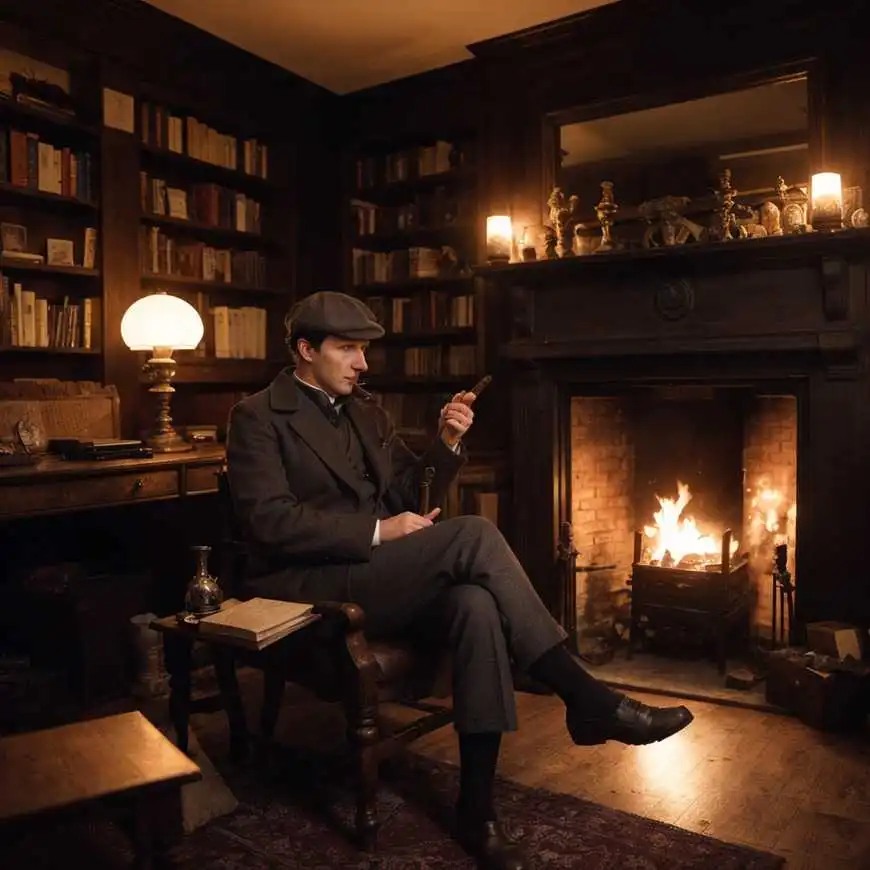
By the final story, The Adventures of Sherlock Holmes has created a recognizable world from recurring elements: Baker Street, Watson’s records, clients at the door, disguises, London journeys, sudden deductions, and explanatory endings. Later illustrators, actors, filmmakers, and readers consolidated additional visual signs, including the deerstalker and curved pipe, into an image more fixed than the stories themselves. Adaptation turns selected details into universal symbols.
Arthur Conan Doyle made that process possible by combining an unusual mind with a stable narrative relationship. The protagonist alone might become an abstract mechanism. Watson supplies memory, admiration, skepticism, and companionship, making the detective observable without making him fully accessible. The cases can then expand indefinitely because the friendship provides continuity while each client brings a new social world into the room.
The myth also simplifies its source. Popular culture often remembers pure rational victory, although the collection contains error, chance, moral discretion, delayed rescue, and mysteries rooted in unequal power. Irene Adler escapes. John Openshaw dies. Ryder is freed. Some explanations restore order, while others reveal that no institution can fully deliver it. These variations are not exceptions to the achievement. They keep the formula alive.
The work endures because it offers both confidence in interpretation and evidence against interpretive arrogance. Objects carry histories, stories can be reconstructed, and attention matters. Yet the observer remains a person whose knowledge, assumptions, and authority require judgment. That tension gives The Adventures of Sherlock Holmes a reach beyond its formula. The modern detective myth begins not with infallibility, but with a compelling method repeatedly tested by lives that exceed it.
More Reviews of Works by the well-known writer