King Lear by William Shakespeare: Power and Ruin
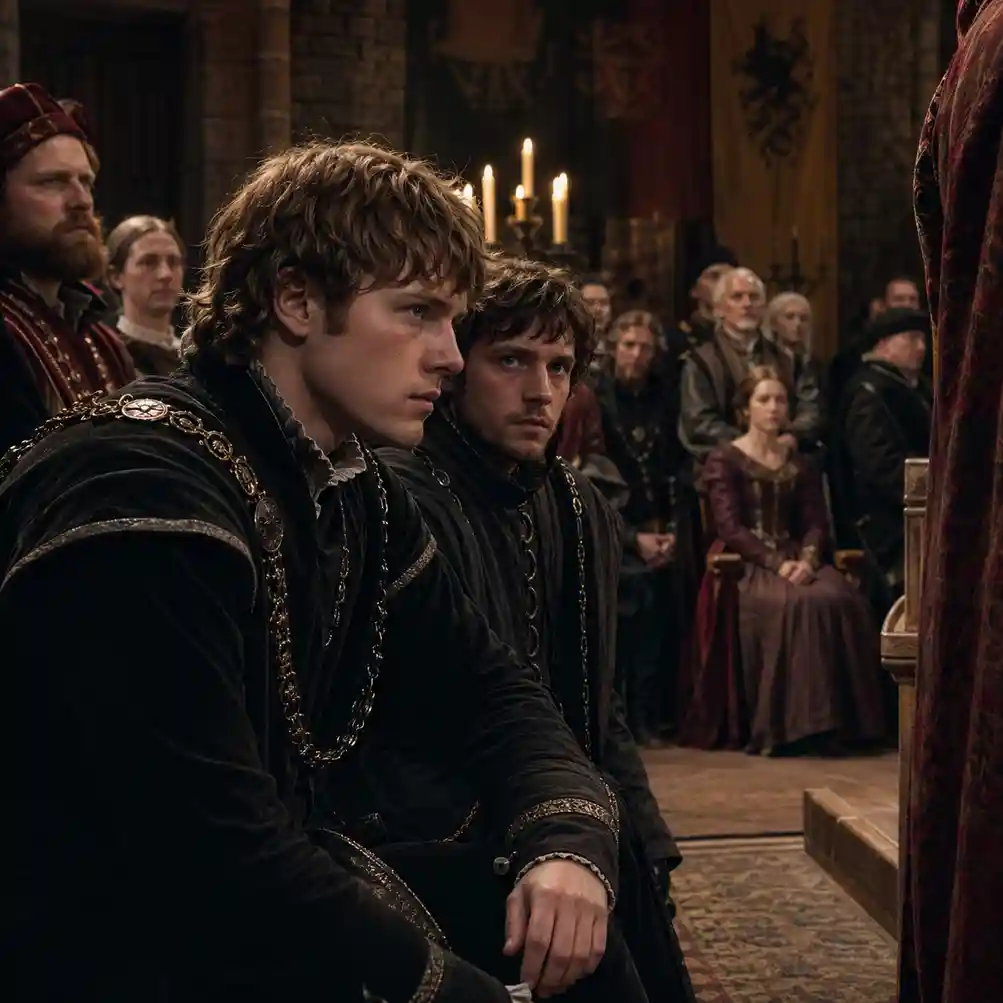
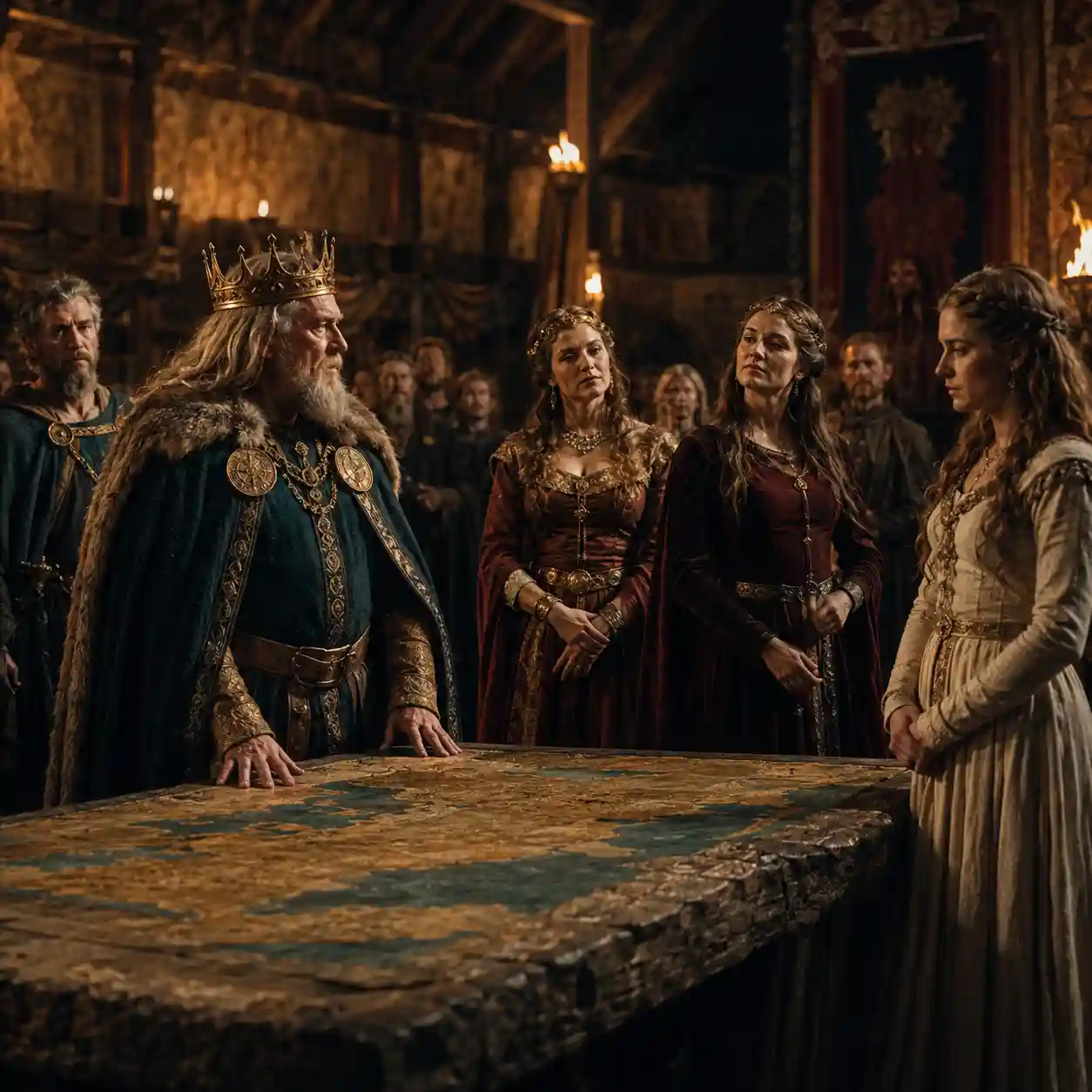
King Lear decides to divide Britain among his three daughters while retaining the name and privileges of kingship. Before distributing the land, he asks Goneril, Regan, and Cordelia to declare how much they love him. William Shakespeare makes the ceremony both political and intimate. A transfer of state power depends on a father’s need for emotional confirmation. Lear makes affection answerable to authority.
Goneril and Regan understand the performance. They describe limitless devotion and receive their portions. Cordelia refuses exaggeration. She loves him according to her bond as a daughter, but she will not convert that love into public spectacle. Her honesty enrages him. He disowns Cordelia, divides her share between her sisters, and banishes Kent for defending her. The King of France accepts Cordelia without a dowry.
Parental love and destructive possession also shape 👉 Beloved by Toni Morrison. Morrison works from slavery and maternal trauma, while he stages royal patriarchy. Both works ask how love can become violent when a parent claims authority over the beloved person’s meaning.
The tragedy begins with a demand for language. Lear already appears to know how he will divide the kingdom. The test exists to hear his preferred story of himself. In King Lear, Cordelia’s “nothing” does not mean an absence of love. It marks the boundary beyond which truthful feeling cannot be enlarged by speech. Lear treats that boundary as rebellion and gives power to the daughters most willing to flatter him.
King Lear Keeps the Title but Gives Away Control
After dividing the kingdom, Lear plans to alternate between Goneril’s and Regan’s households with one hundred knights. He has surrendered political control but expects the ceremonial and domestic privileges of sovereignty to remain untouched.
The arrangement fails because authority cannot be separated cleanly from the power to enforce it. Goneril objects to the behavior of his followers and reduces his retinue. Regan supports her sister. King Lear discovers that the title of king no longer compels obedience. He wanted retirement without limitation. His daughters’ cruelty is real, but it develops inside a political design built on his refusal to recognize dependence.
Family decisions and public history interact on an immense scale in 👉 War and Peace by Leo Tolstoy. Tolstoy questions the fantasy that rulers control history through will. The playwright concentrates a related lesson in one old king whose command collapses as soon as others possess the resources behind it.
He answers each loss with a larger curse. His language tries to recover material power through emotional force. Rage becomes the shadow of vanished command. Goneril and Regan are not merely ungrateful daughters. They are new rulers defending authority they were officially given. Still, their actions move beyond political consolidation toward humiliation, cruelty, and competition. King Lear refuses to make the original division innocent. The daughters exploit their father’s mistake, but Lear created a system in which family affection, inheritance, and government became impossible to separate.
Gloucester’s Family Repeats the Disaster in Secret
The Earl of Gloucester has two sons. Edgar is legitimate and positioned to inherit. Edmund was born outside marriage and has spent his life hearing his father treat that fact as an amusing embarrassment.
Edmund decides to seize the place denied him. He forges a letter suggesting that Edgar plans to overthrow Gloucester, then manipulates each man’s fear of the other. A false document defeats a lifelong bond. The subplot reflects his story without copying it. King Lear rejects the truthful child and rewards flattering children. Gloucester trusts the deceptive son and turns against the loyal one. Both fathers mistake confidence for insight.
An incomprehensible accusation dominates 👉 The Trial by Franz Kafka. Kafka’s Josef K. cannot reach the authority behind his prosecution. Edgar faces a more personal conspiracy, yet he also becomes guilty through a process whose supposed evidence he cannot challenge.
Edgar survives by becoming Poor Tom, a figure of nakedness, madness, and social abandonment. His disguise removes the rank Edmund desires. The legitimate son lives by appearing to possess nothing.
Edmund’s resentment contains a valid protest against laws that convert birth into destiny. His response, however, reproduces the same logic of domination. He seeks freedom by controlling Gloucester, Edgar, Goneril, and Regan. In King Lear, unjust exclusion can produce understandable anger without making every act of rebellion just. Edmund identifies a cruel hierarchy, then uses its methods more ruthlessly than those who benefited from it.
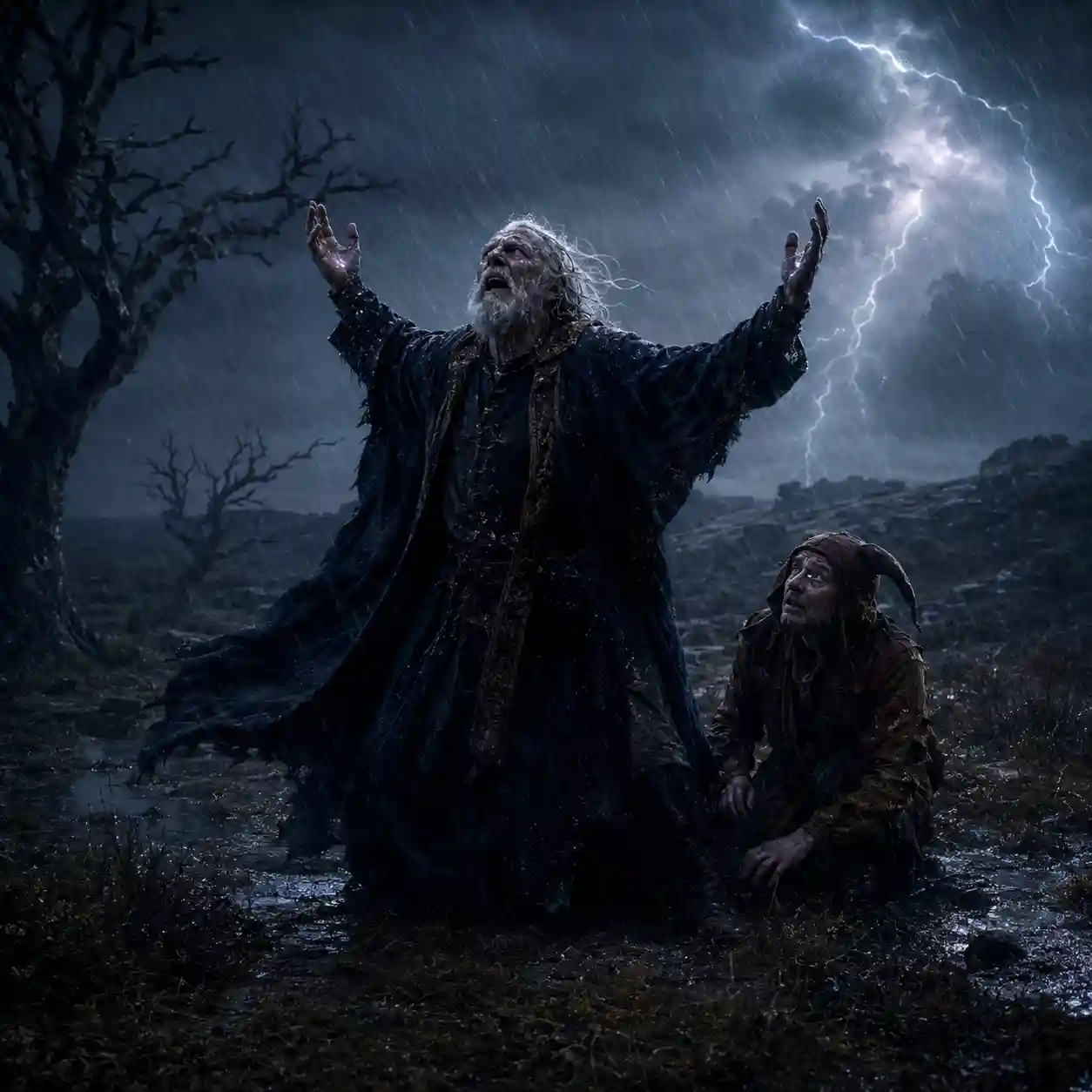
The Storm Removes the Shelter of Rank
Rejected by both elder daughters, Lear enters the storm with the Fool and the disguised Kent. The weather is physical, theatrical, and psychological at once. Wind and rain attack a body that has spent a lifetime protected by royal structures.
The king meets a world that does not obey him. Lear commands the storm to intensify because rage is the only sovereignty he can still perform. The extremity breaks his usual self-concern. Seeing Poor Tom, he begins to think about people who endure exposure without servants, homes, or political protection. The insight arrives late, but it is morally significant.
Crisis also reveals character in 👉 The Plague by Albert Camus. Camus places ordinary people inside collective disaster and asks what solidarity remains possible. His storm is shorter and more symbolic, yet it similarly removes the illusion that status protects anyone from bodily vulnerability.
Madness enlarges Lear’s attention. It also punishes him. The bard does not romanticize mental collapse as a simple route to wisdom. He gains recognition while losing the stable power to use it.
The Fool guides this transformation through riddles, songs, and cruel accuracy. He can tell the king truths that formal advisers cannot safely speak. Kent serves through disguise because open loyalty led to banishment. In King Lear, truth survives at the margins of official identity: in a fool, an outlawed nobleman, a disguised son, and a king who can begin to see only after losing command.
Blindness Becomes Literal Before Insight Arrives
Gloucester helps him despite orders from Cornwall and Regan. Edmund betrays him, and Cornwall has Gloucester’s eyes torn out. The violence makes the play’s language of sight brutally physical.
Only after being blinded does Gloucester learn that Edgar was loyal and Edmund deceived him. Recognition arrives when vision is gone. The reversal is severe because the truth had been available through character long before it became undeniable through suffering.
An old servant resists Cornwall and wounds him. The intervention cannot save Gloucester’s eyes, but it proves that hierarchy does not erase moral judgment. A subordinate can recognize atrocity more clearly than the nobles commanding him.
Edgar encounters his blinded father while still disguised as Poor Tom. He does not immediately reveal himself. Instead, he guides Gloucester toward Dover after the old man expresses a wish to die. At the imagined cliff, Edgar stages a survival. Gloucester believes he has fallen and been miraculously preserved. A loving deception answers Edmund’s destructive lie. Both sons manipulate perception, but one does so to restore a desire to live.
The parallel does not make Edgar’s conduct ethically simple. His delay prolongs Gloucester’s ignorance. Yet King Lear distinguishes lies by their relation to another person’s freedom and survival. Sight in the play is therefore more than perception. It involves the willingness to recognize another person outside inherited assumptions. Lear and Gloucester possessed healthy eyes when they misunderstood their children. Physical loss forces each man toward a more difficult vision.
Cordelia Returns Without Demanding Victory
Cordelia comes back to Britain with French forces and reunites with him. Their meeting abandons the competitive language of the opening scene. Lear no longer asks her to prove love. He recognizes his foolishness and does not assume he deserves forgiveness. Reconciliation begins after authority stops bargaining. Cordelia answers with tenderness rather than a speech of triumph. Her brevity remains consistent. She loved him when he demanded excess, and she loves him when he can finally receive something quieter.
Redemptive sacrifice shapes 👉 A Tale of Two Cities by Charles Dickens. Dickens gives sacrifice a future-oriented moral design. Shakespeare offers no comparable guarantee. Cordelia’s goodness restores a relationship but cannot control military defeat.
Lear briefly imagines prison with her as a protected world. They will talk, sing, laugh at court politics, and observe power from outside it. Captivity appears freer than kingship. The fantasy is moving because he has learned intimacy after losing the conditions that might have allowed it to continue.
Edmund’s order for their deaths interrupts that hope. Although he later attempts to reverse the command, the correction comes too late for Cordelia. King Lear refuses the structure in which moral awakening earns rescue. He changes, Cordelia forgives, and their reunion still ends in catastrophe. Redemption exists within the relationship, not as control over the plot. That distinction makes the final loss more devastating. What dies is not merely an innocent daughter. It is a shared future that had only just become imaginable.
Nothing Comes of Nothing: Essential King Lear Quotes
- “Nothing will come of nothing. Speak again.” Lear mistakes verbal restraint for emotional emptiness. His inability to recognize Cordelia’s honest love initiates the tragedy. 🌐 Source
- “How sharper than a serpent’s tooth it is / To have a thankless child.” Lear gives his suffering cosmic force, but the animal image also hides his responsibility for destroying the family’s bonds.
- “Blow, winds, and crack your cheeks! Rage, blow!” The storm externalizes Lear’s fury while stripping away the political authority that once protected him from nature and consequence.
- “I am a man / More sinned against than sinning.” Lear begins to recognize his vulnerability, although his judgment remains incomplete. Suffering has produced insight, but not yet full self-knowledge.
- “As flies to wanton boys are we to th’ gods; / They kill us for their sport.” Gloucester imagines human pain as meaningless divine entertainment. The image articulates the play’s bleakest interpretation of existence.
- “Never, never, never, never, never.” Repetition replaces argument when Lear enters with Cordelia’s body. Language contracts into a single word that cannot contain his grief.
- “Speak what we feel, not what we ought to say.” The ending reverses the love test that began the play. Survival now depends upon honest feeling rather than ceremonial performance.🌐 Folger.edu
Two Texts, One Shattered Kingdom: Surprising King Lear Facts
- Its earliest recorded performance was a Christmas event: The 1608 Quarto reports that King Lear was performed before James I at Whitehall on St Stephen’s Night, December 26, 1606. Richard Burbage probably created the role of King Lear. 🌐 RSC
- There is no single uncontested early text: The 1608 Quarto and 1623 First Folio differ in wording, speeches, scene construction, and character emphasis. The Folio omits hundreds of lines found in the Quarto while supplying material absent from it.
- The final speaker changes between editions: Albany delivers the concluding lines in the Quarto, but Edgar receives them in the Folio. That small alteration changes who appears responsible for rebuilding the ruined state—a question also central to 👉 Wallenstein by Friedrich Schiller.
- Deliberately destroyed the traditional happy ending: Earlier versions of his legend generally restored Cordelia and her father. The writer instead lets political error culminate in irreversible family catastrophe, creating an instructive parallel with 👉 Medea by Christa Wolf.
- A happy adaptation displaced his tragedy: Nahum Tate’s 1681 version removed the Fool, saved Lear and Cordelia, and married Cordelia to Edgar. It dominated English performance until William Charles Macready restored much of his text in 1838.
- The play was once considered too painful for the king: Performances were prohibited in Britain from 1810 to 1820 because George III’s mental illness made a tragedy about a mad monarch politically and personally uncomfortable.🌐 Source RSC.CO.UK
- The Fool possesses protected truth-telling power: A court fool could challenge the monarch under the cover of comedy. HIs Fool consequently understands the king’s mistake earlier than almost anyone, transforming jokes into political diagnosis.
- Nature overwhelms the play’s language: According to the Royal Shakespeare Company, King Lear contains more references to animals and the natural world than any other play. Serpents, wolves, vultures, dogs, and predatory birds turn family conflict into a vision of elemental disorder.
Language Builds and Destroys Political Reality
Words redistribute land in the opening scene, invent Edgar’s conspiracy, disguise Kent’s loyalty, and give Poor Tom a new identity. Speech in King Lear does not simply describe power. It performs power. The repeated word “nothing” becomes central. Cordelia offers nothing beyond honest duty. Lear warns that nothing will come of nothing. Edgar loses social identity and becomes an apparent nothing. Emptiness repeatedly exposes false value.
He also gives different characters distinct verbal pressures. Lear’s language expands through curses, questions, and elemental imagery. The Fool compresses truth into jokes. Edmund argues with sharp, energetic logic. Cordelia speaks sparingly. Edgar moves between educated speech, invented madness, and moral guidance.
Its position in english literature also involves a complicated textual history. The 1608 quarto and the 1623 folio differ substantially, including lines and scenes unique to each version. Modern editions may combine them or treat them as related but distinct dramatic texts. There is no perfectly neutral King Lear. Editorial choices affect pace, characterization, and performance. The instability suits a play already concerned with unreliable speech and contested authority.
Nature carries several meanings as well. Lear appeals to natural bonds between parent and child. Edmund invokes nature against social laws of legitimacy. The storm demonstrates nature’s indifference to royal titles. Language creates kingdoms, families, and identities, yet words cannot guarantee that those structures correspond to truth. The tragedy begins because he believes public speech can measure love. It ends after experience has taught him what language cannot secure.
The Ending Offers Grief Without Moral Balance
Edmund, Goneril, and Regan destroy one another through ambition and sexual rivalry. Gloucester dies after learning Edgar’s identity, overwhelmed by grief and joy. Cordelia is executed, and he enters carrying her body.
He searches for signs of breath and cannot accept the stillness before him. The father finally sees the child without a role. Cordelia is no longer an heir, a rebel, or an emblem of honesty. She is the person he loves and cannot restore. The ending resists a confident belief in earthly justice. Several villains die, but their deaths do not compensate for Cordelia, Gloucester, the Fool, or the suffering created by civil war.
Edgar and Albany remain to govern what survives. Their authority begins in exhaustion rather than celebration. The kingdom is inherited as damage. King Lear nevertheless avoids simple nihilism. Kent’s fidelity, the servant’s resistance, Cordelia’s forgiveness, Edgar’s care, and his late compassion all possess value even though they do not defeat death.
The tragedy’s moral world therefore rests on action without guaranteed reward. People must choose loyalty and mercy because those acts answer suffering, not because the universe promises to balance an account.
The main character began by asking how much love his daughters could declare. He ends unable to convert love into language large enough for grief. That movement gives King Lear its enduring force. Power is stripped away, insight arrives too late, and justice remains incomplete. Yet the capacity to recognize another person becomes more precious precisely because it cannot command the ending.