The Book of Sand by Jorge Luis Borges
The Book of Sand feels like a late return to his oldest obsessions, but with a leaner and colder touch. Jorge Luis Borges gathers stories about infinite books, doubles, mirrors, old enemies, memory, fate and objects that break the limits of ordinary perception. The collection does not try to be expansive in the usual sense. Many stories are short, almost bare. Yet each one opens a trapdoor beneath reality.
The title story gives the book its central image: a volume with no first page and no last page, a book whose pages never return in the same way. That object is frightening because it looks harmless. It is not a monster with teeth. It is a book, the very thing readers normally trust. The author turns reading into danger. Knowledge becomes endless and therefore unbearable.
This late style is important. The stories often feel simpler than earlier Borges, but the simplicity is deceptive. A stranger arrives. A book is offered. A memory returns. A meeting occurs. Then the world tilts. The plot may be modest, but the metaphysical shock is not.
That is why The Book of Sand remains so effective. It understands that the infinite is most frightening when it enters a room quietly. He does not need cosmic spectacle. A conversation, a page number or a mirror can be enough to suggest that reality is less stable than habit claims.
Infinity in a human room
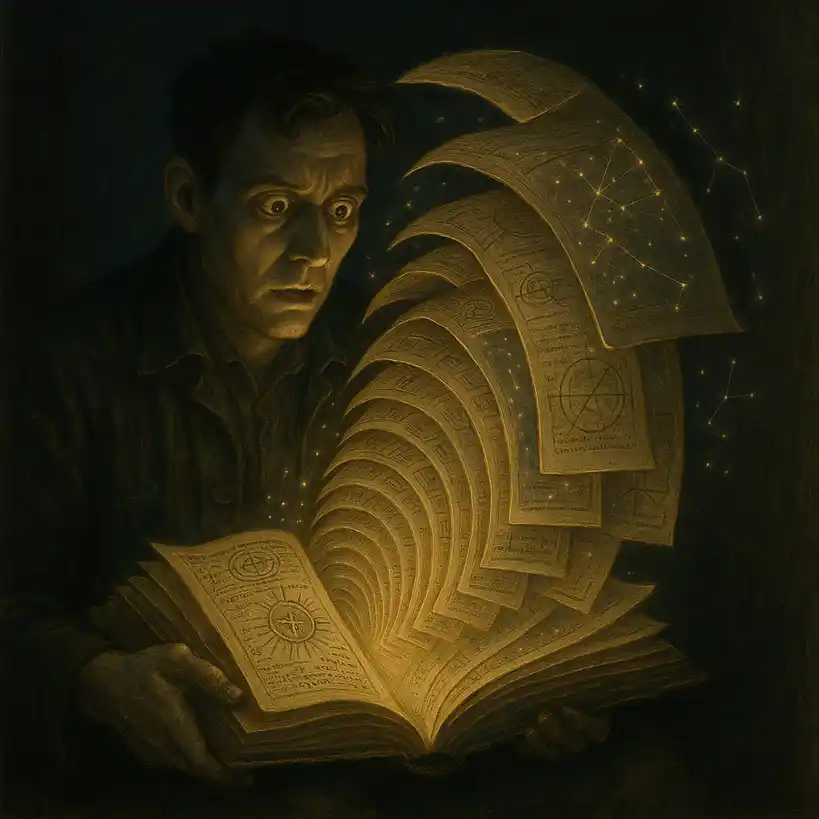
The infinite in The Book of Sand is not abstract mathematics. It enters domestic space. It sits on a shelf, passes from hand to hand and occupies the mind of a narrator who slowly becomes unable to live normally. His genius lies in reducing the universe to an object small enough to hold. The effect is terrifying because the object cannot be mentally contained.
This is different from wonder in a romantic sense. The infinite does not liberate the owner of the book. It imprisons him. He becomes obsessed, secretive and afraid. He wants to look, but each look confirms that the book exceeds him. The desire to know becomes a form of sickness. The mind collapses before endlessness.
That idea gives the collection a strangely modern force. A reader today can recognize the fear of infinite information, even when he writes through an older, quieter symbolic world. The endless book anticipates a condition in which attention is trapped by abundance. More pages do not mean more wisdom. They may mean less peace.
A useful companion is 👉 The Glass Bead Game by Hermann Hesse. Hesse imagines a refined intellectual system that turns knowledge into almost sacred play. The novelist is more compact and more unsettling, but both writers ask what happens when the mind tries to create or enter total structures.
In The Book of Sand, totality is not victory. It is a curse disguised as possession. The narrator does not master the infinite book. He must hide it, because some objects can be survived only by losing them.
Doubles, strangers and other selves
Several stories in The Book of Sand return to the fear of meeting oneself in another form. The writer had long been fascinated by doubles, and this late collection treats that fascination with a special severity. A double is not just a playful device. It is an assault on identity. If another self exists, then the boundaries of the person become uncertain.
The power of these stories comes from their calmness. The author rarely stages panic in obvious ways. A meeting happens. A voice speaks. A recognition dawns. The narration remains controlled, but the situation undermines everything. The self, which should be the most intimate certainty, becomes a puzzle with more than one answer.
This theme links strongly to 👉 The Book of Disquiet by Fernando Pessoa. Pessoa’s prose fragments turn identity into a field of masks, impressions and unstable selves. He is less confessional and more architectural, but both writers understand the self as something divided by language and thought.
In The Book of Sand, the double also carries time. To meet another version of oneself is to meet memory, regret or destiny in human form. Identity becomes a corridor, not a room. The person is no longer a single center. He is a relation between versions.
This gives the collection emotional depth beneath its intellectual surface. His puzzles are never merely clever. They disturb because they touch ordinary fears: What if I am not unique? What if my life could have been otherwise? What if the stranger is not outside me, but waiting inside my own name?
Stories as traps of belief
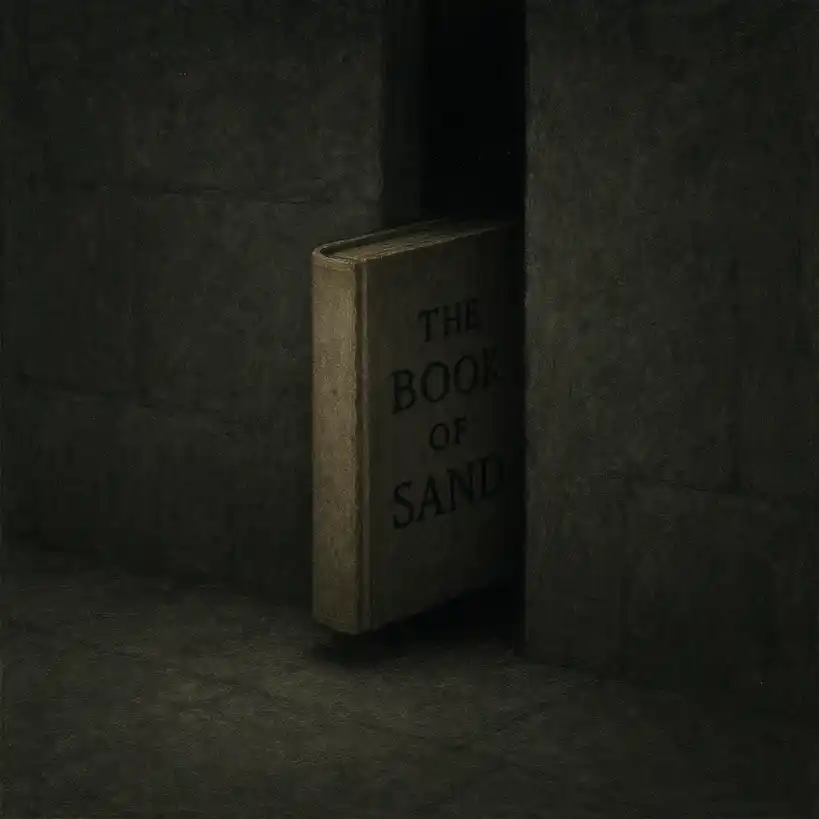
The writer often begins with a tone of reliability. A narrator reports, remembers or confesses. The voice can sound modest, even factual. Then the story introduces an impossible element and asks the reader to accept it with the same calm. This method is central to The Book of Sand. The fantastic does not arrive with thunder. It arrives inside believable speech.
That is why the collection’s stories feel like traps of belief. They use the manners of testimony to smuggle in metaphysical impossibility. The reader knows that something cannot be true, but the voice behaves as if truth has already been settled. The novelist makes uncertainty elegant. He does not need to explain every mechanism. The unexplained is part of the design.
This creates a distinctive reading experience. We are not asked only what happened. We are asked what kind of story could make the impossible feel reportable. The voice becomes the first labyrinth.
That quality connects the book to 👉 The Counterfeiters by André Gide. Gide also plays with fiction, authorship and the unstable relation between life and literary form. He works in miniature and with stronger metaphysical compression, but both writers enjoy exposing the artificiality of narrative without destroying its power.
In The Book of Sand, belief is never innocent. A story can persuade before it proves. A narrator can seem truthful while leading us into paradox. His craft lies in making the reader enjoy that danger. We step into the trap because the sentences are clear, balanced and quietly irresistible.
The art of sparseness
The late Borges of The Book of Sand is not simply repeating earlier triumphs. He is reducing them. The stories often move with remarkable economy. They avoid decorative excess. They feel close to parable, anecdote, dream report or scholarly aside. This sparseness can make the collection seem less dazzling at first than some earlier work, but its restraint has its own severity.
The sentences often behave as if they have removed everything unnecessary. A room, a visitor, an object, a memory, a name. From these few elements he builds philosophical unease. The result can feel almost skeletal, yet the bones are arranged with precision. The simplicity is a form of pressure.
This restraint also suits the collection’s themes. Infinity, death, identity and memory do not need elaborate staging. The writer suggests that the greatest terrors are already near ordinary life. A book on a shelf can be more disturbing than a supernatural battlefield. A casual encounter can disturb the idea of self more deeply than a dramatic revelation.
The collection may not have the shock of absolute novelty for readers who already know his major stories. Still, it has the authority of an artist returning to essential forms. The late style is drier, quieter and sometimes harsher.
That dryness matters. The Book of Sand does not try to seduce the reader with lushness. It offers polished surfaces that reflect impossible depths. The pleasure comes from watching how little he needs in order to disturb everything.
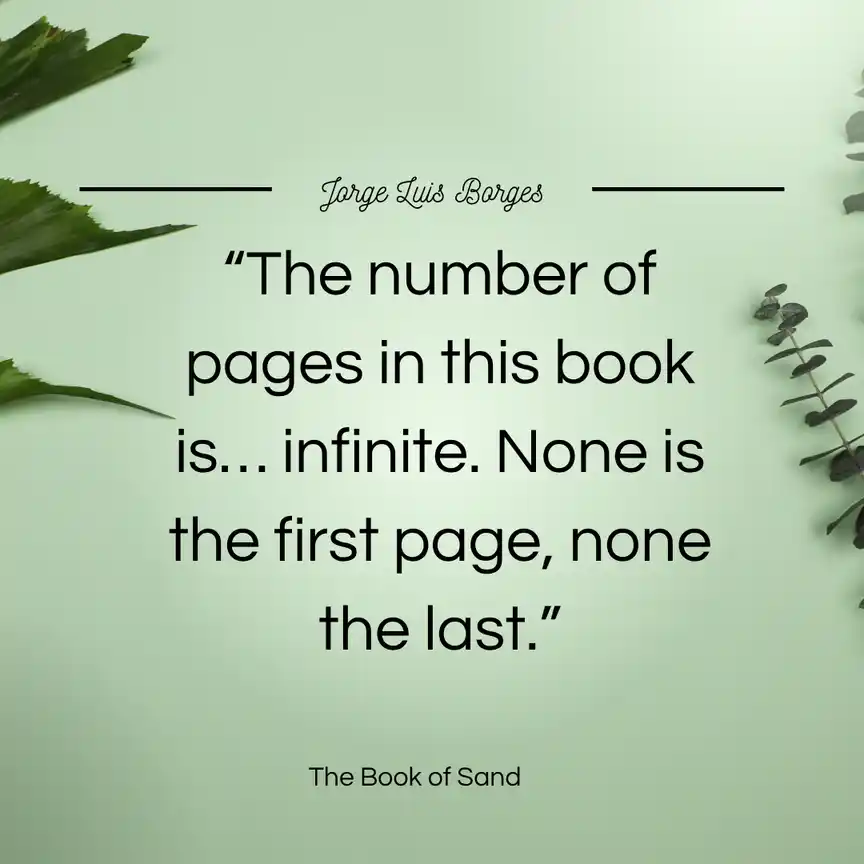
Quote List for The Book of Sand
- “Mine, however, is true.” This opening claim gives The Book of Sand its sly power. The narrator knows that fantastic stories often pretend to be factual, yet he insists on truth anyway. As a result, the reader enters a paradox before the impossible book even appears.
- “Holy Writ” These words on the spine make the object look sacred before it becomes terrifying. In The Book of Sand, holiness and danger sit close together, because the book promises revelation while slowly damaging the person who owns it.
- “This can’t be.” The narrator’s disbelief matters because it is so ordinary. He does not respond with theory first, but with shock. Therefore the story turns infinity into a physical disturbance, something handled, opened, closed, and still not mastered.
- “a nightmarish object” This phrase marks the shift from wonder to contamination. The book no longer feels like treasure or miracle. Instead, it becomes an obscene pressure on reality, because its endlessness breaks the scale that lets human life remain bearable.
- “the best place to hide a leaf is in a forest” This final strategy is beautifully ironic. The narrator does not destroy the infinite book. Instead, he buries it among ordinary books, as if one library could absorb the impossible. Consequently, The Book of Sand ends not with mastery, but with avoidance, relief, and lingering fear.
Context-Rich Trivia List for The Book of Sand
- A late collection: The Book of Sand first appeared in Spanish in 1975 as El libro de arena. 🌐 Penguin describes it as Jorge Luis Borges’s last major story collection, and that late position matters because the stories feel stripped, direct, and haunted by final forms.
- The New Yorker bridge: “The Book of Sand” reached English-language readers through 🌐 The New Yorker in 1976, translated by Norman Thomas di Giovanni. The magazine version places the narrator in Buenos Aires and builds the plot from a strange visitor, a Bible seller, and an impossible book.
- A book as labyrinth: The volume has no first or last page, so reading becomes a trap rather than a path. That makes 👉 The Castle by Franz Kafka a strong internal echo, because both works turn access and orientation into torment.
- Infinity with rules: The story’s numbered pages and repeated search for order recall abstract games of meaning. Therefore 👉 The Glass Bead Game by Hermann Hesse fits the context, because both works connect intellect, pattern, and spiritual danger.
- An old bookish lineage: The seller’s Bibles, the Wyclif volume, and The Thousand and One Nights place the tale inside a long history of sacred and enchanted books. That tradition also links naturally to 👉 Don Quixote by Miguel de Cervantes, where reading transforms reality itself.
Books, danger and secret possession
Books in The Book of Sand are never only books. They are portals, burdens, temptations and traps. He writes as someone who loves libraries, but he refuses to make reading harmless. To possess a book may mean to possess danger. To open a page may mean to lose peace. To search for knowledge may mean to become owned by what one finds.
The title story makes this danger clearest, but the logic spreads across the collection. Texts preserve, but they also unsettle. They promise order, but they can reveal that order is impossible. They may connect the reader to tradition, yet they may also isolate him from ordinary life. The owner of the infinite book becomes less free because of what he knows he has.
This ambivalence gives the book its quiet horror. It is not anti-literary. It is too literary to be naive about literature. The author knows that books can enlarge life, but he also knows that they can replace it. The reader can become the prisoner of reading.
A strong comparison appears in 👉 Fahrenheit 451 by Ray Bradbury. Bradbury imagines a society that fears books and burns them. The writer imagines a reader who fears a book because it cannot be mentally burned away. One writer sees censorship as nightmare. The other sees unlimited textual excess as metaphysical terror.
In The Book of Sand, the most dangerous possession is not wealth or power. It is a book that proves the mind has limits. The narrator must hide it among other books, almost as if burying an idol.
Why the sand still shifts
The Book of Sand endures because its central anxieties have become more recognizable, not less. The novelist writes about infinity, unstable identity, dangerous books and the failure of mastery. Those concerns belong to metaphysics, but they also feel close to modern experience. We live surrounded by more information than we can hold, more versions of ourselves than we can control and more stories than we can verify.
The collection is powerful because it gives these anxieties perfect shapes. An endless book. A double. A strange visitor. A memory that refuses to settle. Borges’s images are precise enough to be memorable and open enough to keep changing meaning. That is why the sand of the title still moves. The book cannot be fixed in one interpretation.
It is also a deeply disciplined collection. Even when the ideas are vast, the stories remain compact. He trusts implication. He does not exhaust his symbols by explaining them. The mystery survives because the form is exact.
For new readers, The Book of Sand may be a colder entrance into the author than some earlier collections. For returning readers, it offers the pleasure of late concentration. The familiar obsessions are still there, but they sound closer to final statements.
The book’s lasting force lies in its refusal to comfort the mind. It suggests that reality may contain objects, memories and selves that exceed every system we build. He does not ask us to solve that terror. He asks us to notice how beautiful its form can be.