West-Eastern Divan by Johann Wolfgang von Goethe
West-Eastern Divan begins with an act of reading that becomes an act of reply. In 1814, Johann Wolfgang von Goethe encountered the poetry of the fourteenth-century Persian poet Hafez through Joseph von Hammer-Purgstall’s German translation. He did not treat Hafez as a silent authority to be admired from afar. Instead, he imagined the Persian poet as a companion, rival, teacher, and poetic twin. The resulting collection, first published in 1819 and expanded in 1827, turns literary influence into a staged conversation across languages, religions, and centuries.
This origin gives the book its distinctive energy. It is neither a translation of Hafez nor a systematic account of Persian culture. It is a German lyric cycle that tests how far a poet can travel through language and imagination. Reading becomes a form of movement, while imitation becomes a way of discovering another voice within one’s own. The title’s hyphen matters because East and West are not placed in sealed compartments. They continually approach, question, and alter each other.
The poems move between praise, love, satire, spiritual reflection, maxims, historical figures, wine, old age, and poetic ambition. A playful couplet may open onto theology, while a declaration of love may also describe the bond between poets. Readers who value poetry on a broader historical canvas may continue with 👉 Canto General by Pablo Neruda, where geography and inherited voices likewise shape an expansive lyrical project.
What makes West-Eastern Divan compelling is therefore not a single argument. Its achievement lies in the restless practice of encounter. The collection asks what happens when admiration refuses to remain passive and begins to create.

Reading Hafez from Weimar
The German poet never visited Persia, and he did not read Hafez in the original language. His journey eastward passed through translation, scholarship, travel writing, biblical learning, and the European Oriental studies available to him. That mediation must remain visible. West-Eastern Divan does not offer unfiltered access to Persian poetry. It records how a highly informed European poet responded to materials that had already crossed several linguistic and intellectual borders.
Hammer-Purgstall’s translation proved decisive. Its limitations have often been discussed, yet it gave the author a sufficiently vivid sense of Hafez’s shifting tones: reverent and irreverent, sensual and mystical, intimate and public. He recognized a poetic freedom that resisted rigid interpretation. Hafez could praise wine without reducing wine to one meaning, invoke religious language while teasing religious authority, and present the poet as both lover and sage. Ambiguity became the point of kinship.
The encounter arrived after Europe had endured the Napoleonic wars. The aging writer sought a space beyond immediate political exhaustion. Yet this poetic refuge was not simple withdrawal. Distance allowed the poems to reconsider authority, belief, desire, and identity from unfamiliar angles.
That process resembles an imaginative journey more than a scholarly destination. In 👉 The Voices of Marrakesh by Elias Canetti, attention to speech, gesture, and sound likewise makes cultural encounter depend on alert perception rather than mastery. Yet West-Eastern Divan remains rooted in books. Its Persia is encountered in a library, and its creative honesty depends on remembering that fact.
Twelve Books in Motion
The word “divan” suggests an assembled collection, and the architecture of West-Eastern Divan honors that principle. Its twelve books include sections devoted to the singer, Hafez, love, reflection, ill humor, maxims, Timur, Suleika, the cupbearer, parables, the Parsees, and paradise. These headings promise order, but the poems refuse to stay inside neat thematic borders. Love becomes poetics, wine approaches revelation, and historical reference turns into self-portraiture.
This arrangement creates unity without a continuous plot. Motifs return in altered forms, voices answer earlier voices, and Persian names allow the speaker to shift identities. The collection can be read from beginning to end, yet it also invites wandering. A maxim may compress an uncertainty that a love poem leaves unresolved. Such echoes matter more than chronology.
The sequence also expands the idea of lyric authorship. Instead of presenting one stable authorial speaker, the poems use masks, roles, dedications, and imagined dialogues. Hatem, Suleika, the cupbearer, the sage, and the admirer of Hafez overlap without becoming identical. The author does not disappear, but his authority becomes mobile. The self grows through adopted forms.
Readers familiar with European lyric collections may find a useful companion in 👉 The Book of Songs by Heinrich Heine. Heine’s sharper irony and more concentrated emotional drama differ greatly, yet both works show how a sequence can build meaning through recurring tones rather than narrative continuity.
The twelve-part design therefore does more than display cultural learning. It gives West-Eastern Divan a flexible inner rhythm. The book behaves like a gathering whose participants enter, depart, and return. No voice owns the room for long, and no theme reaches a final definition.
Hatem and Suleika Speak
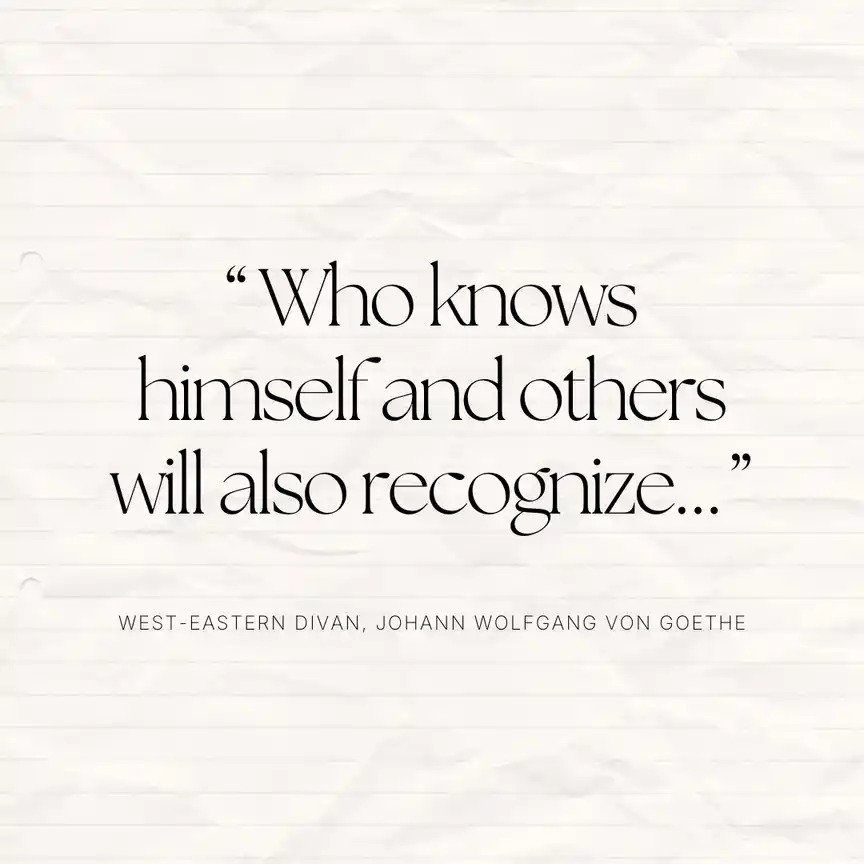
The “Book of Suleika” forms the emotional center of West-Eastern Divan. Here the masks of Hatem and Suleika turn love into dialogue. Hatem carries aspects of the poet himself, while Suleika is connected with Marianne von Willemer, whom Goethe met during the years in which the cycle took shape. Their exchange draws on Persian names and traditions, but it also preserves the excitement, distance, and intellectual intimacy of a real relationship.
This section changes the balance of the collection because Suleika does not function merely as an object of praise. She answers. Her voice redirects images, interprets absence, and gives desire its own intelligence. Several poems included under his name were written by Marianne von Willemer, whose authorship became publicly known only later. That history makes the dialogue materially collaborative. The beloved is also a poet, and the apparent solo performance contains another authorial presence.
Wind, scent, leaves, writing, and direction become agents of connection. Separation forces feeling into signs that can travel. The ginkgo leaf, divided and joined within one form, becomes a fitting emblem: two identities remain distinct within a shared shape.
Love in these poems is playful, ceremonious, sensual, and self-aware. It often reflects on the language that carries it. That reflexive quality links the section to 👉 Tenderness by Gabriela Mistral, another lyric space in which intimacy acquires formal discipline and emotional force.
The Hatem-Suleika exchange gives West-Eastern Divan its warmest human pulse. More importantly, it demonstrates dialogue as a creative structure. One voice does not complete the other. Each voice creates the conditions in which the other can be heard differently.
Wine, Faith, and Double Meaning
Wine flows throughout West-Eastern Divan, but it never settles into a single symbolic role. It belongs to sociability and sensuous pleasure, yet also suggests inspiration, spiritual release, forbidden knowledge, or resistance to moral supervision. The cupbearer can serve the body, imagination, and soul at once. Hafez’s images similarly resist a final division between sacred and profane.
The religious language of the collection works in a similar way. Islamic references, Quranic resonances, biblical traditions, Zoroastrian material, and the poet’s own speculative faith enter a field of comparison. They do not produce a tidy universal creed. Instead, the poems look for affinities while retaining contradiction. Faith appears as lived poetic tension, not as a doctrinal system.
This method can unsettle readers who expect firm statements. A line may sound devout before humor changes its pressure. Praise may contain self-mockery. Earthly desire may rise toward transcendence, only for transcendence to return to the senses. The collection repeatedly rejects the assumption that spiritual seriousness requires a joyless tone.
Its wisdom poems and parables deepen that effect. They offer compact insights, yet many behave less like rules than provocations. A maxim may clarify one problem while opening another. In this respect, 👉 Four Quartets by T. S. Eliot provides a revealing counterpoint. Eliot’s meditations on time and spiritual discipline are more austere, but both works ask poetry to approach realities that direct explanation cannot exhaust.
The doubleness of wine, love, and belief is central to the pleasure of West-Eastern Divan. Meaning ripens through instability. The poems do not ask readers to solve their images. They ask us to remain alert to several meanings living together.

The Risk of an Imagined East
A contemporary reading of West-Eastern Divan must hold admiration and scrutiny together. The collection reaches beyond the provincial confidence of its period, respects Persian poetry as a major tradition, and imagines cultural difference as intellectually transformative. Yet its East remains constructed through European translations, scholarship, conventions, and desires. The poet controls the frame, even when he seeks dialogue within it.
This tension prevents easy celebration. Persian names and settings can sometimes operate as poetic costumes. Broad references to “East” and “West” compress diverse languages, peoples, histories, and religions into large symbolic regions. An invitation to encounter can still contain imbalance. The writer possesses the freedom to travel imaginatively, select what speaks to him, and return with new forms. The cultures he invokes do not receive equal historical specificity.
At the same time, the work often exposes rather than conceals the mediated nature of its project. Its “Notes and Essays for a Better Understanding” acknowledge the reader’s need for context and reveal the labor behind the poems. They also display the period’s classifications and blind spots. Reading the prose alongside the lyrics shows knowledge being assembled, tested, and sometimes strained.
The right response is neither dismissal nor innocence. West-Eastern Divan becomes more valuable when read as a bold but situated experiment. Its openness was real, and so were its limits. The book demonstrates that cross-cultural reading does not abolish distance. It makes the ethical handling of distance part of interpretation.
That complexity distinguishes the cycle from a fantasy of exotic escape. The imagined East reflects questions back toward Europe: Who defines orthodoxy? What makes a poet free? The questions outlast the answers.
Poetry as World Literature
The deepest legacy of West-Eastern Divan lies in its model of literature as circulation. A Persian poet reaches a German reader through an Austrian translator. That reader responds with new poems, some of which contain the voice of Marianne von Willemer. Later translators, composers, scholars, and poets carry the cycle into further languages and art forms. No stage of the journey is final.
This movement anticipates the expansive idea often associated with Goethe’s later reflections on world literature. The point is not a bland global canon in which differences become interchangeable. The cycle suggests something more demanding: traditions develop through attention, translation, misreading, correction, imitation, and reply. Literature crosses boundaries because readers accept the risk of being changed by what they cannot wholly possess.
Form makes that idea tangible. The poems borrow the name and organizing principle of the divan without reproducing a Persian original. They create German rhythms around foreign names, images, and histories. The result belongs completely to neither side of the title. It occupies the hyphen, a narrow sign made into a meeting place.
Still, the collection’s ideal of exchange should not be confused with effortless harmony. Translation changes what it carries. Historical inequalities accompany cultural curiosity. West-Eastern Divan matters because it allows those pressures to remain visible within a work of pleasure. Its worldliness comes not from covering the world, but from recognizing that a poem may begin in one place and acquire an unpredictable life elsewhere.
Quote List for West-Eastern Divan
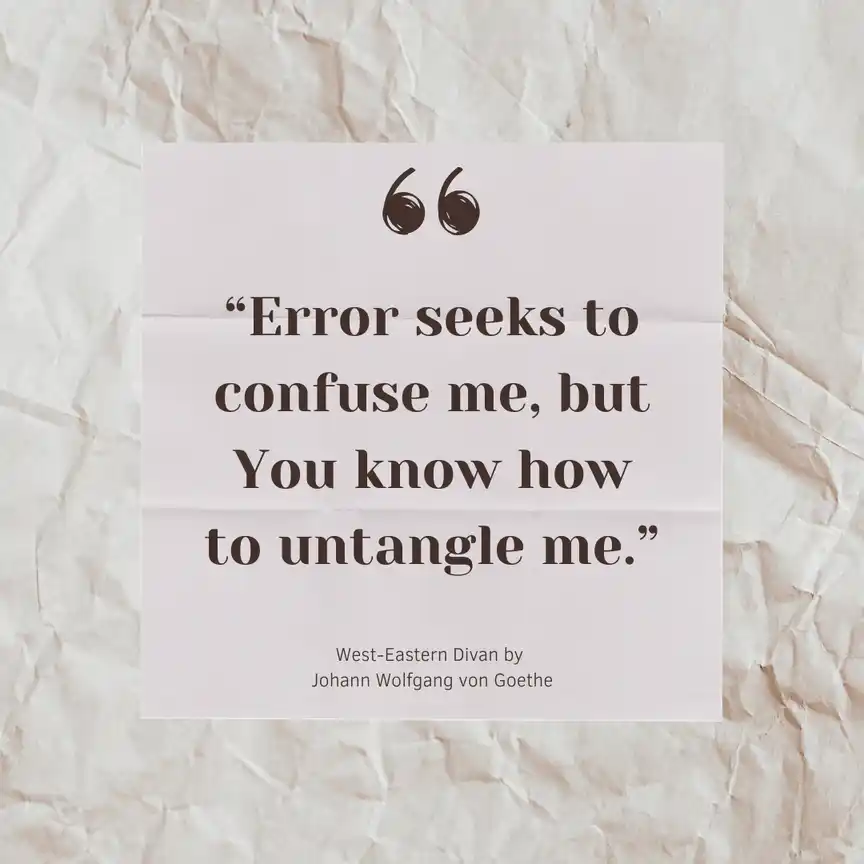
- “Who the song would understand, / Needs must seek the song’s own land.” The opening couplet presents attentive reading as a journey toward another culture. Understanding requires curiosity, context, and movement beyond familiar assumptions.
- “God of the east possessed, / God is ruler of the west.” These lines reject any spiritual division between regions. Instead, the poem places both worlds within one sacred order.
- “That thou canst never end, doth make thee great.” Addressing Hafez, the speaker praises poetry that resists final boundaries. Consequently, artistic greatness becomes an inexhaustible conversation rather than a finished monument.
- “Love’s torments sought a place of rest.” Love appears almost as a wandering creature searching for shelter. However, it finds that refuge inside a lonely and emotionally exposed human heart.
- “What makes time short to me? / Activity!” This compact exchange celebrates purposeful action. Meanwhile, its brisk question-and-answer rhythm converts practical wisdom into a memorable verbal spark.
- “For time mine own possession is, the land I till is time!” Here, time becomes cultivable ground. Therefore, human value depends on how attentively and productively someone tends each passing day.
- “Love for love, and moments sweet, / Lips returning kiss for kiss.” Reciprocity governs this intimate vision. Each gesture receives an answer, while affection creates harmony through balance rather than possession.
- “Strength to the drop and firm endurance gave.” Within the pearl parable, apparent fragility becomes lasting beauty. The modest drop survives pressure and consequently acquires unexpected radiance and worth.
Context-Rich Trivia List for West-Eastern Divan
- A Persian awakening: In 1814, Johann Wolfgang von Goethe encountered Hafez through Joseph von Hammer-Purgstall’s German translation. The discovery inspired West-Eastern Divan as a lyrical conversation between German and Persian traditions. 🌐 Princeton University explains this creative encounter.
- Twelve-part design: Rather than imitate a conventional European collection, the poet arranged the work into twelve thematic books. Their subjects range from love and proverbs to parables, wine, Hafez, and paradise. Moreover, prose notes introduce Persian history, literature, and religion.
- A concealed collaborator: Marianne von Willemer helped shape the “Book of Suleika,” while the lovers adopted the poetic identities Suleika and Hatem. Her contributions initially appeared without acknowledgment, although scholars later restored her place as co-author. 🌐 The Klassik Stiftung Weimar documents her role.
- A bilingual title: The 1819 first edition paired German and Arabic lettering. Significantly, the Arabic frontispiece identifies the volume as “The Eastern Divan by the Western author,” which turns the title page itself into an act of cultural dialogue.
- An archival treasure: The surviving fair copy forms the largest major collection of these poems in the writer’s own hand. Consequently, UNESCO included it within the Goethe literary estate on its Memory of the World Register. 🌐 UNESCO describes the manuscript’s importance.
- Heine’s fragrant tribute: Heinrich Heine compared the collection to a bouquet sent from West to East. Readers interested in his own lyrical architecture can continue with 👉 The Book of Songs by Heinrich Heine.
- A wider poetic lineage: Like West-Eastern Divan, both 👉 Canto General by Pablo Neruda and 👉 Four Quartets by T. S. Eliot build meaning across interconnected poems, shifting voices, histories, landscapes, and philosophical reflections.
How the Divan Rewards Reading
West-Eastern Divan is best approached as a cycle to revisit rather than a sequence to conquer. Its short poems can appear transparent, especially in translation, but their relationships deepen slowly. A reader may first notice the love lyrics, then discover that the language of lovers also describes poets, cultures, and competing forms of belief. A comic turn can modify a solemn passage remembered from many pages earlier.
The prose notes deserve attention, though they should not dictate every interpretation. They provide historical scaffolding and expose the intellectual workshop behind the lyrics. Moving between poem and note creates a productive rhythm: enchantment gives way to context, then context sends the reader back to sound and image. Understanding remains a repeated approach, never a completed possession.
Translation inevitably shapes the English experience. Versions make different choices about rhyme, Persian terminology, names, and the compact German movement. Comparing them reveals how much tone depends on texture. It also reenacts the book’s central condition, since West-Eastern Divan arose from translated reading.
The collection asks patience, but not reverence. Its unevenness belongs to its experimental abundance. Some historical pieces feel remote; some classifications show their age. Yet the strongest poems remain unusually fresh in their wit, desire, and curiosity. They make learning feel sensuous.
What finally stays with me is the book’s refusal to choose between rootedness and movement. It does not ask the poet to abandon his language before meeting another tradition. It asks him to make that language more spacious. West-Eastern Divan remains essential because it understands cultural encounter as a verb: unfinished, imperfect, and capable of generating forms that neither solitude nor certainty could have produced.
More Reviews of Works by the famous German writer