The Idiot : Goodness on Trial
The Idiot begins on a train to Saint Petersburg. Prince Lev Myshkin is returning from treatment for epilepsy in a Swiss clinic. He has little money, uncertain prospects, and a manner so direct that strangers mistake openness for intellectual weakness.
Among those strangers is Parfyon Rogozhin, newly enriched and consumed by his desire for Nastasya Filippovna. Their first conversation introduces the novel’s central opposition. Myshkin responds to people through compassion, while Rogozhin approaches love through appetite and possession.
Published serially in 1868 and 1869, The Idiot tests whether unusual goodness can survive inside a society organized by money, pride, erotic competition, and performance. Fyodor Dostoevsky does not send a flawless moral authority into Petersburg. He gives the city a vulnerable man whose insight and helplessness often arrive together.
The title records a social judgment, not a diagnosis. Characters call Myshkin an idiot because he fails to hide what he feels, does not defend his rank, and refuses familiar games of advantage.
His simplicity nevertheless unsettles every room. People confess to him, mock him, seek his approval, and attempt to use him. Candor exposes the calculations around it.
The train scene gives The Idiot its method in miniature. Opposing temperaments meet without preparation, speak too intimately, and become bound before they understand the consequences. The novel advances through such collisions rather than through a calm, controlled plan.

Goodness Becomes a Social Provocation in The Idiot
The author wanted to imagine a deeply good person without making goodness sentimental or easy. Myshkin listens without immediately ranking people by status, reputation, or usefulness. His attention can make even compromised characters feel briefly seen.
This openness resembles the humane folly of 👉 Don Quixote by Miguel de Cervantes. Both protagonists appear ridiculous when measured by ordinary calculation. Yet their apparent foolishness reveals how much accepted reality depends on cruelty, vanity, and restricted imagination.
The Idiot makes compassion disruptive. Myshkin speaks about an execution with such intensity that polite conversation loses its protective distance. He recognizes suffering in Nastasya before learning how society has classified her. He responds to the person beneath the role.
Yet goodness does not automatically produce good outcomes. Myshkin wants to save others but cannot always distinguish compassion from emotional rescue. His reluctance to choose clearly can increase the uncertainty of people already living at an extreme.
The prince also depends on others for practical decisions. Money, marriage, illness, and social expectation require boundaries that sympathy alone cannot provide. Moral perception is not the same as effective action.
This limitation keeps The Idiot from becoming a simple contrast between a saint and a corrupt world. Myshkin changes people, but he cannot reorganize the conditions governing them. His presence reveals truth without guaranteeing transformation.
Goodness therefore enters the novel as a question. Can compassion remain pure when every relationship asks it to decide, refuse, judge, or take responsibility for consequences?
Nastasya Lives Inside Other People’s Judgment
Nastasya Filippovna enters The Idiot first as an image and a scandal. Orphaned and raised under the control of the wealthy Totsky, she has been sexually exploited and then treated as though his abuse created her moral disgrace.
She understands the hypocrisy surrounding her. Intelligence becomes sharp performance as she humiliates men who hope to buy, marry, rescue, or dismiss her. The famous scene involving a large sum of money and a fire turns social bargaining into public theater. She makes hidden transactions visible.
Social judgment and destructive desire also close around the heroine of 👉 Anna Karenina by Leo Tolstoy. Tolstoy and the author construct very different women, but both novels show respectable society punishing female transgression while tolerating the structures that produced it.
Myshkin sees Nastasya’s injury and refuses the identity imposed on her. His compassion offers recognition, yet she struggles to accept a future not governed by shame. At crucial moments, hope itself becomes frightening.
The Idiot does not reduce her to a passive victim. Nastasya makes choices, wounds others, tests affection, and sometimes stages her own destruction. Still, those actions grow inside a world that has taught her to interpret happiness as something meant for other women.
Shame has become an internal narrator. It tells her what kind of ending she deserves even when another possibility appears. Her tragedy lies partly in seeing society clearly while remaining unable to escape its verdict. Neither Myshkin’s pity nor Rogozhin’s obsession can give her the secure freedom she has never possessed.
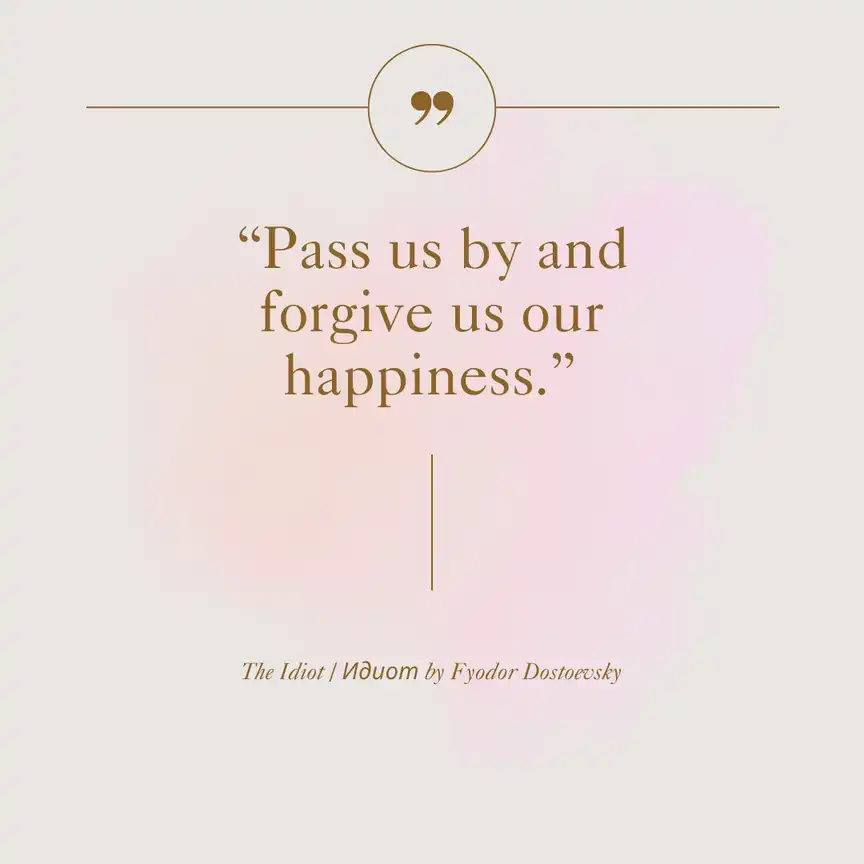
Rogozhin Confuses Love With Possession
Rogozhin carries the darkest energy in The Idiot. His attraction to Nastasya has the force of fate, but it rarely recognizes her freedom. He wants proximity, surrender, and exclusive possession. Love becomes indistinguishable from threat.
His inherited wealth intensifies rather than satisfies desire. Money allows him to gather followers, compete publicly, and imagine that devotion can be proved through expenditure. Passion adopts the logic of ownership.
The bond between Rogozhin and Myshkin gives the novel more than a simple rivalry. They exchange crosses and call one another brothers, even while both understand that Nastasya stands between them. Their intimacy makes violence feel less external. Each man recognizes something in the other that he cannot master in himself.
Rogozhin’s dark house reflects his emotional world. Inside hangs a copy of Hans Holbein’s painting of the dead Christ in the tomb. The brutal physicality of the body threatens faith by showing death without visible transcendence.
In The Idiot, the painting connects erotic possession with mortality. Rogozhin’s desire seeks to stop change, uncertainty, and refusal. What cannot be possessed may be destroyed.
Myshkin senses the danger but remains drawn back into the relationship. Compassion keeps him near the person most likely to cause harm. The novel refuses to guarantee that understanding another person will restrain that person’s actions. Rogozhin is terrifying because his obsession contains genuine feeling stripped of ethical freedom. Intensity alone cannot distinguish love from violence.
Aglaya Dreams of a Different Prince
Aglaya Epanchin appears to offer Myshkin another future. She belongs to a respected family and combines wit, pride, romantic imagination, and impatience with social convention. Her attraction to the prince contains both affection and an ideal she wants him to embody.
She imagines heroic sacrifice and responds to his goodness as something almost legendary. Myshkin, however, is not a knight who can organize life through decisive action. Admiration creates expectations he cannot fulfill.
Their possible marriage would place the prince inside ordinary family life. That prospect gives The Idiot a quieter kind of suspense. Can compassion become commitment rather than universal sympathy? Can Myshkin choose one relationship without interpreting the choice as abandonment of another suffering person?
Aglaya’s sharpness is not mere cruelty. She recognizes that pity can humiliate the person receiving it. She wants to be loved freely, not included in a moral project. Her resistance exposes the emotional cost of Myshkin’s inability to establish boundaries.
The confrontation between Aglaya and Nastasya turns two women into rivals under the pressure of male idealization. One is imagined as purity and possibility, the other as suffering and rescue. Neither woman fits the role assigned to her.
The author gives their conflict explosive force, though he often filters both women through what they mean to Myshkin. The result is emotionally compelling and ethically uncomfortable.
The failed promise of ordinary happiness shows why goodness in The Idiot cannot remain abstract. Love eventually demands a choice, and refusing to choose is itself an action with consequences.

Illness Changes the Experience of Time
Epilepsy shapes Myshkin’s body, perception, and relation to mortality. Before some seizures, he experiences a moment of extraordinary clarity and harmony. The instant feels complete, yet it arrives immediately before consciousness breaks apart.
Illness structures time differently in 👉 The Magic Mountain by Thomas Mann. Mann expands sickness into years of suspended intellectual life, while The Idiot compresses revelation and collapse into seconds. Both novels unsettle the idea that healthy, measurable time is the only form of experience.
The writer also draws on his own reprieve from a death sentence. Myshkin describes the terror of a condemned person counting the final minutes before execution. Limited time makes every ordinary second immeasurable.
Ippolit approaches death from another direction. Young and terminally ill with tuberculosis, he reads a long explanation of his beliefs and anger. He refuses consoling interpretations of suffering, yet desperately wants his words to command the attention of the living.
Holbein’s dead Christ becomes central to this struggle. The painting presents a body subjected to natural decay. Faith must confront matter without aesthetic protection. The Idiot does not resolve that challenge through a simple religious statement.
Revelation remains physically vulnerable. Myshkin’s moments of harmony do not cure him, and Ippolit’s intellectual defiance cannot give him control over death. Illness therefore does more than characterize individuals. It breaks the confident timelines of society, exposing how ambition, insult, and reputation change when life can contract without warning.
Conversations Refuse to Stay Orderly
The Idiot unfolds through crowded rooms, sudden visits, public scenes, confessions, arguments, and rumors. Characters speak past one another, reverse positions, and reveal motives they had intended to conceal. The novel often feels socially unstable because stability is exactly what its encounters destroy.
Psychological crisis receives a more concentrated form in 👉 Lenz by Georg Buechner. Büchner follows a mind losing its secure relation to landscape and self. The novelist distributes instability across an entire social field, where each consciousness puts pressure on the others.
Dialogue creates events rather than merely explaining them. A birthday gathering can become a moral trial. A proposal becomes a spectacle. A philosophical declaration turns into a demand for recognition.
The four-part structure includes abrupt shifts and crowded subplots. Secondary figures bring debts, gossip, generational conflict, political ideas, comic vanity, and opportunism. Some readers will find this abundance exhilarating. Others may experience the middle sections as unruly.
That unruliness belongs to the experiment of The Idiot. A perfectly balanced form might falsely suggest that the ethical and emotional conflicts can be mastered from above. Instead, voices compete to define Myshkin, Nastasya, love, faith, and freedom.
No single interpretation controls the room. Even the prince’s compassion can be understood as holiness, naïveté, pride, weakness, or an impossible demand placed on ordinary people. The novel’s power comes from preserving these contradictions until they become unbearable. Its form does not solve the conflict. It makes readers inhabit the pressure.

Quotes from The Idiot
- “Compassion is the chief law of human existence.” (translation and context) The author places this thought inside Myshkin’s reflections on Rogojin and Nastasya Filippovna. Therefore, compassion means more than gentle temperament. It becomes a principle governing jealousy, guilt, forgiveness, and the reader’s response to destructive behavior. Yet the novel never treats mercy as an easy cure. Myshkin understands several wounded people at once, but that sympathy also prevents decisive action. The sentence consequently expresses both his moral greatness and his tragic limitation.
- “It is better to be unhappy and know the worst, than to be happy in a fool’s paradise!” Ippolit’s declaration rejects comforting ignorance, although his tone reveals how suffering can turn truth into a weapon. Moreover, the contrast between knowledge and happiness echoes the novel’s distrust of pleasant appearances. Characters prefer fantasies about love, money, health, or virtue until reality breaks through. In The Idiot, lucidity offers no guarantee of wisdom. Nevertheless, the sentence grants honest misery greater dignity than contentment built upon denial.
- “A fool with a heart and no brains is just as unhappy as a fool with brains and no heart.” During a family argument, this balanced sentence refuses the simple choice between feeling and intellect. In fact, its mirrored structure turns “heart” and “brains” into incomplete virtues when either operates alone. The title’s insult therefore acquires another meaning: worldly cleverness may conceal its own form of foolishness. Myshkin’s compassion lacks strategic defenses, while calculating characters often lack humane judgment. Consequently, The Idiot asks readers to seek moral intelligence rather than praise innocence or sophistication by itself.
Trivia List for The Idiot
- A difficult European composition: The novelist worked across Geneva, Vevey, Milan, and Florence while debt, gambling losses, epilepsy, and grief disrupted his life. Consequently, the book’s reversals and unstable gatherings reflect genuine compositional pressure.
- Goodness as an experiment: Myshkin tests radical openness and Christian compassion inside a society ruled by money, rivalry, and reputation. Moreover, a 🌐 Northwestern University Press critical companion connects the notebooks and letters to comparisons between Myshkin and Christ.
- Epilepsy shapes time: Myshkin describes the instant before a seizure as a flash of harmony and intensified life. However, ecstasy immediately precedes collapse, creating an unsettling treatment of perception and unreliable transcendence.
- A mock execution returns as fiction: Myshkin recounts a condemned man measuring his final minutes. The episode transforms the writer’s 1849 mock execution into an argument about time’s value. Similarly, 👉 The Stranger by Albert Camus examines consciousness under a death sentence.
- Holbein haunts the novel: While preparing the book, the writer saw Hans Holbein the Younger’s The Dead Christ in the Tomb in Basel. In fact, the 🌐 Kunstmuseum Basel identifies three passages where the painting enters the novel and challenges faith through the brutal materiality of death.
- Kurosawa changed the setting: Akira Kurosawa moved the story to postwar Hokkaido for his 1951 film. Meanwhile, the 🌐 Criterion Collection describes how studio interference reduced his intended version, leaving a 166-minute adaptation shaped by loss and postwar aimlessness.
Beauty Offers No Simple Rescue
The Idiot is often associated with the hope that beauty might save the world. The novel itself treats that hope far less comfortably than a detached slogan suggests. Physical beauty inspires desire, spiritual beauty awakens trust, and both can become objects of projection.
Religious humanity receives another provocative reimagining in 👉 The Gospel According to Jesus Christ by Jose Saramago. Saramago revises sacred narrative through irony and argument, while the writer tests Christian compassion inside social chaos. Neither book allows belief to remain untouched by suffering.
Myshkin’s goodness is real, but purity does not grant control over consequences. He recognizes pain and offers presence, yet cannot rescue Nastasya, reform Rogozhin, satisfy Aglaya, or protect his own mind from collapse.
The ending brings compassion and catastrophe into the same intimate space. It refuses the reassuring idea that a good person’s influence must produce visible redemption. Love may remain meaningful even when it fails to prevent destruction.
This severity is why The Idiot continues to resist easy admiration. Its women sometimes bear too much symbolic weight, its social scenes sprawl, and its protagonist can frustrate readers who want moral clarity translated into decisive conduct.
Yet those difficulties sharpen the central question. What can goodness do without power? The novel answers neither everything nor nothing. Compassion can interrupt judgment, reveal another person, and remain beside suffering. It cannot possess freedom or guarantee salvation.
That unresolved boundary gives his novel its painful force. The Idiot does not prove that beauty saves the world. It asks whether people can recognize beauty without trying to buy, idealize, exploit, or destroy it.