The Kreutzer Sonata by Leo Tolstoy: Music and Marriage
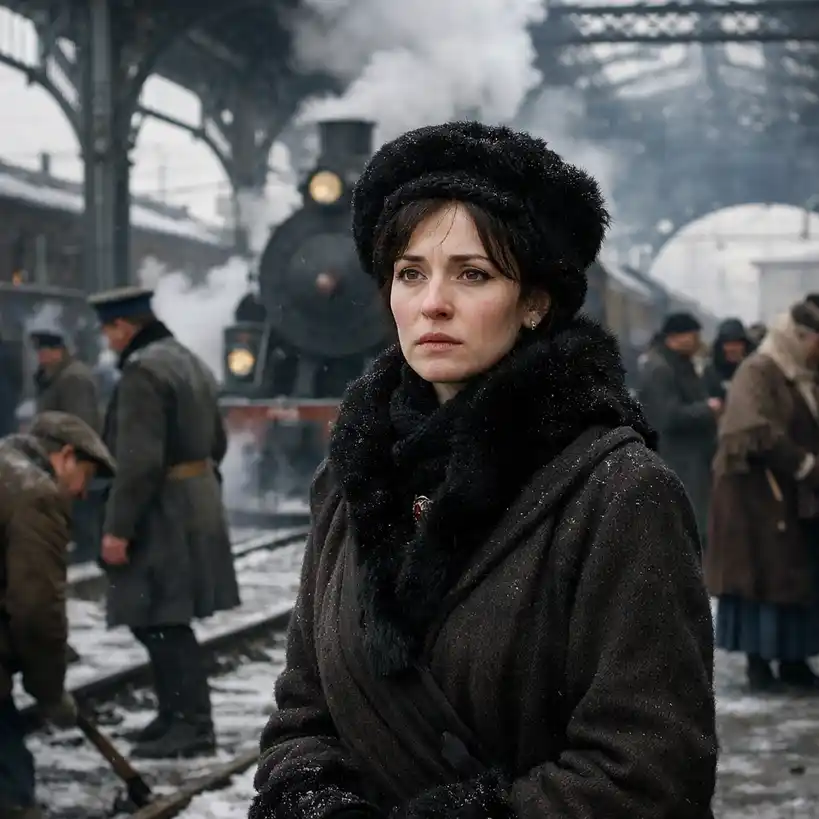
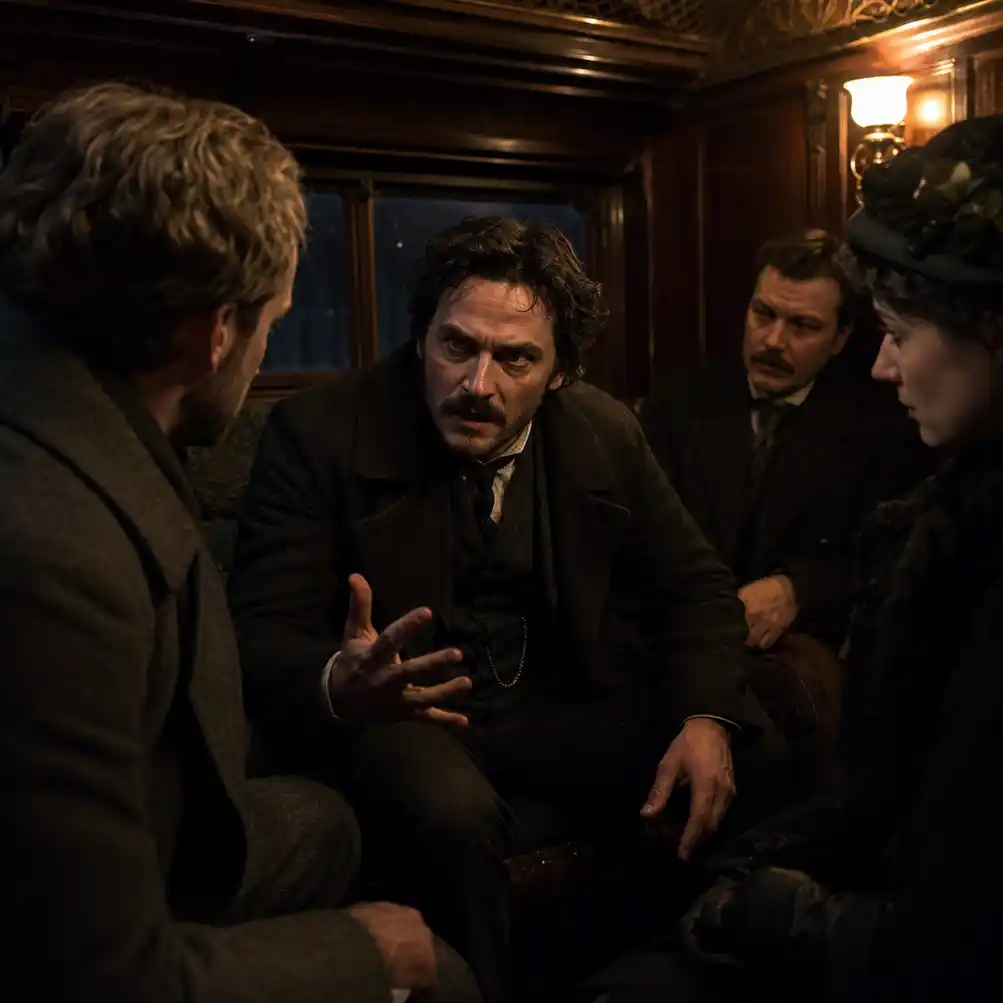
The Kreutzer Sonata begins among strangers arguing in a railway carriage. Their talk turns to love, marriage, divorce, and the changing position of women. One passenger listens with alarming intensity. Pozdnyshev then reveals that he killed his wife and was acquitted. The journey becomes the setting for his long confession.
Leo Tolstoy gives the narrative no neutral courtroom. Pozdnyshev controls the history, selects the evidence, and interprets every motive. His listener rarely interrupts. The murderer becomes his own chief witness. That arrangement pulls readers close to a charismatic voice without making it trustworthy.
The enclosed carriage also matters. People enter and leave, while the confession continues through the night. Physical motion contrasts with a mind trapped inside one explanation. Pozdnyshev claims that society, sexuality, medicine, fashion, and music all led toward the crime. Each claim expands his indictment and reduces his apparent responsibility.
The self-exposure in 👉 The Immoralist by Andre Gide creates a similarly uneasy relation between confession and justification. Gide’s speaker also presents his transformation to listeners, asking narrative control to do ethical work that conduct cannot.
The Kreutzer Sonata belongs to Russian Literature, but its compact first-person design differs from the broad social worlds associated with the nineteenth-century novel. A whole marriage is compressed into one voice. The result is immediate, claustrophobic, and morally unstable. Readers hear a man admitting the truth of his violence while continually displacing its cause.
Marriage Starts as a Social Performance
Pozdnyshev describes courtship as a market disguised by elegant manners. Clothes, dances, family expectations, and financial standing guide the selection of a spouse. He insists that respectable society condemns prostitution while teaching young men to treat women as objects and marriage as licensed possession.
Some of his criticism is penetrating. The sexual double standard permits male experience but demands female purity. Women are trained to attract men, then blamed for using the only influence society has granted them. Respectability conceals an economy of desire.
Yet The Kreutzer Sonata never lets the critique separate cleanly from the speaker’s misogyny. Pozdnyshev notices structural inequality, then turns women themselves into its cause. He describes female beauty as manipulation and treats autonomy as a threat. The argument exposes injustice while reproducing it.
Marriage as a public ideal and private negotiation also shapes 👉 An Ideal Husband by Oscar Wilde. Wilde uses comedy, political scandal, and verbal reversal, whereas the author strips domestic respectability toward horror. Both works ask what remains of an admired union when concealed motives become visible.
Pozdnyshev and his wife enter marriage with desire but without a language for mutual knowledge. Their early passion soon becomes competition. Domestic life brings repeated quarrels, reconciliations, pregnancies, and resentments. The institution cannot create intimacy by itself.
In The Kreutzer Sonata, the wedding does not conclude courtship. It begins a struggle over bodies, authority, and appearances. What society calls a successful match can therefore shelter hostility that neither partner has learned to name honestly.

His Wife Exists Behind His Language
Pozdnyshev’s wife is never granted a first name or a sustained voice. Everything readers learn about her passes through the man who will kill her. He describes her desires, health, motherhood, clothing, music, and possible infidelity, yet his certainty repeatedly exceeds his knowledge.
This absence is not a minor gap in The Kreutzer Sonata. Silencing is part of the violence. The confession converts a living woman into evidence for a theory about sex. Even her final actions arrive framed by the husband’s suspicion.
Motherhood intensifies the imbalance. Pregnancies and breastfeeding place demands on her body, while doctors intervene with advice that Pozdnyshev distrusts. He resents both her maternal absorption and her recovery of independence. Whatever role she occupies becomes proof against her.
The analysis of women as a class in 👉 The Second Sex by Simone de Beauvoir offers a useful counterpoint. Beauvoir examines how woman is constructed as the secondary other. Tolstoy’s novella dramatizes that process from inside a possessive male consciousness, even when its speaker imagines himself a critic of social convention.
Readers must therefore practice resistance. Small details suggest a person beyond the account: a capable pianist, a mother exhausted by domestic strain, and a woman seeking forms of expression not governed by her husband. Her unknowability exposes his failure to see.
The deepest moral conflict in The Kreutzer Sonata lies between Pozdnyshev’s claim to revelation and the narrative evidence of domination. He says suffering has taught him truth. His grammar still treats his wife as something owned, judged, and explained.
Jealousy Converts Possibility Into Proof – The Kreutzer Sonata
When the violinist Trukhachevsky enters the household, Pozdnyshev studies his clothes, manners, face, and social ease. Every detail becomes suspicious because jealousy has already established its conclusion. The musician does not need to commit adultery. He only needs to make it imaginable.
The Kreutzer Sonata carefully separates evidence from conviction. Pozdnyshev leaves town, receives a letter mentioning the visitor, and returns unexpectedly. He finds his wife and Trukhachevsky together at a table. The scene confirms intimacy in his mind, but it does not confirm the affair he has constructed.
Jealousy is an interpretive system. It takes neutral or incomplete signs and forces them into a single plot. Once that system is active, reassurance looks deceptive, absence looks strategic, and ordinary pleasure looks guilty.
Desire and violence circle a musical gathering in 👉 Moderato Cantabile by Marguerite Duras. Duras uses repetition, silence, and an overheard murder to create ambiguity. The writer makes ambiguity intolerable to his speaker, whose need for certainty drives him toward irreversible action.
Pozdnyshev also fears ridicule. Even during the attack, his self-image matters. The possibility of appearing foolish before another man becomes almost as painful as betrayal itself. Possessiveness depends on an audience. Masculine honor turns marriage into a contest in which the wife is both participant and prize.
The tragedy of The Kreutzer Sonata does not require readers to solve whether adultery occurred. The decisive fact is that Pozdnyshev treats suspicion as permission. He transforms what he cannot know into a verdict only violence can enforce.
Beethoven Makes Feeling Impossible to Contain
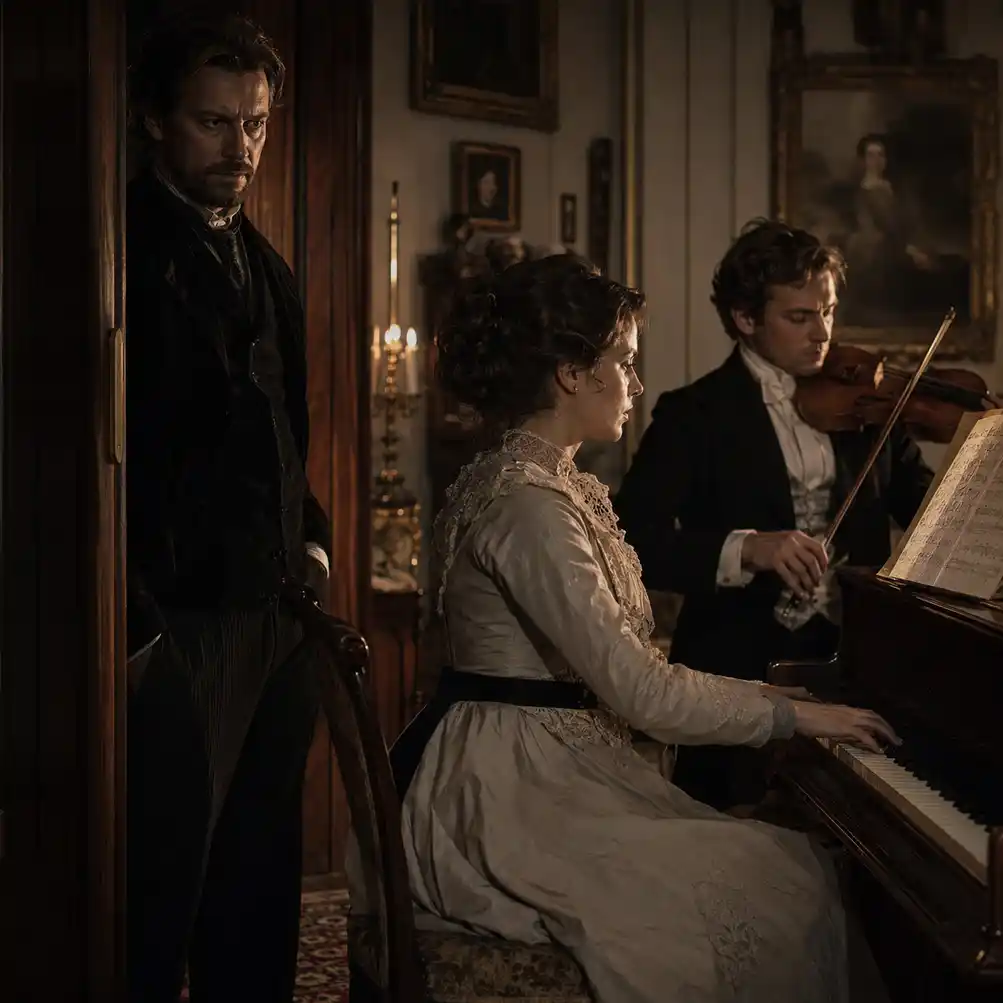
The performance of Beethoven’s Violin Sonata No. 9 gives The Kreutzer Sonata its title and its central artistic disturbance. Pozdnyshev’s wife plays the piano while Trukhachevsky plays the violin. Their coordination creates an intimacy that the watching husband cannot enter or control.
He responds to music with both awe and terror. Music can produce emotions without explaining what action should follow. It moves listeners into another person’s state, yet leaves them inside ordinary circumstances when the performance ends. Feeling arrives without an ethical instruction manual.
Pozdnyshev blames this power for dissolving boundaries. His complaint recognizes something real about art. Rhythm, tension, release, and shared attention can alter the body before rational judgment catches up. His error lies in treating emotional intensity as evidence of sexual betrayal.
The performers’ cooperation also challenges ownership. To play a sonata together, each musician must listen, answer, and yield. The husband hears reciprocity as exclusion. The Kreutzer Sonata thus turns ensemble playing into everything the marriage lacks.
Music reveals a relationship rather than causing the crime. It exposes Pozdnyshev’s fear that his wife has an inner life capable of answering another person. He can tolerate her talent while it remains decorative. So he cannot tolerate it when talent creates independent connection.
He does not reduce Beethoven to a simple corrupting force. The performance reaches beyond the speaker’s interpretation. Readers can hear in it discipline, beauty, danger, or freedom. Art remains powerful precisely because no jealous listener can dictate its meaning.
Violence Arrives Through Domestic Objects
Pozdnyshev’s return home gathers suspense from ordinary sensations. The lateness of the hour, the light in the house, the servant’s words, and the sound of conversation become stages in an approach toward violence. Nothing supernatural enters the scene. Terror grows from a familiar home becoming a place of surveillance.
The weapon is close at hand. So are the clothes, doors, table, and rooms that once organized family life. Domestic space becomes the architecture of murder. The Kreutzer Sonata refuses the comforting idea that violence belongs outside respectable households.
Pozdnyshev remembers practical and humiliating details even at the height of rage. He notices how he looks and whether the violinist might escape. Such observations puncture any claim that passion simply erased consciousness. The attack is furious, but self-awareness persists inside it.
This is why the novella’s psychological precision remains so disturbing. The murderer presents himself as overtaken by jealousy, yet his account contains decisions. He retrieves a weapon, advances, calculates, and later arranges his explanation. Loss of control becomes another controlled narrative.
The wife’s death finally breaks his abstraction. Only when he sees her dying does he recognize a person separate from the role he created. The recognition comes too late to become redemption.
The Kreutzer Sonata locates horror in the distance between action and later understanding. Pozdnyshev may perceive the enormity of what he has done, but perception cannot restore the life his possessive imagination refused to acknowledge.
Quotes for The Kreutzer Sonata
- “I killed her before I knew her.” Pozdnyshev moves responsibility backward from the stabbing to his sexual education. Therefore, the sentence compresses the claim that possessiveness and objectification prepare violence before the visible crime. However, his formulation also controls the story: by turning social corruption into the first murder, he presents himself as both culprit and damaged product of his culture. The line remains powerful because confession, accusation, and self-exculpation occupy the same six words.
- “Really, I was continually tortured by jealousy.” This admission arrives while the violinist and Pozdnyshev’s wife rehearse. Although nothing proves adultery, he reads glances, courtesy, and musical cooperation as confirmation. Consequently, jealousy becomes a self-renewing method of interpretation. Every detail feeds the conclusion that produced it. “Torture” also lets him imagine jealousy as an external force, even though his surveillance generates much of the pain. Thus the sentence reveals both genuine suffering and evasion of agency.
- “This music transported me into an unknown world, where there was no room for jealousy.” During the Beethoven performance, music briefly releases Pozdnyshev from his dominant emotion. Moreover, the “unknown world” feels liberating because art interrupts his narrative about ownership and betrayal. Yet the relief does not last. He later converts the performance into evidence and blames music for awakening uncontrollable states. In The Kreutzer Sonata, aesthetic intensity offers transcendence and danger at once, but the tragedy grows from the listener’s interpretation rather than sound alone.
Trivia for The Kreutzer Sonata
- A scandal before legal publication: Russian censors blocked The Kreutzer Sonata, yet manuscript copies and foreign editions spread its argument about marriage, sexuality, and violence. Leo Tolstoy gained Russian publication within a collected-works volume in 1891. A 🌐 Yale University Press overview records the initial ban.
- A confession on rails: An unnamed traveler listens while Pozdnyshev recounts the jealousy that culminated in his wife’s murder. Consequently, the train compartment creates a courtroom without a judge. Readers hear only the killer’s case, so his eloquence never validates his suspicions.
- The title has a hidden first dedicatee: Beethoven composed his Violin Sonata No. 9, Op. 47, for George Bridgetower, who premiered it with him in 1803. However, a dispute prompted a dedication to Rodolphe Kreutzer. The Beethoven-Haus Bonn explains the name that the novella inherits.
- The chain of inspiration continued: Leoš Janáček transformed the novella into his 1923 String Quartet No. 1. In fact, the 🌐 Metropolitan Museum of Art explains that he centered the tormented wife rather than her husband’s ideology. This shift anticipates the female viewpoint of 👉 The Lover by Marguerite Duras.
- Obsession links literary traditions: Pozdnyshev’s jealous narration also invites comparison with the destructive emotional absolutism of 👉 The Sorrows of Young Werther by Johann Wolfgang von Goethe.
- Music acts as catalyst, not evidence: Pozdnyshev watches his pianist wife perform with a violinist and converts intimacy into sexual certainty. By contrast, The Kreutzer Sonata never confirms adultery. Jealousy supplies its own proof and then treats violence as a conclusion.
The Verdict Exposes a Gendered Order
Pozdnyshev is acquitted because the killing is interpreted through injured marital honor. The legal outcome widens the novella beyond one household. Society that condemns murder still finds a story in which a husband’s jealousy can make violence understandable, even excusable.
The courtroom completes the domestic hierarchy. His wife cannot testify, and her alleged conduct becomes more important than his deliberate act. Male feeling receives public authority while the dead woman’s experience remains inaccessible.
The aftermath of violence is approached differently in 👉 The Snows of Kilimanjaro by Ernest Hemingway. Hemingway’s dying writer confronts wasted talent and private failures through memory. Pozdnyshev also looks backward under the pressure of death, but it is another person’s death that forces his accounting.
His acquittal complicates the meaning of confession. He is not speaking because the law requires it. He speaks because he wants a stranger to accept the worldview produced from his catastrophe. Remorse and persuasion remain entangled.
In The Kreutzer Sonata, legal innocence and ethical responsibility move in opposite directions. Pozdnyshev understands that he killed his wife, yet continues to present sexuality and marriage as the true offenders. A confession can preserve self-deception.
The novella’s scandal therefore extends beyond its views on abstinence. It shows how institutions, gender codes, and narrative habits cooperate after violence. A verdict can close a case without reaching its truth. The train conversation reopens that case, but the murderer still controls the testimony.
An Extreme Argument Resists Easy Agreement
The Kreutzer Sonata is not a balanced essay about marriage. It is a feverish work built around an extreme voice. Pozdnyshev condemns sexual desire so completely that human continuation itself seems logically impossible. The severity gives his argument force while revealing its contradictions.
His late religious concerns shape the appeal to chastity, self-command, and Christian love. Yet the novella exceeds any doctrine its speaker announces. Fiction makes the argument answerable to human detail. Pozdnyshev may condemn desire in universal terms, but readers see particular injuries, evasions, and structures of power.
The work also provoked responses because it leaves open the distance between author and narrator. Treating every statement as direct instruction flattens the narrative design. Treating the speech as mere madness ignores the social hypocrisies it exposes.
That unstable balance explains the continuing power of The Kreutzer Sonata. It can be read as an attack on marriage, a study of misogyny, a warning about possessiveness, or a demonstration of unreliable confession. No single label neutralizes the discomfort.
Its most convincing lesson concerns the danger of ownership. Pozdnyshev calls his feelings love while denying his wife an independent mind, body, and artistic life. His jealousy does not prove the depth of attachment. It proves the violence hidden inside entitlement.
The final effect is less a moral solution than a demand for judgment. Readers must separate valid social criticism from hatred, remorse from excuse, and powerful feeling from ethical truth. The novella’s music stops, but its unresolved accusation continues.