The Jungle Cat and the Hill Dog by Ana Maria Machado
The Jungle Cat and the Hill Dog begins by placing each protagonist inside a setting that seems almost generated by his name. The wild cat lives in the woods, while the dog belongs to the hill. Ana Maria Machado builds these facts from brief clauses, repetitions, and linked sounds rather than explanatory description. Character and geography rhyme together. The opening makes language feel like a landscape the reader can enter, anticipate, and remember.
The Portuguese title, O Gato do Mato e o Cachorro do Morro, carries sonic relationships that the English rendering can suggest but not completely reproduce. “Gato” answers “mato,” just as “cachorro” answers “morro,” creating two verbal pairs before the animals have formed any emotional bond. In The Jungle Cat and the Hill Dog, sound therefore establishes a hidden symmetry beneath visible opposition. The protagonists occupy different homes, yet the sentence gives each the same structural importance. The rivals resemble one another from the start.
The deceptive simplicity of The Little Prince by Antoine de Saint-Exupéry offers a useful comparison. Saint-Exupéry also trusts animals and direct encounters to expose pride, attachment, and misunderstanding without heavy explanation. The author chooses quicker comedy and denser wordplay, but The Jungle Cat and the Hill Dog similarly treats young readers as capable interpreters of social behavior. The first page does more than introduce a cat and a dog. It creates a balanced verbal world that their competition will temporarily disturb. That formal balance quietly prepares readers to question every later claim of natural superiority.
A Burst Pipe Turns Alarm Into Ridicule
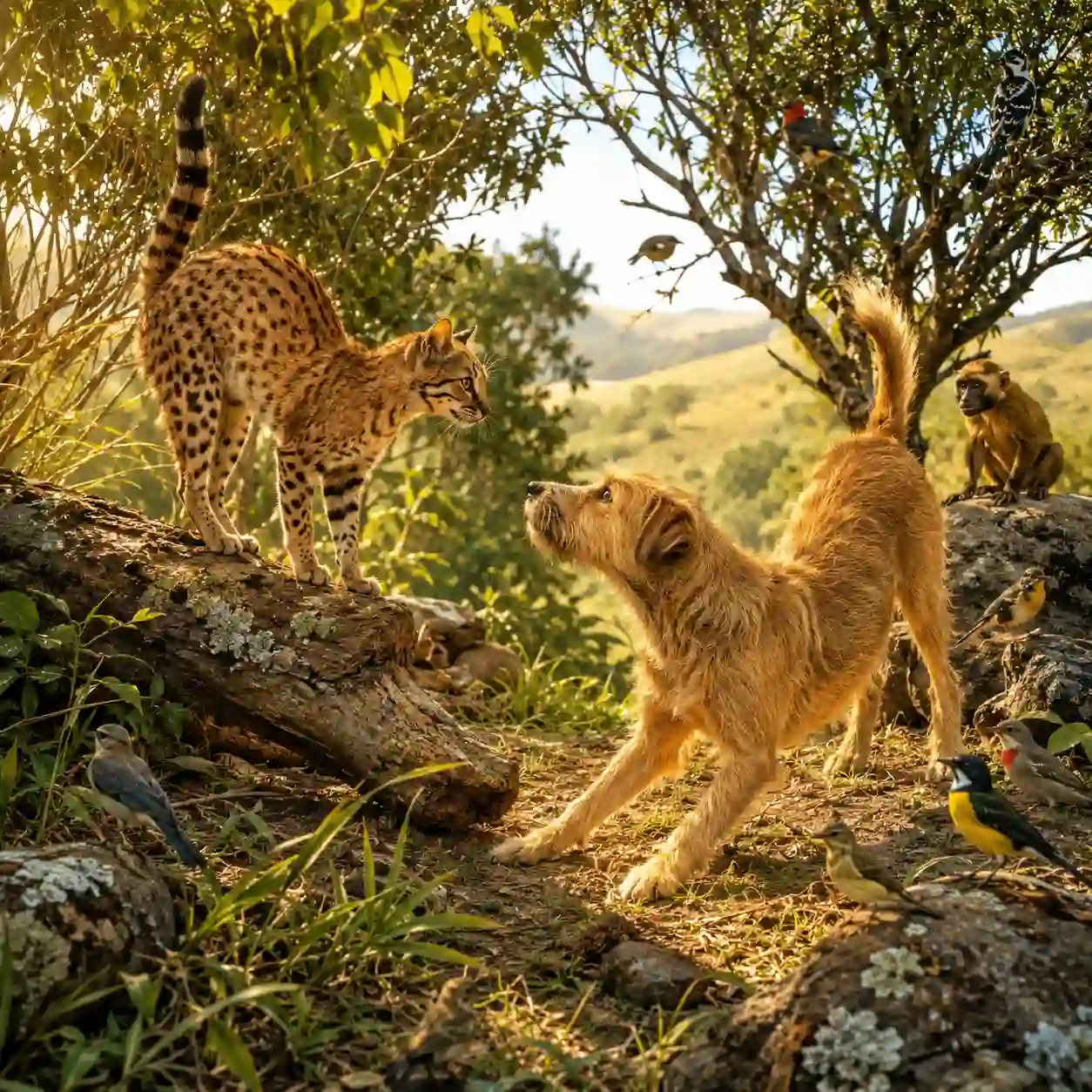
The conflict begins when the cat hears the dog calling for help and abandons his meal to respond. Expecting a rat, a duck, or another creature he can dramatically defeat, the cat arrives announcing immediate bravery. He instead finds water spraying from a pipe and soaking the frightened dog. An imagined rescue ends in comic anticlimax. The event gives The Jungle Cat and the Hill Dog its first distinction between danger itself and the stories characters create around it.
The cat treats the dog’s alarm as proof of cowardice, although an unexpected jet of water reasonably caused panic. His mockery depends on controlling the interpretation after the problem has become visible and manageable. The dog answers by insisting that he was merely startled, not afraid, and refuses the inferior position assigned to him. The Jungle Cat and the Hill Dog thus converts a household mishap into a contest over reputation. Neither animal is initially discussing what happened. Each is defending the identity he wants the others to recognize.
The burst pipe later becomes more than a comic prop because she preserves objects that appear during the verbal play. Water introduces disorder, embarrassment, and noise, but it also remains a resource that can be used differently when genuine danger arrives. Weakness depends upon situation and purpose. This transformation prevents the episode from functioning as a disposable joke. In The Jungle Cat and the Hill Dog, the same spray that makes the dog look helpless can contribute to collective defense, showing young readers that meaning changes when characters replace humiliation with practical thought.
Rhyme Makes Boasting Pleasurable and Absurd
After the disagreement begins, the cat and dog organize a contest to decide who is more courageous. Each names animals he claims he could strike, bite, kick, or otherwise defeat, and every threat leads toward another rhyme. The speeches escalate through association rather than evidence, allowing verbal ingenuity to masquerade as physical strength. Sound becomes the engine of exaggeration. The Jungle Cat and the Hill Dog makes the boast enjoyable to hear while steadily revealing how little it proves.
This musical structure is central to shared reading. Children can predict sounds, repeat phrases, and enjoy impossible combinations before they articulate the ethical difference between confidence and bullying. The narrative voice invites performance because pacing, breath, and emphasis turn the catalogue into a miniature theatrical duel. A different celebration of rhythm and childhood adventure shapes The Halloween Tree by Ray Bradbury. Bradbury uses lyrical abundance to carry children through history, while she uses compression to accelerate a comic dispute.
The rhyme also exposes the instability of each claim. One threat does not logically establish the next, but a matching sound makes escalation feel temporarily inevitable. The Jungle Cat and the Hill Dog lets readers experience how persuasive language can outrun truth without presenting a formal lesson about rhetoric. Fluency is not evidence of courage. The animals command attention because they are entertaining, yet the approaching lion will test whether verbal performance can survive contact with a danger that does not participate in their game. Pleasure and criticism remain inseparable throughout this carefully controlled verbal acceleration.
Imaginary Victories Depend on Convenient Victims
Many animals named during the contest are smaller, gentler, or safely absent. The cat and dog create heroic identities by imagining creatures who cannot interrupt the performance or contradict its details. Their aggression therefore resembles playground boasting, where status grows through stories about weaker opponents. Borrowed victims make courage look easy. In The Jungle Cat and the Hill Dog, comedy allows this imbalance to become visible without making either protagonist permanently cruel.
Animal figures often sharpen human patterns by removing realistic social detail. Gregor’s transformation in The Metamorphosis by Franz Kafka exposes dependence, labor, and exclusion through a dark adult fable. The poet works in a warmer register, but she likewise uses nonhuman characters to make power relations immediately legible. Children can recognize the unfairness of bragging about attacks on vulnerable creatures before they possess abstract terms for domination. The Jungle Cat and the Hill Dog keeps that recognition playful enough to invite reflection rather than defensiveness.
As their lists continue, the rivals begin naming more dangerous animals, including the jaguar and lion. This change increases comic tension because the audience can sense language approaching a test the speakers never expected to face. The boast summons its own correction. Their contest has made courage a performance for spectators, but real bravery cannot be settled by applause. By allowing the lion to move from a rhyming object inside speech to a physical presence outside it, the story turns verbal excess into narrative consequence. The Jungle Cat and the Hill Dog makes that transition feel surprising and formally inevitable.
The Lion Replaces Performance With Real Fear
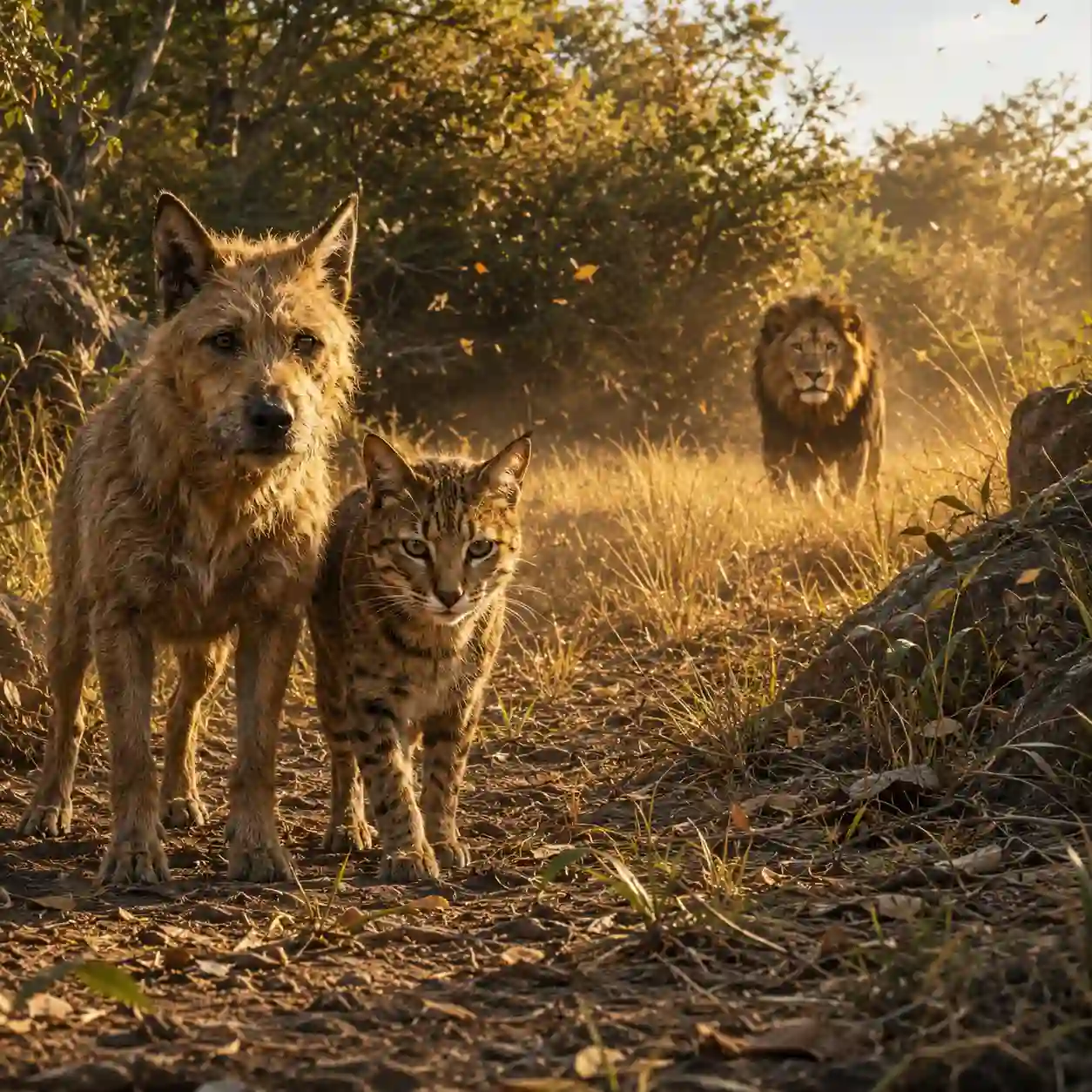
A roar abruptly ends the contest and scatters the watching animals. The cat runs toward the woods, and the dog retreats toward the hill, abandoning the confident identities they had constructed in public. She does not need a complicated description of the lion because sound alone reverses the scene’s hierarchy. Real danger silences imaginary heroism. The appearance gives The Jungle Cat and the Hill Dog a test that neither protagonist can control through rhythm or ridicule.
Their flight is comic, but the story does not define fear itself as shameful. Running from a lion is a sensible instinct, especially for two animals who cannot defeat him through individual force. The moral question emerges only after they have reached temporary safety and can choose what happens next. The Jungle Cat and the Hill Dog therefore distinguishes an involuntary reaction from a considered decision. Courage begins not with the absence of fear but with the ability to act after fear has revealed the real scale of a problem.
The lion also changes the status of the surrounding animals. They are no longer an audience entertained by two boastful performers because everyone now shares exposure to the same threat. Danger turns spectators into a community. The earlier contest asked which individual deserved admiration, whereas the new situation asks how different abilities can protect the group. That shift deepens the tale beyond a simple punishment for vanity. The cat and dog do not merely learn that they are weaker than a lion. They discover that the wrong question has been organizing their behavior.
Cooperation Transforms Ordinary Objects Into Strength
The cat and dog soon return rather than remaining concealed in their separate territories. The cat throws plates, while the dog directs water from the troublesome pipe toward the lion. Other animals add noise, movement, and whatever limited resistance they can contribute. Combined action changes the balance of power. The Jungle Cat and the Hill Dog makes success depend on coordination rather than on suddenly granting one protagonist superior strength.
Comic teamwork also drives The Reivers by William Faulkner, whose characters create problems through competing desires and survive by adapting to one another. The writer reduces that social mechanism to a pattern accessible to much younger readers. Plates are not heroic weapons, and sprayed water is not magical protection, yet both become useful when directed toward a shared aim. In The Jungle Cat and the Hill Dog, practical intelligence accomplishes what individual boasting could not. Resourcefulness matters more than impressive appearance.
The solution also completes the earlier pipe episode. What made the dog seem ridiculous now helps drive away the animal everyone genuinely fears, so the story quietly corrects the cat’s original judgment. Objects and abilities possess no permanent social rank because their value depends on context, timing, and cooperation. This principle gives the action a broader emotional meaning without stopping the comedy.
The animals do not win by becoming alike. They succeed by allowing different responses to form one coordinated defense. The Jungle Cat and the Hill Dog thus presents solidarity as an active arrangement, not simply a pleasant feeling after danger has passed.
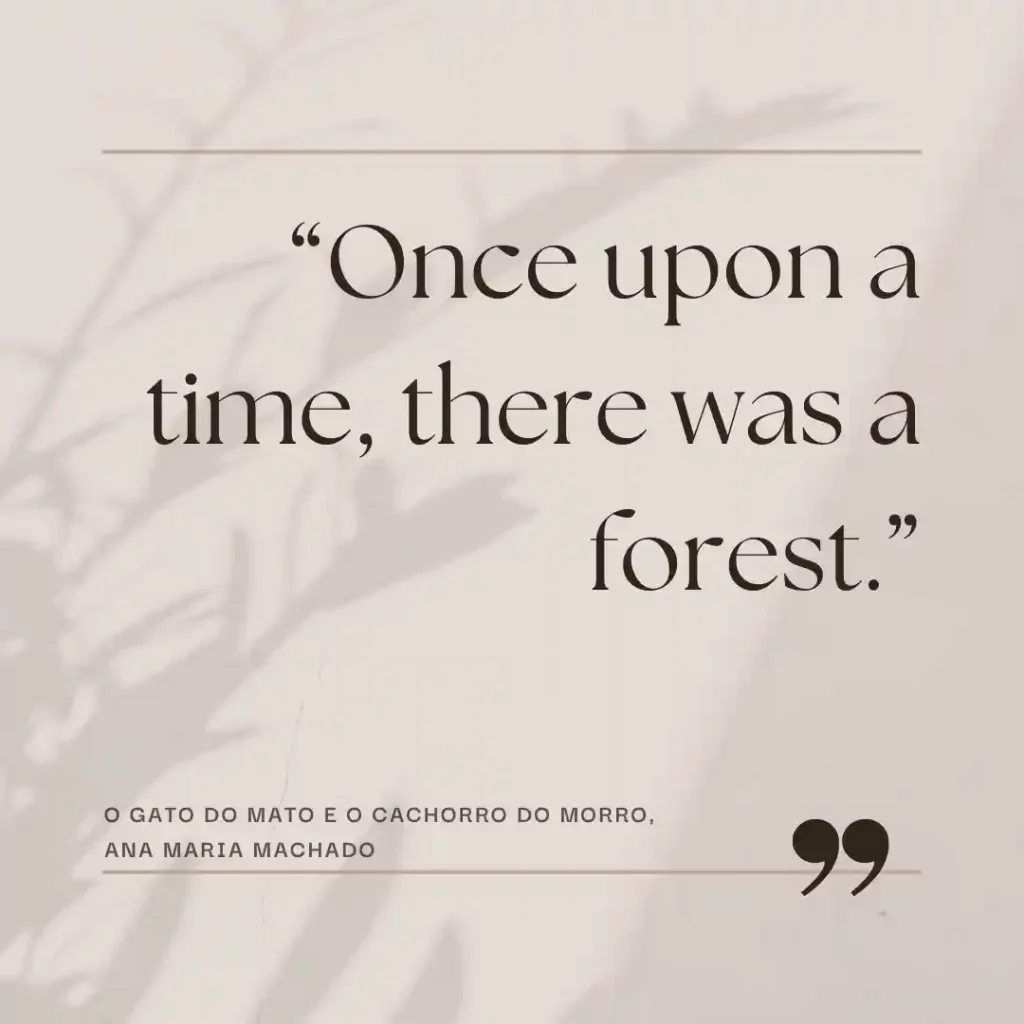
Woods, Hills, and Cries for Help: Lines from The Jungle Cat and the Hill Dog
- The quotations remain in Portuguese because I could not verify a published English translation.
- “Era uma vez um mato.” She adapts the traditional fairy-tale opening to a place rather than a person. The wood arrives before its inhabitant.
- “Um gato do mato.” The compact line makes animal and environment rhyme. The cat appears to belong naturally to language as well as landscape.
- “E era outra vez um morro.” “Once upon another time” humorously restarts the story. The dog receives a parallel origin rather than entering the cat’s world.
- “Um cachorro do morro.” The matching syntax establishes equality between the future rivals. Neither possesses narrative priority.
- “Socorro! Socorro!” The first urgent cry breaks the balanced introduction. Repetition transforms rhyme into alarm.
- “Ai, que eu morro!” Fear exaggerates danger while completing the morro/socorro/morro pattern. Even panic obeys the book’s music. All six quotations
Rhyme Against the Roar: Facts About The Jungle Cat and the Hill Dog
- The Portuguese title is a miniature sound machine:O Gato do Mato e o Cachorro do Morro pairs gato/mato with cachorro/morro. The protagonists’ homes, identities, and rhythms are inseparable before the plot even begins. Official
- Its opening constructs two perfectly balanced worlds: First comes a wood inhabited by a cat; then a hill inhabited by a dog. That mirrored introduction gives their later rivalry the symmetry of a verbal game. Publisher’s sample
- Bravery begins as competitive boasting: Cat and Dog argue over which of them is more courageous. The comedy resembles the animal debates in The Dialogue of the Dogs by Miguel de Cervantes, although the author writes for much younger readers.
- The lion changes the meaning of courage: When a genuinely dangerous animal arrives, the rivals discover that neither can defeat it alone. Fear becomes the first step toward solidarity.
- Their victory is collective rather than heroic: The cat, dog, and other animals combine noise, objects, water, and whatever abilities they possess. The supposedly weakest creatures succeed through numbers and cooperation.
- The rhyme drives the action: When the dog cries socorro, the cat leaves his prato while imagining a rato or pato. Words do not merely decorate the adventure; one rhyme continually generates the next event.
- The cat’s self-image is deliberately theatrical: He announces his courage before discovering what the danger is. His swaggering performance offers a comic counterpoint to the affectionate dignity of Ode to the Cat by Pablo Neruda.
- The physical edition is designed for early readers: Ática publishes the 24-page book in its Barquinho de Papel collection, with illustrations by Fê. The official catalogue describes it simply as a humorous story “full of rhymes.” Edition details
Friendship Completes the Book’s Verbal Design
Once the lion retreats, the rivalry can no longer continue on its original terms. The cat and dog have both acted courageously, but neither can claim exclusive victory because their plan required shared effort and support from others. Their embrace transforms the story’s paired names from a formula of opposition into a formula of connection. Shared danger dissolves the false contest. The Jungle Cat and the Hill Dog ends with friendship because experience has supplied the evidence that argument could not.
The book belongs distinctively to brazilian literature for children through its confidence in oral rhythm, comic accumulation, and social intelligence. Its movement toward discovery recalls The Alchemist by Paulo Coelho, although Machado avoids spiritual abstraction and keeps her lesson rooted in physical action. The 24-page Ática edition, illustrated by Fê, gives facial expressions, gestures, and crowd movement room to develop beside the compact text. Pictures reveal the distance between talk and feeling. They help early readers follow changes in confidence even when the rhyme moves quickly.
This combination of sound and image makes The Jungle Cat and the Hill Dog especially rewarding when read aloud. Adults can perform the rival voices, while children anticipate sounds, inspect reactions, and identify the moment competition becomes cooperation. The ethical conclusion never needs to be detached from the pleasure of the story because form and meaning arrive together. Friendship restores the balance already hidden in the title: two different homes, two different animals, and two matching verbal patterns finally occupy one communal world.