What is the oldest book in the world?
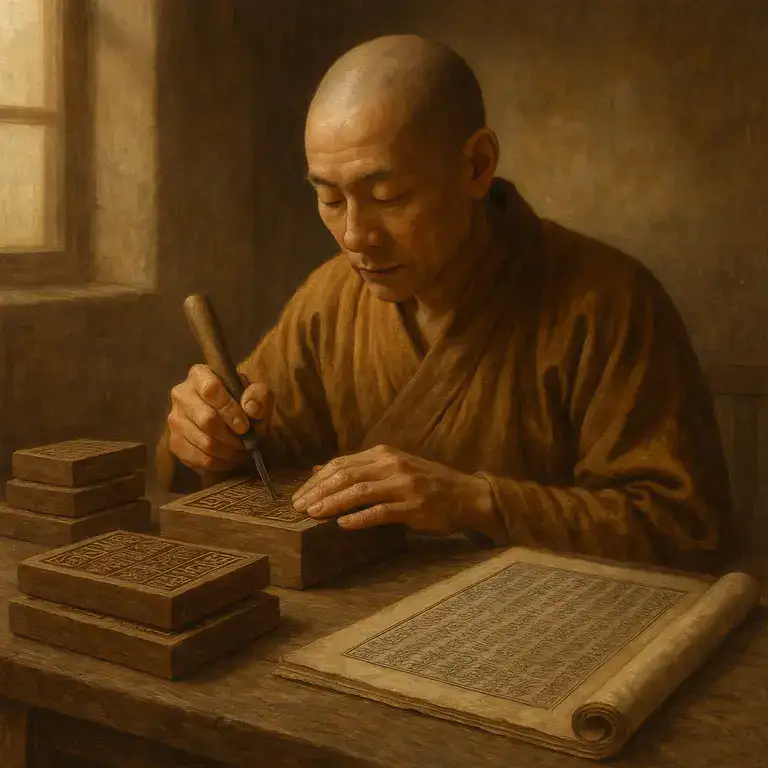
The oldest book in the world is the Diamond Sutra, printed in China in 868 CE. It’s a Buddhist text and is the earliest known surviving printed and dated book. Discovered in a sealed cave along the Silk Road, it was made using woodblock printing—carved wooden blocks pressed onto paper, page by page. It’s now preserved at the British Library.
The Diamond Sutra wasn’t handwritten. It was printed—bound, titled, and dated. That makes it the first of its kind: not just a scroll, but a book as we understand it today. And it’s still intact.
It’s strange to think that in a world with millions of books published every year, the very first printed book we still have was made over 1,150 years ago, in a quiet temple by Buddhist monks.
They weren’t chasing bestseller lists and they weren’t going viral. They simply wanted to preserve wisdom and pass it on. That goal hasn’t changed. Whether it’s a spiritual text or a fantasy novel, a good book still tries to do one thing: last.

The oldest book in the world? 📜 Hemingway and the Lost Art of Keeping Things
Ernest Hemingway never worked with carved woodblocks. He used paper, pencils, and typewriters. He believed in short sentences and strong verbs. But he also believed in permanence. He wanted his words to last. That’s where he connects—strangely—with the Diamond Sutra, the oldest book in the world. Printed in 868 CE. Still here.
Hemingway’s style was modern, but his hope was ancient: that something well written could stay. The monks carved their pages with great care. Hemingway carved his sentences the same way. Different time, different tools—but both aimed for clarity. For truth. In the end, they both got what they wanted: books that didn’t just say something, but stayed around long enough to matter.
Franz Kafka wanted his work destroyed after his death. Thankfully, it wasn’t. Most of what we now admire—from The Trial to The Castle—was published later. That’s the irony: Kafka’s legacy survived in ways he didn’t plan.
The Diamond Sutra, the oldest book in the world, was also nearly forgotten. It sat in a cave for centuries, untouched. Waiting. Silent. And then one day, it was found. Both Kafka and the Sutra remind us that books don’t always rush. Some wait. Some get saved when no one expects it. And some resurface when they’re needed most.
Kafka’s writing speaks to our modern anxieties. The Sutra speaks to spiritual stillness. Yet both share a strange power: they last. Not because they were supposed to—but because someone chose to preserve them.
📖 Virginia Woolf and the Book as a Moment of Stillness
Virginia Woolf once wrote that every book is a “record of a state of mind.” That phrase stays with me when I think about the oldest book in the world, the Diamond Sutra.
Printed in 868 CE, the Diamond Sutra doesn’t shout. It’s quiet. Focused. It’s not about events. It’s about how the mind works when it slows down. When it lets go. That feels close to Woolf, doesn’t it?
In To the Lighthouse, nothing much happens. There’s no major twist. No grand conclusion. But everything matters — every thought, every silence, every flicker of perception. It’s modern fiction built on ancient insight.
The Diamond Sutra teaches impermanence. Woolf shows us how fleeting each moment is. They live far apart in history, but they echo the same mood: slow down, pay attention, let go. Both books make you sit still. And sometimes, that’s where the truth hides.
🪔 Albert Camus and the Wisdom That Refuses to Shout
Albert Camus once said, “The struggle itself toward the heights is enough to fill a man’s heart.” He didn’t believe in easy answers. He believed in clarity. Honesty. And carrying on, even when the world doesn’t explain itself.
That’s why I think of Camus when I read about the Diamond Sutra, the oldest book in the world. Printed in 868 CE, it teaches that reality is always shifting. That clinging to anything—ideas, outcomes, even the self—leads to suffering.
Camus wasn’t a monk. But he understood impermanence. In The Stranger and The Myth of Sisyphus, he wrestled with meaning in a world that doesn’t hand it to you. That refusal to look away from the absurd? That’s spiritual, even if it’s not religious.
Both the Diamond Sutra and Camus offer this strange comfort: the truth might be hard, but you can face it. Quietly. Fully. With both feet on the ground. Camus didn’t carve woodblocks. But he carved sentences that still feel like stone.
More Facts and Figures



Recommended Book Reviews for you while looking for What is the oldest book in the world?